Normal view

There are new articles available, click to refresh the page.
Before yesterdayPixel Envy

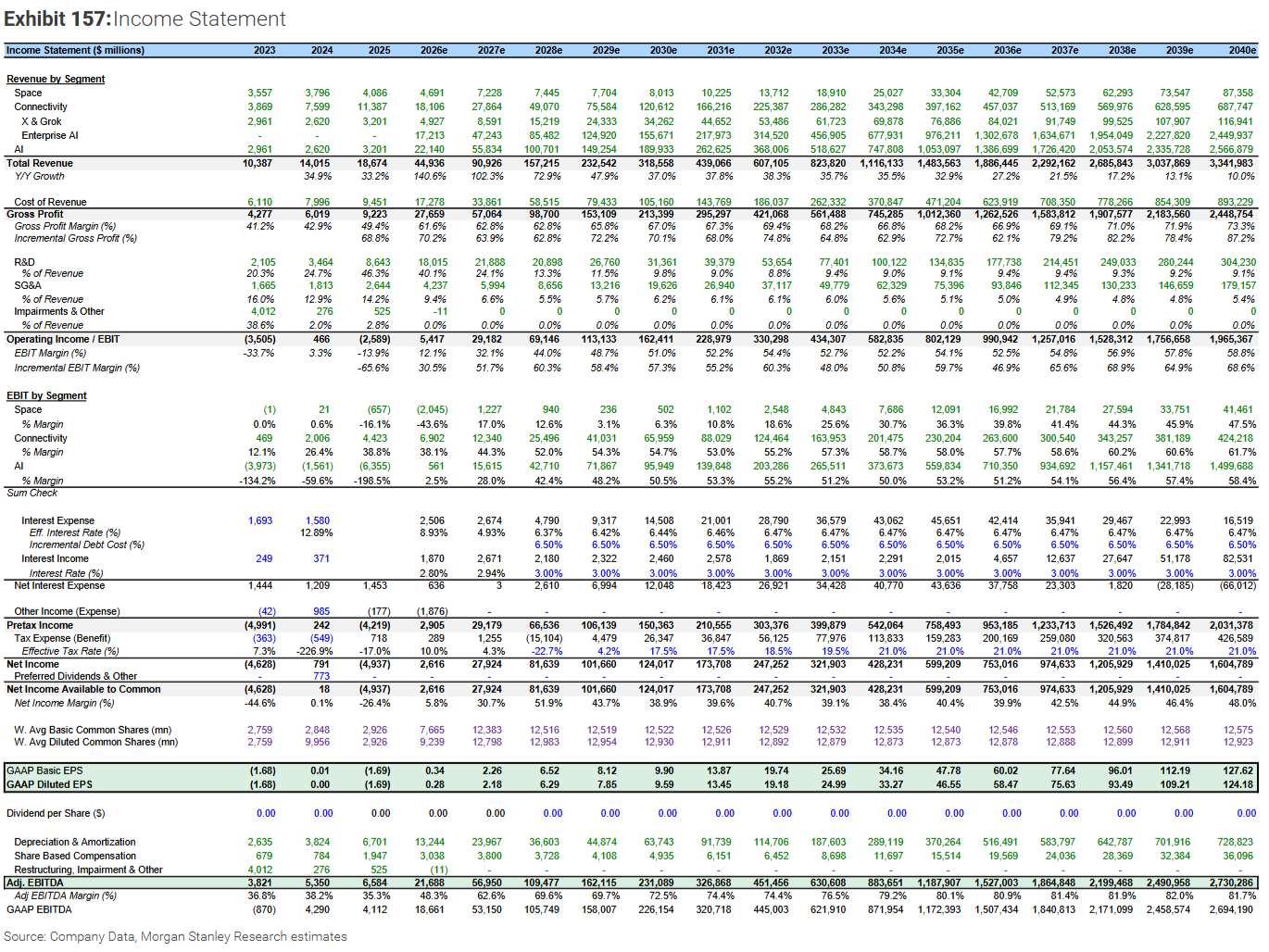
Morgan Stanley Says the ‘Space’ in SpaceX Is Worth About $8 Per Share

By: Nick Heer
16 July 2026 at 04:36

Bryce Elder, on the Financial Times’ Alphaville blog:

Here’s paragraph one of the Morgan Stanley’s SpaceX initiation note:

With an ‘X of 1’ position in space infrastructure, we believe SpaceX can convert energy into intelligence at scale with optionality to monetize through a range of consumer and enterprise solutions for the next era of AI… the final frontier.

[Adam] Jonas — formerly the Wall Street bank’s Tesla and occasionally other auto companies analyst — was last year reallocated to the sort of free-radical futurologist role we’d thought had been cornered by Shingy.

Today’s news that SpaceX has already started dipping below its IPO valuation reminded me of this piece. Remind me — is being compared to Shingy good?

At any rate, Morgan Stanley estimates that the combination of X and Grok will grow this year to generate only a little less revenue than Twitter did in 2021, its last full fiscal year as a public company. Fear not, investors, as the bank also says SpaceX will make $17 billion in “enterprise A.I.”, and then nearly triple that next year. I guess everyone wants to give money to the CSAM and misogynist fantasy generator for business.

⌥ Permalink

No Privacy Impact Assessment Was Conducted of Grok Imagine Until After Launch, Finds Canadian Privacy Commissioner

By: Nick Heer
11 June 2026 at 23:25

The Office of the Privacy Commissioner of Canada:

An investigation by the Privacy Commissioner of Canada has found that Grok’s AI image-generation tool was launched without proper safeguards or sufficient consideration of potential privacy harms.

This lack of protections allowed users around the globe to create and share non-consensual, sexualized deepfakes, many targeting women and children.

In a report released today, Commissioner Philippe Dufresne found that X Corp. and xAI violated Canada’s federal private-sector privacy law.

According to the full report, while a privacy impact assessment was completed of the previous version of Grok’s image generation model, one was not done for Grok Imagine until March, well after its July 2025 launch. Even then, the assessment “did not accurately reflect […] risks to security, safety and privacy”.

Grok is now owned by SpaceX, which is going public tomorrow in extraordinary fashion. It is still generating abusive imagery.

⌥ Permalink

Checking in on Some Pro-Hate-Speech Social Networks

By: Nick Heer
28 May 2026 at 02:58

The Agence France-Presse reporting on the U.S. president’s social-media-and-cryptocurrency-and-maybe-nuclear-fusion operation:

Trump Media & Technology Group (TMTG) reported revenue of less than US$1 million for the three months ending March 31, according to a company filing.

Under $4 million in annual revenue is less than how much Twitter was earning in 2009 — unadjusted for inflation — an amount Steven Levy described as “modest”.

Speaking of Twitter, let us check in on SpaceX which, after a series of totally normal business deals, now owns the company and is preparing to trade publicly. Mike Masnick, of Techdirt:

Remember, the plan was $26.4 billion [in Twitter/X revenue] by 2028. We’re more than halfway there. How’s it going? Well… when he combines xAI (grok) revenue with X revenue (so not even just breaking out X’s ad revenue)… we get… a total of $3.201 billion in 2025. So, just to put this in perspective… when he took over in 2022 he laid out a five year plan to take the company that had $4.5 billion in ad revenue the year before he bought it up to $12 billion in five years. Three years in and… it’s now somewhere pretty far below $3 billion. […]

Earlier this year, a judge found against Elon Musk in a lawsuit filed by X against advertisers claiming they staged an illegal boycott.

The SpaceX prospectus, by the way, is one of the funniest documents to ever live on the sec.gov domain. It is lucky the business it is known for is so damn photogenic because it is, at present, a profitable satellite internet provider with side businesses of space exploration and artificial intelligence that each lose money. (How it internally accounts for the cost of sending Starlink satellites into orbit is a fantastic question.) And the present business model of the latter is something Patrick Boyle described as “renting GPUs to a competitor on terms that can vanish in a fiscal quarter”. Yet the company still claims the size of its total addressable market is over $28 trillion, or over one-fifth of the entire world’s GDP.

Even so, a $1.75–2 trillion valuation is plausible simply because of Musk. Similarly, and back to that AFP article:

According to its filing, TMTG generated US$900,000 in revenue during the first quarter, a paltry amount for a company valued at US$2.47 billion on the stock market.

That valuation is not much; at time of writing, it is worth about as much as Central Garden & Pet, owners of Nylabone and McKenzie plant seeds. That company last quarter posted revenues one thousand times greater than TMTG, with profit margins of over 12%. Nevertheless, TMTG has a connection to the U.S. president, so it is similarly valued. Lots of good, normal stuff happening in the world’s largest and most powerful economy.

⌥ Permalink

The Myth and Reality of Mac OS X Snow Leopard

By: Nick Heer
28 March 2025 at 03:56

Jeff Johnson in November 2023:

When people wistfully proclaim that they wish for the next major macOS version to be a “Snow Leopard update”, they’re wishing for the wrong thing. No major update will solve Apple’s quality issues. Major updates are the cause of quality issues. The solution would be a long string of minor bug fix updates. What people should be wishing for are the two years of stability and bug fixes that occurred after the release of Snow Leopard. But I fear we’ll never see that again with Tim Cook in charge.

I read an article today from yet another person pining for a mythical Snow Leopard-style MacOS release. While I sympathize with the intent of their argument, it is largely fictional and, as Johnson writes, it took until about two years into Snow Leopard’s release cycle for it to be the release we want to remember:

It’s an iron law of software development that major updates always introduce more bugs than they fix. Mac OS X 10.6.0 was no exception, of course. The next major update, Mac OS X 10.7.0, was no exception either, and it was much buggier than 10.6.8 v1.1, even though both versions were released in the same week.

What I desperately miss is that period of stability after a few rounds of bug fixes. As I have previously complained about, my iMac cannot run any version of MacOS newer than Ventura, released in 2022. It is still getting bug and security fixes. In theory, this should mean I am running a solid operating system despite missing some features.

It is not. Apple’s engineering efforts quickly moved toward shipping MacOS Sonoma in 2023, and then Sequoia last year. It seems as though any bug fixes were folded into these new major versions and, even worse, new bugs were introduced late in the Ventura release cycle that have no hope of being fixed. My iMac seizes up when I try to view HDR media; because this Extended Dynamic Range is an undocumented enhancement, there is no preference to turn it off. Recent Safari releases have contained several bugs related to page rendering and scrolling. Weather sometimes does not display for my current location.

Ventura was by no means bug-free when it shipped, and I am disappointed even its final form remains a mess. My MacBook Pro is running the latest public release of MacOS Sequoia and it, too, has new problems late in its development cycle; I reported a Safari page crashing bug earlier this week. These are on top of existing problems, like how there is no way to change the size of search results’ thumbnails in Photos.

Alas, I am not expecting many bugs to be fixed. It is, after all, nearly April, which means there are just two months until WWDC and the first semi-public builds of another new MacOS version. I am hesitant every year to upgrade. But it does not appear much effort is being put into the maintenance of any previous version. We all get the choice of many familiar bugs, or a blend of hopefully fewer old bugs plus some new ones.

⌥ Permalink

‘Adolescence’

By: Nick Heer
22 March 2025 at 21:54

Lucy Mangan, the Guardian:

There have been a few contenders for the crown [of “televisual perfection”] over the years, but none has come as close as Jack Thorne’s and Stephen Graham’s astonishing four-part series Adolescence, whose technical accomplishments – each episode is done in a single take – are matched by an array of award-worthy performances and a script that manages to be intensely naturalistic and hugely evocative at the same time. Adolescence is a deeply moving, deeply harrowing experience.

I did not intend on watching the whole four-part series today, maybe just the first and second episodes. But I could not turn away. The effectively unanimous praise for this is absolutely earned.

The oner format sounds like it could be a gimmick, the kind of thing that screams a bit too loud and overshadows what should be a tender and difficult narrative. Nothing could be further from the truth. The technical decisions force specific storytelling decisions, in the same way that a more maximalist production in the style of, say, David Fincher does. Fincher would shoot fifty versions of everything and then assemble the best performances into a tight machine — and I love that stuff. But I love this, too, little errors and all. It is better for these choices. The dialogue cannot get just a little bit tighter in the edit, or whatever. It is all just there.

I know nothing about reviewing television or movies but, so far as I can tell, everyone involved has pulled this off spectacularly. You can quibble with things like the rainbow party-like explanation of different emoji — something for which I cannot find any evidence — that has now become its own moral panic. I get that. Even so, this is one of the greatest storytelling achievements I have seen in years.

Update: Watch it on Netflix. See? The ability to edit means I can get away with not fully thinking this post through.

⌥ Permalink

Mozilla Is Worried About the Proposed Fixes for Google’s Search Monopoly

By: Nick Heer
27 November 2024 at 00:46

Michael Kan, PC Magazine:

Mozilla points to a key but less eye-catching proposal from the DOJ to regulate Google’s search business, which a judge ruled as a monopoly in August. In their recommendations, federal prosecutors urged the court to ban Google from offering “something of value” to third-party companies to make Google the default search engine over their software or devices. 

“The proposed remedies are designed to end Google’s unlawful practices and open up the market for rivals and new entrants to emerge,” the DOJ told the court. The problem is that Mozilla earns most of its revenue from royalty deals — nearly 86% in 2022 — making Google the default Firefox browser search engine.

This is probably another reason why U.S. prosecutors want to jettison Chrome from Google: they want to reduce any benefit it may accrue from trying to fix its illegal search monopoly. But it seems Google’s position in the industry is so entrenched that correcting it will hurt lots of other businesses, too. That does not mean it should not be broken up or that the DOJ’s proposed remedies are wrong, however.

⌥ Permalink

❌
❌