 Login
LoginThese are HGTD-IJS group meeting pages
https://cern.zoom.us/j/96207798641?pwd=STczWTN5YjFYTmlITFB3bEdPTE1MUT09

These are HGTD-IJS group meeting pages
https://cern.zoom.us/j/96207798641?pwd=STczWTN5YjFYTmlITFB3bEdPTE1MUT09
For the second meeting of the Ljubljana RNA Salon in 2025/2026, we will have a invited lecture given by Dr. Marcus Jahnel from TU Dresden, Germany. This will be followed by a pre-Christmas gathering.
The RNA Salon will take place at the National Institute of Chemistry.

These are HGTD-IJS group meeting pages
https://cern.zoom.us/j/96207798641?pwd=STczWTN5YjFYTmlITFB3bEdPTE1MUT09
In this talk I will consider models connecting baryogenesis with first order phase transition. In particular, I will elaborate on scenarios where the required amount of CP-violation originates from the production of heavy particles after scalar shells interpolating between true and false vacuum collide. I will focus on the case when both heavy particles are produced on-shell as well as the opposite regime when one of the heavy particles is produced off-shell, subsequently decaying to light Standard Model states. I will elaborate on the phenomenological implications of both scenarios.
Welcome to the registration form of the ERA KR21 Conference 2025 for members of the KR21 Regional Alliance.
These are HGTD-IJS group meeting pages
https://cern.zoom.us/j/96207798641?pwd=STczWTN5YjFYTmlITFB3bEdPTE1MUT09
These are HGTD-IJS group meeting pages
https://cern.zoom.us/j/96207798641?pwd=STczWTN5YjFYTmlITFB3bEdPTE1MUT09
These are HGTD-IJS group meeting pages
https://cern.zoom.us/j/96207798641?pwd=STczWTN5YjFYTmlITFB3bEdPTE1MUT09
These are HGTD-IJS group meeting pages
https://cern.zoom.us/j/96207798641?pwd=STczWTN5YjFYTmlITFB3bEdPTE1MUT09
These are HGTD-IJS group meeting pages
https://cern.zoom.us/j/96207798641?pwd=STczWTN5YjFYTmlITFB3bEdPTE1MUT09
These are HGTD-IJS group meeting pages
https://cern.zoom.us/j/96207798641?pwd=STczWTN5YjFYTmlITFB3bEdPTE1MUT09
These are HGTD-IJS group meeting pages
https://cern.zoom.us/j/96207798641?pwd=STczWTN5YjFYTmlITFB3bEdPTE1MUT09
These are HGTD-IJS group meeting pages
https://cern.zoom.us/j/96207798641?pwd=STczWTN5YjFYTmlITFB3bEdPTE1MUT09
This 1.5-day organized workshop within Adriatic Edition of Bioexcel offers a hands-on introduction to modern computational tools and workflows in biomolecular simulations. Participants (primarily from Italy, Croatia and Slovenia) will explore key software frameworks such as BioExcel Building Blocks (BioBB) for setting up reproducible molecular dynamics workflows, and gain practical experience with protein MD setup and automatic ligand parameterization. Further two topics of the workshop cover integrative modelling with HADDOCK, including a tutorial on antibody–antigen complex modelling and alchemical free energy calculations, followed by a PMX-based practical on ligand modifications.
Through a combination of lectures and guided tutorials, the workshop provides both theoretical grounding and practical skills best suited for PhD students and young researchers in computational biology and molecular modelling.
Prerequisites:
Date: 11-12 February 2026
Location: Ljubljana, Slovenia
Venue: National Institute of Chemistry, Ljubljana, Slovenia
Room: Grand Lecture Hall, National Institute of Chemistry (Map)
Format: On-site
Fee: 70€ (to be paid after application is accepted; fee includes workshop participation, three coffee breaks and two lunches)
Topics: see Contribution list
Participation: 40 applicants will be selected for on-site participation. Applicants from Croatia, Italy and Slovenia will be prioritized for on-site participation. We can only accept participants from EuroHPC Joint Undertaking member institutions. In our selection, we will account for geographical and gender distribution. A letter of motivation needs to be handed in when registering (see form). Participants will need to bring a laptop for participating for the tutorial session and refresh their Linux skills. We recommend reviewing this introduction to the UNIX shell.
Registration starts: 5 November 2025
Registration ends: 30 November 2025
Acceptance: 10 December 2025
Payment deadline: 10 February 2026





These are HGTD-IJS group meeting pages
https://cern.zoom.us/j/96207798641?pwd=STczWTN5YjFYTmlITFB3bEdPTE1MUT09
These are HGTD-IJS group meeting pages
https://cern.zoom.us/j/96207798641?pwd=STczWTN5YjFYTmlITFB3bEdPTE1MUT09
These are HGTD-IJS group meeting pages
https://cern.zoom.us/j/96207798641?pwd=STczWTN5YjFYTmlITFB3bEdPTE1MUT09
These are HGTD-IJS group meeting pages
https://cern.zoom.us/j/96207798641?pwd=STczWTN5YjFYTmlITFB3bEdPTE1MUT09
These are HGTD-IJS group meeting pages
https://cern.zoom.us/j/96207798641?pwd=STczWTN5YjFYTmlITFB3bEdPTE1MUT09
Delavnice »International Masterclasses« srednješolcem ponujajo edinstveno priložnost, da sami vstopijo v svet kvarkov in leptonov. Udeleženci bodo izvajali meritve na pravih podatkih, izmerjenih pri eksperimentih v CERN-u in drugih raziskovalnih centrih po svetu, se srečali z raziskovalci ter izmenjali rezultate in izkušnje s sovrstniki iz drugih držav.
Na enodnevnem dogodku, ki vključuje predstavitve in praktično delavnico, bodo dijaki z uporabo podatkov iz detektorjev ATLAS in Belle II spoznavali osnovne delce in sile med njimi ter se srečali z uporabo osnovnih delcev v sodobni medicini, zlasti pri hadronski radioterapiji.
Dogodek bo potekal cel dan na Institutu Jožef Stefan v Ljubljani. Dopoldne bodo raziskovalci z Instituta Jožef Stefan, Fakultete za matematiko in fiziko Univerze v Ljubljani ter Fakultete za kemijo in kemijsko tehnologijo Univerze v Mariboru predstavili fiziko osnovnih delcev, medicinsko fiziko in detektorje, ki jih uporabljajo pri svojem raziskovalnem delu.
Udeleženci se bodo na virtualnem sprehodu sprehodili po notranjosti detektorja Belle II, vmes pa bo obilo priložnosti za pogovor z raziskovalci o njihovem delu in življenju v CERN-u in na Japonskem. Spoznali bodo tudi, kako raziskave zgradbe vesolja prispevajo k napredku v medicinskih tehnologijah. Jutranji del se bo zaključil s kratko predstavitvijo enega izmed naših industrijskih partnerjev.
Kosilo bo organizirano v menzi Instituta Jožef Stefan (doplačilo približno 7 EUR, plačilo udeleženci poravnajo sami).
V popoldanskem delu delavnice se bodo dijaki lotili iskanja neznanih, kratkoživih delcev z analizo podatkov iz detektorjev ATLAS in Belle II. Ogledali si bodo simulacijo radioterapije ter izbrali obsevalni načrt, ki kar najbolje zavira rast tumorja in hkrati ščiti zdravo tkivo. Na koncu se bodo povezali z dijaki iz drugih raziskovalnih središč po svetu in se prek videokonference vključili v neposreden pogovor s kontrolno sobo eksperimentov.
Vabimo te, da se nam pridružiš na poučnem in zabavnem dnevu fizike ter doživiš, kako poteka pravo raziskovalno delo!
Delavnica bo potekala v živo na Institutu Jožef Stefan.
Za prijavo se registriraj prek zavihka na levi ali s pomočjo spodnje QR kode.
These are HGTD-IJS group meeting pages
https://cern.zoom.us/j/96207798641?pwd=STczWTN5YjFYTmlITFB3bEdPTE1MUT09
These are HGTD-IJS group meeting pages
https://cern.zoom.us/j/96207798641?pwd=STczWTN5YjFYTmlITFB3bEdPTE1MUT09
These are HGTD-IJS group meeting pages
https://cern.zoom.us/j/96207798641?pwd=STczWTN5YjFYTmlITFB3bEdPTE1MUT09
These are HGTD-IJS group meeting pages
https://cern.zoom.us/j/96207798641?pwd=STczWTN5YjFYTmlITFB3bEdPTE1MUT09
These are HGTD-IJS group meeting pages
https://cern.zoom.us/j/96207798641?pwd=STczWTN5YjFYTmlITFB3bEdPTE1MUT09
These are HGTD-IJS group meeting pages
https://cern.zoom.us/j/96207798641?pwd=STczWTN5YjFYTmlITFB3bEdPTE1MUT09
These are HGTD-IJS group meeting pages
https://cern.zoom.us/j/96207798641?pwd=STczWTN5YjFYTmlITFB3bEdPTE1MUT09
These are HGTD-IJS group meeting pages
https://cern.zoom.us/j/96207798641?pwd=STczWTN5YjFYTmlITFB3bEdPTE1MUT09
These are HGTD-IJS group meeting pages
https://cern.zoom.us/j/96207798641?pwd=STczWTN5YjFYTmlITFB3bEdPTE1MUT09
These are HGTD-IJS group meeting pages
https://cern.zoom.us/j/96207798641?pwd=STczWTN5YjFYTmlITFB3bEdPTE1MUT09
These are HGTD-IJS group meeting pages
https://cern.zoom.us/j/96207798641?pwd=STczWTN5YjFYTmlITFB3bEdPTE1MUT09
These are HGTD-IJS group meeting pages
https://cern.zoom.us/j/96207798641?pwd=STczWTN5YjFYTmlITFB3bEdPTE1MUT09
These are HGTD-IJS group meeting pages
https://cern.zoom.us/j/96207798641?pwd=STczWTN5YjFYTmlITFB3bEdPTE1MUT09
These are HGTD-IJS group meeting pages
https://cern.zoom.us/j/96207798641?pwd=STczWTN5YjFYTmlITFB3bEdPTE1MUT09
These are HGTD-IJS group meeting pages
https://cern.zoom.us/j/96207798641?pwd=STczWTN5YjFYTmlITFB3bEdPTE1MUT09
These are HGTD-IJS group meeting pages
https://cern.zoom.us/j/96207798641?pwd=STczWTN5YjFYTmlITFB3bEdPTE1MUT09
These are HGTD-IJS group meeting pages
https://cern.zoom.us/j/96207798641?pwd=STczWTN5YjFYTmlITFB3bEdPTE1MUT09
These are HGTD-IJS group meeting pages
https://cern.zoom.us/j/96207798641?pwd=STczWTN5YjFYTmlITFB3bEdPTE1MUT09
These are HGTD-IJS group meeting pages
https://cern.zoom.us/j/96207798641?pwd=STczWTN5YjFYTmlITFB3bEdPTE1MUT09
These are HGTD-IJS group meeting pages
https://cern.zoom.us/j/96207798641?pwd=STczWTN5YjFYTmlITFB3bEdPTE1MUT09
These are HGTD-IJS group meeting pages
https://cern.zoom.us/j/96207798641?pwd=STczWTN5YjFYTmlITFB3bEdPTE1MUT09
These are HGTD-IJS group meeting pages
https://cern.zoom.us/j/96207798641?pwd=STczWTN5YjFYTmlITFB3bEdPTE1MUT09
These are HGTD-IJS group meeting pages
https://cern.zoom.us/j/96207798641?pwd=STczWTN5YjFYTmlITFB3bEdPTE1MUT09
These are HGTD-IJS group meeting pages
https://cern.zoom.us/j/96207798641?pwd=STczWTN5YjFYTmlITFB3bEdPTE1MUT09
These are HGTD-IJS group meeting pages
https://cern.zoom.us/j/96207798641?pwd=STczWTN5YjFYTmlITFB3bEdPTE1MUT09
These are HGTD-IJS group meeting pages
https://cern.zoom.us/j/96207798641?pwd=STczWTN5YjFYTmlITFB3bEdPTE1MUT09
These are HGTD-IJS group meeting pages
https://cern.zoom.us/j/96207798641?pwd=STczWTN5YjFYTmlITFB3bEdPTE1MUT09
These are HGTD-IJS group meeting pages
https://cern.zoom.us/j/96207798641?pwd=STczWTN5YjFYTmlITFB3bEdPTE1MUT09
These are HGTD-IJS group meeting pages
https://cern.zoom.us/j/96207798641?pwd=STczWTN5YjFYTmlITFB3bEdPTE1MUT09
These are HGTD-IJS group meeting pages
https://cern.zoom.us/j/96207798641?pwd=STczWTN5YjFYTmlITFB3bEdPTE1MUT09
These are HGTD-IJS group meeting pages
https://cern.zoom.us/j/96207798641?pwd=STczWTN5YjFYTmlITFB3bEdPTE1MUT09
These are HGTD-IJS group meeting pages
https://cern.zoom.us/j/96207798641?pwd=STczWTN5YjFYTmlITFB3bEdPTE1MUT09
These are HGTD-IJS group meeting pages
https://cern.zoom.us/j/96207798641?pwd=STczWTN5YjFYTmlITFB3bEdPTE1MUT09
These are HGTD-IJS group meeting pages
https://cern.zoom.us/j/96207798641?pwd=STczWTN5YjFYTmlITFB3bEdPTE1MUT09
These are HGTD-IJS group meeting pages
https://cern.zoom.us/j/96207798641?pwd=STczWTN5YjFYTmlITFB3bEdPTE1MUT09
Description: A 2.5 hour live-demo seminar on practical, high-impact use of ChatGPT in academia: effective prompting and voice tactics, verified Deep Research, programmatic problem-solving (live code — digital filter design), figure creation from text/screenshots, and LaTeX outputs (Beamer slides & posters in Overleaf). Hands-on participation optional.
Detailed description: This seminar provides a comprehensive introduction to using ChatGPT as a versatile academic assistant for the entire research workflow. Participants will see, step by step, how to use ChatGPT to perform structured literature reviews, locate relevant open-source repositories, and organize research findings efficiently. The emphasis is on verifiable, citation-based outputs and critical interaction with the model rather than passive use. Real-world examples will show how Deep Research mode can complement traditional search engines and databases when used responsibly.
A major part of the seminar focuses on practical code generation and execution. Attendees will observe how ChatGPT can design, implement, and run small-scale analytical projects directly inside the chat interface, including numerical simulations and data visualizations. The demonstration will include a digital filter design example, highlighting verification strategies, interpretation of results, and common pitfalls. This section will also touch on multimodal features such as generating figures from text or screenshots, showing how image understanding and textual reasoning combine to support reproducible research workflows.
Finally, the seminar will demonstrate how ChatGPT can support academic writing and dissemination. Participants will learn how to automatically produce Beamer presentations and scientific posters directly from LaTeX papers in Overleaf, ensuring consistency between research outputs and presentations. The session concludes with a short bonus demo of text-driven 3D scene generation to illustrate creative applications of language-to-visual synthesis. Throughout the event, best practices for prompting, critical review, and AI literacy will be emphasized to ensure reliable and ethical use of generative models in research and education.
Date and time: 22. October 2025 from 16.00 - 18.30
Language: English
Level: Intermediate
Location: Virtual (Zoom) - link will only be available to registered participants
Target audience: Researchers, graduate and undergraduate students, lecturers, and technical staff in academia who want to integrate ChatGPT effectively into research, coding, writing, and presentation workflows.
Max. number of participants: 300
Prerequisites (optional):
• Overleaf account;
• ChatGPT (Plus/Team/Pro)
Workflow: Live Zoom session with screen-shared demonstrations. The seminar begins with prompting and voice tactics, followed by Deep Research for literature and repository discovery, live Python code execution (digital filter example), figure generation from text or screenshots, and creation of Beamer presentations and posters in Overleaf. Concludes with a short bonus demo (text-described 3D scene) and Q&A.
Learning outcomes:
• Effective prompting and voice/dictation for complex academic tasks.
• Verified literature and code-repository search.
• Using ChatGPT’s built-in code execution for analysis and visualization.
• Generating publication-quality figures from text or screenshots.
• Creating Beamer presentations and posters from LaTeX papers in Overleaf.
• Minimizing hallucinations and improving response reliability.
Organizator:

Lecturers:
| Assoc. prof. dr. Janez Perš |
|
Associate professor at the Faculty of Electrical Engineering, University of Ljubljana, and a member of the Laboratory for Machine Intelligence (LMI). His research and teaching span computer vision, machine intelligence, and embedded systems, with a strong focus on applying artificial intelligence to real-world problems such as autonomous vehicles, robotics, and precision agriculture. He has been an early and active adopter of AI-assisted tools in research, teaching, and academic communication, exploring how systems like ChatGPT can augment productivity, creativity, and critical thinking in academic contexts. |
| janez.pers@fe.uni-lj.si |
| as. dr. Janez Križaj |
| Dr. Križaj is a postdoctoral researcher at the Laboratory for Machine Intelligence, Faculty of Electrical Engineering, University of Ljubljana. His research focuses on computer vision, biometrics, and deep learning. |
| janez.krizaj@fe.uni-lj.si |


Kratek opis: Ta tečaj nudi praktičen uvod v globoko učenje, zmogljivo tehniko umetne inteligence, ki se uporablja v panogah, kot so zdravstvo, maloprodaja in avtomobilizem. Študenti se bodo naučili trenirati modele globokega učenja z uporabo orodij, kot je PyTorch, s poudarkom na ključnih konceptih, kot so konvolucijske nevronske mreže (CNN), povečevanje podatkov in prenos učenja. Skozi praktične vaje bodo udeleženci pridobili izkušnje pri gradnji modelov za klasifikacijo slik, obdelavo naravnega jezika ipd. Ob koncu tečaja boste pridobili veščine za reševanje projektov globokega učenja s sodobnimi okviri in pristopi.
Podrobnejši opis: Ta tečaj ponuja obsežen uvod v poglobljeno učenje, ključno tehnologijo, ki spodbuja napredek v panogah, kot so zdravstvo, maloprodaja in avtomobilizem. Globoko učenje uporablja večplastne nevronske mreže za reševanje kompleksnih nalog, kot so prepoznavanje slik, prevajanje jezikov in obdelava govora. Cilj tečaja je opremiti študente s temeljnimi veščinami, potrebnimi za usposabljanje in uvajanje modelov globokega učenja z uporabo sodobnih orodij, kot je PyTorch. S praktičnimi aplikacijami, ki segajo od zaznavanja predmetov do prilagojenih izkušenj, se boste naučili, kako uporabiti umetno inteligenco za težave v resničnem svetu.
Skozi tečaj boste raziskovali pomembne koncepte globokega učenja, kot so konvolucijske nevronske mreže (CNN), povečanje podatkov in prenos učenja. Te tehnike so bistvene za izboljšanje natančnosti in učinkovitosti modela, zlasti pri delu z velikimi, zapletenimi nabori podatkov. Kurikulum zajema tudi uporabo vnaprej pripravljenih modelov, ki omogočajo hitrejše usposabljanje modelov z izkoriščanjem obstoječega znanja. Poleg tega boste raziskali napredne teme, kot so ponavljajoče se nevronske mreže (RNN) in obdelava naravnega jezika (NLP), ki so ključne za zaporedne podatkovne naloge in besedilne aplikacije.
Ob koncu tečaja boste svoje znanje uporabili v končnem projektu, kjer boste s tehnikami računalniškega vida zgradili model klasifikacije objektov. Izboljšali boste delovanje modela z učenjem prenosa in povečanjem podatkov ter pridobili dragocene izkušnje pri optimizaciji modelov z omejenimi podatki. Tečaj vas bo vodil tudi skozi nastavitev lastnega razvojnega okolja AI in vas tako pripravil na samostojno izvajanje projektov globokega učenja. Ne glede na to, ali ste začetnik pri umetni inteligenci ali želite razširiti svoje spretnosti, ta tečaj zagotavlja trdno osnovo za vse, ki jih zanima hitro razvijajoče se področje globokega učenja.
Ob koncu delavnice lahko udeleženci pridobijo uradni certifikat Deep Learning Institute pri NVIDIA.
Zahtevnost: Osnovna
Jezik: Slovenski
Opis poteka izobraževanja: Delavnica poteka na daljavo preko brskalnika na oblačni infrastrukturi AWS.
Priporočeno predznanje: Razumevanje osnovnih konceptov programiranja v Python 3, kot so funkcije, zanke, slovarji in polja; poznavanje podatkovnih struktur Panda; in razumevanje, kako izračunati regresijsko črto.
Ciljna publika: Študenti računalništva, inženirji, raziskovalci, razvijalci ter vsi, ki želijo razumeti, kako ta tehnologija deluje.
Na izobraževanju pridobljena znanja:
Omejitev števila udeležencev: 30
Virtualna lokacija: MS Teams
Organizator: UM FERI, NVIDIA

| Ime: | Domen Verber |
| Opis: | Domen Verber je docent na Fakulteti za elektrotehniko in računalništvo Univerze v Mariboru (UM FERI) ter ambasador NVIDIA Deep Learning Institute za Univerzo v Mariboru in njihov specialist za umetno inteligenco in HPC. S problematiko HPC in umetne inteligence se ukvarja že več kot 25 let. |
| domen.verber@um.si, deep.learning@um.si |
| Ime: | Jani Dugonik |
| Opis: | Jani Dugonik je raziskovalec na Fakulteti za elektrotehniko, računalništvo in informatiko Univerze v Mariboru (UM FERI). Ukvarja se z raziskavami na področjih obdelave naravnega jezika, evolucijskih algoritmov in umetne inteligence ter kibernetske in informacijske varnosti.. |
| jani.dugonik@um.si |


SLO: Seminar bo potekal virtualno. Predstavitev bo potekala 1h, po predstavitvi bo predavatelj na voljo za vprašanja. Upravljanje izvorne kode (SCM) z Gitom nudi podporo za različice z razvejanjem in združevanjem v skupnem razvoju. Git kot porazdeljeni SCM je običajno povezan z osrednjim strežnikom Git, ki ponuja spletno funkcionalnost za pregled virov, povlečenje zahtev in integracijo z drugimi storitvami, kot sta stalna integracija (CI) in dokumentacija kode. Na tem seminarju si bomo ogledali razvojni proces Git ter priljubljene strežnike in integrirane storitve (CI, Read the docs). Kako upravljati z različicamin velikih datotek v okolju HPC, skupaj s kodo in dokumentacijo, bomo razpravljali s praktičnega vidika in izvora podatkov.
ENG: The seminar will be held virtually. The presentation will last 1 hour, after the presentation the lecturer will be available for questions. Source code management (SCM) with Git provides support for versioning with branching and merging in a collaborative work. Git as distributed SCM is usually connected to a central Git server that provides web functionality for source review, pull requests and integration with other services such as continuous integration (CI) and code documentation. In this seminar we will take a look into Git development process and popular servers and integrated services (CI, Read the docs). How to Git version large files in HPC environment along with code and documentation will be discussed from practical and data provenance viewpoint.
Date and time: 23. 10. 2025 od 15.00 - 16.30
Language: According to applications
Organiser:

Lecturer:
| Name: | Leon Kos |
| Izr. prof. dr. Leon Kos je docent na ULFS in je usposobljen za več tem, povezanih s HPC. Je kvalificirani trener iz programa HLRS za usposabljanje in je bil ključni razvijalec PRACE MOOC Managing Big Data with R in Hadoop. Bil je vodja PRACE poletja HPC treningov v letih 2014, 2015, 2016, 2017, 2018 in 2019. Je tudi slovenski nosilec več državnih in mednarodnih projektov. | |
| E-mail: | leon.kos@fs.uni-lj.si |
Opis: Raziskovalci se pogosto spopadajo z velikimi računskimi izzivi, na primer pri analizi velikih podatkov, fizikalnih simulacijah, računski kemiji, računski biologiji, napovedovanju vremena, simulacijah dinamike tekočin ipd. Za reševanje mnogih problemov je pogosto na voljo ustrezna programska oprema, ki pa jo je potrebno prilagoditi za izvajanje na izbranem superračunalniku.
Na delavnici si bomo ogledali več načinov nalaganja programske opreme: v domačo mapo, preko okoljskih modulov in vsebnikov. Spoznali se bomo s konceptom virtualnih strojev in vsebnikov ter osvetlili razlike med zasnovo vsebnikov Docker in Apptainer. Naučili se bomo uporabiti že pripravljene vsebnike in na praktičnih primerih spoznali, kako zgraditi enostaven vsebnik Apptainer ter ga zagnati v superračunalniškem okolju. V nadaljevanju si bomo ogledali, kako v vsebnik vključiti podporo za grafične pospeševalnike in procesiranje na več vozliščih.
Delavnica bo praktično usmerjena, vaje bomo izvajali na modernem sistemu HPC.
Zahtevnost: Napredna
Jezik: Slovenski
Termin: 11. 11. 2025 od 10:00 - 15:00
Omejitev števila udeležencev: 30
Virtualna lokacija: ZOOM (povezava bo na voljo samo registriranim udeležencem)
Ciljna publika: raziskovalci, inženirji, študenti, vsi ki potrebujejo več računskih virov pri svojem delu
Priporočeno predznanje:
opravljena delavnica Osnove superračunalništva,
razumevanje zgradbe računalniške gruče,
delo preko odjemalca SSH (ukazna vrstica, prenašanje datotek),
osnovno poznavanje vmesne programske opreme Slurm,
osnovno znanje operacijskega sistema Linux in lupine Bash
osnovno poznavanje programskega jezika Python
Na izobraževanju pridobljena znanja:
poznavanje vmesne programske opreme Slurm
razumevanje okoljskih modulov in vsebnikov
uporaba obstoječih vsebnikov Docker in Apptainer
gradnja lastnih vsebnikov Apptainer za izvajanje izbranih programov na superračunalniški gruči
raba različnih računskih virov v okoljskih modulih in vsebnikih (procesorska jedra, grafični pospeševalniki, vozlišča)
Organizator:

Predavatelja:
| Ime: | Davor Sluga |
| Opis: | https://fri.uni-lj.si/sl/o-fakulteti/osebje/davor-sluga |
| E-mail: | davor.sluga@fri.uni-lj.si |
| Ime: | Ratko Pilipović |
| Opis: | https://www.fri.uni-lj.si/sl/o-fakulteti/osebje/ratko-pilipovic |
| E-mail: | ratko.pilipovic@fri.uni-lj.si |
Dnevi slovenskega superračunalniškega omrežja (Dnevi SLING) so ključni dogodek, na katerem predstavljamo najnovejše dosežke na področju superračunalništva, delovanje kompetenčnega centra ter primere dobre prakse uporabe HPC infrastrukture v raziskovalnem in industrijskem okolju. Letos bo dogodek potekal od 19. do 21. novembra v okviru Arnesove konference Mreža znanja v hotelu Four Points by Sheraton Ljubljana Mons.
Poleg bogatega programa s področja superračunalništva bodo vključeni tudi novi tematski sklopi, kot so umetna inteligenca, Tovarna UI, povezovanje superračunalništva in odprte znanosti ter številne druge aktualne teme.
Več informacij, program in prijava bodo v kratkem objavljeni na spletni strani Mreže znanja.
Description: Scientific computing increasingly relies on GPU acceleration to handle large datasets and complex numerical tasks. While traditional CPU-based workflows remain essential, modern research benefits greatly from learning how to harness GPUs in an accessible way through Python. CuPY provides a NumPy-like interface that enables users to offload array computations to the GPU with minimal code changes.
On Day 1, we will cover the motivation for GPU computing, discuss what GPUs are best suited for, and set up a self-contained environment. Participants will learn to use conda/mamba for environment management, install and configure a GPU-ready CuPY setup, and verify its functionality. On Day 2, we will focus on the CuPY library itself. We will explore its syntax and functionality, emphasizing similarities and differences with NumPy. Through a series of simple examples, and culminating in a more involved case study, participants will gain the skills to confidently integrate GPU acceleration into their Python workflows.
Difficulty: Beginner
Date & Time:
Day 1: 26. 11. 2025 from 13.00 to 17.00
Day 2: 27. 11. 2025 from 13.00 to 17.00
Language: English
Prerequisite knowledge: Basic knowledge of Linux, the Terminal and some Python
Target audience: The workshop is intended for beginners and others interested in using GPUs with python.
Virtual location: ZOOM (only registered participants will see ZOOM link)
Workflow: The training is live over zoom, in the afternoon. The workshop will combine lecture and practical parts, where your own laptop suffices is needed to gain access to the ARNES gpu cluster.
Organizer:

| Name: | Luka Leskovec |
| Description: | Scientist and educationalist involved in theoretical physics and supercomputing |
| E-mail: | luka.leskovec@fmf.uni-lj.si |
Opis: Intenzivna, praktična delavnica za inženirje, kjer bodo udeleženci s pomočjo ChatGPT (GPT5-thinking) in ChatGPT Codex (research preview) zasnovali in implementirali učinkovit psihoakustični zvočni enkoder/dekoder: najprej prototip v Pythonu, nato prenos v čisti C.
Za to delavnico rabite svojo opremo. Podrobneje so zahteve specificirane na koncu strani. Kot izvajalci vam ne moremo zagotoviti ne računalnikov in ne potrebnih ChatGPT licenc!
Podrobnejši opis: V prvem delu predstavimo teoretične temelje perceptualnega kodiranja zvoka: osnove psihoakustike (maskiranje), časno‑frekvenčne transformacije (DCT, okna), kvantizacijo in entropijsko kodiranje. Nato z vodenimi iterativnimi poizvedbami modela GPT5-thinking oz GPT5-pro (za udeležence ki imajo naročnini Teams ali Pro) razvijemo prototip para enkoder/dekoder v pythonu. (framing, DCT, enostavni psihoakustični model, brezizgubno kodiranje bitnega toka, optimizacija bitov).
V drugem delu vzpostavimo GitHub repozitorij, dodamo teste ter s ChatGPT Codex izvedemo prepis v C (NE C++), skupaj z avtomatskim refaktoriranjem in avtomatskim dokumentiranjem kode. Delavnica zahteva uporabo lastnega prenosnika z inštaliranim Linux ali Windows z WSL; poudarek je izdelavi prototipa ki je lahko deliverable na nivoju TRL 3-4 ali višjega.
Zahtevnost: Napredna
Priporočeno predznanje: Osnove uporabe ChatGPT; Linux ali Windows z WSL (Windows subsystem for Linux, sam Windows ni podprt!); Git in GitHub; Osnovno znaje python (NumPy/SciPy); osnovno poznavanje signalne obdelave (FFT/DCT) in entropijskega kodiranja, ali želja naučiti se teh osnov; osnove jezika C.
Ciljna publika: Inženirji in raziskovalci s področij računalništva, elektrotehnike, strojništva, fizike; razvijalci programske opreme; uporabniki HPC.
Omejitev števila udeležencev: 15
Na izobraževanju pridobljena znanja:
• Razumevanje temeljnih pojmov perceptualnega kodiranja zvoka (maskiranje, kritični pasovi).
• Poznavanje cevovoda DCT + brezizgubno kodiranje: framing, okna, kvantizacija, entropijsko kodiranje.
• Zasnova in implementacija delujočega para audio enkoder-dekoder v Pythonu.
• Uporaba ChatGPT5 (thinking/pro) za iterativno prototipiranje, razlago in preverjanje kode.
• Prenos Python kode v ANSI C s ChatGPT Codex, osnovne optimizacije in testiranje.
• Delo z Git/GitHub (vejitev, pull requests)
Opis poteka izobraževanja: Uvod → teoretične osnove → voden razvoj Python prototipa → organizacija kode in testi → GitHub → prenos v C s ChatGPT Codex → optimizacija/refaktoriranje → zaključek in priporočila.
Lokacija - fizična: Fakulteta za elektrotehniko - Multimedijska dvorana, Tržaška cesta 25, 1000 Ljubljana
Pozor: pogoj za udeležbo so:
1. Lastni prenosnik in lastne slušalke. Na prenosniku mora biti inštaliran delujoč Linux ali Windows z WSL2. Preverite delovanje s kodo ki jo najdete na koncu strani (Github). Koda, ki jo bomo pisali bo specifična za Linux, da bo delo enostavneje. Uporabniki Windows 10 z WSL2 boste imeli morda probleme z usposobitvijo zvoka v realnem času, zato bomo predvideli tudi izvoz v WAV datoteke, ki jih boste predvajali na slušalkah, tako da bo delo vseeno možno. Če želite, lahko poskusite inštalitati GWSL - v Microsoft Store izberite "Trial" ki je polnoma ekvivalenten plačljivi verziji: https://opticos.github.io/gwsl/
2. Lastna naročnina na ChatGPT najmanj nivoja Plus (Team ali Pro sta seveda tudi ok). Če imate deljeno naročnino poskrbite, da to ne bo blokiralo vašega dela!
Na koncu strani najdete testno kodo s katero preizkusite ali vam zvok deluje ok. Preizkusite preden se prijavite!
|
|
Organizator:
Predavatelji:
| Janez Perš |
| JRaziskovalec in mentor na UL FE; področja: obdelava signalov, računalniški vid, razvoj raziskovalne programske opreme in uporaba velikih jezikovnih modelov v inženirskih projektih. |
| janez.pers@fe.uni-lj.si |
| Janez Križaj |
| Janez Križaj je raziskovalec na Fakulteti za elektrotehniko Univerze v Ljubljani. Njegova področja raziskovanja so globoko učenje, računalniški vid, biometrija, razpoznavanje obrazov, razpoznavanje vzorcev in obdelava slik. |
| janez.krizaj@fe.uni-lj.si |
Vabljeni na brezplačni spletni dogodek, kjer boste izvedeli, kako lahko s pomočjo superračunalništva (HPC) in umetne inteligence (AI) izboljšate storitve javne uprave. Večje računalniške zmogljivosti so že na voljo v Slovenskem superračunalniškem omrežju SLING. Potrebovali jih boste za hitrejše obdelave in povezovanje velike količine podatkov in dokumentov, izvajanje kompleksnih analiz, modeliranje, simulacije in vizualizacije, aplikacije umetne inteligence (AI), razvoj velikih jezikovnih modelov (LLM) in analiziranje velepodatkov (HPDA).
Kdaj: 11. 9. 2025, 11:00-12:30
Lokacija: ZOOM
Na spletnem seminarju boste:
Program dogodka:
Udeležba je brezplačna. Zaradi omejenega števila udeležencev je predhodna prijava na dogodek OBVEZNA.
Vsi prijavljeni boste dan pred pričetkom usposabljanja na vašo elektronsko pošto prejeli opomnik s povezavo za dostop do usposabljanja.
Lepo vabljeni.
Organizatorji dogodka: Ministrstvo za digitalno preobrazbo, Ministrstvo za javno upravo, Nacionalni kompetenčni center SLING
Opis: Na delavnici se bomo seznanili z zgradbo računskih gruč in programsko opremo na njih ter zagnali svoje prve naloge. Naučili se boste razlikovati med prijavnimi vozlišči, računskimi vozlišči, ter sistemi za shranjevanje podatkov. Spoznali boste vlogo operacijskega sistema, vmesne programske opreme Slurm in uporabniških programov. Povezali se boste na prijavna vozlišča, prenašali datoteke na in iz superračunalnika, zaganjali naloge, s katerimi bomo obdelovali video posnetke, in spremljali izvajanje nalog.
Zahtevnost: Osnovna
Jezik: Slovenski
Termin: 23. 09. 2025 od 10.00 - 15.00
Omejitev števila udeležencev: 30
Virtualna lokacija: ZOOM
Ciljna publika: raziskovalci, inženirji, študenti, vsi ki potrebujejo več računskih virov pri svojem delu
Na izobraževanju pridobljena znanja:
Organizator:
Predavatelji:
| Ime: | Davor Sluga |
| Opis: | https://fri.uni-lj.si/sl/o-fakulteti/osebje/davor-sluga |
| E-mail: | davor.sluga@fri.uni-lj.si |
| Ime: | Ratko Pilipović |
| Opis: | https://www.fri.uni-lj.si/sl/o-fakulteti/osebje/ratko-pilipovic |
| E-mail: | ratko.pilipovic@fri.uni-lj.si |
Opis: Delavnica je namenjena raziskovalcem, inženirjem, študentom in drugim, ki ste spoznali, da potrebujete več računskih virov, kot vam jih ponujajo običajni računalniki. Delavnica bo potekala v okviru konference IEEE ERK 2025.
Na delavnici se bomo seznanili s slovensko superračunalniško infrastrukturo in možnostmi dostopa do nje. V okviru delavnice bomo delali na eni od superračunalniških gruč - povezali se bomo na prijavno vozlišče, prenašali datoteke na in iz superračunalnika ter zaganjali naloge in spremljali njihvo izvajanje preko vmesne programske opreme Slurm.
Delavnica je brezplačna. Na delavnico pridite s svojim prenosnim računalnikom, mi vam bom priskrbeli poverilnice na superračunalniški gruči.
Jezik: Slovenski
Zahtevnost: Osnovna
Omejitev števila udeležencev: 15
Termin: Petek, 26. 9. 2025 9:00-12:00
Lokacija-fizična: Hotel Bernardin, Portorož
Priporočeno predznanje: /
Ciljna publika: raziskovalci, inženirji, študenti, vsi ki potrebujejo več računskih virov pri svojem delu
Na izobraževanju pridobljena znanja:
Organizatorja:
Predavatelji:
| Ime: | Davor Sluga |
| Opis: | https://fri.uni-lj.si/sl/o-fakulteti/osebje/davor-sluga |
| E-mail: | davor.sluga@fri.uni-lj.si |
| Ime: | Ratko Pilipović |
| Opis: | https://www.fri.uni-lj.si/sl/o-fakulteti/osebje/ratko-pilipovic |
| E-mail: | ratko.pilipovic@fri.uni-lj.si |
The inaugural Ljubljana RNA Salon will bring together Ljubljana-based researchers working on diverse RNA-related topics.
In the first part, three short talks (15+5 minutes) will be given by the members of the participating groups. The second part of the meeting will provide space for informal discussion and exchange of ideas between the participants over food and drinks.
SiNOG (Slovenian Network Operators Group) je neodvisna skupnost, ki združuje omrežne strokovnjake različnih področij. Ustanovljena je bila z namenom povečati kakovost, učinkovitost, stabilnost in varnost slovenskih omrežij in omrežnih storitev ter dejavno vzpodbujati izmenjavo idej, znanja in dobre prakse med strokovnjaki v Sloveniji ter širše. Srečujemo se na letnem srečanju in tematskih delavnicah. Osrednji dogodek skupnosti je letno SINOG srečanje, ki bo letos že deveto po vrsti.
Ker cenimo in spoštujemo vaš čas smo se tudi letos na vašo željo odločili, da strnemo vsa predavanja na eno popoldne in vam tako omogočimo lažjo udeležbo na vseh predavanjih SINOG srečanja.
SiNOG 9.0 srečanje nadaljuje dobro prakso predhodnih IPv6 in SINOG srečanj in združuje visoko-tehnološka predavanja vrhunskih mednarodnih in domačih strokovnjakov o aktualnih izzivih, reševanju le-teh in kratke predstavitve dosežkov domačih podjetij in organizacij.
Kje: Fakulteta za Elektrotehniko, Tržaška c. 25, 1000 Ljubljana (Google Maps)
Organizatorji: Upravni odbor SINOG, LTFE in Arnes
Kdaj: 16. september 2025
Cena udeležbe: brezplačno
Omejitev udeležencev: 150 (prijava je obvezna; po zapolnitvi kapacitet bo uvedena čakalna lista)

The most recent searches by the LHC collaborations in final states with soft leptons and missing transverse energy show mild excesses which can result from decays of electroweakinos featuring a compressed spectrum. We demonstrate that while recent searches in the monojet channel can exclude some of the associated parameter space regions, they exhibit overlapping excesses in certain models, including a simplified scenario with pure higgsinos. We further explore an array of models that go beyond the simplified scenarios considered by the experimental collaborations, and show that the excesses persist in realistic supersymmetric models featuring a bino-like lightest supersymmetric particle with some wino admixture. On the other hand, for the Next-to-Minimal Supersymmetric Standard Model with a singlino-like lightest supersymmetric particle and higgsino-like next-to-lightest supersymmetric particles, the excess in the two-lepton channel fits rather well with the parameter space predicting the correct relic abundance through freeze out, but the monojet fit is much poorer. Interestingly, the excesses either do not overlap or do not exist at all for two non-supersymmetric models seemingly capable of producing the correct final states.
Overview: LAPP, as part of the ESCAPE Collaboration work programme, and in collaboration with the CC-FR Competence Centre is organizing the third Gray Scott summer school from 23 June to 4 July 2025. This summer school on High Performance Computing, in a unique format and entirely free of charge, will be dedicated to programming and optimization on Heterogeneous Architectures.
The school will cover the optimisation of computations on different types of hardware (CPU, GPU), presenting their respective characteristics, architectures and bottlenecks. It will cover generic optimisation methods applicable to all types of hardware, as well as the various libraries, technologies and languages available to achieve the best possible performance. Ideally, the peak performance of the machine.
All the methods will be illustrated on simple examples, such as Hadamard products, reductions, barycentre calculations and matrix products, in order to be applied to a single problem: the simulation of a Gray Scott reaction.
This problem is simple enough to be understood quickly and complex enough for compilers to have difficulty optimising it without help. Each method will be broken down into a simple version, using default options, and one or more advanced versions, which will allow their advantages and disadvantages to be discussed and quantified.
How to attend the Gray Scott School 2025:
NCC Slovenia is offering a distance learning in Ljubljana, where one of the various satellites in Europe will take place.
The satellite will take place in hybrid format - the speakers will be present in France, and will stream via Zoom. Our lecturers will be in the room to help participants with access and implementation. At the same time, there will be a discord next to it, where the discussion will take place.
Date and location:



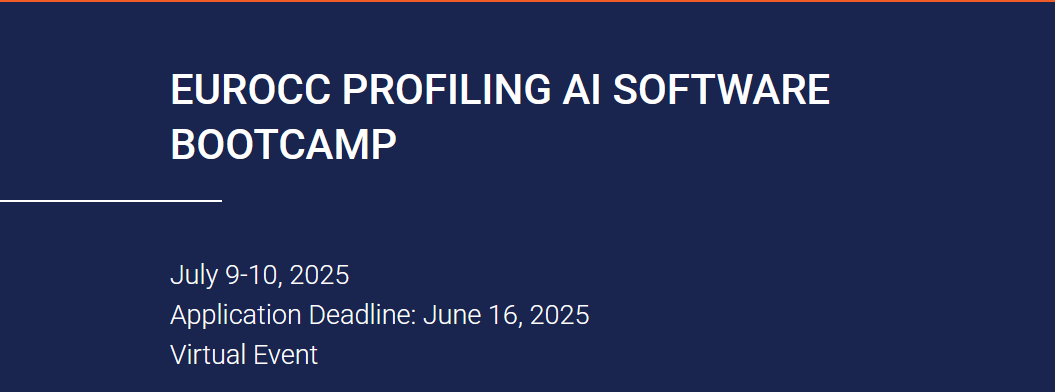
Overview: Together with NVIDIA and OpenACC organization, EuroCC2 will host a virtual Profiling AI Software Bootcamp on July 10, 2025.
The Profiling AI Software Bootcamp covers the process and tools needed to profile AI and machine learning applications to fully utilize high-performance systems. Attendees will learn to profile applications using NVIDIA Nsight™ Systems, a system-wide performance analysis tool; analyze and identify optimization opportunities; and improve performance of applications to scale efficiently across systems of any quantity or size of CPUs and GPUs. Additionally, this bootcamp will walk through the system topology to learn the dynamics of multi-GPU and multi-node connections and architecture.
People who complete the bootcamp are encouraged to apply to participate in the upcoming EuroCC AI Hackathon, which will be open for applications shortly.
Due to EuroCC2 regulations, generic or private email addresses cannot be accepted. Please use your official university or company email address to prove your affiliation when applying.
Application Deadline: 16th June 2025
Prerequisites: Basic experience with Python programming and PyTorch distributed training.
Event format: This bootcamp will be hosted online in Central European Summer Time (CEST). All communication will be through Zoom, Slack and email.
Compute Resources: Attendees will be given access to a GPU cluster for the duration of the bootcamp.
Description: In the three-day course, the use of the OpenFOAM software package, which is currently the most developed open-source CFD system, will be demonstrated. As the name itself suggests, it is an open-source system that any user can enhance according to their needs. Initially, the use of ParaVIEW, a graphical environment for visually reviewing and processing data from OpenFOAM, will be shown. This will be followed by an explanation of how the OpenFOAM environment, with demonstrations of simple examples. Since the foundation of CFD is the mesh, the use of three open-source mesh generators will be demonstrated: GMSH, BlockMesh, and SnappyHexMesh. Subsequently, the application of various areas within the OpenFOAM environment will be explained and demonstrated, including:
Difficulty: Advanced
Language: According to applications
Date and time: Day 1 from: 9:00 - 13.00
Day 2 from: 9:00 - 13:00
Day 3 from: 9:00 - 13.00
Max. number of participants: 30
Virtual location: ZOOM
Prerequisite knowledge: The basics of the Linux operating system and the basics of fluid mechanics and Python programming.
Target audience: The training is aimed at students and staff in academia and industry who want to learn more about the OpenFOAM open source CFD platform.
Workflow: The training is on-line, in the mornings. The interactive work is done via remote access to the HPC system at ULFS.
After the workshop you wil:
Organiser:
Lecturers:
| Ime: | Dr. Aleksander Grm |
| Opis: | Aleksander Grm graduated with a Bachelor's degree in Physics from the Faculty of Mathematics and Physics at the University of Ljubljana. He then completed a Master's degree in Applied Mathematics at ICTP/SISA in Trieste, Italy. After the MSc, he continued his studies at the University of Kaiserslautern in Germany and obtained a PhD in Industrial Mathematics. After the PhD, he worked partly in academia and fully in industry. In 2014, he moved to the University of Ljubljana to work in basic and applied research and to teach young people mechanics and mathematics at the engineering level. |
| E-mail: | aleksander.grm@fs.uni-lj.si |
| Ime: | Dr. Pavel Tomšič |
| Opis: | He is a research assistant at ULFE and is well qualified for several HPC related topics. He is actively involved in efforts to raise competencies in the field of supercomputing, such as the Partnership for Advanced Computing in Europe (PRACE). He is also coordinator of Erasmus + project SCtrain - a strategic partnership for the transfer of knowledge from supercomputing between Slovenia, Austria, the Czech Republic and Italy. As part of the EuroHPC project for the establishment of European National Competence Centers in the field of supercomputing (EuroCC), he is the champion for Training and Skills Development for NCC Slovenia. |
| E-naslov: | pavel.tomsic@fs.uni-lj.si |

Four-day intensive training for early-stage researchers:
This workshop is tailored for PhD students and early-career scientists eager to learn how to discover and engineer nanobodies — single-domain antibody fragments derived from camelid heavy-chain antibodies.
Participants will engage in a program consiting of lectures, hands-on laboratory sessions, and interactive computational tutorials. You will learn to identify nanobody candidates both in silico (using computational tools) and in vitro (through wet-lab panning techniques).
How nanobody libraries are constructed, characterized, and screened
Computational workflows to model, rank, or design nanobody candidates
Hands-on training with phage display and wet-lab selection of antigen binders
This workshop is open to PhD students with a basic background in biochemistry, molecular biology or related fields. It’s ideal for researchers ready to integrate nanobody discovery into their work—computationally, experimentally or both. We will select participants based on their submitted abstract and motivation letter. To encourage learning from each other, all accepted participants are expected to deliver a 10-minute short presentation in the daily PhD2PhD sessions. Successful applicants will be notified and asked to pay a €300 registration fee (see FAQ for what is included).
Each registered participant presents either their current PhD project as it relates to nanobody research or a method/idea they plan to adopt. Talks are strictly 10 minutes, followed by a moderated discussion with peers and lecturers. Participation in these sessions is a requirement of registration.
The program includes informal discussion rounds, dedicated networking events, and social activities designed to foster connections and future collaborations.
This workshop is supported by:





The trilateral meetings are a series of one day events designed to strengthen the scientific relations in particle, astroparticle physics and cosmology between Trieste, Nova Gorica and Ljubljana.
Venue
Teslova E-classroom, 1st floor (rooms 38 and 39) on Teslova 30 in Ljubljana, near the Jožef Stefan Institute
Speakers
Oragnizing committee
Past meetings

Description: In this seminar, we explore practical strategies for running legacy and modern scientific code—originally developed for the CPU—on the NVIDIA Grace Hopper superchip.
Focusing on Fortran, C, and C++ projects that compile cleanly with GCC, we will examine how to leverage NVIDIA’s HPC SDK to ensure performance portability (and gain), highlight common pitfalls, and discuss compatibility quirks between toolchains. Real-world examples will guide the discussion, making it relevant for researchers looking to transition their workloads to heterogeneous architectures.
Difficulty: Intermediate
Date & Time: 20. 5. 2025 from 14.00 to 15.00
Language: English
Prerequisite knowledge: /
Virtual location: ZOOM (only registered participants will see ZOOM link)
Organizer:
| Name: | Luka Leskovec |
| Description: | Scientist and educationalist involved in theoretical physics and supercomputing |
| E-mail: | luka.leskovec@fmf.uni-lj.si |

Overview: Together with NVIDIA and OpenACC organization, EuroCC2 will be hosting an AI for Science Bootcamp, beginning on 27th May and concluding on 28th May.
The End-to-End AI for Science Bootcamp provides a step-by-step overview of the fundamentals of deep neural networks, walks attendees through the hands-on experience of building and improving deep learning models using a framework that uses the fundamental laws of physics to model the behaviour of complex systems, and enables attendees to visualize the outputs of the trained model.
This online bootcamp is a hands-on learning experience where you will be guided through step-by-step instructions with teaching assistants on hand to help throughout.
Appication Deadline: April 25th, 2025
Prerequisites: Mathematical background in Differential equations, Python proficiency, and familiarity with deep learning fundamentals and frameworks are required.
Event format: The AI for Science Bootcamp will be hosted online in the time zone of the hosting organization (CEST). All communication will be done through Zoom, Slack and email.
Date and time:
Compute Resources: Attendees will be given access to a GPU cluster for the duration of the bootcamp.
