Apple held its annual September major product rollout today announcing, among other things, updated Apple Watch models with “Audio Intelligence” features. One of those features is “Live Rewind”:
A double press of the Digital Crown shows the previous 15 seconds of a conversation as a text snippet, so the user can catch something they may have missed or are less familiar with. Users can ask Siri about the content of the text or save it to the Siri app to revisit later.
This feature is also coming to iPhone 16 and newer models. Apple swears up and down it is doing all it can to make this private and secure, and I have no reason to believe otherwise. The audio is apparently not actually saved and is, instead, merely transcribed by a dedicated coprocessor. That text is automatically deleted unless the user takes an action to save it, too.
But good luck explaining that to anyone around you after you read back an exact transcript of what they just said. Apple says they should be sufficiently notified Live Rewind is active because “an audible chime plays from the speaker on your Apple Watch, even if your Apple Watch is on silent or you have headphones connected”, plus the watch plays an animation, but it is not clear to me when this happens. It is not shown in Apple’s video. The impression I get is that Live Rewind is always running in the background and these notifications are only played after you double-click the Digital Crown to look at the text.
This feels like a glimpse of how Apple will market its inevitable wear-anywhere glasses product. I do not think it does enough to assuage privacy concerns. I think normal people will continue to react negatively when you tell them you have been passively recording them because, outside Silicon Valley, that is considered gross and invasive.
[…] So somebody at LG decided that, in addition to the basic monitor driver and management app delivered to its users via Windows Update, it would slip in an additional program, “LG Monitor App Installer.” This extra bit of software includes McAfee, or an ad for it — as if there was any difference.
This is bigger than one bad app. LG and Samsung smart monitors run the same operating systems as their smart TVs — webOS and Tizen — both already built for automatic content recognition and ad targeting. Acer’s monitor privacy policies permit sharing device data with advertisers. The trajectory mirrors the rise of free-to-play gaming: low barrier to entry, monetization creep once you’re locked in.
This week, Gamers Nexus followed up with another blockbuster showing how LG’s smart televisions find other devices on the same network and, in some cases, record their activity; and, because they can recognize what is being played onscreen, LG tracks everything you watch, too. It is presumptively allowed do this because it presents a bunch of user agreements that anyone can bypass without reading, enables tracking by default, and buries all the opt-out stuff. Oh, and there is more.
The video also demonstrated an LG TV’s ability to record sound around it, even when the TV isn’t online.
“We were even able to capture microphone audio while the TV was unplugged from the network. Burke said the audio was reportedly stored locally via plaintext, which could potentially allow the data to be sent to LG [if] the TV connects online again.”
LG told Harding it is only listening for the wake word, but Gamers Nexus was able to capture audio in a variety of different ways because there are so many microphones and, in many cases, so many vulnerabilities in LG’s software. If I had one criticism, it is that Gamers Nexus connects the voice recording and transcription to LG’s ads service — an apparently real-life version of the conspiracy theory. I do not think there is not enough evidence to support that, even as speculation.
The transformation of seemingly every major company into, ultimately, vendors for advertising is an outcome basically everyone hates. The televisions tested by Gamers Nexus are thousands of dollars in Canada. That exchange of money used to be where the relationship ended, assuming the product did not need servicing. Now, though, selling ads on the screen itself prints so much money that it is nearly impossible to buy something different. You cannot vote with your wallet when advertisers are paying more.
I cannot tell you how much it disgusts me that so much of the archival footage from September 11 has now been age-gated and restricted as “mature” or “sensitive or adult” content, as in this example from this Reddit film archive.
It’s history. It’s archival footage of history. It’s a thing that happened.
If you were in school in 2001, there were probably televisions playing live news coverage in your classroom or in the hallways. There were in mine.
I am with Burns, and with the greatest of respect — she was there that day. But that particular subreddit is an unfortunate example as, while I do not think it should be age-gated, it should be moderated far better. So many of the users there are not treating it as an archive or a way of learning, but as a puzzle where they can play detective.
Aaron Vegh and Ben Rice McCarthy have been steadily updating Indigo since they launched it in May. In the latest version, you can now swipe between different filtered timelines, the scroll position is synced between devices, and there is a new lower price point if you use it exclusively for a single network.
As for me, the one big thing I wanted at launch was the ability to easily switch between multiple accounts, and this was added some time ago. It works exactly as you might expect: you can group sets of your own accounts — my personal Bluesky and personal Mastodon are one set, while my Pixel Envy accounts are in another — and just toggle the two sets.
This is one of my very favourite iOS apps. Just a great piece of software made by some great people.
A new identity theft service launched on the dark web this week is selling digital scans of more than 153 million drivers licenses from people in the United States and Canada. Based on interviews with individuals whose licenses are available for purchase on this service, it appears to be siphoning images collected by a widely-used identity verification company based in Louisiana. KrebsOnSecurity also has learned that the New Orleans field office of the Federal Bureau of Investigation (FBI) today launched an official inquiry into the source of the images.
You cannot do age or identity verification safely. It always creates some sort of record and that set of records will always become a target. That’s what happened here. And it’s what will happen with any such systems.
If you support “age verification” online, you are supporting a system that GUARANTEES privacy meltdowns — endangering all of us — because the giant databases of scanned IDs are perpetually hacked by criminals who sell private data.
I am opposed to identity verification, but this argument is not particularly effective for me because there are incredibly low-risk solutions. In Canada, for example, we have an interbank service called Interac that offers an identity verification service. I am not naïve, but I would entirely trust this bank-based system to verify me on a regular basis. In fact, I already do — like many Canadians, I use my banking information to log into government websites. Maybe this relatively safe proxy for a centralized identification system is unique to Canada.
I imagine this argument lands fairly well for lots of people elsewhere, however. The rapid introduction of age verification laws has produced a market for these businesses, but handing your identifying information to some random third-party should terrify you, as it is exactly the behaviour any security expert warns against doing. You have no idea who is able to access that scan of your driver’s license or what they can do with it. And, as it turns out, neither do some of these companies, either.
Dan Luu, after finding one wrong prediction after another made by Ed Zitron, comparing him to mediocre futurists, and exploring his writing style:
That last sentence really sums up Zitron’s position. “There are so many guys to be mad at the moment”. In this talk, he throws in this jab at Andreesen and blames Andreesen for Meta, Google, and Microsoft pursuing growth. In reality, if Marc Andreesen had never existed, Meta, Google, and Microsoft would almost certainly still be trying to grow so we of course cannot actually blame Andreesen for these companies trying to grow. There’s just this thing that he says is bad, and in his usual style, he pulls some person and says they’re the evil villain that’s to blame for this, and then moves on to the next non sequitur.
Instead of more carefully scrutinizing Zitron’s record, outlets like Vanity Fair are publishing soft interviews with him where he gets to make predictions like “large language models, when you remove all of the insane financialization, it’s probably a $30 billion-a-year industry”. Oh, sure, they ask a single question about wrong predictions since 2024, but he brushes it off by saying he has learned lots in those two years — Luu documents incorrect predictions all the way up until November 2025, after which “most further predictions that I saw were either non-falsifiable or resolve in the future” — and ends the interview by saying “[w]hat comes after the A.I. bubble is actually a little scarier”. Ominous.
The beauty of Zitron’s voluminous output, for him, is that there is a vast difference between what he actually writes and what people remember. Financial experts and more reputable journalists have raised plenty of concerns about how much money is being spent on developing this infrastructure, and how highly these companies are valued. But the words Zitron writes are far more incendiary and conspiratorial than many seem to remember. It is frustrating to see his many media experiences filling the role of the A.I. skeptic when there are far more qualified, sober, and accurate options. We have enough boosters; this is an industry that is co-signed by the world’s most powerful economies. We deserve better A.I. criticism in popular media.
Between scrolling, notifications, and messages, smartphones can be hard to put down. Just over half of U.S. adults say they spend too much time on their smartphone, according to a Pew Research Center survey from May and June 2026. About a third of adults say their smartphone use is about right, while just 3% say they spend too little time using these devices.
Notably, 70% of smartphone owners in the U.S. aged 18–29 say they believe they use it too much. I am skeptical of public polling — maybe we are societally more approving of shaming our own device use — but this also tracks with what I hear casually from friends and family. Anecdotally, many people I know have expressed that they want to be on their phones less often.
But the editors of Andreessen Horowitz’s It’s Time to Build newsletter — hosted on Substack, a platform they are investors in — believe this behaviour actually indicates people are very happy. Ruby Thelot, professor of design and media studies at New York University and “astute tech observer”, says the heavy use of social media platforms, like Meta’s Facebook and Instagram — Andreessen Horowitz invested in both, and Marc Andreessen is on Meta’s board; none of this is disclosed — is simply evidence we love them:
People en masse are getting on social media, by choice. From 2016 until now, the number of social media users has grown from 2.5B to close to 6B people. Enshittification isn’t real. It’s three TikToks in a trenchcoat, and, maybe, a book deal. It’s good for discourse but does not describe actual reality and user patterns.
Returning to Instagram. The average daily usage showcases an increase in time spent on Instagram every day as well. Users are coming back for more, in a highly competitive attention arena, year after year.
There is a lot of assumption in these two paragraphs, and I think the “close to 6B people” is worth examining to start. Thelot attributes this statistic in the chart above to Backlinko. It cites no source, but a web search indicates to me this originates with Manochi’s DataReportal, which disclaims “‘user identities’ may not represent unique human individuals” because, as the company explains on the sixth slide of its report, it may count multiple social media accounts or business accounts as individual identities. These are not necessarily people, and Manochi says it is improper to compare figures year over year as Thelot does. (And, to be fair, which Manochi also does on slide 321.)
A lack of rigour is not unique to this data point.
Thelot next shows a chart indicating daily Instagram use rose from 25 minutes in 2017 to nearly 34 in 2026. This is, to Thelot, simply evidence that people like using it and want more. But, to return to the Pew poll above, it seems that people do not feel good about spending more time on their smartphones. Though Pew did not ask (PDF) about social media specifically, roughly half of respondents aged 18–29 said it negatively affects their productivity. And, according to slide 337 of that Manochi report, 30.7–44.0% of people say they use social media to “fill up spare time”, trending higher for younger generations. It is plausible that more younger people are spending increasing amounts of time on social media apps and they do not feel good about it. In other words, the time spent numbers are not a good proxy for enjoyment or value.
People need to be on Linkedin to find jobs. Municipalities and news organizations share important updates on social media first. You might be pulled onto Facebook or WhatsApp against your will because your local school or community of parents congregate there. That doesn’t mean they like it. It is possible to hate something with your entire being and still participate in it.
Regardless of whether you call it “addiction” or some kind of compulsive behaviour, it is plausible many people dislike their own actions but struggle to change them. It is also possible these products are designed to take advantage of that to extract more time out of each user.
John Ternus became Apple’s chief executive on Tuesday, succeeding Tim Cook, the company’s leader for the last 15 years. The long-anticipated handoff, Mr. Cook has said, will be “perfectly smooth.”
[…]
This summer, Apple hired Nate Gatten from American Airlines to lead government affairs, replacing Kate Adams, who will retire this year. Laura Legros, a hardware engineering vice president and deputy of Mr. Ternus’s before retiring from Apple in 2022, has rejoined the company, three people familiar with her hiring said, speaking on the condition of anonymity. Ms. Legros, who reports to Mr. Ternus, could act as his adviser and emissary to various parts of the company, the three people said.
Apple’s Phil Schiller is no longer going to run the App Store or oversee product events, reports Bloomberg. Schiller isn’t leaving Apple, but he is narrowing his responsibilities and working on unspecified projects.
Employees at Apple told Bloomberg that 66-year-old Schiller appears to be taking another step toward retirement.
Cook and Ternus each sent pretty anodyne company-wide memos about the transition. Cook’s tenure was the longest of any CEO in Apple’s history and he was the one who turned it from a successful company into a global behemoth.
The thing I have liked about Apple — one of the things that made me a longtime customer and someone who writes about the company — is that it has historically been a very simple kind of business: it designs products and sells them to people, mostly. Every one of its peers is a more complicated business. They often balance the needs of massive institutional and government customers, advertisers, or two-sided marketplaces.
That change began in the latter years of Jobs’ tenure and accelerated under Cook. Most software, including operating systems, was accounted for as part of device purchases, and was turned into a software-as-a-service model. Its subscription-based business became a revenue growth centre, which was important for Wall Street because it was a way to turn the company’s successful but inconsistent device sales into predictable money printers. And there are now ads and upsells throughout the operating systems, which are shown to all users regardless of how much other money they have already given Apple.
Ternus has inherited that Apple. Regardless of how much he gives off the vibe of a cool Californian — by way of Philadelphia — who just cares about the best stuff, he is also selling ad space and making sure more people upgrade to Apple One.
Joel Dryden, in a CBC News article with the headline “On the Road With Pro-Independence Albertans, One Small Town at a Time”:
The restaurant owner, who gained prominence during the COVID-19 pandemic, has hit the road this summer to talk independence, travelling with a group of people who also support the idea of Alberta becoming its own nation.
[…]
On the back of the vehicle, a Bible verse printed in script: Jeremiah 29:7 — “Seek the peace and prosperity of the city to which I have carried you into exile. Pray to the Lord for it, because if it prospers, you too will prosper.”
Mike Skerrett, in a 2018 McSweeney’s article with the headline “I Traveled to a Diner In Trump Country to Write Another Article On Whether the President’s Supporters Still Want to, Quote, ‘Smash My Libtard Face In'”:
I came to this diner, The No Safe Space Café, to get a taste of the Real America. This America exists outside the liberal echo chambers, somewhere with real diversity of thought: The opinions of straight, white, Christian men.
Chris Scott — the “restaurant owner” driving the separatist campaign bus with Dryden aboard — has previously called the CBC “liars, thieves and Federalist bootlickers” who publish “drivel”. Replace the U.S.-centrism of the McSweeney’s piece with a Canadian vibe, and is it really all that different?
All of these since January — and I excluded most rewrites of articles by Mark Gurman, Ming-Chi Kuo, and other well-known Apple rumour writers. Also, my list does not include articles about products rumoured to be announced at specific events. They also have another thing in common: nearly all are by Ryan Christoffel, who seems to have taken up the 9to5Mac beat for making listicles of Apple products that could be updated in the future. Cool.
Careful readers might think I listed one of these articles twice — the “15+ new products this fall” one. But this is because Christoffel originally published it in May, and then changed the date on it to August after making a few changes.
I do not know who this is supposed to serve. Maybe this is a play for search engine traffic or A.I. chatbot citations. Maybe it works pretty well, too, and maybe I should be less cynical about these kinds of churned-out listicles in a time when A.I. search features are capturing traffic that used to go to third-party websites. Or maybe this is all just filler when there is nothing newsworthy but you need to publish a dozen or so articles daily.
It’s a secret third thing: Google Discover, Google News, Flipboard, Apple News, and other algorithmic aggregators. Articles like that tend to reach a much broader audience.
“One listicle a day” was our goal at Cult of Mac before I was laid off. It’s a tough time out there for independent blogs. The Google AI overview is devastating.
I obviously have no authority to give business advice. I would only point out that it is disappointing to hear about chasing referral strategies. One would think the pivot to video era would be treated as a cautionary tale and not something to repeat — if one, I suppose, is not responsible for staff and paycheques.
Alex Skopic, at Current Affairs, wrote about the functional use and abuse of stimulants by people who are overworked. I stumbled upon it by way of the latest issue of Web Curios, and I think the general thrust of the article is something I find noteworthy enough to link to it. Alas, it is sloppy in the details.
The second paragraph is a good place to start. Skopic dumps a litany of numbers about declining affordability and the difficulties of modern life; among them:
[…] And according to the Bureau of Labor Statistics, 21.6 percent of Americans now work longer than 40 hours a week, with a beleaguered five percent working as many as 60 hours. […]
The way this is phrased — “now work longer than 40 hours a week”, emphasis mine — may give the impression this figure is a new high, either historically or at least in recent memory. But it is not. This figure has been declining for at least twenty years. In 2005, the BLS reported 27.9% of people employed in nonagricultural jobs in the U.S. worked 41 or more hours; by 2015, that was down to 24.8%, compared to 21.6% in 2025. The same drop is also present for workers committing 60 hours per week or more: 7.2% in 2005, 6.3% in 2015, and 5.4% in 2025.
I am not selectively quoting here. I picked ten and twenty years ago for comparative convenience, but you can check the intervening years and find a clear trend. The misuse of this data point is a poor choice when there is perhaps an interesting narrative in reconciling the declining percentage of overworked U.S. adults with the proliferation of highly caffeinated beverages, mysterious energy shots, and powders and supplements of questionable substance.
This is the kind of sentence that made me begin searching up all kinds of stuff in this article. It raises doubts, making me do the kind of work all of us should probably do any time we read something, but do not because we decide we have better things to do. Well, I decided this is what I was going to do today. I am going to skip past the health claims because they are not in my wheelhouse — double-checking easily verified numbers is something I am more comfortable with — and I will jump to this part:
Monster Energy, for instance, seems to think it owns the word “monster.” In 2009, the company threatened to sue a small brewery in Vermont for selling a beer called the “Vermonster,” claiming it infringed their trademark rights. That was at least a beverage, but in 2020 they did the same thing with video game company Ubisoft, forcing them to change a game’s title from “Gods and Monsters” to “Immortals Fenyx Rising.” In 2023 they once again targeted the gaming industry, this time over an independent game called “Dark Deception: Monsters and Mortals”; according to the developers, the drink company wanted them to “agree to never use a green & white logo on a black background for any game we ever make. So they own the colors green & white too apparently.” In all of these cases, Monster’s legal claim is shaky at best — but with a revenue of $7.9 billion in 2025, they have enough money to bankrupt anyone who tries to take them to court, so it doesn’t matter.
Monster Energy is an aggressive litigant when it comes to protecting its trademarks, but it does not always succeed. Glowstick Entertainment, makers of “Dark Deception: Monsters and Mortals”, fought and won its trademark case. Also, I think it would have been useful for Skopic to cite cases where Monster Energy lost — or likely would have lost — but the defendant went out of business anyhow. For example, in a 2022 case against a store with “Monster” in its name, the energy drink company would have been unlikely to prevail (PDF). Even so, a search of state records showed the company was ultimately dissolved. No matter whether this was directly connected to the litigation, it is a stronger argument for having “enough money to bankrupt anyone who tries to take them to court” than this evidence-free article.
Also, it is kind of weird that Coca-Cola — a company which owns 21% of Monster Energy after the latter acquired Coke’s energy drink portfolio, has a line of teas and coffees, and whose namesake beverage used to contain cocaine and still contains caffeine — goes entirely unmentioned in this piece. Perhaps it is too obvious, or feels like too much of a stretch. But it is strange to dedicate a paragraph to Monster’s trademark battles, which has nothing to do with the thesis of this piece, and leave the Coca-Cola stone unturned.
I wish an editor took another pass on this article as I think there are points that could be clarified, facts that desperately need checking, and interesting narratives that could be teased out. Skopic notes, for instance, the supposed incompatibility of sleep with an economy based on relentless production and consumption. It is true that we cannot make or buy things in your sleep, nor can we provide revenue-generating services, but sleep itself is an enormous business. We are encouraged to spend thousands of dollars on beds and mattresses because less expensive options are insufficiently rest-promoting, and then we should spend more money to wake up and keep ourselves alert throughout the day.
I find all of this baffling, even as — perhaps especially as — a daily coffee drinker. I get that people have different relationships with caffeine and alcohol, so do not take this as anything greater than my feelings-based vibe, but I have never really understood these as functional products. Coffee, when made well using the kinds of beans that I like, is a delicious beverage regardless of its effects. Wine is sort of similar to me. They both have effects, of course, but I think of those as a kind of warning sign: if I have consumed so much coffee or wine that it noticeably changes how I feel, I have probably had too much. This makes them, unlike energy drinks, a delicious treat for me. Your mileage may vary.
U.S. President Donald Trump signed an executive order on Thursday to change the name of Lake Ontario to “Lake America” as tensions with Canada worsen.
Elect stupid people and get stupid policies. This report contains a good explanation of the name’s history, and also has a deliciously petty map illustrating where the border is drawn.
Like the moronic Gulf of Mexico relabelling, expect digital mapping companies like Apple and Google to fall in line. MapQuest, a holdout on that change, also says it will keep the correct name. I still think maps should reflect government names regardless of whether they were assigned by a thumb elected by the world’s least responsible country, but I sympathize with MapQuest’s stance.
Update: Just like that, Google has updated its map to reflect “Lake America” when using a U.S. map, “Lake Ontario” in Canada, and “Lake Ontario (Lake America)” elsewhere. Google’s concession — and, soon, Apple’s — is a good reminder to all users that the U.S. may be the most powerful country in the world, but it is no longer a leader.
Apple, after previously saying it would move Hide My Email to the private.icloud.com subdomain:
After further consideration and reviewing community feedback, iCloud+ Hide My Email addresses will remain on icloud.com.
The whole point of an email address like this is that it can be used anywhere someone does not want to provide an address that can be tied to them or remarketed to, or if they want to be able to cut off communications. This change, if implemented, would have made these addresses basically useless. I am glad to see this was reversed.
In September, the European Commission began pondering how to correct its 2009 privacy law that resulted in cookie permission banners littering the web, with the resulting proposal announced in November.
EU officials said users would remain in control of their data on the internet, but new rules on cookies — the internet files that are stored on a user’s device so a website can remember them — would make life simpler by ensuring one-click consent. “I think we can all agree we have spent too much of our time accepting or rejecting cookies,” [Henna] Virkkunen said.
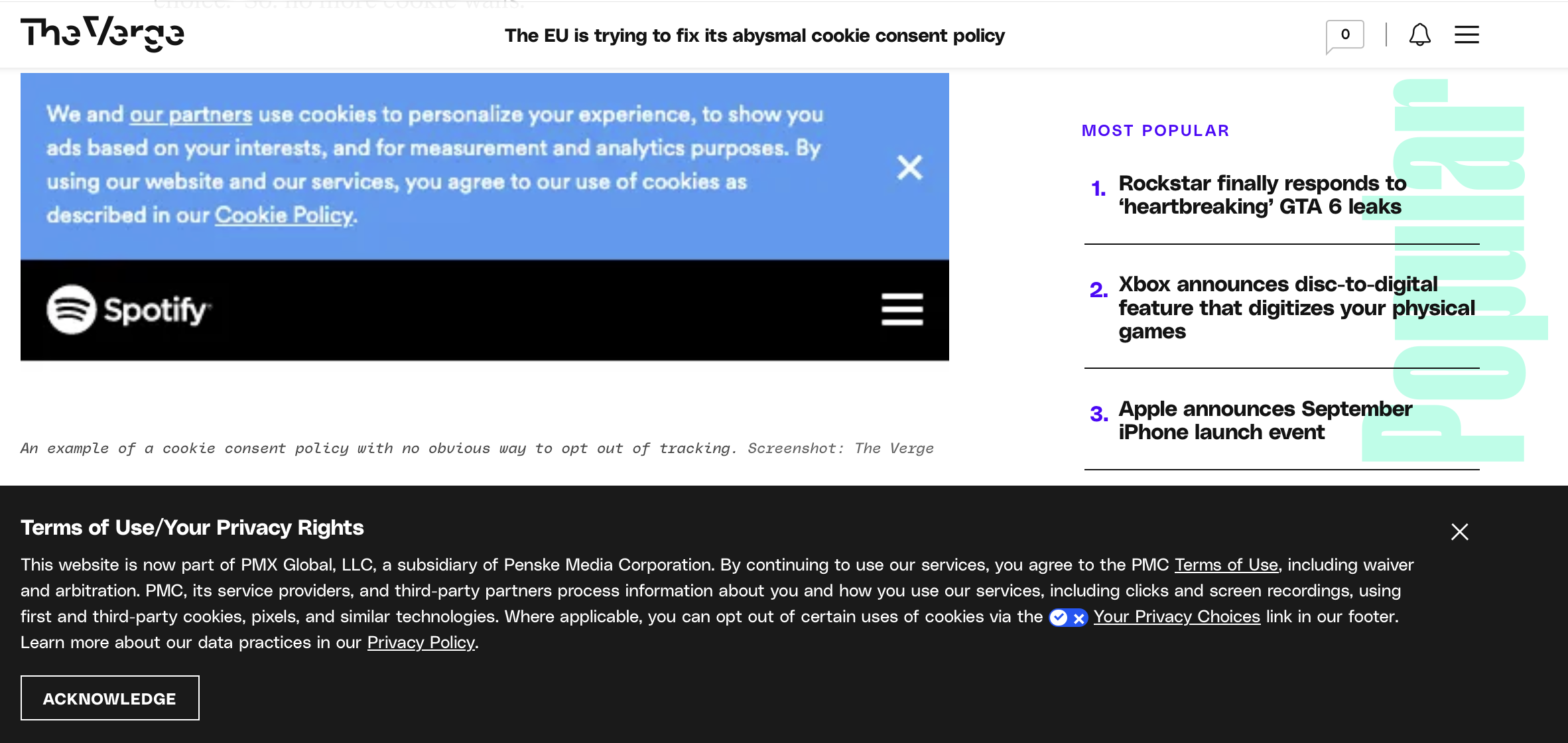
This was not the first time the Commission had attempted to correct for the permissions pollution that resulted from the e-Privacy Directive. In 2020, its efforts were focused on ineffective consent options like, as reported at the Verge, “a cookie consent policy with no obvious way to opt out of tracking”. I still see many websites, like the Verge itself, providing no meaningful consent for third-party tracking.
This time, though, the Commission said it was trying to make cookie consents less prevalent by allowing, for example, simple statistical cookies without any consent, and it was going to give users an option to decline tracking universally. When I looked into the changes in November, it seemed like this signal could be ignored by publishers and media companies who would be free to ask for consent anyway. As of May, it seemed this proposal was moving forward by requiring consent management platforms to respond to browser signals. By summer, however, things had changed.
Ernestas Naprys, Cybernews (“Article 88b” refers to the universal browser signal proposal):
Google suggested ditching Article 88b.
“Article 88b should be deleted. Retaining this provision risks anchoring the Omnibus to a proven-failed architecture, Google’s position reads.
“It will drastically impair the ability of most websites to monetize content and drive client acquisition. The resulting low consent rates and severely restricted data access.”
It was not just U.S.-based companies that argued against better user privacy controls. According to noyb, French, German, and Polish representatives were in alignment with Google’s position, which ultimately led to its scrapping. All three countries are home to companies that would be affected by this regulation. None, however, are as big or as powerful as Google or Meta.
Privacy-defending organizations are understandably not impressed. They have launched Kill the Cookie Banner to drum up support for legal recognition of a browser signal. In the U.S., five state governments say the Global Privacy Control must be respected. At a browser level, it is only implemented in Brave, DuckDuckGo, and Firefox, but it seems that Apple is working toadd it to Safari, and it seems it is being actively worked on for Chromium, too. The European Commission should throw its weight behind this control, too.
[…] I believed then and still believe that operating a car is too difficult for human beings. This is obviously not true at the level of making a car move. Making a car move is easy. A rat can make a car move. But the level of skill involved in driving really well is not dissimilar from that required to be a concert pianist, if the pianist-centered movies I’ve watched are to be believed. Now imagine that in most parts of the country leading a normal life required more or less constant piano playing. Now imagine that playing the piano badly killed people.
Just about everything we do to make driving a car easier instead seems to make people complacent. The lanes on roads are wider than they need to be to account for lateral imperfection, and then there are wide berms so that someone may drive completely off the road in relative safety. Cars that are enormous, heavy, hulking things do not allow drivers to feel their weight because of myriad assistance features that make it possible to steer with a single finger.
But driving is a skill. Like any skill, it is something people will have varying degrees of success learning. Some people simply cannot drive, whether on a temporary or permanent basis. We can bet the farm on autonomous vehicles which, though seemingly capable in warm and dry urban settings, are an expensive and individualized answer that exacerbates all the other problems of car dependency. It is also a risky bet as, like any technology, current performance is not indicative of future gains. Public transit, on the other hand, is a proven technology that, among other things, strengthens the social contract while giving everyone the ability to move around a city.
On 24 August 2026 cease and desist letters have been sent by X Corp. demanding a permanent takedown of Nitter instances and the project’s repository.
Nitter mirrors X; it powers websites like XCancel which remains online and functional as of writing. (Update: A few hours after I published this, XCancel says it was also told by X to shut down its service.)
This is not surprising but it is very stupid. Companies like X and Meta are very happy to scrape the web at unprecedented scale and without permission, but have zero tolerance for the same to be done to them by, in effect, individual users. That is not because they are protective of the creative works users have contributed to these platforms. It is simply because users are not trusted to use the platforms. X does not permit third-party readers, and neither does Instagram, because their value does not come from us using these services as we wish, but from how they dictate we must. Bafflingly, however, some argue they should face little responsibility for those choices.
Jeffrey Kopp, of CNBC, wrote a short profile of Judge Yvonne Gonzalez Rogers, whose name you may have heard even if you do not live in her district of Northern California. That is because her district covers such areas as San Francisco and Silicon Valley, so her rulings on the many cases heard there have a disproportionate impact on U.S. technology policy.
These policies should catch the attention of people in the U.S., of course; it is also a factor to be mindful of in the rest of the world. The boundaries and limitations surrounding the behaviour of some of the most impactful companies in the world are decided by a relative handful of people, among whom are the justices of the Northern District of California. This article is not a deep examination of such consequences — but I would love to read that story, if it exists.
Now that it has been a couple of years since Apple began requiring administrators to sign in to the News Publisher dashboard or risk their accounts losing their role, there are a few things we have learned:
These notifications arrive on an approximately five-month schedule, perhaps a couple of weeks longer.
News Publisher has little additional functionality that requires or would encourage signing in on a more regular basis if you do not use Apple’s special format.
In my case, I cannot even see the articles I have published, nor are there analytics. I checked on a device that is not my own and I can see that recent articles are broadcasting to Apple News just fine from my website, but there is effectively nothing in News Publisher reflecting that.
Apple News is still frighteningly limited from a publisher’s perspective. It launched eleven years ago and there is still no way to set a custom URL in News Publisher or, in fact, anywhere. That is, this website’s Apple News link is https://apple.news/TAjcS0c5sRV2HYftzmJ6UMQ instead of, say, https://apple.news/pixel-envy. It is not a function of size, either — here are the URL slugs of a few publishers you definitely recognize: ThfiauYLtQlOfqyiHkempkw, TVKIb0N6iSsOyGSnR4zF1Kw, and TUKgA_OjuTe20v1ndDwQjxQ. Catchy.
This limitation also extends to the URLs of individual stories. It is the kind of basic functionality that exists on every other public-facing platform I can think of that a publisher might use, but Apple does not support because its “Services” business prints money anyway.
I still do not know what happens if I fail to sign into News Publisher five months from now, other than that my role becomes reduced to an editor. There is nobody else authorized with News Publisher, so I guess I simply lose administrator access forever if, every five months, I complete the necessary busywork of signing in.
The new Meta AI desktop app is version 1.0 beta at launch and weighs just 16MB once installed.
Based on initial inspection, it runs natively on Apple silicon Macs with macOS 15 or later, using an AppKit and SwiftUI shell with WebKit for richer chat content. In other words, this is not an Electron app or a repackaged iPad release.
Meta’s other major Mac app is WhatsApp, and it comes in at over 650 MB (and over a gigabyte on Windows). Its iOS apps are no better: Instagram is 605 MB, Facebook is 491 MB, and even Threads is over 200 MB. I do not understand why since virtually everything displayed in these apps is served remotely.
[…] Smartglasses bring the functionality of smartphones, cameras included, into every moment. Several people I spoke to said that even when the LED is functioning as intended it can be subtle and difficult to spot from far away, especially if you aren’t aware of how smartglasses work. Others shared that they sought out the glasses to capture more “natural” footage of those around them, explicitly because people act differently when they know they’re being recorded. As Meta themselves put in their advertising materials: “Record life as you live it – every detail, every angle.”
[…]
Meta refuted to the Guardian that the main purpose of the glasses is to make unnoticeable recordings. […]
Actually, it is the whole point of these things. What Meta probably intends to say is that the main purpose of these glasses is not to make creepy and gross unnoticeable recordings. However, they are absolutely intended to be a less-obvious way of shooting photos and videos “as you live it”, if you believe Meta’s own marketing. Sure, maybe someone recorded you today with their smartphone and you did not notice, but it is very obviously an effect of hidden camera glasses like these — and, perhaps, headphones — that such recordings become dramatically more covert.
Harrison Dupré quotes Ryan Clarkson in this article, an attorney who filed a sprawling class action lawsuit (PDF) against Meta alleging serious privacy violations. But virtually all its claims refer to the blockbuster article published by Svenska Dagbladet in March revealing that contractors in Nairobi were reviewing recordings without the explicit knowledge or consent of users — undeniably, in my view, a violation of their privacy and expectations. But so many of the examples in this article and others are entirely about the simple fact that images or videos were captured.
So prepare for a year of breathless and evidence-optional claims that Chinese AI is a dire threat to U.S. consumer privacy and national security, followed by an elaborate bipartisan train of bad policy and shitty new laws crafted by a clumsy coalition of technofascists, extremists, and competition-averse chickenshits.
A bit rant-ish for my liking, but the kind of thing that makes me worried about living in what our prime minister called a “middle power”. The success of A.I. models developed in China has caused much concern among U.S. hyperscalers.
In his recent essay, Mark Zuckerberg warned that “[a]ny policy that slows American model releases — even by a month — could add significant risk to American leadership while letting foreign models race ahead”; by “foreign models”, he means those from China. Much of this section of the essay bemoans the already feeble restrictions in the U.S. on training and building A.I. models. Zuckerberg even says “falling behind in A.I. overall would almost certainly be a larger and longer term national security issue than any specific issue we’ll face in its development”. These talking points are ripped from the history Bode documents of the supposedly essential 5G “race”.
But if you live in a middle power, what matters are the knock-on effects of these battles that are about political and public relations more than they are about actual technology. For U.S. allies, it means a further entrenchment of U.S. companies in our technology landscapes.
Under the commitments that have now been declared binding, Apple will align the consent prompts for its own offerings and for third-party apps much more closely. This involves removing possibly discouraging symbols and wording in Apple’s predefined requests for third-party providers. The design of the consent prompts will be neutral in terms of content, wording and layout. In addition, app publishers and content providers, such as media publishers, will be given more scope to explain to users what significance personalised advertising has for their offering and their business model.
The regulator helpfully offers an illustration of the differences between these prompts on the fourth page of its FAQs (PDF) about the case. There are many things they say could be deterrents in the App Tracking Transparency dialog, and I do not think Apple would deny that they are suggesting that users opt out of tracking. The definition of “tracking” Apple uses is self-serving, which would not matter so much if it did not also have a parallel desire to grow its advertising business.
A particularly damning finding in that comparison, to my eyes, is the way Apple puts “Ask App Not to Track” as the topmost button in the App Tracking Transparency dialog, but puts the option to “Turn Off Personalised Ads” at the bottom of it its own advertising prompt. Regardless of whether you believe one particular order is more suggestive of a primary and secondary action, the mere fact they are not in the same order is indicative to me of ill intent or, at the very least, sneakiness.
Apple had previously threatened to withdraw App Tracking Transparency in Europe because of financial penalties and what it called “intense lobbying” by European advertising companies. In a statement to 9to5Mac, however, it seems perfectly fine with making these changes.
One of the many changes Apple has agreed to make is that both prompts will contain “an accurate explanation of how data may be processed if the user gives their consent”. I am unsure what this looks like, but I hope it addresses a shortcoming of App Tracking Transparency, which is that it provides basically no information for users to make an informed choice about consent. What does it mean to allow tracking in App A compared to App B? This requirement may help clarify that. Then again, I also think it is grossly unfair to make users responsible for figuring out whether they should consent to persistent and invasive data collection on an individual level.
Here is a thought that must have occurred to someone on the MacOS user interface team: if Liquid Glass supports colour, why not use it to give more dimension to window controls? So Apple did just that in the latest Golden Gate beta, and it looks good.
Last year, we updated how we count public views for Shorts to better capture how viewers watch on YouTube. Now, we’re aligning all other video formats to this same standard for consistency across the platform. Beginning on 8/24/2026, a view will be counted the moment a video begins to play—from the very first frame. This standard will now apply globally across all formats.
YouTube does not provide an easy answer about how it counts “legitimate views” on non-Shorts videos right now — an article called “how engagement metrics are counted” does not actually say how — but I see many people referencing a rule of thumb of thirty seconds. Dropping this to a single frame on a platform that automatically plays every video is essentially a page view count, not a “view” by any stretch of the imagination.
Instagram and TikTok similarly add a view to a video when it starts to play or replay, while X counts a view when a user watches a video for at least two seconds. […]
YouTube says it is keeping the old metric, now called “Engaged Views”, visible only to uploaders. The publicly disclosed numbers mean basically nothing about how many people actually watched something or enjoyed it, but at least that is now a consistently stupid number across all major platforms.
The defining questions of our age are who will have access to superintelligence and what will we direct it towards. Will it be centralized and restricted to a few institutions, or will it be a tool that empowers everyone?
We propose a philosophy based on individual empowerment as the source of prosperity, invention as the primary purpose of superintelligence, and balance of power as the foundation of safety.
The themes of this essay are reminiscent of those in the “Personal Superintelligence” one Zuckerberg published a year ago. It has the same aspirational messaging about empowering individuals with decentralized superintelligence, the same acknowledgement of the new risks of this technology, and the same total reluctance to define “superintelligence” in any meaningful sense. The term appears 55 times in his latest essay, not one of which explains what it actually is. I suppose it must be synonymous with generative A.I. but the beauty of a proprietary term like this one is in its flexibility.
What I would like to focus on are the specific references Zuckerberg makes to studies, initiatives, or plain anecdotes. Despite the word count, there are few concrete references; much of this is about visionary concepts, not grounded reality. Despite their paucity, Zuckerberg also provides no links or citations, making it particularly difficult to track down the source of claims like this one (emphasis mine):
People fear that automation will outpace individuals’ capability growth, leading to job displacement followed by a difficult period as people learn new jobs. But there is no rule that AI must increase automation faster than it increases individuals’ capabilities or demand for new skills. Recent statistics suggest it may be more likely that individuals’ capability growth could match or outpace automation, in which case people will gain the ability to do many new things before their current jobs change. This would lead to a healthy balance and potentially even job growth.
What this actually refers to I have no idea. There is enough hedging — “recent”, “suggest”, “may be”, “likely” — that it kind of means nothing at all. What I think Zuckerberg is saying in this paragraph is that people can learn new things faster than A.I. can take jobs, but I could not find “recent statistics” backing this up.
There are some relevant observations, though. A June research note (PDF) from the Stanford Digital Economy Lab found, using data from ADP payroll services, that automation-friendly entry-level positions saw employment declines since the November 2022 launch of ChatGPT. Meanwhile, a report published by PWC in June (PDF) suggested increasing wages and employment in jobs that could be automated, even at the entry level. One possible difference is in methodology; while Stanford’s information came from payroll data, PWC’s was from job ads. PWC’s findings were also highly sector-dependent, and indicate entry-level jobs now require more skills to compete with automation. I think PWC’s report is the closest match to what Zuckerberg is arguing, but it is difficult to know for sure. Also, how exactly are young people fresh out of school supposed to develop skills like “team building” and “stakeholder management” before they can be hired?
Here is another anecdote from Zuckerberg’s essay, this time about how Meta is committed to building its physical A.I. infrastructure to support “high-paying local jobs, investment in schools and public services, ensuring energy prices don’t rise, and taking care of the environment”:
For example, in Richland Parish, Louisiana, where Meta is building a large data center, teachers received a $50,000 bonus this year because of the increased tax revenue from our investment. The superintendent told us that teachers are now moving there from across the country and he believes it will become one of the nation’s best school districts.
This is true, but elides the reasons why teachers are somehow getting bonus cheques from a data centre construction project they have nothing to do with. Reporting about this for the New York Times, Jacey Fortin writes that this undeniably exciting windfall is due to a “decades-old ordinance that directs 1 percent of local sales tax revenue to educators”. However:
But many of the workers are likely to leave in the next few years, ending the tax boom. And the Meta payment, which amounted this year to about $22 million, represents only a fraction of the taxes that a company would normally pay to build in the area.
Meta’s tax bill should be over nine times the amount it actually pays, and it will drop precipitously when construction is complete. But Meta made backroom negotiations to get all kinds of concessions and incentives to build its enormous data centre in the region. If the tax breaks had not been implemented and Meta constructed the data centre anyway, it would raise enough money to cover the salaries of all Louisiana public school teachers for more than a year. Eli Tan and Maureen Farrell, also of the Times, noted one resident’s sixfold rent increase thanks to housing demand from construction crews, but quotes the state’s governor saying the tax revenue pre-Meta was “zero”.
Zuckerberg:
We help keep electricity prices low by building our own energy-generating infrastructure wherever we invest. This ensures that not only are we not consuming energy that could have gone to the local communities, but in some cases we even supply a surplus of low-cost energy back to the communities. We think this is an important investment principle for sustainability.
Meta has previouslyemphasized its sustainability bonafides, but Zuckerberg omits such discussion here, perhaps because it would require considerable caveats that could be a distraction from the essay’s marketing angle. In Louisiana, for example, Meta is paying $2.65 billion to build several power plants with Entergy, but the region still needs more power. So Entergy is looking to acquire a plant in Texas, which could increase customers’ rates. In El Paso, at a different data centre project, Meta is only contracted to cover power plant construction costs for one to five years, after which costs will be transferred to customers. Like in Louisiana, it is also gas-fired.
Closer to home, a gas-fired plant in Alberta will not come online until years after Meta’s to-be-built data centre is up and running, all while electricity rates are predicted to climb.
Zuckerberg:
Developing personal agents requires a new way of thinking about alignment. Most labs today view alignment as a defensive measure for enforcing a centralized set of values. For example, one leading model was aligned to refuse helping draft a letter to prospective parents at a school because it thought standardized testing was unethical.
If this is a real anecdote, I cannot find the source.
And, if you can believe it, those are all the specific and checkable claims Zuckerberg makes in this essay. The rest of it is strikingly like one of those Microsoft concept videos from a decade ago albeit without the After Effects artist expense. One last thing, though, from Zuckerberg:
Privacy is an important foundation for individual empowerment and freedom. […]
Meta continues to make virtually all of its income from advertising targeted by some of the most privacy hostile technologies ever created. While “superintelligence” appears over fifty times in this essay, the words “ads”, “advertising”, and “advertisement” go unmentioned. They appear not even once.
[…] the point has been made: looking after the information economy can no longer be a side project for underfunded institutions. Wikipedia is as miraculous as the Wayback Machine is indispensable. Still, we need to stop pretending volunteerism alone can hold up the public internet. We understand this duty more clearly in other domains. After all, roads aren’t governed by ride-sharing companies; payment apps don’t set monetary policy; cloud service providers don’t dictate national security frameworks (at least not yet). Yet we have been shockingly casual about governing our digital dependencies.
This paragraph is fantastic. But one of the things I found frustrating about this article as a whole is the lack of links or substantial proof. For example, I felt compelled to fact-check this claim:
The retrieval crisis has reached even Wikipedia, one of the world’s most significant volunteer-run public knowledge resources. For years, search engines sent billions of viewers to its pages. But now, AI systems scrape and ingest Wikipedia’s content directly when presenting their results, eliminating the need for users to click through. Wikipedia has become the infrastructure of its own demise: dwindling traffic means attention and donations no longer reliably flow back to the encyclopedia to keep it alive.
On a gut level, this feels like it should be true. An initial glance at the views of English Wikipedia’s main page, however, suggested it was not. But then I looked at total pageviews across English Wikipedia since January 2020 — as far back as it goes — and, indeed, page view have dropped from 7–8 billion per month in early 2024 — before Google launched A.I. Overviews — to 6–7 billion per month in 2026. Perhaps it is simply not this writer’s style, but I would prefer to have had concrete numbers to reference.
Sarah Perez, in a TechCrunch story about monthly active user numbers for Bluesky, Threads, and X, using data provided by Similarweb:
Instead, the data shows that X’s worldwide monthly active users on mobile were down around 3% year-over-year in June, and X’s mobile daily active users dropped 7% in July to 123.7 million. (Of course, X remains a sizable social network with around 302 million monthly active users on its app as of June 2026 and a growing number of web visits, up 5.3% year-over-year in July to 4.7 billion.)
Similarweb’s data is janky as hell, and this number is a long, long way from SpaceX’s self-reported monthly active user count of 550 million on X alone. I am not saying either number is reliable, only that a gulf of 248 million users is an error not easily explained by rounding or estimation assumptions. Pre-takeover, Twitter had about 338 million monthly active users, according to an estimate by Insider Intelligence; in four years, the platform either declined by around 36 million monthly users or grew by over 200 million.
By the way, how is X doing from a financial perspective?
Let’s break all this down: In the second quarter of 2022, the last full quarter before Elon took over, Twitter brought in $1.08 billion in ad revenue. In the second quarter of 2026, X brought in $367 million. That’s $713 million a quarter, gone. Elon has wiped out two-thirds of Twitter’s ad business over the exact period in which he promised investors he’d nearly triple it.
Musk said in his 2022 Twitter investor pitch that he would quintuple revenue by 2028, though advertising would represent just 45% of that for a total of $12 billion annually. But, then again, Musk says a lot of things that are not true, like how his heart goes out to you.
Look, there’s maybe nothing less cool than waxing nostalgic about Google of all things. It’s like mourning the Astor Place Starbucks (or getting sentimental about any Blockbuster Video — although most people aren’t ready for that conversation). But I don’t think I’m really missing Google Search as much as I’m missing the days when it was mining more fertile and open ground.
As Baker writes, it is not simply the effect of declining Google traffic on publishers that is concerning. It is also the effect A.I. tools and features — including those from Google itself — are having on the web at large. Many websites have attempted to restrict traffic from scrapers and automated services, a side effect of which is that they become more difficult to use for people, and less findable through advanced search queries like the site: operator.
It is hard to reckon with the notion that Google was only incidentally a utility. It worked so well for so long and for so many different audiences that it now seems positively quaint to think of a time when I could use it for deep research into other stuff. It still is the best we have simply because of its longevity: there is no competitor with a usable index dating back to the 1990s. (Bing’s date picker, for example, was designed by someone who hates you, your family, and your friends.) But Google has abused the trust of publishers so thoroughly that it has effectively sabotaged its most specialized and helpful use cases. It is a shame.
A state district judge in Santa Fe on Thursday ordered social media giant Meta Platforms Inc. to pay $567 million into an abatement fund to address public harm to New Mexico children and teens.
Judge Bryan Biedscheid’s ruling resolves the second of a two-part civil proceeding in a landmark case filed in 2023 by New Mexico Attorney General Raúl Torrez, who argued Meta’s social media platforms have led to a youth mental health crisis in the state and have exposed kids to exploitation by sexual predators.
This is in addition to a $375 million penalty issued by a jury in March.
The judge’s orders are worth reading, I think, because they show the careful reasoning that guided the state’s new requirements of Meta. People like Eric Goldman and Techdirt’s Mike Masnick who worried that Section 230 of the Communications Decency Act would be fundamentally undermined by the verdict of this case might be pleased. For example, the judge declined to mandate changes to “features designed to maximize screen time, such as autoplay videos [and] infinite scroll” because it would risk “running afoul of the First Amendment and Section 230 because of the direct effect those features have on content presentation”. If features like those — or algorithmic recommendations, about which the state’s proposed changes “are vague and aspirational” — are to be altered, it is something this judge punted to the two other branches of U.S. government.
Similarly, the judge declined the state’s proposal to restrict or eliminate end-to-end encryption in Instagram messages. In part, that is because Meta already removed the feature in March. But it is also because the evidence did not point to end-to-end encryption being of particular concern (paragraph 149):
Fundamentally, regarding sextortion, grooming and other exploitative activities, it is the algorithmically recommended connections of adults and adolescents that creates the most significant harm.
To that end, the judge says children’s accounts must not be recommended to adult users (paragraph 143), something Meta apparently does not already do.
Meta must make many other changes to the way it handles accounts belonging to children, including this curious restriction (paragraph 170):
Meta shall implement a mandatory usage time limit for accounts belonging to users under 18 years of age. Meta shall restrict the usage of all such users to not more than 90 hours of use per month cumulatively across Facebook and Instagram.
However, because of the Children’s Online Privacy Protection Act of 1998, the judge cannot order that Meta “request children to submit personal data or be passively tracked online, even for age-verification purposes”. Therefore, all of these age-based limitations will be based on estimations or information derived from other interactions.
Many of the most damning statements in this decision are quotes from internal Meta research, and the company could have made lots of positive changes itself. Instead, it exploited its own findings. A May 2020 presentation, for example, “explicitly connected notifications to time spent: a graphic included in the presentation shows the phrase ‘Fewer Notifications,’ which is then followed by an arrow pointing to ‘Fewer Sessions,’ which is followed by an arrow pointing to ‘Less Time Spent.'” while a presentation from June 2023 found “[p]erceived life interference from app use is highest for younger users”. Now that it has been forced to react by this court, it suggested a bunch of stuff it could do, which often agreed with its recommendations: limiting push notifications during school hours and at night, removing like counts, comparing itself to a polluting factory, and so on. Meta and its peers cannot and will not self-govern, even when they have the research. I have low expectations these changes will be rolled out to child users worldwide.
When web traffic is funneled through LLMs instead of a traditional search results page, as Google has been doing, being cited by a chatbot becomes ever more important. Now, a whole host of startups, brands, and agencies are coming to Reddit to try to promote their companies in hopes that they will get picked up by AI. In an effort to try to manipulate LLM responses and stuff AI search results with brand-friendly answers, marketers have descended upon Reddit, a pseudo-anonymous platform that users have come to associate with authenticity and unfiltered, truthful opinions.
Marketers and search optimization specialists have been doing this kind of thing for years but, as Sato explains, their strategies have become more surreptitious in recent years. Because they are no longer as singularly focused as juicing the ranking position of a client’s website in search results, they no longer need to include links or other common tells of search marketing spam. They merely need to mention the brand name in a positive context — a lot — with the hope of influencing what A.I. search will regurgitate.
I have noticed this kind of thing on Wikipedia, too. According to a presentation given last year by NP Digital, the search optimization company run by Neil Patel, Wikipedia.com [sic] is the second most commonly cited domain in Google’s A.I. Overviews. In a different presentation, this one from December 2024, NP Digital “highly recommend[s]” treating Wikipedia as a marketing opportunity. I stumbled across a result of their work recently when I was reading the article for James Hoffmann. There are two mentions of Bellwether Coffee that seemed out of place and, when I checked the page’s revisions, saw that they had been made by an employee of NP Digital to promote Bellwether. The employee tried creating a page for the company, too, but it was deleted, but the company still has those critical brand name mentions on one of the world’s most visited web domains.
Sato interviewed Mike Moschella, director of analytics at marketing firm DKC, about the wisdom of the crowds at Reddit and Wikipedia:
“The starting point of all business analytics is this idea that you can have a better price, you have better service, or you can have better quality, but you can’t have all three,” Moschella says. “If you say [your company’s stock] is the best stock ever in the universe, you can issue that press release a million times, but WallStreetBets [the subreddit] isn’t going to buy it if the fundamentals don’t agree.” Reddit should force brands to be more “honest and authentic,” Moschella says — at least in an ideal world.
Remind me again: the users of which website succumbed to mass hysteria based on a conspiracy theory about mall video game retailer GameStop and, subsequently, applied the same formula to Bed, Bath & Beyond? Top minds, I tell you.
Sally Sax, writing for the Association of Research Libraries:
Twenty-five years after the US copyright office’s first DMCA review, libraries operate in an increasingly non-competitive digital information environment. A lack of digital ownership rights remains a critical barrier to libraries serving their missions as memory institutions. The closest libraries can get to ownership of commercial digital content is a perpetual access license (PAL), and the marketplace may be deciding that PALs are no longer viable from its perspective. […]
If libraries are restricted from keeping working copies of digital media due to software restrictions, prohibitive costs, and legal concerns, people are going to look back a hundred or more years from now and wonder why we decided we no longer wanted to keep a cultural record. But for a beautiful moment in time, we created a lot of value for shareholders.
Under current U.S. hacking laws, a human can face criminal charges for breaking into someone else’s computer without permission. But when an AI agent autonomously hacks into a company’s computers, determining who is liable is much murkier.
The surprise admissions by OpenAI and Anthropic that their unreleased AI models autonomously hacked into several companies have upended our understanding of America’s computer hacking laws, prompting discussions over whether the companies could face legal reprisals.
You can add Meta to the list of companies that have done some light digital breaking-and-entering because they insufficiently secured an A.I. model. In any case, I am fascinated by the seemingly pervasive idea that obviously illegal things somehow become a grey area when a highly-valued A.I. company is responsible. Corporations now allegedly authorize mass piracy at the highest levels and use illicit movie rips as though it is just another day.
I’m shutting down EchoFeed within the next 12 months when the final subscriptions expire. It will continue to run as it is until then so if you’ve already paid you have access until the end of your subscription.
EchoFeed was launched just a couple of years ago and I have been using it ever since to automatically publish links to the latest posts on Bluesky and Mastodon. It has been a really good service — the kind of thing I happily paid for and, in the best way, would forget about.
But the reasons Knight gives for shutting it down are completely understandable. Trying to manage this kind of service with, say, hundreds of normal users would probably be challenging; with lots of abusive users, too, it sounds like a nightmare.
If you know of a similar service, please let me know.
More than 4,000 lawsuits have been filed, so many that thousands were combined to streamline procedural matters. Most remain in the early stages. The New York Times reviewed documents from the three cases that reached trial and about a dozen others that have advanced to the stage when the parties start exchanging documents and conducting depositions.
The litigation has revealed a clear pattern: Uber’s lawyers scour women’s private communications, medical records, therapy notes and other sources for sensitive details, including other sexual assaults, childhood abuse and domestic violence. They grill the women about those issues, their sex lives and their behavior on the night of the incident.
There is a brief exploration in this article about why victims and their family members, therapists, and friends are deposed in these cases. In short, these are civil lawsuits that, per Steel, are filed by people “seeking compensation for pain and suffering”, thereby giving Uber great latitude in its defence. This is more limited in criminal trials. Perhaps my true frustration here is with a justice system that leaves sexual assault victims with few options that treat them with dignity and provide a chance at closure.
In 2023, Bloomberg Businessweek asked TikTok for comment as it reported out a story about users who were recommended videos about self-harm and suicide, particularly teenagers like Chase Nasca. It is a difficult read. As a result of this press outreach, TikTok analyzed Nasca’s account and why he was given so much of this material that it likely played a role when he took his own life at just sixteen years old.
Olivia Carville, of Bloomberg Businessweek, recently obtained that internal report:
Chase’s account was stuck in a so-called filter bubble, an online echo chamber that pumped out repetitive content the algorithm predicted he’d want to watch. There he received an “onslaught” of suicide and self-harm content, according to the document. Because Chase was in the control group, it says, “TikTok’s filter bubble prevention strategies did not take effect on this user by design.”
Those two words, “by design,” carry extra weight against the backdrop of litigation over social media addiction that’s playing out in US courts. The crux of the legal argument being wielded against the world’s biggest social media platforms is that their products are dangerous by design. The companies, including TikTok, vehemently deny this and point to safety features they’ve introduced to protect users. But the document shows TikTok intentionally withheld a safety feature from millions of people, and why.
The “why” is simple: TikTok made a change to its recommendations system and wanted to see how it performed. TikTok rolled out this change to 90% of its users but kept 10% as a control group; Nasca’s account was in that group.
That split is odd to me — when Google experiments with new features, it first tries them with a “small” and “narrow” group, only expanding them later. Trying a new feature with nearly every user suggests to me that TikTok had a hunch this was a promising enhancement and it only needed to keep a small number as validation. In the report obtained by Carville, one consideration was “the ability to measure impact on [daily active users] and core metrics”, which suggests an alarming followup question: if a better-moderated feed hurt these metrics, would TikTok have considered rolling it back?
A steelmanned argument in TikTok’s favour is that such metrics are only one consideration in adjusting recommendations, and that depressive material was probably still seen by users who were using the newer system. And, yeah, those two things may be true, but the simple fact is that TikTok differed its recommendations system for different users, and one of them was fed an obsessive number of similar videos advocating suicide. That is a choice the company made about what videos would be seen by which users. TikTok has agency, and it should have responsibility.
It’s been almost a month since Sony announced the end of PlayStation discs for new games starting in 2028, and a loud contingent of angry fans has continued to criticize the company for going all-digital. Asked about the ongoing backlash during its latest earnings call, Sony said it understands why people have strong feelings about physical games, but it’s still going to move forward with getting rid of them.
“There are various reasons we made this decision, the biggest being that the digitalization of content overall has been progressing, that’s the big factor,” Sony chief financial officer Lin Tao said through an interpreter during a Q&A on July 31. “It’s not just for PlayStation, but for all kinds of content, digitalization is progressing.”
No concern for preservation efforts. No concern for the 20% or so customers who still want to buy physical media. No concern for any brick and mortar retail partners and what will happen to them.
It appears Sony is going to listen to anyone but its own customers on this one.
In pure market forces terms, Sony is arguably listening to the overwhelming majority of its customers by moving to a digital-only distribution strategy. Most people will not notice, at least in the short-term, that they can only acquire new games through downloading them and agreeing to some onerous digital rights restrictions. None of that matters until Sony has more licensing disagreements or shuts off some servers. But then it will matter.
We need government agencies that actually take seriously these kinds of power transfers and advocate for consumer rights. There should at least be a time-based limit to how long DRM can protect something, after which it should be possible to keep a wholly local copy to the greatest possible extent.
Apple has launched a new legal challenge against the UK’s latest attempt to create a “backdoor” to access encrypted customer data, a year after the Home Office agreed to drop a previous order after a row with Washington.
As a reminder, this is different from the order made in February last year that would have demanded Apple create a backdoor to encrypted iCloud data globally. The current order reportedly applies just in the U.K., so this is effectively a domestic issue there. But because the orders and hearings are so secretive — the Home Office did not even want their existence shown on the calendar — few external parties know exactly what those demands are. Britons have to trust their government’s intentions, and the rest of the world has to assume it does not apply to their data.
Apple has not again made Advanced Data Protection available to U.K. iCloud users.
OpenAI has discovered other instances in which autonomous agents have escaped containment as the company expands its investigation of the hacking incident at tech firm Hugging Face that drew global attention this month, two people familiar with the matter said on Friday.
Not satisfied with just a couple of agents being left unattended and spiralling into security nightmares, OpenAI will have more to acknowledge. Stay tuned, I guess, for the company’s full report.
“We have a whole industry where the people designing, developing and putting out these tools aren’t keeping up themselves to responsibly develop these things and keep them safe,” said Maurice Chiodo, a mathematician who works at Cambridge University’s Centre for the Study of Existential Risk.
Extraordinary — and the world is at the mercy of U.S. regulators who are so paralyzed by competition with China they are reluctant to do anything that would slow these companies down.
Interestingly, since the launch of her namesake frames, Jenner doesn’t seem to be wearing them much in public. At the World Cup finals, she wore what appeared to be different tapered oval sunnies, and at a Knicks game, she used an old-school point-and-shoot camera to take photos of her boyfriend, rather than Meta glasses.
She did wear them in a recent Instagram post promoting her swimwear line.
Surely a good sign when a celebrity endorses a product they do not really care for. Imagine lending your entire image and your voice to something and then not promoting the hell out of it. Then again, imagine getting paid all that money and then realizing you are not contractually obligated to do so.
Post galleries, share 24-hour stories, and browse feeds by following, For You, camera, or location.
The most obvious comparison is Instagram, but without videos. I have been trying Grain for several months; it is really fun and worth checking out despite an icon that is, charitably, difficult to love. It is built on AT Protocol, the same as Bluesky, so you can log in with the same credentials. Here is a recent photo set I posted.
If you are on an iOS 27 beta build, you will probably need the TestFlight version that includes a fix for a crashing bug.
Last December, Google sued SerpApi over scraping its search results, and now a court has granted SerpApi’s motion to dismiss the case. U.S. District Judge Yvonne Gonzalez Rogers dismissed these claims with leave to amend, giving Google 21 days to refile its complaint if it can demonstrate authorization from copyright owners.
You can see the court filing here (PDF) which basically says Google brought claims under Section 1201 of the Digital Millennium Copyright Act (DMCA), alleging SerpApi bypassed its anti-bot barrier (“SearchGuard”). However, Section 1201 only protects technological measures that restrict access to copyrighted works.
I had complicated feelings about this lawsuit because while I think there is little distinction between the web scraping activities of each party, and the effect of limiting SerpApi would be to reinforce Google’s illegal search monopoly, a win for SerpApi also seems to invalidate the meagre control website owners have over scraping. These restrictions are noticeable during normal web use and are quite frustrating. But without effective copyright reform, there really are few options for choosing whether you want your work to be incorporated into training data.
Reddit’s comparable lawsuit against SerpApi, among others, is ongoing.
People also asked if AI in Search would mean that people never click through to websites anymore.
Actually, as we’ve shared before, we continue to send billions of clicks to the web every day through Search. And we’ve designed our AI features in Search to connect people to websites. In fact, we’re now sending billions of clicks to websites every week through AI features in Search alone – and we’re just getting started.
The specific effects of Google’s A.I. search features is made murkier by all the other features the company has to answer queries immediately instead of sending them to an external website. Nevertheless, the claim that Google still sends “billions of clicks” is just another way of saying Google still has a monopoly on the world’s web searches. It is a substantially similar statement to the one Google issued a year ago, and something the company is only repeating because the New York Times asked for comment.
If only Google had some kind of dashboard or console with information about a website’s search performance.
Google even built out the AI performance reports in Search Console but excluded clicks. This is because Google is “continuing to work with website owners to understand what insights will be most helpful to inform their strategies” and Google doesn’t think those are clicks. Nope, because Google does not want us to see our click-through rates from AI Search features compared to traditional search features.
I am sure this is a mere oversight that Google will be eager to correct.
Apple and Klarna are partnering on a new “Apple Upgrade” program set to launch in the U.S. on Tuesday, July 28, according to Bloomberg’s Mark Gurman.
The program will allow you to finance most iPhone, iPad, Mac, and Apple Watch models, with a 24-month term for iPhones and Apple Watches and a 36-month term for iPads and Macs. Customers will be able to pay off the device early during the term, upgrade early to a newer device, or keep or return the existing device after the term.
In 2017, working with McKinsey, Apple said its supply chain would eventually become a closed loop, without specifying a timeframe or even a firm methodology for how it might do so. Perhaps encouraging people to treat devices as leased objects exchanged every few years gets closer to this goal, as Apple can capture a greater number of sold devices. (Be honest: how many of you have a bunch of old products sitting around unused? There is gold in them thar hills.)
Then again, the other thing I thought about is the rising cost of components, and the negative effect increasing prices could have on new purchases. Spreading the cost out over monthly payments might make some people feel less burdened by a dramatically pricier new Mac — something like what has happened with car sales. In the United States, for example, the most common way to purchase a new car is increasingly through financing, which divides the purchase price into monthly payments with added interest. Because the cost is divided up, it means manufacturers can increase prices and buyers can be pulled into longer and costlier payment plans.
Apple, of course, already has financing options for its new product purchases — Affirm in Canada, and a slew of options in the U.S. — as it has rapidly become a bank. If a large enough number of new Apple product buyers choose financing instead of outright purchases, it could incentivize more expensive products and longer payment plans. If you read that and got excited, you probably own lots of Apple stock.
If you believe Meta, its forthcoming Albertan data centre will be, at worst, unnoticeable to people across this province:
We pay the full costs of our data centers’ energy use so consumers aren’t negatively impacted, and fund new and upgraded infrastructure. We worked closely with Greenlight Limited Partnership, Altalink, Capitol Power, and the Alberta Electric System Operator to plan for and meet our energy needs years in advance of this data center coming online.
Sure sounds like the commitments of a stand-up corporate citizen. However, if you listen to the power companies, they tell a somewhat different story.
In its latest earnings call, [Capital Power’s] CEO Avik Dey predicted a “return to higher pricing” telling analysts that he couldn’t rule out prices of “$80 or $90” per megawatt hour of electricity by early 2028. By 2029, rival company TransAlta is predicting an average of $100 — more than triple the average price this year — a high not seen since the province’s 2021-2023 energy crisis.
Driving this increase is the province’s reliance on natural gas power, which cannot be built fast enough to accommodate data centre demand, according to Will Noel, a senior electricity analyst at the Pembina Institute. “In Canada and internationally, we’re seeing this huge crunch in gas turbine supply shortages,” he said. The province has also backed itself into a corner in terms of its options for alternatives. “Alberta has over the past couple of years really stifled the growth in its wind and solar.”
White reports this would increase the electricity costs to a typical household by “hundreds of dollars more per year”. However, as White caveats, these prices have precedent as recently as three years ago — and that undersells it. In 2022, electricity costs were as much as five times above current rates. Even without adjusting for inflation, we are currently paying less than we did from 2018–2020, and a tripling of the current rate would have a nominal cost similar to that of 2008. That is not to say this is good, but I think it is worthwhile seeing the “tripling” figure within the context of recent fluctuations.
Apple will make a rare conference appearance in Calgary next week, joining the inaugural Swift Rockies gathering for iOS developers at the Calgary Zoo.
Taking place July 22 and 23, Swift Rockies is a boutique, single-track conference created by Calgary-based iOS engineer Raman Singh. The independently organized event is capped at 180 attendees and designed to encourage closer interaction between speakers and developers through round-table seating and an intimate format.
[…] Even if the session being presented is one they offer globally, it’s fantastic to see Apple’s Developer Relations team again relating to developers outside of an Apple-managed event. That’s a welcome shift from the last few years that I was there (even pre-pandemic). My favorite part of being on that team was direct developer engagement. I hope it marks a return to form for WWDR.
Swift Rockies is sold out. According to the conference’s website, the presentation is open to any registered Apple developer regardless of whether they have a pass, though it does seem to be largely a recap of the biggest WWDC announcements. I have no idea if there is still space but, if you would like to go, you need to submit your request to Apple by midnight.
Also, if you are going to Swift Rockies and have never been to Calgary, send me a message and I can give you a couple of recommendations for things to do near the conference, if you want.
Meta Platforms faces trial in Tennessee on Monday over the state’s claims that Instagram’s design is to blame for a youth mental-health crisis, one of several trials in the coming weeks testing allegations that the company’s social media platforms were intentionally built to be addictive.
I imagine Meta will spend considerable time trying to nail down a definition of “addiction”. The lawsuit makes no attempt to define the term, though it does quote several internal Meta communications acknowledging this as an outcome of the company’s products.1 In a legal sense, this might be an important question.
The term, however, seems loaded: is Instagram really comparable to cigarettes? As a matter of practicality and ethics, I have personally found it more useful to think of this in terms of whether Instagram and its competitors are intended to be hypnotic and compelling beyond users’ comfort levels. I believe they are. A social media app today looks more like gambling, where you wager your time, than it does a continuation of real-world social experiences.
It is therefore too bad this lawsuit and others like it are exclusively related to the effects they have on children. I understand why, but I think we all need greater control over what we see. There are people I know whose TikTok feeds are absolutely full of A.I.-generated nonsense, often a mix of not-harmful trash and malicious information. This will not be solved by simply telling people of all ages to just say no to using these apps.
One hundred and forty years on from the Berne Convention, the basic principles of copyright remain the same, but GenAI poses a threat to authors different from anything that has existed before. Its novel technology is not only destabilizing what it means to reproduce works, but what it means to produce them.
This is a terrific and well-rounded exploration of copyright law and generative artificial intelligence from a non-U.S. perspective. That matters because the U.S. has a carve-out for “fair use” of copyrighted works, which is something generative A.I. companies are relying on for their defence of their unethical and maybe illegal practices. If it holds, it makes the rest of the world less desirable for A.I. development which, I fear, means it becomes a race to the bottom for all the countries that want a slice of this well-funded pie.
The AI music generation tool Suno scraped millions of songs and lyrics from YouTube Music, Deezer, and Genius, as well as from the stock music libraries Pond5, Jamendo, Freesound, the International Music Score Library Project, and podcasts via RSS feeds, according to a hacker who breached the company and shared data about Suno’s training libraries with 404 Media. The hacker was also able to access user information for hundreds of thousands of Suno’s customers, as well as Stripe payment information, they said.
Suno is fighting severallawsuits, including one filed by UMG in which it makes the argument its use is sufficiently transformative. But people have been prosecuted for the mere act of downloading hundreds to thousands of songs. This line of argument suggests to me that, beyond some astronomical number of downloads, it becomes entirely legal because no single song will be of much consequence.
A couple of days ago, Casey Liss took a break from arguing about temperature scales to tweak me about the recent passage of the Sunshine Protection Act by the House. The Act would make Daylight Saving Time permanent, something Casey knows I disapprove of. A similar bill passed the Senate a few years ago, and Donald Trump has said he will sign this one, so there’s a decent chance it’ll become law. Let’s see what will happen if it does.
Like many people, I was all ready to abolish DST until 2013, when I read Drang’s article advocating for the twice-yearly ritual of clock changing. I was converted.
Five years ago, the Albertan government asked voters whether we should “adopt year-round Daylight Saving Time, which is summer hours”. A bare majority, 50.2%, voted against it. So, of course, our government has adopted permanent DST, and we will not be turning our clocks back this November. This aligns with the practices of our neighbouring provinces.
The United States at least has the advantage of a large population living fairly far south. On the shortest day of the year, Los Angeles still sees nearly 10 hours of daylight and over 14 on the longest day. In somewhere as far north as Calgary, the difference in daylight hours is far greater — from under 8 hours in December to over 16 in June. That means the effects of permanent DST are highly acute. The sun will not rise here before 8:00 am from October 15 through February 8, with the latest sunrises at 9:39 am for several days in a row.
Theory is different from reality and perhaps my mind will be changed if it is still daylight after 5:00 pm on the shortest days of the year. I look forward to that. But this has been tried before — unsuccessfully — and I question why this time would be any different.
If you cannot get enough squircle talk, Michael Tsai has a whole roundup of different takes, some of which you may not have seen already.
Here is another thing: robbing icons of a variable for creative excellence and flexibility is just another form of context collapse. You know how Instagram and YouTube are host to professionals and amateurs alike? There are benefits to creating an impression of similar legitimacy, but the rigidity of social media platforms’ formats also collapses the difference between legitimate information and absolute nonsense.
Losing some of the artistry in an icon makes it more difficult to distinguish between legitimate and well-crafted Mac apps, and everything else. It is not a perfect proxy, to be sure, and there are some very nice squircle icons. But it is nevertheless an unfortunate change that makes apps of varying levels of quality look more similar.
Kashmir Hill, of the New York Times (gift link), learned about an A.I.-generated biography of her for sale on Amazon for $27. It is just one of many wholly-generated books available there:
Amazon does not mind if people hawk A.I.-generated books on its platform, unless they are truly and deeply terrible. “Charlie Kirk: An Inspiring Journey of Young Political Conservative and Activist Who Fights for America,” published in February 2025, became an Amazon best seller after Mr. Kirk was killed last September — which means it probably sold thousands of copies. But after dozens of scathing reviews called it “mind-numbing,” “a scam” and “a disgrace,” Amazon took it down.
Too bad about all the trees killed for this print-on-demand nonsense, though at least it fits with Amazon’s decline into one of the world’s biggest retailers of sketchy, counterfeit, and knock-off products.
Bryce Elder, on the Financial Times’ Alphaville blog:
Here’s paragraph one of the Morgan Stanley’s SpaceX initiation note:
With an ‘X of 1’ position in space infrastructure, we believe SpaceX can convert energy into intelligence at scale with optionality to monetize through a range of consumer and enterprise solutions for the next era of AI… the final frontier.
Today’s news that SpaceX has already started dipping below its IPO valuation reminded me of this piece. Remind me — is being compared to Shingy good?
At any rate, Morgan Stanley estimates that the combination of X and Grok will grow this year to generate only a little less revenue than Twitter did in 2021, its last full fiscal year as a public company. Fear not, investors, as the bank also says SpaceX will make $17 billion in “enterprise A.I.”, and then nearly triple that next year. I guess everyone wants to give money to the CSAM and misogynist fantasy generator for business.
In a newly published Apple Advertising Services policy, effective as of July 14, 2026, the iPhone maker shares its rules for advertising on Apple Maps. Notably, it prohibits the broad category of home services businesses, like plumbing, electrical, locksmith, HVAC, pest control, roofing, and general contracting services, among others.
If Apple is interested in updating its advertising policy further, I suggest none. I spent lots of money on its nominally premium products, and I pay a monthly fee to use the company’s services. Alas, here we are.
Apple is also prohibiting ads for cryptocurrency ATMs. Also, there is this:
2.7.2 Ad content that directly or indirectly promotes or facilitates the sale of products or services that compete with Apple hardware products (e.g., mobile phones/smartphones, tablets, notebook/desktop computers, and smart watches) is reviewed on a case-by-case basis.
Eric Benjamin Seufert, who writes Mobile Dev Memo, noticed the phrase “on the relevant Apple software applications or
Apple devices” has been changed to remove references to Apple-specific devices or software:
The new language could simply accommodate the availability of Apple-owned services on the web and through third-party devices and operating systems; the Apple TV app, for instance, is available on smart TVs, streaming devices, and game consoles. But the addition of “other properties” is conspicuously broad and appears to give Apple the contractual latitude to distribute ads beyond its own services entirely. This would allow for a material expansion of the company’s advertising surface area.
Apple Maps is also available on the web and is used by DuckDuckGo, so this could simply be covering that inevitable broader placement. But the reality is that Apple is now operating an advertising business, and putting more ads in more places is one way to make the numbers go up. Not the user satisfaction numbers, of course — I cannot imagine a single user who wants more ads in their life, unless they own shares in this company. But it will print money at no cost, and that is what the people running a huge corporation with little competition want to do. It was not inevitable until Apple made it so by opening the door.
With last year’s release of MacOS 26 (Tahoe), Apple made a mess of app icons. In the first betas of MacOS 27 (Golden Gate), however, there are signs of a turnaround. We’re urging Apple to continue making improvements, by restoring the ability for MacOS app icons to have distinct shapes.
Kafasis reignited my simmering frustration with the mandated squircle in MacOS. My Dock contains three of the apps shown in the collection in this post: MarsEdit, NetNewsWire, and Sketch. I like their current more-uniform icons fine enough, but they are less distinguished than the ones these applications used to have.
The shape of apps is a squircle. And it has been proven to work for everyone. Companies can use their logo as an app icon. Designers can create something specifically for the platform. And both of these get to look like an app. Whether people consider the squircle a container or a canvas, this uniform appearance communicates its function: a squircle represents an app, just like how a piece of paper represents a digital document, or a folder represents, well, a folder.
Semantically, there’s something really beautiful about that. As an icon designer, I appreciate that different types of things have visual distinction.
Mantia touches on all the pragmatic reasons to unify the shape of icons in an operating system, all of which I have considered, and then drops the above paragraphs — and things started to make more sense to me. This is a different way to think about it. This is not a situation where a cleaner looks like a zesty beverage with toxic consequences. The shared general function of these icons does help communicate something and makes them less ambiguous in that sense.
But a broad category of functionality is only part of the story of an icon and — with respect to Mantia’s long and illustrious history of work in this area, and that of co-Parakeeter Luka Grafera — taking away a difference of shape also limits what an icon can communicate. It may not be a cleaning product that looks and is packaged like juice, but imagine if every consumable liquid was in identical bottles with only a different label. You might go for something refreshing after a workout and end up drinking soup. Sure, you can argue the label for a beverage should not look similar to the one for soup, but the two would be far easier to distinguish if they were not in the same package.
I still think constraining designers to a singular shape, while more clearly defining specific objects as apps, has made it harder to distinguish between them, particularly when combined with the glassy and contrast-killing layer effects of Tahoe. Happily, though not retreating on the squircle, the shapes within icons in MacOS Golden Gate are at least more clearly defined.
A friend pointed me to this option in Meta Accounts Center called “Activity from other businesses”, which shows “activity sent from other businesses or organizations to show you relevant content.” Their main help page doesn’t even work in my region.
If you dig around in your Meta account privacy settings, you can turn this feature off. While you are there, though, you might take a scroll through the audience-based advertising list. These are companies that have, most often for me, “uploaded or used a list” of email addresses or phone numbers. In my case, this is hundreds of businesses — some of which I recognize or can see why they would have my contact information, and many of which I have never heard of. Advertisers are supposed to have permission to use this information, of course, but there is basically no way for me to confirm whether I gave permission or report that I did not. Restricting further use is also comically unfriendly: it is a button two levels deep and, for all but the first four advertisers, you must click a “See more” button each time to display the full list.
Update:Rodrigo Ghedin counts four separate privacy-hostile things Meta has done or is rumoured to be working on since the beginning of June.
One lie that companies have been telling local municipalities is that if they greenlight a massive local AI data center, it will immediately bring a flood of savvy innovators to your podunk-ass town.
The promotional materials for Kevin O’Leary’s still hypothetical “data centre park” imagine a futuristic campus full of bright young minds doing complicated A.I. stuff on-site in north-central Alberta. But why would they be there — fifty kilometres from the nearest city and 500 kilometres from Edmonton, the nearest major city? Why would they not be in Vancouver, or Silicon Valley, or anywhere else with an internet connection?
Also:
These companies aren’t coincidentally aiming construction at states and municipalities that are too broken and corrupted to put up meaningful regulatory opposition. […]
The fixer — Ellis called him Ray and won’t reveal his name — met him in North London near Hampstead Heath for coffee and cakes. When it came time to discuss business, to avoid being overheard, they strolled into the park.
Ray had brought Ellis a few jobs before. But this job, he warned, was of an entirely different order. As Ellis claims in “The Art of Robbery,” a self-published memoir written after his release from prison, he eventually learned that Ray had been contacted by a consultant employed by “some influential bankers from America.” The bankers “were involved in prime mortgages” and had “circumnavigated” certain regulations. Damning evidence of these circumnavigations could be found in banking files held in the King’s Cross area in a giant building known as a data center.
This is a dramatic story, and one I think should be read with a heavy dose of skepticism. It seems that most of the criminal details have been shared by Ellis. For a start, the claim that some bankers ostensibly contracted with “Ray” is just a little too perfect for a recession-era tale. These bankers are pretty much universally loathed, and this justification makes this theft seem more palatable than a simple financial motive. For example, there was a similar data centre theft in October 2006, which would be unrelated to the lending crisis in the following years.
Another problem is that Rich says crimes like these are covered-up in part by a data centre operator because they are loathe to “admit to flaws in its security, [which] would only encourage additional attacks and scare away its clients”. Therefore, the lack of evidence for the specific circumstances of this crime is supposed to be a buttress for its likelihood, not a weakness, which is not reassuring.
The story of the theft was, as far as I can tell, broken by Here is the City, then a gossipy financial news site:
The data center itself is thought to be used by a number of companies, including JPMorgan, which is believed to have told staff that some of its systems could be off-line for parts of the day today as a result of the theft. Fortunately the thieves are thought to have got away with just the computer hardware, and not any sensitive information which may also have been stored at the facility.
Reports circulating on the Internet last week that JPMorgan, a customer of Verizon Business, had been affected by the burglary were incorrect, according to a source at the investment bank. There has been no loss of service or data, said the source.
On the one hand, of course all these parties tried to cover this up. The reading-between-the-lines story implied by these early reports and Rich’s telling is that some banking higher-ups, perhaps from JPMorgan, wanted to cover up some crimes, and denying any meaningful effect is just more cover-up. But little of this is substantiated by contemporary or current reporting — which is, of course, the whole problem with using a lack of evidence as the foundation for a story.
Rich, in the Times:
“The banks knew they were sending mortgages to people who couldn’t pay back,” he says today. “That’s what broke the whole system. That was the big con.” Ellis remains convinced that the bankers who paid for the Verizon job wanted to destroy evidence of their involvement in fraudulent subprime mortgages — the inside information that Ellis received about the data center, he believes, “would have had to come from the top” — but he can’t prove it. He never saw what was on the servers.
“Our job was to get the motherboards,” he says. “We were paid quite handsomely. Whatever happened after that was none of our concern.”
In contemporaneousreports, the Metropolitan Police noted the theft of motherboards and processors. But if these bankers wanted to cover up their fraudulent practices, surely the hard drives would have been the target, right? In Rich’s version, entire servers were taken, so perhaps this is just a misunderstanding.
This story smells fishy. I believe the theft happened, of course, and Ellis’ involvement, but I am not as convinced this had anything to do with covering up some white collar crime. (By the way, the Guardian in 2018 published an interview with Ellis about the interesting prison where he was transferred and which led to his rehabilitation.)
The heist element is only about half of Rich’s story; much of it is a discussion about data centre secrecy:
The public fogginess about data centers is not an accident. It is the product of a willful strategy by the world’s largest tech corporations, whose business models rest on the public assumption that the internet, and all the data it holds, is as immaterial as air — or as a cloud, to borrow the metaphor commonly used to describe the sum of information stored on servers. As the digital-media scholar Tung-Hui Hu writes in “A Prehistory of the Cloud,” the cloud “hides its physical location by design.”
[…]
It was a lot easier to defend data when people didn’t know it existed. The more people learn about data centers, the more they hate them. […]
If you read a website like this one, you were probably aware that data centres were commonplace twenty or more years ago. Like the one near King’s Cross, some were hidden in plain sight, while others were purpose-built facilities that look like hangars stuffed with servers. But the A.I. boom has meant rapid increases in the speed, scale, and quantity of data centres. People quickly learned not only of their existence, but how much pressure they put on local resources. Tech companies, it seemed, were caught by surprise; and as someone who spends a lot of time immersed in this world, so was I.
Much of the consternation I have seen in more general audiences has been about data centres in general. People simply were not aware that Amazon has warehouses full of products, and other warehouses full of computers. As Rich writes, this is deliberate, for business secrecy reasons, security, and environmental costs. But, also, I think some of that unawareness is because of just how boring it is. If nobody wants to know hidden information, is it really a secret? It only became one when the information these companies were hiding had real-life effects.
It does seem that public awareness is putting pressure on corporations to improve data centres and make them more efficient. But that is not a standard. New data centres are powered by petroleum with a pinky promise of renewable offsets. In some regressive regions, like Alberta, new power plants for data centres must be powered by methane gas. In a further complication, Meta’s proposed data centre is scheduled to be completed before the power plant is ready, meaning it will be dependent on existing grid power for perhaps years. Meta’s is just one of the data centres proposed for Alberta. Another one, a gigawatt cluster, would also require a dedicated gas-fired power plant, while Kevin O’Leary’s questionable project is supposed to require over three times the combined power of those other two.
For years, the tech industry told us we did not need to have much concern for how digital products and services worked, and many of us did not bother to find out. But it turns out the demands of our email and Netflix subscription were comparatively easy to hide. At the very least, what we ought to demand from projects with the scale and ambition of these data centres is open disclosure of their power consumption, water use, and emissions.
But we ought to demand more than the bare minimum. Transparency does as much good as a big banner reading we are destroying the planet but we are also creating a lot of value for shareholders. When a single data centre is projected to use about as much power as the entire city of Calgary is currently — Enmax says 1,260 megawatts as of writing — we should have a say in whether that makes sense. A.I. remains a thing that is happening to us rather than with or for us. It is built on assuming consent and asking forgiveness, which has more-or-less worked for the industry and gave it way too much confidence. Tech companies could have spent decades being better corporate citizens. Data centres are just one part, but they are representative of the difference between the stories told by tech companies and the things we can actually know.
Meta, in a press release called “Meta’s A.I. Glasses: Your Questions Answered”:
Can’t people just cover up or disable the LED?
The camera is disabled when people try to do this. Beginning with our second generation of glasses, the camera is automatically disabled if we detect that the capture LED has been blocked. No photos or videos can be taken until we detect that the light is unblocked.
Since the introduction of this safeguard, we’ve seen some people go beyond using tape to sophisticated efforts to modify or destroy the capture LED. We are continuously improving our ability to detect tampering, and now we’re updating the glasses to disable the camera if they detect the LED was physically tampered with or destroyed. No other kind of camera has done this and we’re proud to lead the industry forward.
Meta is not being entirely honest here. For many, many years, Apple’s laptops have contained a camera indicator light with among the highest security protections possible. Over ten years ago, iSight cameras were not adequately secured. I cannot find a more recent example showing a similar vulnerability, at least suggesting a better level of protection in today’s cameras. Other computers also have built-in cameras with in-use indicators, with various approaches to security, some of which have vulnerabilities. In general, though, it is not new for an indicator light to resist tampering as long as the camera remains functional.
What is different is the threat. Cameras built into computers need protection mostly from remote attacks, while Meta’s glasses need protection from an owner deliberately altering them. Meta is selling creep glasses and hoping it can outsmart everyone buying them — and that the rest of us similarly trust Meta to protect our privacy.
But it gets better! Meta’s planning a new version of the glasses that records continuously! [FT, archive]
a new hardware line of smart glasses that would continuously record audio while taking photos every few seconds.
And they won’t have a recording light. […]
This product is still rumoured, and perhaps the shipping version will have some kind of external recording indicator. But given the way Meta would intend a device like this to be used, I doubt it will, otherwise it would be indicating basically all the time.
Meta is in the business of asking for forgiveness instead of seeking permission. It will release these regardless of public approval, and with the belief it can control how that continuous recording is used. But determined people will surely find workarounds and vulnerabilities, and Meta surely believes it can trust itself to fix them. But I do not. Meta has not earned the right to ship anything like this without incurring deep suspicion about the product and anyone using it.
A new pivot point for Apple? Seems like a good time for a new pivot for me, too. This year has been full of milestones for me, from appearing on “Jeopardy!” to reviewing David Pogue’s book about Apple for The Wall Street Journal, to crowdfunding a new podcast about Apple history. Along the way, I’ve had to say goodbye to some longstanding projects.
That’s my long way of saying that this is my last More Color column at Macworld. […]
Snell would likely not appreciate it if I mentioned how old I was when I first read his byline, so I will not, but I will point out that I continue to love what he is doing independently at Six Colors. My congratulations for an amazing run.
Apple’s Certified Refurbished store has been a sanctuary for people who balk at the prices of new Apple products, but it provided little shelter from today’s increases across many of its lines. Reconditioned items are also more expensive.
These increases seem to be driven less by the current refurbished lineup and more by what happens when Apple adds inventory from its newly-pricier products — which sucks. Even explaining it to myself feels dishonest.
“The consumer electronics industry is facing an unprecedented challenge,” Apple said in a statement to CBC News. “We have never seen a component price increase this much, this quickly.”
The company has shielded customers from increases thus far, it said. “But we have now reached a point where we need to begin raising prices on a number of products, including today’s increases for iPad and Mac.”
I do not think you need me to emphasize the qualifier words in that final sentence to understand what Apple is telegraphing. Bummer I did not buy a new Mac yesterday when I could not afford to, so now I can not afford to but even more.
Om Malik passed away on June 24, 2026, at Stanford Hospital after a long health journey with his heart. He was surrounded by family and friends.
I will miss Malik’s writing, of course. I will also miss his photography, where he had found a distinctive and recognizable style that was very often breathtaking.
Here is a little marketing pop quiz for you: the company you work for wants to increase the prices of its products across the board urgently — and by a significant amount — because key components are suddenly more expensive. Which strategy do you choose?
Wait until there is a good time, like the next product launch cycle, and swallow an unpredictable cost increase until then.
Rip the bandage off immediately, knowing this will cause alarming headlines and a corresponding drop in sales that could be expected by making anything more expensive.
Pre-announce it with a small delay, thus giving you a temporary sales boost as people scramble to get their orders in at current prices, and to soften the blow when the increases hit.
The first two options have clear problems. The third has effectively no down-side, given the circumstances, and clearly telegraphs the unusual nature of the increase, which is why it is what Apple went with.
Hartley Charlton, of MacRumors, has the full list of changes in U.S. dollars, to which Apple anchors its worldwide prices:
The average price increase is $269.23. The iPhone, AirPods, Studio Display, and accessories such as the Apple Pencil are seemingly the only unaffected product lines.
In pure numbers, the biggest increase is by $1,300 to the high-end Mac Studio. In relative terms, the Apple TV carries a 50% premium compared to yesterday. In reputation, however, the loser has to be the MacBook Neo, which was launched less than four months ago with its $600 base price a marketing factor as loud as its lime green finish. I do not think it is a worse product at $700, but I think the price bump so close to its introduction indicates the wild world of component costs. Notable, too, that the iPhone lineup remains unchanged — for now.
Canadian pricing is now eye-watering. A few examples:
MacBook Neo: $949, from $799
MacBook Air: $1,799, from $1,499
MacBook Pro: $2,799, from $2,399 (with the M5 Pro, $3,499 compared to $2,999; and with the M5 Max, $5,799 compared to $4,999)
Mac Mini: $1,099, from $799
Mac Studio: $3,499, from $2,699 (with the M3 Ultra, $7,499, from $5,499)
When choosing the URL slug for this post, I first assumed apple-price-increases-2026 would be enough; on second thought, I figured I would add june, just to be safe.
Meta left potentially sensitive information collected from employee laptops accessible to anyone inside the company, according to an internal security notice seen by WIRED and three current employees familiar with the issue.
The data, which was collected as part of a divisive initiative to train artificial intelligence models, is believed to include keystrokes, mouseclicks, and content displayed on the computer screens of Meta’s US employees.
Meta said on Monday it will pause an internal program that tracks employee mouse movements and digital activity for AI training as the social media giant investigates data security concerns.
Meta staying in character by doing something creepy, badly.
Cynthia Khoo, writing for the Institute for Research on Public Policy’s Policy Options:
If Bill C-22 passes as is, it could put in place one piece of a bigger cross-border law enforcement data-sharing system, as envisioned in the CLOUD Act and other international data-sharing treaties.
Once completed, this system could further expose Canadian residents and our human rights to U.S. government and corporate surveillance apparatuses and their well-documented abuses of power. This is the last thing Canada needs in an era of destabilized relations with an increasingly authoritarian Trump administration.
Therefore, the federal government should withdraw Bill C-22’s provisions involving sharing data with foreign states, among other provisions, or otherwise suspend the bill’s progress through Parliament until and unless the government has provided opportunities for full public and parliamentary debate.
Over the last several years it has become readily apparent that there has been a shift in the editorial framing and focus of the New York Times when it regards issues relating to transgender people. This is particularly pronounced when it comes to issues of gender affirming care for transgender youth. The Times has contested this accusation of bias or editorial shifting of their priorities and framing, often by pointing to individual stories and claiming that the stories are rigorously fact checked and true. The issue is that any particular article can be argued about in isolation about whether or not the framing is biased against transgender people but when viewed in the aggregate the shift can become much more pronounced and difficult to defend.
To assess the framing of thousands of articles, Caraballo ran the text through three different large language models plus VADER. Caraballo notes the LLMs fared better at interpreting words in a greater context.
Setting aside the technology, it is alarming to see the Times’ coverage shift, and so noticeably in 2022. Caraballo attributes this to several predominantly internal factors, including losing the paper’s only openly trans writer, but I stumbled across another possible external influence.
[The Manhattan Institute’s] attacks on education also target K-12 schools. Starting in 2022, it began frequentlydemonizing schools for teaching “radical gender” ideology and “transitioning kids without parental consent.” Wuest says this is because disparaging public schools supports its longtime policy goals related to school choice. She cites a 2022 speech by [Christopher] Rufo at Hillsdale College.
The links in the quoted paragraph primarily go to the innocuous-seeming City Journal, though it is a publication of the Manhattan Institute. It ran loads of articles in 2022 from Rufo taking things out of context to, as Pisoni writes, advance the broader conservative policy goals of the Institute and stirring up a broader panic about trans people. And the Timeslovestaking directionfrom Rufo.
The surge in pedestrian deaths has baffled researchers. Most other wealthy countries haven’t seen similar increases, suggesting that possible culprits like smartphones don’t tell the whole story.
Other likely causes of deadly crashes, such as drunken and distracted driving, have attracted immense attention from the public and policymakers. But the trend toward ever-larger vehicles has received much less scrutiny, even after federal researchers in 2022 cautioned regulators that it was endangering pedestrians.
After analyzing federal and industry records, including never-before-examined data on vehicle dimensions, we found that the rise of large pickups and S.U.V.s is an important factor.
I am fascinated by the Times’ repeated investigation into rising pedestrian deaths in the U.S. — here is another story, this one from 2023 — in which reporters notice how it differs from other countries, including Canada, but do not seem to interrogate that question further. The Canadian auto market is extremely similar to that of the U.S. and the sales of large trucks and SUVs has been booming here, too; yet, we have not seen a comparable rise in pedestrian injuries or fatalities. This is something I explored in response to that 2023 article because it is personally relevant: I am most frequently a pedestrian and cyclist, and I would prefer to not be hit by a vehicle.
Since I published that, researchers from the Insurance Institute for Highway Safety published an extensive comparison (PDF) of this divergent trend in general traffic fatalities. Though not specific to pedestrian deaths, they point to a variety of different factors, including greater adherence to speed limits in Canada, lower speed limits on average, greater transit use, stricter enforcement of impaired driving laws, and climate-related factors. But this data is only up to 2021 for the U.S. and 2020 for Canada — and those years had specific and unique differences.
Those researchers, in turn, cited a 2022 Bloomberg article by David Zipper, specifically comparing collision fatalities in the U.S. and Canada. I wish I had read that article first; it is very good. Zipper points to factors like growing average vehicle use in the U.S. compared to a flat trendline in Canada, no doubt influenced in part by much lower U.S. fuel prices. And, yes, Zipper also pointed to a trend toward larger and heavier vehicle purchases in the U.S., even more than in Canada. All of these things add up. If people are driving bigger and heavier cars over an already-higher speed limit for greater distances while being more likely to be impaired or distracted, that is likely to cause a much higher number of fatalities than can be explained by any one of these factors alone.
In his article, Zipper quoted Ian Jack, of the Canadian Automobile Association, saying “[it] worries me about the future here in Canada, because we often end up emulating the U.S. some years later”. This, unfortunately, appears to be true. Transport Canada’s motor vehicle casualties dashboard shows a modest increase in pedestrian deaths in 2023 compared to 2022, and a massive increase in all deaths in 2022 and 2023. Injuries are also on the rise, though the story there is more mixed: total injuries are climbing from a low point in 2020, though not to the pre-pandemic levels, but pedestrian injuries spiked in 2020 compared to preceding and subsequent years.
In Alberta, specifically, we seem disinterested in learning anything. Speed camera use has been sharply curtailed and the province has raised the speed limit of a busy stretch of highway. The result is a modest increase in collisions overall in the province and a significant increase in fatal and injurious collisions, including a record-breaking number of fatalities last year in Calgary. Some of that is, undoubtably, due to the factors in this Times article about big trucks and SUVs which, unfortunately, are still growing. Chevrolet just announced its newest Silverado pickup truck line “with a bolder stance [and] stronger face”, one trim level of which, according to Motor Trend, “include[s] a 2.0-inch lift that makes it one inch taller than 2026”.
Meta has a booming business, and is already a beneficiary of AI via increased ads revenue. Meanwhile, my Facebook feed is filled with fake, AI-generated videos, with hundreds of comments from bots and people who seemingly don’t realize it’s AI. It all seems like just more content for Meta to show ads next to.
And yet, despite business booming, Meta’s leadership has gone on a crusade to inflict the most damage possible on its engineering org. Apparently, they’re now learning that most of it was pointless.
Just a devastating assessment of Meta’s cultural shift from an organization that values software engineers to one that is very excited to see them minimized. This is already impacting users — see above, the month of account hijackings, and so on — and its software engineers. But Meta is not accountable to them as much as it is to advertisers and, so long as it continues matching ads to users, the money will keep flowing.
Apple announced this week it would be implementing its “alternative app marketplaces” and “alternative app payments” schemes to residents of Brazil after a settlement with the country’s antitrust authority. Michael Tsai has a good roundup of the history of this settlement and reactions from developers.
The people living in places where Apple’s standard App Store policies have been found non-compliant has now reached one-third of the world’s population. That is a poor measurement, of course, and half that is thanks to the mildly adjusted commission in China. But it has all happened recently, and it goes to show the number of influential markets taking this seriously. Even in the U.S., developers are allowed to link to an external purchasing option, effectively its sole concession of the lawsuit filed by Epic Games. Which raises the question: what are Canadian regulators waiting for? Apple is clearly not going to correct its policies without governments stepping in.
I think these policies are similar to those implemented in Japan — Apple even recycled the press release, swapping only the local details. But because these policies are all being revised piecemeal and region-by-region, and because Apple has a whole bunch of separate fees and commissions related to third-party distribution, I am trying to put together a comparison to better understand how this plays out in the real world.
Apple plans to raise prices on its products to offset the surging costs of memory and storage chips, Chief Executive Tim Cook said in an exclusive interview with The Wall Street Journal.
“Unfortunately, price increases are unavoidable,” he said. “We’re doing our best to mitigate the huge increases that are being passed to us, and we’ve been trying to shield our customers from the increases, but the situation has become unsustainable.”
During its holiday quarter, Apple’s profit margin on hardware was 40.7%; in its most recent quarter, that dropped to 38.7% — a remarkable figure for physical products. It is these high margins that led to analysts like Ming-Chi Kuo to claim Apple would keep prices more-or-less stable and offset the additional costs through its even higher-margin — 76.7% — services business. The launch of the MacBook Neo and iPhone 17E a few months agoconvinced some that Apple would hold steady.
That Cook is pre-announcing these increases suggests to me this will not be a modest bump coming with the release of new products later this year. It indicates the current lineup will cost more, and products launching later could cost a lot more — partly because well-funded A.I. companies are pre-purchasing production capacity, and partly because Apple Intelligence features have a new RAM floor. All I know is this — plus the gangbuster sales of Mac desktop models — really throws a wrench in my personal purchasing plans.
If I take a screenshot of your app at any moment, you should be able to explain what I see.
Why care about every frame? It builds trust. Users can’t see the code, so UI is the only way for them to judge the quality of the app. If UI looks good, that means developers had time to polish it, which means that they probably spent a comparable amount of time to iron out the code. It’s a heuristic, but a reasonable one.
Prokopov lists several criteria, but this post is almost wholly dedicate to the last one: “precise animations”. More specifically, in the case of this article, a lack thereof, particularly throughout MacOS and its first-party apps. I loved this post, and Prokopov did not even mention one of the most glaring in MacOS Tahoe: the four-finger trackpad gesture, the one that used to show Launchpad, now displays the App Drawer before the animation plays, then plays the animation, then shows the App Drawer again. If animations like these ship, it certainly raises questions about what else was deemed unworthy of being fixed.
Later this summer, Apple will unify the email domains used by Sign in with Apple and iCloud+ Hide My Email under a single, shared domain: private.icloud.com.
New addresses generated for both features will be issued on the new domain. […]
Previously, Hide My Email addresses were generated on icloud.com, the same domain as any other iCloud email address. This made it basically impossible for web admins to block registration using Hide My Email. After this change, they can just block signups that use private.icloud.com. Some similar third-party services have a list of alternative domains for creating an email account, and I hope it is possible to use icloud.com in addition to the unified subdomain — but if it were, Apple probably would have said that.
I have previously noted I am not a fan of Ed Zitron’s writing on A.I., which I think is driven more often by adherence to narrative than by genuine skepticism. Even so, his newsletter is extremely popular, and occasionally that pays off with honest-to-goodness scoops. Yesterday, he got a big one — a smattering of OpenAI financial documents revealing the company’s spending and earnings for the past two years. In 2024, it made billions of dollars less than it spent — including over a billion dollars on sales and marketing alone — and its 2025 numbers look even worse:
The financial condition of OpenAI is deeply concerning. $38.53 billion in losses are astronomical, and far higher than most believed it would be. Losses also appear to be mounting year-over-year at a dramatic rate, and I’m not sure how this company finds a way toward any kind of sustainability or profitability.
Zitron shared these documents with the Financial Times, which independently verified them, and added some much-needed context. In particular, that whopping $38.5 billion loss accrued in 2025 and highlighted by Zitron — including in his headline — seems far less dramatic:
Before OpenAI’s switch late last year to become a public benefit corporation, investors in the company received convertible interest rights rather than conventional equity. Under US accounting rules, those interests were treated as liabilities and periodically revalued as the company’s valuation increased.
As OpenAI’s worth rose, the increased value of those investor rights created a roughly $30bn charge, added the person. The charge is not expected to recur following the restructuring, they said.
That expense is not something that can be waved away, of course, but it does not seem to be materially related to the company’s actual costs of creating and selling its products. Losses without including that charge were, according to the Times’ “person familiar with the matter”, $8 billion, or roughly 60% more than in 2024. But that is against revenue of $13 billion in 2025, a significant increase over 2024’s $3.7 billion. (OpenAI, in the first three months of 2026, earned $5.7 billion.)
These juicy numbers were republished by outlets like Reuters, the Next Web, Stocktwits, Benzinga, and Startup Fortune. Shamefully, all attributed them solely to the Times without mentioning Zitron’s critical role. These publications — particularly Reuters — should be giving full credit to the original source.
That Zitron now has actual, verified numbers also allows us to check some of his own reporting. For example, in April, he was quite upset that “every outlet has continued to repeat that OpenAI ‘made $13 billion in 2025,’ despite that being very unlikely given that it would have required it to have made $8 billion in a single quarter”. It is unclear to me which outlets Zitron is referring to as I could find just one — Russia Today — using that quoted phrase verbatim.
Even so, Zitron goes on to write about some apparently conflicting numbers reported by Anthropic before concluding:
Though I cannot say for certain, both of these situations suggest that Anthropic and OpenAI are misleading their investors, the media and the general public. If I were a reporter who had written about Anthropic or OpenAI’s revenues previously, I would be concerned that I had published something that wasn’t true, and even if I was certain that I was correct, I would have to consider the existence of information that ran counter to my own. I would be concerned that Anthropic or OpenAI had lied to me, or that they were lying to someone else, and work diligently to try and find out what happened. I would, at the very least, publish that there was conflicting information.
Two days after this article, he again claimed that “every single story about OpenAI’s revenue other than my own reporting (which came directly from Azure) massively overinflates its sales”, which are more like “a mere $2.27 billion in the first half of last year”.
The numbers Zitron now has for OpenAI suggests this narrative is complete hogwash. Yes, these companies leak overly-optimistic annualized run rates, but if that was a factor in the audited financials Zitron obtained, he likely would have mentioned that. He does not — and neither does the Times, for that matter. “Due to the seriousness of this story”, Zitron wrote, “I am not going to do very much editorializing”, so we will see in a later issue of this newsletter whether he acknowledges this self-induced frenzy was all in his head.
This is why I read Zitron’s work in the framework of conspiracy thinking. He accused OpenAI of “massively overinflat[ing] its sales” and “misleading their investors” based on his own calculations using leaked Azure figures. But it turns out OpenAI did, apparently, have that $13 billion in real non-ARR-fudged revenue for last year, and its operating loss is shrinking. Real analysts, not me, can figure out whether this company is on a path to a functional business. Zitron conjured a whole fictional narrative out of misreading some numbers and then, it would seem with this latest update, misunderstanding them again because it is useful for the story. Still, he should be credited for this scoop.
What’s striking about the Intel Mac era is that Apple switched to and away from Intel chips for basically the same reason: It was looking for a more compelling processor roadmap and the best possible performance-per-Watt for its chips. When Intel was executing well—and during the decade between the mid-00s and mid-2010s, Intel was executing exceptionally well—Apple wanted in. It was only after years of watching Intel struggle that Apple wanted out.
Apple used Motorola CPUs for ten years, PowerPC processors for eleven, and Intel for fifteen. Unbelievably, we are already six years into the Apple Silicon Mac era.
Given the kinds of things made possible by the ARM-based processors in today’s Macs, it is difficult not to imagine this transition was inevitable, though perhaps catalyzed by the Intel models in the mid-to-late-2010s. I harbour a small fascination with the culmination of issues in that generation of Macs not limited to the processors; Cunningham points to a former Intel engineer’s comments that Skylake generation processors were a key point of friction. If you know a lot about the engineering story behind those Macs, like the keyboards, I would love to hear from you, perhaps on Signal.
Customizable select is coming to Safari 27. With this technology, developers can fully control the appearance of <select> elements — custom arrows, option layouts, color swatches, icons, full visual styling — without the need for JavaScript libraries or an endless parade of <div> elements. And because it’s a built-in control, you don’t have to compromise on keyboard navigation or accessibility semantics.
If you have ever tried to build a really nice-looking site-specific <select> menu, this is probably a huge relief. It certainly is to the me of a past life, back when I did a lot more front-end development day-to-day. Support for the base-select value began rolling out to other browsers last year.
The media focused on the higher age limit — it’s been happening in other parts of the world and is easier for people not well-versed in tech policy to understand, including many journalists — but it was not really the centerpiece of the legislation. If anything, the age limit serves as a stick to get companies to comply with a broader set of design standards meant to make their platforms safer for younger users. Unlike in the Australian legislation, if platforms make those changes, they can win an exemption from the age limit.
I also appreciated the implied nuance in the legislation; however, critically, those design standards have yet to be defined. Perhaps users will be granted actual control over what they see in their feeds; perhaps there will be legally defined promises for what notifications users may opt into or out of. These would be welcome improvements. But we simply do not know what they are yet.
Worse, by tying all-user policies on the one hand to an age gate on the other, I worry the outcome will be a compromise satisfying neither. Someone is currently supposed to be 13 or older to have an account with a social media service, both under Canadian law and in platforms’ terms of service agreements. Raising the floor to 16 is not the biggest issue one way or another. The real carrot is, therefore, weighing whether social media companies are willing to stop mandating their slot machine for feelings on every Canadian user in exchange for not having to verify their ages. Given the number of places already enforcing some age-gating and the development of infrastructure associated with that, I think many social media platforms will find it far easier to start carding people rather than changing their ways.
I do not think an imperfect law is inherently bad, however. Like Marx, I am encouraged to see a worldwide discussion among policymakers of how to rein in these specific kinds of businesses that have marketed directly to children despite their many design flaws for which these companies accept no responsibility. I am only skeptical these companies will do the right thing when they always prefer the cheaper and less accountable option.
Bill C-34, the Safe Social Media Act, would force social media services — defined as traditional social media platforms, live-streaming services and adult content services focused on user-shared content — to restrict accounts for children under 16 years old.
However, services could seek an exemption if they implement what officials briefing reporters called adequate safeguards to protect children. The exemption wouldn’t apply to platforms offering adult content services.
The “adequate safeguards” are not yet defined and, it turns out, are far from the only things to be determined. It was striking to read the text of the bill and come across so many key pieces punted to a later date or committee. Some of these policies, for example, might only apply to services over some number of users, but that cut-off is to be established later. There is a whole committee, the Digital Safety Commission, with “three to five full-time members” but few specific details. Even things which appear to be strictly defined — removing CSAM within twenty-four hours of being flagged by a user — might be different “if a period of a different length is provided for by regulations”.
Bill C-34 suggests the government absorbed only part of the lesson. The Criminal Code and Human Rights Act provisions are gone, but in their place the government has thrown in everything else: the original Online Harms Act platform duties, an under-16 social media ban backed by mandated age verification, Bill S-209’s pornography age verification requirements, a new AI chatbot regulatory regime, and sweeping powers for a Digital Safety Commission that will write the rules, enforce them, and decide which platforms escape the ban restriction. It is an everything-all-at-once approach in which nearly every key component, including which services face the restriction, how age gets verified, which AI systems are covered, and what standards govern exemptions, is left to regulations that do not yet exist.
The internet has plenty of problems that deserve attention. Predators exist. Addiction is real. Platforms optimize for engagement over well-being. None of those facts requires the rest of us to accept a system of digital ID that will follow every user who wants to comment on the news or express their position on whatever.
There is the tiniest, faintest shred of hope in that some platforms implementing “adequate safeguards” will not actually need to verify ages at all. I am not banking on that, to be clear, but it is at least a notion of something that could be promising. Then again, we have no idea about what that means or, in fact, any material policies in this bill. All we have is this framework, and it sucks.
Do you want to block all YouTube ads in Safari on your iPhone, iPad, and Mac?
Then download Magic Lasso Adblock – the ad blocker designed for you.
As an efficient, high performance and native Safari ad blocker, Magic Lasso blocks all intrusive ads, trackers, and annoyances – delivering a faster, cleaner, and more secure web browsing experience.
Magic Lasso Adblock is easy to setup, doubles the speed at which Safari loads, and also blocks all YouTube ads — including all:
video ads
pop up banner ads
search ads
plus many more
With over 5,000 five star reviews, it’s simply the best ad blocker for your iPhone, iPad, and Mac.
And unlike some other ad blockers, Magic Lasso Adblock respects your privacy, doesn’t accept payment from advertisers, and is 100% supported by its community of users.
An investigation by the Privacy Commissioner of Canada has found that Grok’s AI image-generation tool was launched without proper safeguards or sufficient consideration of potential privacy harms.
This lack of protections allowed users around the globe to create and share non-consensual, sexualized deepfakes, many targeting women and children.
In a report released today, Commissioner Philippe Dufresne found that X Corp. and xAI violated Canada’s federal private-sector privacy law.
According to the full report, while a privacy impact assessment was completed of the previous version of Grok’s image generation model, one was not done for Grok Imagine until March, well after its July 2025 launch. Even then, the assessment “did not accurately reflect […] risks to security, safety and privacy”.
His [Bill Gates’] carefully crafted image has been shattered as more details of Gates’s association with the late Jeffrey Epstein have spilled into public view, challenging prior efforts by the 70-year-old to downplay his relationship with the sex offender. In a February town hall with foundation employees, Gates owned up to two affairs with Russian women referenced in Epstein’s emails.
[…]
Two different polling teams — at the Gates Foundation, and his private office, Gates Ventures — for years have closely tracked opinions about Gates, including on favorability, trustworthiness and inspiration. A media analysis prepared for the Gates Foundation found that there had been a more than 40% increase in “critical news narratives” about Gates and the foundation since the Epstein files were released through February, according to internal documents reviewed by The Wall Street Journal.
There are so many little details in this story that are worth your time, but my big takeaway — aside from the Epstein stuff — is the neurotic obsession with building image that, I imagine, is fairly common among public figures. I know this, of course; you probably do, too. But to see it spelled out in the way Glazer does is quite something.
Gates pays people to obsess over his public perception for him — to choose his clothes, to work with Netflix on documentary-style vehicles for him, and to massage his blog and social media accounts. There is something truly bizarre about having a team edit together a video of a rich businessman going for pizza in an attempt to make him relatable and likeable, and then — presumably — tracking the performance of that Instagram post.
Gates and his foundation have done undeniable good in the world, while also being a figurehead of the mixed results of billionaire philanthropy. Also, he spent a lot of time around Epstein. It remains a mystery to me why billionaires like him also want to become beloved celebrity intellectual figures.
A video released on Telegram by pro-Iran hackers claimed to document a remarkably simple exploit that appears to have involved using a VPN connection with an IP address that is in or near the target’s usual hometown, requesting a password reset for the account, and then choosing to chat with Meta’s AI support assistant. From there, the video shows the attacker told the bot to link the account in question to a new email address, after which the bot dutifully sent that address a one-time code that allowed a password reset.
Meta, a trillion-dollar corporation, should probably hire a few more people who have read the SMBC comic.
[Sarah] Wynn-Williams, whose bestselling memoir, Careless People, details her years working at Facebook, was due to appear in conversation with the investigative journalist Carole Cadwalladr and academic Tim Wu.
Instead, Wynn-Williams sat on stage for the duration of the hour-long discussion between Cadwalladr and Wu, without speaking or responding. She was unable even to nod or shake her head.
To be sure, Wynn-Williams’ silent appearance onstage is the kind of thing that would encourage press coverage and, presumably, this publicity could encourage book sales. Yet Meta has, for a full year now, insisted that “Careless People” is just a bunch of old anecdotes; pay no mind, there is nothing to see here. But its lawyers are vigorously enforcing the arbitration order (PDF) preventing her from making public remarks about Meta that could be construed as critical or negative.
I am no media relations expert, but I bet “Careless People” would feel much less potent if Meta realized it is a trillion-dollar corporation with a crappy reputation regardless of one ex-employee’s book, and with shareholders who do not care about what she wrote so long as the ads keep selling.
Here are some updated numbers. Just like last time, these numbers only include App Store Search impressions from iOS devices. As you’ll see, these numbers get harder and harder to compare over time.
Chris Lindsay, developer of Nihongo, a Japanese dictionary app:
Before the rollout, my organic and paid downloads had remained pretty steady for most of the last year. After the rollout, my my organic installs dropped, and my paid installs rose. My overall downloads actually stayed roughly flat, but a large chunk of what used to be organic downloads appears to have shifted into paid downloads instead:
The ads themselves still work well. The problem is that many of these paid downloads seem to be users I previously would have acquired organically.
These ads are effectively another surcharge Apple has foisted upon developers for the privilege of distributing software to my iPhone and yours. Far from being premium “curated” experience, the App Store is this way because Apple has every incentive to steadily make it a little bit worse for users and developers — because where else are you going to go for your iPhone apps?
Remember, the plan was $26.4 billion [in Twitter/X revenue] by 2028. We’re more than halfway there. How’s it going? Well… when he combines xAI (grok) revenue with X revenue (so not even just breaking out X’s ad revenue)… we get… a total of $3.201 billion in 2025. So, just to put this in perspective… when he took over in 2022 he laid out a five year plan to take the company that had $4.5 billion in ad revenue the year before he bought it up to $12 billion in five years. Three years in and… it’s now somewhere pretty far below $3 billion. […]
Earlier this year, a judge found against Elon Musk in a lawsuit filed by X against advertisers claiming they staged an illegal boycott.
The SpaceX prospectus, by the way, is one of the funniest documents to ever live on the sec.gov domain. It is lucky the business it is known for is so damn photogenic because it is, at present, a profitable satellite internet provider with side businesses of space exploration and artificial intelligence that each lose money. (How it internally accounts for the cost of sending Starlink satellites into orbit is a fantastic question.) And the present business model of the latter is something Patrick Boyle described as “renting GPUs to a competitor on terms that can vanish in a fiscal quarter”. Yet the company still claims the size of its total addressable market is over $28 trillion, or over one-fifth of the entire world’s GDP.
Even so, a $1.75–2 trillion valuation is plausible simply because of Musk. Similarly, and back to that AFP article:
According to its filing, TMTG generated US$900,000 in revenue during the first quarter, a paltry amount for a company valued at US$2.47 billion on the stock market.
That valuation is not much; at time of writing, it is worth about as much as Central Garden & Pet, owners of Nylabone and McKenzie plant seeds. That company last quarter posted revenues one thousand times greater than TMTG, with profit margins of over 12%. Nevertheless, TMTG has a connection to the U.S. president, so it is similarly valued. Lots of good, normal stuff happening in the world’s largest and most powerful economy.
And somewhere along the way the whole emotional center of the thing shifted. I set out to build an anti-Photos utility — a search engine for a hard drive. What I actually ended up with is a memory keeper. Open a photo today and Iris tells you the date, surfaces “16 items on this day,” drops a pin on the map, and lists the people in the frame with their ages quietly calculated from their birthdays. That is not a utility. That is the opposite of anti-anything.
I have been testing Iris for a couple of months and I think it is delightful. It reads all the photo libraries you point it at — your system library, whether that is in iCloud or local, and any folders you want like the one that contains your Lightroom edits, for example — and makes them accessible in a single, giant view.
But that is not the coolest part. No, that is that it lets you explore your tens- or hundreds-of-thousands of photos in a way that treats each of them as little memory boxes. So often, it is not just a picture of your kid, or your dog, or your dinner; it is a time you would like to remember. There are a bunch of things in each file that can bring you back to that moment. Photos does a poor job of that; Iris, on the other hand, is made for exactly that, something Hall takes seriously. How many apps are there with a manifesto?
Your account, your listening history, and your data remain exactly where they are. The team building Last.fm is the same. The service continues as normal.
It is difficult to know whether it is riskier for Last.fm to be independent or under the banner of the hilariously corrupt Paramount Skydance conglomerate, but I imagine it would not — uh — last long if the leadership of the latter continues making cuts. I am happy to be a paying subscriber to a service I care about, and am excited to learn what comes next.
I’d like to make an analogy between software development and Apple App Store review. A common, cursory reaction to the obvious failures of app review, the continual appearance of countless scams in the App Store, is to suggest that Apple hire more reviewers. My contention is that adding reviewers is not a solution to the problem of App Store curation, and the belief in such a solution is a myth. I don’t claim that hiring more reviewers would make app review slower. Rather, I think that meaningful, effective curation can’t be measured simply by the amount of available labor, much like [Fred] Brooks argues that the possibility of measuring useful work in units of time, man-months, is a myth.
Apple markets the App Store as a “curated storefront”, but that is not meaningfully true if it is serving up, as Apple says, about two million apps. Meanwhile, as Johnson writes, “nobody worries about scams in Apple Arcade […] a truly curated service”.
The thing is that Apple’s App Store should have a carefully selected inventory of apps. That is Apple’s whole brand: premium, highly-desirable products, and people are willing to pay a little more. The App Store does not match that promise. I think the direction of regulatory and court decisions on the governance of iOS app distribution could be a gift for more selective curation, the kind of thing for which some third-party developers would want to pay extra compared to the competing third-party app marketplaces that would also be available.
Alas, we are on the cusp of another WWDC during which Apple seems unlikely to make major changes to software distribution across its many “post-P.C.” platforms.
The Federal Trade Commission will require Cox Media Group (CMG) and two smaller marketing firms to pay a total of $930,000 to settle allegations they deceived customers by falsely claiming to offer an AI-powered service that could target localized ads based on conversations captured from consumers’ smart devices and that consumers had opted into such targeting.
Congratulations to Joseph Cox of 404 Media who broke this story in December 2023 and a related story about MindSift and 1010 Digital, the “smaller marketing firms” who settled with the FTC. According to the FTC’s complaint (PDF), Cox Media Group continued its fraudulent marketing through mid-2024, around the time the pitch deck was leaked to Cox. All three of these companies helped to feed the conspiracy theory that apps use device microphones to collect data for ad targeting.
For what it is worth, Cox Media Group told Reuters it “relied on marketing materials provided by a third-party vendor about the vendor’s product”.
Like many conspiracy theories, elements of this story were covered without skepticism by websites like the Daily Mail and Zero Hedge. These are crank websites that hinge on unreliable narration driven by confirmation bias; yet, both happen to be extremely popular, particularly among those who immerse themselves in conspiracy thinking. Because companies like Cox Media Group misrepresented how they collect information and took advantage of the relatively widespread suspicion that devices are listening to everything we say for ad targeting purposes, it undermines our ability to have a reasonable discussion about the actual ways in which they are ruining our privacy. From the FTC’s press release:
According to the complaints, this service did not, in fact, listen in on consumers’ conversations or use voice data at all — nor did the service accurately place ads in customers’ desired locations. Instead, the service the companies provided consisted of reselling — at a significant markup — email lists obtained from other data brokers.
Of course that is what Cox Media Group was doing. Not only does this settlement clarify this whole audio-based-ad-targeting narrative is nonsense, it also shows the power of the normalized yet still invasive practices of data brokers and ad tech. The damage done by Cox Media Group is that it is harder to have this conversation because they have poisoned the well. Meanwhile, anyone who is clinging to the conspiracy theory might point to this settlement as evidence of a cover-up — if crank websites cover this settlement at all. As of writing, I could not find it on either the Daily Mail or Zero Hedge.
Attorney General Ken Paxton filed suit against Meta Platforms Inc. and WhatsApp LLC (collectively “WhatsApp”) after the company misled consumers regarding the strength and scope of its privacy protections for its messaging app, WhatsApp.
Paxton is alleging (PDF) Meta is fully lying about the end-to-end encryption promise of WhatsApp in this wild lawsuit.
The sole factual evidence cited for the claims is an article published last month by Bloomberg. It reported that the US Commerce Department’s Bureau of Industry and Security [BIS] had abruptly closed an investigation into allegations that Meta could access encrypted WhatsApp messages shortly after one of the department’s agents sent an email outlining the probe’s preliminary findings.
[…]
Thursday’s lawsuit doesn’t indicate that the AG’s office has obtained the email itself or gathered any information from the investigators involved. Instead, it cites only the Bloomberg report for support. The complaint also noted that Meta employees receive plaintext WhatsApp messages that are reported to the company by fellow WhatsApp users. Those messages, however, are taken from the reporting party’s device only after they have been decrypted using the decryption keys available only to the reporting party.
More backdoor allegations were made in another lawsuit (PDF), this one filed in March, citing a January Bloomberg article that, in turn, says this was being investigated by the U.S. Department of Commerce and noting a 2024 SEC whistleblower report. There is no explanation in the lawsuit of how such a vulnerability could exist.
Earlier this year, before either Bloomberg article was published, a group of plaintiffs hired one of the most prestigious law firms in the United States to sue Meta with similar allegations, though they provided no technical evidence either. In later filings, the plaintiffs eventually cited the same April Bloomberg piece as Paxton. In response, Meta’s attorney submitted a forceful declaration (PDF) explaining that “the [Bloomberg] article itself included a statement from a BIS spokesperson explaining that the claims against WhatsApp were ‘unsubstantiated’ and BIS was not investigating WhatsApp or Meta”, and cited a number of external public articles questioning the technical merits of the case. The plaintiffs lawyer wrote in response (PDF) that “saying an investigation was not complete is very different than saying the facts are wrong” and, in turn, points to an article on Medium by Adrian Găitan. Găitan writes:
By the end of this article, you’ll understand not just that WhatsApp’s privacy model is broken — but exactly how it’s broken, layer by layer, from the cryptographic primitives all the way up to the FBI agent pulling your metadata every 15 minutes in near-real time.
This article feels compelling in its length, technical detail, and citation of declassified documents, but I found a closer reading conspicuously differs from what its introduction — and, indeed, these lawsuits — allege. Găitan points to eight distinct vulnerabilities. Two of them are extraction methods when data is at rest, like when it is stored in an iCloud or Google Drive backup, or bugs in the app that are exploited by a spyware vendor. This is not nothing, but it is also not a problem with end-to-end encryption; it is, in fact, a reminder of its limitations. Two others are irrelevant: Meta does not claim either A.I. prompts nor business chats are end-to-end encrypted.
That leaves four possible vulnerabilities Găitan alleges in WhatsApp’s specific security. One is the company’s willingness to install a “pen register” which provides to law enforcement a near-real-time record of user chat metadata, but not the contents of chats themselves. The second is the metadata WhatsApp stores and how it can be used to triangulate connections. Another complaint Găitan has is that WhatsApp is not open source, so it is not possible to fully verify Meta’s claims of secure end-to-end encryption. Lastly, Găitan points to research claiming it is possible for WhatsApp to surreptitiously modify the participants in a group chat.
For those keeping track, that leaves basically one vulnerability — the latter group chat problem — that would satisfy the kinds of claims being made in these lawsuits: that Meta has “unrestricted access to users’ communications”; that Meta and WhatsApp “have access to all WhatsApp users’ encrypted communications in their entirety”. One could make the case — and I certainly have — that backups of supposedly secure and private messaging platforms should be similarly inaccessible for meaningful “end-to-end encryption”. One could even make a reasonable argument that all of the issues raised in Găitan’s piece as all of them degrade WhatsApp’s privacy promise.
But these lawsuits are not making those claims. They are citing a single email from a government investigator as passed through a media report, and claims from whistleblowers and others that have not been validated. I am not stumping for WhatsApp here. If Meta has been lying about its privacy to the extent these lawsuits allege, it should face serious punishment. I suppose we will learn as they play out whether these claims have merit. It is, however, shocking to me how many lawsuits have been filed in such a short time period making essentially the same allegations yet without any actual proof.
On the morning of December 4, five ninth grade girls, all 14 or 15 years old, showed up for class at Radnor High School. By 8 a.m. — the sun had been up for less than an hour — it felt like the entire school already heard what happened the night before. A fellow freshman boy allegedly created AI-generated sexually explicit videos of the girls using an app, and sent them to his friends. From there, word of the videos and gossip spread from teenager to teenager, school to school, until they made their way back to the girls whose faces were in the deepfakes.
[…]
The images originated from one boy, who used an app called Movely, the girls and their parents believe. The app is similar to dozens hosted in the Apple and Google app stores and advertised on Instagram and TikTok that promise to create AI images and videos of users as superheroes, animals, or influencers; behind a paywall, however, users could edit photos and videos with text prompts.
It almost goes without saying, but the “paywall” is — or was; the app has been removed — an in-app payment from which Apple takes a 15–30% cut.
Apple released its annual justification for running software distribution through the App Store — it told European regulators it actually has five, so maybe this press release only concerns the one accessible from an iPhone — and there are some big numbers in it, as usual. Apple says it “took a number of actions to block bad actors from distributing malicious software, rejecting over 2 million problematic app submissions last year alone”. This Movely app was not one of them. It was only removed after the Tech Transparency Project reported in April that App Store search terms like “nudify” and “undress” displayed results for apps that do exactly that. In its press release, Apple says it has many features for directing kids to age-appropriate apps and restricting them from downloading those which are not but, of the software found by TTP in the App Store and Google Play Store, “31 of the apps were rated suitable for minors”.
Of Movely, the TTP said in its report:
Likewise, an App Store search for “adult AI” returned an ad for Movely – AI Photo to Video. The app offers a suite of AI photo and video editing tools including a try-on feature that will replace a woman’s clothes with outfits including bikinis and lingerie. One tool allows users to select part of any photo and edit it with a text prompt. To test this feature, TTP uploaded an image of a woman in a white T-shirt standing next to a river. After using the selection tool to highlight the woman’s shirt, we entered the prompt “topless.” The app immediately generated four versions of the woman nude from the waist up. It required a paid subscription to download the AI images.
TTP could not reach Movely’s developer, FES2 Inc., for comment. Emails sent to the developer bounced back as undeliverable.
(For clarity, the TTP says it used A.I.-generated images of women to test these apps.)
The search query used to find this app, “adult A.I.”, feels like something Apple should be testing against. If it does not want porn or porn-adjacent apps in its store, it should obviously block these kinds of keywords and flag the apps which are in the results. Moreover, Apple says:
As powerful AI development tools drive a surge in app submissions, Apple’s App Review process has seamlessly scaled to handle the volume and to help ensure every new app and app update meets the App Store’s high standards for privacy, security, and quality.
These red flags are not obvious in hindsight; they should have been obvious from the time this app was submitted. Meanwhile, apps from longtime and trustworthy developers like Manton Reece and Radu Dutzan are stuck in App Review for dumb and basically invalid reasons.
Essentially spyware, an ODIT [on‑device investigative tool] can grant almost unlimited access. Investigators can capture screenshots, monitor keypresses, access emails and text messages — including those that are encrypted — and even remotely activate microphones and cameras. All without the owner knowing.
By August, police announced 23 arrests, 279 charges, and more than $9 million in recovered vehicles.
But the case has also done something else: It has pulled back the curtain on how police forces in Ontario — not just in Windsor, but in Toronto and Peel Region — are now using these powerful technologies to reach deep inside suspects’ devices. And despite ODITs growing use in major prosecutions in the province, government lawyers and police are fighting tooth and nail to keep almost everything about them secret: how they work; what safeguards, if any, govern their use; even the names of the companies that sell them.
The details of this report align with research published last year by Citizen Lab about Paragon’s Graphite spyware, including a likely link to the Ontario Provincial Police. It is not the only police force in Canada using ODITs, either. In 2022, the RCMP acknowledged its own use; Christopher Parsons, a civil rights advocate and director at the Information and Privacy Commissioner of Ontario, keeps a small library of related policies.
You probably know the gist. Predictions and dire warnings of a future lived in an immersive virtual world had been around for decades before Neal Stephenson solidified the concept in his 1992 novel “Snow Crash”, but Stephenson called it the “metaverse”, and that was important. It was a cautionary tale. Not everyone understood that. The video game Second Life, launched in 2003, provided an early glimpse of the concept in a P.C. environment. Another piece of the puzzle, consumer-grade virtual reality, began to take shape when Oculus was founded in 2012, and shipped a developer-centric version of its virtual reality headset in 2013. The company was acquired by Facebook a year later. Oculus released a few more headsets while Facebook figured out what to do to “truly transform the way we live, work and connect with each other”.
Despite this goal, “metaverse” was not yet part of Facebook’s lingo, though it was in Oculus’vocabulary. A 2015 internal memo from Mark Zuckerberg does not once contain the word despite describing the strategy it was developing. Even “Oculus” was barely mentioned in the company’s quarterly earnings calls around this time. But in the Q1 2018 call (PDF), Zuckerberg laid out a “10-year journey” for why Facebook bought Oculus, saying “every 10 to 15 years or so, there’s a major new computing paradigm”, and it is “very likely that the next one is going to be around virtual and augmented reality”. “One of my great regrets in how we’ve run the company so far is I feel like we didn’t get to shape the way that mobile platforms developed,” Zuckerberg said, explaining that it was important to spend vast sums of money now “in order to build some of the muscles to be competitive” later. Facebook was training for a major battle that would never materialize.
In the weeks after Meta announced it was retreating from its metaverse efforts earlier this year, I revisited this and other earnings calls, plus presentations and other documentation, as I tried to better understand what the metaverse was pitched as compared to what it ultimately became. I wanted to know how something so silly was treated by executive and media figures alike as a sincere directional shift for one of the world’s biggest companies in particular. In hindsight, it feels like a particularly narrow period of hype coinciding with — and, I think, benefitting from — the most urgent years of the COVID-19 pandemic. As enthusiasm deflated, it was almost unnoticeable despite forecasters labelling it an essential next step of the internet — a necessary next frontier.
The obsession with the metaverse seems to have solidified in Silicon Valley after Matthew Ball published an essay in January 2020 in which he forecasted that, at the very least…
…it is likely to produce trillions in value as a new computing platform or content medium. But in its full vision, the Metaverse becomes the gateway to most digital experiences, a key component of all physical ones, and the next great labor platform.
Ball admits “we don’t really know how to describe the Metaverse”, but sets seven criteria that, in general, portray it as an expansion and continuation of our blended physical and digital worlds, without the constraints of a physical space and with its own economy. Most notably, he says it will offer “unprecedented interoperability” between platforms and providers. He also lists eight things it is not, among them: it is not just a virtual world, or virtual reality, or a digital economy, or a new app store, or a new platform. It is more about a set of protocols and ideas that, yes, incorporate all these elements, but the metaverse is not itself these qualities.
Ball published this essay with darkly fortuitous timing. A week earlier, Chinese health authorities had isolated a new strain of coronavirus aggressively spreading in Wuhan; a day before, they published its genetic sequence. Within a couple of months, the world had turned upside down and many of us were suddenly spending our days in a space that felt more virtual than physical. We may have only been working from home — or, at least, those of us who had the option and were not laid off — and socializing over Zoom, all while remembering the last concert we went to or the last time we ate a meal in a restaurant.
In July 2020, Forbes contributor and futurist Cathy Hackl imagined a world — one that was “for certain, it’s coming and it’s a big deal” — that connects augmented reality, neural interfaces, and a whole bunch of assumptions. In this environment, you could merely remember that you need to buy something, and then a virtual vending machine would materialize so you could order that thing. Hackl defines the metaverse as “a future iteration of the internet, made up of persistent, shared, 3D virtual spaces linked into a perceived virtual universe”.
In “The Future is a Dead Mall”, a video essay using Decentraland as a jumping-off point for a discussion of the metaverse, Dan Olson navigates several writers’ conflicting definitions before making the reasonable conclusion it is basically irrelevant:
If you comb through dozens and dozens of definitions of the metaverse you can assemble a web of broad attributes where some are generally agreed upon, while others border on being mutually exclusive. It’s a vague, largely incoherent cloud of ideas that’s malleable enough that basically anything can be called part of the metaverse, a proto-metaverse, or a semi-metaverse.
[…]
When you understand that the metaverse isn’t a distinct invention or construct, but merely a rhetorical proxy for The Future of Technology, then all of this becomes a lot easier to deal with.
I think Olson is largely correct; this is how the term is actually used. But, though not his intent, I think defining “metaverse” in vague terms is favourable to its boosters because it does not hold them to something specific. I think the explanation offered by Mark Zuckerberg in Facebook’s Q2 2021 earnings call (PDF) is actually pretty fair. This was two quarters before the company changed its name, and between prepared remarks and the question period, there were twenty total mentions of “metaverse” on this call.
So what is the metaverse? It’s a virtual environment where you can be present with people in digital spaces. You can kind of think about this as an embodied internet that you’re inside of rather than just looking at. We believe that this is going to be the successor to the mobile internet.
You’re going to be able to access the metaverse from all different devices in different levels of fidelity — from apps on phones and PCs to immersive virtual and augmented reality devices. Within the metaverse, you’re going to be able to hang out, play games with friends, work, create, and more. You’re basically going to be able to do everything that you can on the internet today as well as some things that don’t make sense on the internet today, like dancing.
So, in some ways, exactly like Olson’s definition: “different devices in different levels of fidelity” that let you socialize and do work, just like everything you currently do on the internet — plus dancing. It seems almost halfway toward being normalized in his head, though it feels as alien to read this today as it surely did then. Yet Zuckerberg is getting at something here. Virtual and augmented reality are ways of immersing us in unique environments that radically change how we interact with technology. And on the next quarter’s earnings call (PDF), Zuckerberg expanded:
[…] If you’re in the metaverse every day, then you’ll need digital clothes, digital tools, and different experiences. Our goal is to help the metaverse reach a billion people and hundreds of billions of dollars of digital commerce this decade. Strategically, helping to shape the next platform should also reduce our dependence on delivering our services through
competitors.
Your avatar cannot simply be a picture of you. You will “need digital clothes” for this space. Need.
In addition to building hype among investors during these earnings calls, Facebook was pumping up its metaverse efforts in more general audience settings. In May 2021, CNetpublished a transcript of a thirty-minute Zoom call between Zuckerberg and Scott Stein where the former could wax lyrical about the bonafides of where Meta was at the time — “with the fidelity of experiences that are possible today, to me that just says, wow, in five years this is going to be clearly better on almost all of these fronts for a lot of the things that we do”. Casey Newton, of the Verge, was given by Facebook a copy of an internal meeting in which Zuckerberg told employees the company’s “overarching goal across all of these initiatives is to help bring the metaverse to life”. The two then recorded a soft and cuddly episode of the Vergecast that allows Zuckerberg to play visionary and rattle off the company’s metaverse talking points. “I think over the next five years or so, in this next chapter of our company,” Zuckerberg told Newton, “I think we will effectively transition from people seeing us as primarily being a social media company to being a metaverse company.” By October, Sarah E. Needleman was relaying to readers of the Wall Street Journal the words of Unity Software’s Marc Whitten the imperative for businesses to develop a “metaverse strategy”. “The metaverse is going to be the biggest revolution in computing platforms the world has seen,” said Whitten, “bigger than the mobile revolution, bigger than the web revolution”.
It is not difficult to see the deliberate strategy here. In 2019 and 2020, Facebook was not talking about the metaverse and, though a few commentators connected the just-announced Horizon social world to the concept, it was not treated yet as the inevitable future. As 2021 rolled on, Facebook’s promotional drumbeat grew stronger. Suddenly people were talking about the metaverse, and connecting it all back to Facebook. There was, it would appear, real buzz — enough, at least, for the Journal to find corroborating voices and take it seriously.
Three days after its Q3 2021 earnings call, Facebook held its Connect conference, which is centred around its augmented and virtual reality efforts. This was a big moment. This would be the keynote where the company laid out its metaverse-centric vision, and changed its name to Meta to reflect this new focus, and because it had to. “From now on,” Zuckerberg said, “we’re going to be metaverse-first, not Facebook-first”.
Rewatching this presentation in 2026 is a bizarre experience, not least of which because of how it is shot. Most scenes appear to be green screened with composited animations. Demos are virtually nonexistent, with most representations of the metaverse carrying a disclaimer that they are “not actual product images” and they are “strictly for illustrative purposes only”. Even so, Zuckerberg and other executives at Meta are all-in on hyping up an experience that, at best, only barely resembles what it ended up shipping. In many cases, it is not even close.
There is a Jon Batiste concert visualized as something that could be attended in-person by someone in Los Angeles and in the metaverse by someone in Kyoto, presumably through the glasses each person is wearing. We do not see the performance from their perspective, but the implication is that the virtual viewer would see it from the same or similar perspective to the in-person attendee. Both get invited to a virtual after-party where they can buy NFT-based digital merch and meet Batiste or, at the very least, his avatar. The reality of metaverse concerts is quite different than this concept. In 2024, Meta showed a Sabrina Carpenter performance in Horizon Worlds. The seats were great, but even in this immersive environment, it appears more like a concert film than a unbroken show viewed from a single perspective. Also, I cannot find any record of an after-party or virtual merch.
Zuckerberg touts Horizon Worlds as the place users will go to socialize, and Horizon Workrooms as the virtual environment for their job. The latter has since been completely shut down, while the former was put on ice. In gaming, Zuckerberg was particularly excited about Rockstar’s port of “Grand Theft Auto: San Andreas” which, three years later, Rockstar cancelled before it had been released. He said “remote work is here to stay for a lot of people” in this keynote, less than two years before ordering in-office work three days per week; two years after that, Instagram demanded five days per week in-office. I guess “a lot of people” does not include the people who are building the products that let a lot of other people work remotely. That is a little weird.
The wishcast-a-thon of Connect 2021 was treated by some with an entirely unearned gravitas. Dean Takahashi, of VentureBeat, called it a “historic moment” and compared it to the Manhattan Project. He thought Meta could bring about universal basic income, with Zuckerberg “paying us to use his devices so that we can make a living in his ecosystem”. In a mostly skeptical article in the New York Times, Kevin Roose raised the possibility that Meta’s focus change “could help with the company’s demographic crisis”, and advocated taking it seriously because the company “has found what may be an escape hatch” from “Facebook’s messy, troubled present”.
To mark the occasion, Zuckerberg granted interviews to four publications, all embargoed until after the Connect 2021 video was published. Dylan Byers, for Puck, was left with the understanding that Zuckerberg “doesn’t really care” about press coverage or questions about the legitimacy of this pivot — in a good way. “[I]t’s just that he’s not so bothered by the unrelenting criticism, and near-term and collateral damage,” wrote Byers, “that he’s going to check his ambitions or think twice about whether or not he’s the right person to help usher in the next phase of the internet”. Alex Heath, of the Verge, implicitly acknowledges the role Facebook’s public relations team played in creating the impression of interest in the metaverse, writing “it wasn’t thrust into the mainstream conversation until Zuckerberg started talking about it publicly earlier this year”. Heath did not break any news of note; neither did Matthew Olson, of the Information. The latter did at least contradict Zuckerberg’s protest of the “relatively high fees”, “a nod to the 30% commission” of Apple’s App Store and Google’s Play Store, by stating that while “Zuckerberg didn’t indicate what commission Facebook would charge”, “Oculus’ Quest
Store currently takes 30%”.
The following day, Matthew Ball spoke with Zuckerberg in a live audio session that has since been pulled from Zuckerberg’s Facebook page, though clips remain available on YouTube. A transcript of the conversation reads like a context-free time capsule of that era, with praise for meme stocks, NFTs, and Web3 in concept more than in practice — and, of course, Ball’s writing on the metaverse. (Six months after this interview, the NFT market would well and truly collapse, with peak transactions occurring the month before Ball and Zuckerberg spoke.) Ball raises the subject of the company’s $10 billion annual spending on Reality Labs. Zuckerberg believes “the metaverse can reach a billion people, say, in the next decade, and that there can be supported hundreds of billions of dollars of commerce. And that if that’s the case, then even with relatively modest fees on the transactions that happen in our services, we think that could be a big business”. But Zuckerberg says he does not want to lose too much money, which is being treated as a “somewhat moderating force over the next period that will keep us from being able to make all of the fees maybe as low as we would want to”. The strategy is, to be clear, entirely dependent on a massive groundswell of public interest in a fundamentally new understanding of computing.
(Zuckerberg also takes time in this conversation to note his respect for intellectual property, at least for luxury brands: if “someone can just make a knock-off Gucci sweater, then I don’t think Gucci’s going to feel that good about being in that space, right, or participating in that system”. Just a few years later, Zuckerberg would allegedly approve the use of pirated ebooks for training the company’s artificial intelligence systems. The work of authors, it would seem, is not as concerning as the reaction of luxury brands.)
A few days later, Zuckerberg again eschewed traditional media outlets and sat down for an interview with Sara Dietschy; then, he chose a softer approach in spirit, if not in volume or cadence with professional talking guy Gary Vaynerchuk. Earlier that year, Vaynerchuk had launched his own NFT collection and, not long before speaking with Zuckerberg, had sold five of his paper doodles for $1.2 million at a completely real Christie’s auction, so you could say they are both on the same wavelength:
Vaynerchuk: The extremity of the NFT space is going to be even greater for what that means. It’s almost like our
world is all about to become the fashion industry because we communicate so much through what we wear. The digital version of that is going to have an incredible impact on society.
Zuckerberg: Oh, totally.
Totally. Just like the fashion industry.
In 2022, Meta added support for NFTs in Facebook and Instagram, a project which it discontinued less than a year later. Digital collectibles got a shoutout in the Connect 2021 presentation, had a brief moment in the sun, and were quickly forgotten about. These things are supposed to be building blocks of the metaverse and Meta barely tried.
Meta’s annual commitment that Ball referenced, of $10 billion, represents all Reality Labs spending, including game development, some A.I. investments, and its EssilorLuxottica collaboration. Even so, despite a complete change in corporate priorities explicitly in the direction of the metaverse, Meta’s long-term interest did not match its investment. Here is a chart I made of mentions of “metaverse” in the transcripts of quarterly earnings calls from Q1 2021 — the quarter before its public relations push — through Q1 2026:
Mentions of “metaverse” in Facebook/Meta quarterly earnings calls. Source: company transcripts.
The highest point on that chart is the Q2 2021 earnings call I used earlier for the definition of “metaverse”; the second-highest is Q4 2021, the first earnings call after Connect 2021. The total count includes mentions in Meta’s prepared remarks, plus the question-and-answer period that follows. Investor conference calls are not a perfect proxy for a company’s priorities, but they are indicative. At the very least, for a company that entirely changed course with a new goal — “from now on, we’re going to be metaverse-first” — and a directly relevant name, one might imagine the company and analysts will be similarly eager to discuss how that is going. But no. In Q4 2022, mentions are half that of the year prior. By Q1 2024, neither Meta nor the analysts on the call seem to care all that much — while there were just four mentions of “metaverse”, there were ninety of “A.I.”.
This speaks volumes. It is the kind of thing that makes you wonder if this company was ever serious about this metaverse pivot at all. It seems like it had every intention, sure, but could it ever have executed on its vision? Of the four interviewers chosen for pieces related to Connect 2021, only Ben Thompson even thought to question its feasibility. (Thompson was also the only one to say he was permitted to view a copy of the presentation in advance. I do not know if this means the other three interviewers did not see it and, therefore, could not interrogate it more thoroughly, or if they did see it and simply did not bother to ask.) At the time, Facebook had no track record in building an operating system, barely had any credibility in hardware, and it only kind of created a platform on its “blue site”. (It arguably avoided creating platforms for developers with Instagram and WhatsApp.) This same company was claiming it was launching the successor to the smartphone and the next iteration of the internet. Every one of these chosen interviewers should have been all over this, but they were too distracted by the rebrand and Facebook’s sordid history to notice it was only a concept video more than it was any kind of real concept.
2. The Others
While Meta made itself the face and name of the metaverse, it was far from alone in promising the immersive computing platform of the near-future. Time basically acknowledged this by declaring one of the best inventions of 2021 was the Qualcomm Snapdragon XR2 — a foundational headset chip, rather than Meta’s attempt to build the platform.
In April 2020, Washington Post reporter Gene Park proclaimed the “next version of the Internet is often described as the Metaverse”, going on to confidently explain how it would be built. Of all the companies involved, Park wrote, “it’s Epic Games, with Fortnite, that has the most viable path forward in terms of creating the metaverse”, citing Ball’s seminal metaverse essay.
In April 2021, months before Facebook began asserting its commitment, Epic Games announced it had raised a billion dollars to “support [its] long-term vision for the metaverse” with $200 million of that coming from Sony. A year later, Epic raised another $2 billion, a billion of which again came from Sony, and the other billion from Lego. In 2023, a Lego game was added to Fortnite, which is not really the metaverse as much as it is a nifty Minecraft-like game-within-a-game.
Yet in Epic Games’ telling, it is basically delivering the metaverse already. CEO Tim Sweeney spoke at the 2023 Game Developers Conference about the company’s vision. Since there are around 600 million monthly active users of games, like Fortnite and Minecraft, set in virtual worlds, Sweeney reckoned “we can set aside the crazy hype cycle around NFTs and VR goggles. Yes, these technologies may play a role in the future, but they are not required. This revolution is happening right now.” Sweeney spoke of interconnectedness and open standards that would allow users to move between different spaces in a unified way. “What a user would really like is to be able to buy a cool-looking outfit in one place and take it everywhere they go” Sweeney claimed. (Why do they always mention digital clothes? My theory is because they do not view fashion as having much value beyond a basic assessment that how someone dresses is an expression of identity.) Sweeney describes Fortnite, Unreal Engine, and the Epic Games Store as “on-ramps to the metaverse”, and that the users of which already understand their in-game socialization can be extended to “going to a concert and dancing” in a virtual environment. Leaving aside the contradiction with definitions of the metaverse that mandate a more immersive environment, it is a big leap to think a brief animation of Eminem scratches the same itch as an actual performance.
Microsoft, as ever ahead of a trend without fully conceptualizing it, said it was doing metaverse stuff before Facebook started referencing it in public. Satya Nadella, defining the metaverse as “made up of digital twins, simulated environments, and mixed reality”, claimed a mix of Azure features, HoloLens, and Mesh would allow enterprises to get aboard. Last year, Microsoft said it was getting out of V.R. hardware and turning its mixed reality collaboration product into a glorified Snapchat filter in Teams.
Then there is Roblox. When Andreessen Horowitz announced its investment in the company, Marc Andreessen and David George wrote that “[w]hile pundits have been distracted by the readiness debates and questions over V.R. vs. A.R., the foundations of a global metaverse have been quietly built in the background… in Roblox”. This was in February 2020 — before Epic Games, before Microsoft, and well before Meta said anything in public about the metaverse. In January 2021, as part of Wired’s predictions for the coming year, Roblox CEO David Baszucki confidently predicted “the metaverse will experience widespread use, and start to become a human co-experience utility”. In March, the company went public at a $30 billion valuation. After Facebook changed its name to Meta, Baszucki saw that as validation of its strategy. That November, he made the rounds on business television networks like Bloomberg and CNBC to advocate for the company as a trailblazer.
In January 2022, Bernhard Warner of Fortune was getting excited about the possibilities of the metaverse, writing it “might be the most important trend in tech since the iPhone”, perhaps “a tectonic shift in tech that they [big tech and big investors] can’t afford to miss”. The way Roblox was “monetizing the metaverse” was a key piece of evidence, with virtual concerts and — most importantly — brands. “A parade of consumer brands […] have set up a presence on Roblox in the past year”, wrote Warner, citing Nike’s approach as being particularly exciting. A month earlier, it had acquired a company called RTFKT, which its press release extolled was a “leading brand that leverages cutting edge innovation to deliver next generation collectibles”. Guggenheim Securities, a subsidiary of Guggenheim Partners which has over $350 billion in assets under management, said it was the “‘best idea’ of 2022”, according to Warner. People are going to need virtual outfits, right? Yet, just three years later, Nike shut down RTFKT.
Gucci, another of the brands with a virtual presence in Roblox, sold virtual handbags for in-game currency for a limited time in 2021 and 2022; users realized they could effectively counterfeit and resell them. At least one of Zuckerberg’s predictions kind of came true. And, while Warner highlighted Disney as another company with in-game presence, it has not maintained a meaningful investment because, according to Variety, it feels Roblox is unsafe for children, a sentiment that was not helped when Baszucki appeared on the “Hard Fork” podcast. Roblox has settled lawsuits with the attorneys general of Nevada, Alabama, and West Virginia over accusations its platform features enabled child exploitation by other users. Roblox has denied any wrongdoing though it says it is enabling better parental controls and tighter restrictions on children’s accounts.
Through 2021 and 2022, the metaverse hype cycle was apparent across the tech industry. Max A. Cheney, reporting for Barron’s in August 2021, noted “[m]entions of the metaverse in earnings transcripts and other corporate documents are up five times this year compared with 2020, according to data from Sentieo”. This relative figure must have a hilariously low baseline, sure, but it is an indicator of how many businesses became briefly enchanted by this concept. There were serious financial analyses of real estate in the metaverse. Keep in mind that what is meant by “real estate” is much, much, much closer to domain names than it is land and deed. In July 2022, Technavio, a market research company, forecasted this market would be worth $5.37 billion by 2026. This report was picked up by Debra Kamin, of the New York Times, who published an article in the paper’s real estate section in February 2023 explaining this “new frontier for real estate builders and investors”. The primary anecdote in Kamin’s story is a just-completed mansion in Florida with a “twin” in a metaverse platform called the Sandbox. “As these technologies get more immersive”, the homebuilder said, “it’s going to make a lot more sense” to have a 3D virtual model of a house. Kamin was not breaking news on this specific story, as it was first reported by Emma Reynolds, of Forbes, over a year earlier. One would think that Kamin could therefore have asked some more probing questions or surveyed the actual market for NFTs which, by 2023, had fallen off a cliff. But no. Instead, the builder got the imprimatur of the Times describing the combined physical and digital sale in flattering terms. Ultimately, neither the listing nor many of the sale notices mentioned the sole marketing quirk of this house, suggesting that by 2023 the novelty of a digital model of a mansion was kind of over. I was curious if the NFT was a factor in the buyer’s decision, but did not receive a response to requests for comment I sent to a phone number associated with the current owner of the property.
Both the Times and Forbes articles are individual disasters in their own right. Sure, we might not expect a pinacle of journalistic integrity from Forbes and, to a lesser extent, the unabridged property ads that form the real estate section in prestigious newspapers including the Times. But to communicate this nonsense with the framing of “real estate” is treating wild speculation with unearned seriousness. This project was also co-signed by Sotheby’s. The whole thing is an embarrassing validation of a market that, predictably, would prove to have no substance. This was obvious by the time the metaverse mansion was being peddled. Eric Ravenscraft, in Wired in December 2021, reported that the attempts at artificial scarcity “more closely resembles early-access video games and common pump-and-dump schemes” than a real estate market. Indeed, a Coingecko analysis found metaverse “land” was worth 34% less in 2024 compared to the year prior, and 72% less than at its peak in 2022. This was an average across several platforms, and the biggest decline was in the Sandbox, the digital home of that mansion’s 3D model twin. According to a CoinDesk report published last year, the Sandbox laid off half its employees and its token has dropped in value from its peak by 90%. As of March 2026, user rights to space in Sandbox and Decentraland — another metaverse platform — that had originally sold for hundreds-of-thousands to millions of dollars were not a market totalling $5.37 billion as forecasted by Technavio. They had become basically worthless.
3. Fever Dream
Officially, Meta is still all-in on the concept around which it pivoted the entire company in 2021. It still has a whole marketing page proclaiming its belief “in the future of connection in the metaverse”. You can go shop its lineup of Quest headsets which Meta says represent the best and most immersive metaverse experience, though its flagship model is now two-and-a-half years old. It has awkwardly promoted its Ray-Bans as “A.I. glasses” despite them becoming the company’s most successful line of mixed reality products, and it is desperately trying to connect its newest muse of A.I. with its last one. The single mention of “metaverse” on its Q1 2026 earnings call (PDF) is when Zuckerberg claimed to be “excited for more of our metaverse efforts to be powered by the A.I. models we’re training as well”. If you want to be unfairly generous in your interpretation of Zuckerberg’s brief remark, you could point to a December 2020 Andreessen Horowitz piece, in which general partner Jonathan Lai refers to this shape as a “pyramid”, and says that “fully A.I.-created content” is directly correlated with “spontaneous social at metaverse scale”. Obviously. I am not feeling generous.
Others in the space have not fared much better. Roblox has not mentioned the word “metaverse” in its quarterly or annual reports since Q1 2022 (PDF). Epic Games scarcely mentions it in recent news releases, either: since January last year, just one announcement contains the word “metaverse”, while seven are dedicated to the lawsuits Epic has been fighting against Apple and Google. Far from the inevitable next chapter of the internet, the metaverse, supposedly the future of how we live, work, and play online, is a non-event.
Near the end of the Connect 2021 presentation, Nick Clegg, then Meta’s global affairs chief, said “the metaverse isn’t something we’re building, so much as it’s something we’re building for”. Olson, in his video, wryly notes that, in the eyes of its promoters, “the metaverse cannot fail; you can only fail to make the metaverse”. The metaverse is so inevitable that “you might even already be in it”, according to Barron’s. But the metaverse is not predestined; it never has been. It is a construction of tech companies that saw in the pandemic their future — not ours.
A slightly charitable interpretation of what I think the pandemic demonstrated to Facebook executives, for example, was how invaluable technology companies were in maintaining connections even when most people could not do so in-person. They recognized how much time people were spending in front of screens already, even in years prior, and assumed that could be a more social experience.
But a more cynical view is no less fair. With the pandemic undoubtably came a realization of how much money Facebook stood to make, if only it had a platform. In 2019, there were two publicly traded companies worth over a trillion U.S. dollars; by the end of 2021, there were five, with Apple and Microsoft now worth over two trillion dollars each. This pandemic was not going to last forever — but it did not need to. Our world was permanently changed, or so it would have seemed, and we would surely want to virtually attend concerts and buy PNG files of band t-shirts with real money. And these companies would take their cut.
One thing I have mentioned but did not emphasize is just how often Zuckerberg and Sweeney mention Apple and Google platform fees as a primary justification for building the metaverse. Sweeney spent several years fighting lawsuits against both companies, mostly winning the one against Google and mostly losing the one against Apple. His efforts have, nevertheless, shined a spotlight on these grotesque practices. But it would be a mistake to assume this is an objection on ideological grounds. These guys just want to take those commissions for themselves. Sweeney spent his GDC 2023 presentation comparing the need for open standards in the metaverse to the openness of the web, but unlike the web, the Epic Games store takes a 12% commission. Meta beat that, though; it even beat Apple and Google. By the time the individual fees are added together, transactions made through Horizon Worlds could be levied a commission of up to 47.5%. The money thing is not even a secret; it was often the very first thing people like Zuckerberg and Sweeney discussed in interviews about their metaverse plans. This was a financial decision before it was a product or service people might actually want to use.
It would not be fair to characterize Meta’s endeavour as an impulsive flash in the pan. Zuckerberg laid out his vision in a 2015 internal memo in which he explained how the company “would like a stronger strategic position in the next
wave of computing”. Then, in January 2017, the Chan Zuckerberg Initiative acquired a company called Meta, I think mostly for the name; a year later, Zuckerberg floated the idea of a rebrand. The 2015 memo that effectively set this whole thing into motion gives the impression of a surprisingly cogent document if you set aside the wildly optimistic timelines — “VR/AR will be the next major computing platform after mobile in about 10 years” — and the idea that virtual and augmented reality are so compelling it will supersede the desire for phones and televisions. If anything, the unearned confidence in this memo should have been alarming at the time. As Zuckerberg himself writes, the “core social networking work is no longer new, Internet.org is extending something rather than inventing it, and A.I. is not yet tangible”. This is not a company known for doing new, and it is now stuck with a name reflecting a bungled attempt to change that. Staff are not happy after years of mass layoffs, court losses, role reassignments, and internal surveillance to feed the company’s A.I. projects. Do not get me wrong — Meta’s business of collecting vast amounts of information about its users and selling relevant ad slots is as strong as it has ever been. But Meta the ad company is not Meta the platform innovator.
And this feels like the why of it all. If tech companies can channel a meaningful sliver of our entire lived experience into a world of their creation, one where they collect a portion of revenue, it would make them inescapable. Ball, Sweeney, and Zuckerberg may have all written or spoken about the importance of interoperability and open standards, but these platforms want to exercise a degree of control more similar to native software than to the open web. The steps for migrating from Horizon Workrooms to a competitor’s product, for instance, are not what one would expect if openness were a priority.
For a brief couple of years, it seemed like there could be enough enthusiasm from reporters in the space, venture capitalists, and executives to make the metaverse happen. Then ChatGPT launched in November 2022, and the pandemic ended in the U.S. in May 2023, and any interest anyone may have had for spending more time with people in a virtual setting largely evaporated. It turns out we are okay with having meetings and playing games online, but we actually like seeing live music in-person and travelling to real places. The problems each of these things may have — high costs, environmental impact, and so on — are notable and real, but are not ones with metaverse-based solutions.
The pandemic did not make the metaverse. There was sufficient interest in developing it well before then, and it is possible all of these companies would have announced all these products and services on the same timeline. But in a world without a pandemic, I cannot imagine anyone would have treated these metaverse announcements with anything like the seriousness they did. The pandemic officially ended in the U.S. just six months after the first release of ChatGPT, so it is impossible to disentangle the influence of either. But it is notable to me that the nosedive in mentions of “metaverse” on Meta’s investor calls occurred in Q3 2023 — the quarter immediately following the declared end of the pandemic.
As for the futurists like Hackl, who confidently proclaimed the metaverse was “for certain”, they have found an out thanks to its flexible definition. Jeff Barrett, of the Shorty Awards’ “It’s No Fluke” podcast, published a glowing profile of “the Godmother of the Metaverse” earlier this year under the headline “Why Cathy Hackl Keeps Getting the Future Right”. “When enthusiasm cooled and narratives collapsed, many distanced themselves from the space”, writes Barrett, noting with seeming approval that “Hackl did the opposite. She reframed it”. Many people — perhaps everyone, come to think of it — could predict the future if they got to retcon their predictions to fit reality.
There are many open questions about the metaverse; most glaringly among them, whether it could actually become a thing for normal people. That depends a little bit on what definition we use. If it simply means the slow erosion of the boundary between our physical and digital environments, that is probably something that will continue to happen. For most people, though, that does not look like Meta’s Connect 2021 concept animations. Whatever that ends up being will probably be the result of people finding something useful and intriguing about doing something different. It will not be the product of big companies redirecting the money hose of platform fees onto themselves.
With thanks to Marquette University for granting me access to the Zuckerberg Files. A frustrating number of Zuckerberg’s post-Meta interviews are video-based, so the transcripts produced by this effort were invaluable. Where possible, I have checked these copies against the originals.
A Sherwood News analysis shows that the breaks afforded to Meta on just the sales tax of GPUs would come out to more than $3.3 billion — enough to build 33 new high schools, pay the salaries of all the state’s public school teachers for more than a year, or pay for more than seven years of the Louisiana State Police budget. (The secretary from the Parish committee that approved the financing plans declined to comment, and the chair of the committee didn’t respond to requests for comment.)
This is the very same project where Jonathan Weil, of the Wall Street Journal, found “aggressive accounting” that “strains credibility”. Neither of these advantages would be possible for a less-resourced competitor. Meta is a company so rich it benefits immensely without carrying nearly as much risk as the scale of this project would imply.
Yet Bill C-22 doesn’t mandate backdoors nor force companies to introduce any. It explicitly states the government cannot compel companies to introduce “systemic vulnerability” into their services. And it doesn’t give cops or spies new authority to intercept Canadians’ communications; it simply creates a process enlisting companies to help out with doing so.
Ottawa is now scrambling to correct the record. Anandasangaree will reply to the Republicans, conveying “this legislation does not provide for indiscriminate access to devices or communications and does not require companies to weaken encryption and introduce so-called ‘backdoors,’” according to a spokesperson. (The U.S. and the U.K., they also noted, already have these powers; Signal hasn’t withdrawn from either country.)
So the bill is not quite the nightmare some have made it out to be. But there are still some big issues.
Whether Signal is crying wolf or simply believes the laws in those countries are strong enough to prevent mandated backdoors is a good question. In the U.K., for instance, Ofcom is not allowed to require a backdoor, but it is empowered to tell providers to weaken encryption for some without compromising the privacy of their platforms for all when “feasible technology” exists to do so. On the one hand, that technology probably cannot exist; on the other hand, Signal is banking on a privacy-friendly interpretation of that law if it is ever tested.
Apple, meanwhile, has not returned Advanced Data Protection to the U.K. despite the U.S. Director of National Intelligence’s claim that efforts to compromise its encryption have been withdrawn. This demand was made under a different law that, I suppose, Signal must not feel is immediately threatening.
Bill C–22 does, as Ling writes, provide an exemption for instances where compliance with interception demands would “require the provider to introduce a systemic vulnerability related to that service or prevent the provider from rectifying such a vulnerability”. This is the same language as appeared in the Strong Borders Act proposed last year, though C–22 has new powers requiring the retention of metadata. It seems to me that a systemic vulnerability — one that “creates a substantial risk that secure information could be accessed by a person who does not have any right or authority to do so”, according to this bill — might not be found in something like metadata retention, which is what apparently concerns Signal.
The answer is that there’s an entire genre of media coverage best described as “rich guy has an opinion.” It’s surprisingly common, and once you notice it you’ll see it everywhere: entire news stories dedicated to the otherwise unremarkable opinion of a rich person, or news stories that fold the opinions of rich people into their otherwise neutral coverage. It’s taken for granted in many newsrooms that a person’s wealth imbues their opinions with newsworthiness.
Karl Bode has called this “CEO Said a Thing! journalism”, and it is all over the place. I think Shamshiri’s broader definition is useful, too, especially in lower-stakes situations.
This week, for example, the Calgary Herald published a whole entire article dedicated to the complaints of a local landlord about a new protected bike lane. She is quoted as saying “[t]here will be no parking whatsoever for any of the businesses that are already here” below a photograph of her standing in front of the large parking lot, which will remain unchanged following the bike lane upgrades. The only other person apparently interviewed for the article is the area’s councillor. This is just one wealthy person’s grievances treated as inherently newsworthy.
The recent lawsuitNoel v. Perplexity brought the question of AI monetization onto a courthouse docket. Since voluntarily dismissed by the plaintiff, the details of the class action provided a window into how adtech in AI is likely to be challenged in the courts.
The lawsuit targeted generative AI company Perplexity, along with Meta and Google, alleging they disclosed transcripts of users’ conversations with chatbots for targeted advertising. […]
It is not clear to me why the anonymous plaintiff gave up on this case. Abandoning the suit does not necessarily mean its claims are unfounded.
A new class action lawsuit accuses OpenAI of sharing data including user chat queries and personal identifying information like emails and user IDs with the tech giants — and targeted advertising behemoths — Meta and Google, without obtaining proper user consent.
Interestingly, the Office of the Privacy Commissioner of Canada recently concluded an investigation of OpenAI’s training on personal information and whether it can produce that information reliably. It seems to me like questions about third-party ad targeting were out of scope. This is notable, however:
OpenAI represented that ‘untraining’ or ‘reverse-training’ LLMs, so that they no longer use or generate specific personal information for which a deletion request has been submitted, is not currently feasible. OpenAI explained that this is because its models are trained through repeated adjustments of billions of weights (parameters) over successive runs of training datasets and do not contain or store copies of information that they ‘learned’ from.
I think we all knew this was the case, but it underscores the questionable effectiveness of robots.txt rules for website owners wishing to opt out of being a source for LLM training. It is not even clear OpenAI, for example, ensures data in its collection remains in compliance with opt-out requests when training new models.
Secure messaging service Signal, which uses end-to-end encryption, is warning it would withdraw from Canada if asked to compromise its users’ privacy under Bill C-22, Ottawa’s proposed lawful access legislation.
[…]
The bill would require “core providers” — which would later be defined through regulations — to retain metadata for up to a year.
Are lawmakers capable of learning from their peers elsewhere? Do we have to do this kind of thing every year, country-by-country?
To browse the internet today, to consume any sort of content at all, is to be bombarded with AI of all sorts. People think things that are fake are real, things that are real are fake. Much has been written about “AI psychosis,” the nonspecific, nonscientific diagnosis given to people who have lost themselves to AI. Less has been said about the cognitive load of what other people’s AI use is doing to the rest of us, and the insidious nature of having to navigate an internet and a world where lazy AI has infiltrated everything. Our brains are now performing untold numbers of calculations per day: Is this AI? Do I care if it’s AI? Why does this sound or look or read so weird? Does this person just write like this? Is this a person at all?
I imagine there are some people who do not much care if the news article they are reading or the music they are listening to was generated by A.I. — with or without their knowledge. I think it feels cheap and shameful. There are interesting uses for generating material based on known patterns and structures but we are stuck with a bunch of spam, and it makes everything feel inherently suspicious. Perhaps that is in some way a good thing; we should be more careful, in general. I think Koebler captures the feeling of being on constant high alert, and living in an increasingly artificial and scam-filled world.
Maybe you are in the market for a great Bluesky client. Maybe you are in the market for a great Mastodon client. Maybe you are in the market for a combination great Bluesky and Mastodon client.
Today, Ben McCarthy and I are launching Indigo. It’s a full-featured client for both Mastodon and Bluesky, available on iPhone, iPad and macOS. Go get it on the App Store!
I have been using Indigo for a while as my primary iOS client for Bluesky and Mastodon, and I think it is terrific. I would happily use it as a standalone app for either. Mixing the two services in one app, though, is better than I had imagined. Everything feels right: posts are colour-coded, you can reply with either account, and there are clever ways of handling existing cross-posting.
Indigo will automatically detect when a post is duplicated across both networks. If the content is very similar and they both appear within a few minutes as each other, Indigo will merge them so you’re not seeing them twice. You can toggle between each version as well as perform actions like quoting or replying to both posts simultaneously. We’ve done a lot to make the experience of using two different services at once feel seamless.
This kind of app might not work for everyone. I understand the arguments for treating these worlds entirely differently. For me, though, this is a little bit like how I prefer reading email newsletters in my RSS app: my brain is not differentiating between articles on a website and articles sent by email when I just want to read all the new articles. Likewise, I am rarely thinking I need to check Bluesky or I need to check Mastodon; I am usually just in the mood to scroll through or post on social media. Indigo scratches that itch.
There is a caveat. Though Indigo supports multiple accounts of each type, only one of each can be active at a time. This makes sense and, I expect, would have no impact for most people. For those of us with accounts for different purposes, however, it does mean it is slightly more cumbersome than the way account switching typically works in a single-service client. This is, for me, a reasonable compromise.
The search bar you already have is more capable than that arrangement requires you to know. With the right syntax, it becomes a precision instrument: narrow by domain, by date, by file type, by exact phrase. We can pull up archived pages, surface open file directories, and even find what people said in forums instead of what brands want us to find. None of it requires a new tool or a paid account. The capability has been there the whole time.
Advanced search operations are something Google does better than any competitor. DuckDuckGo has its bangs and I like them very much, but Google has a vast catalogue able to be searched with such precision — to a point. If you use these advanced search operators, get ready to see a lot of CAPTCHAs. Google will slow you down and may even block you temporarily if you use it too well.
Jason and Myke tell the story of Apple’s origin. It emerged from the unique environment of the Santa Clara valley suburbs of the ’70s thanks to the particular genius of its two co-founders and some surprising help they got along the way.
Though I was familiar with much of this, I cannot think of many better people to tell it than Jason Snell. I have already seen one thinkpiece after another about what a fifty year-old — ish — Apple means in the grand scope, and there is definitely a place for that. Today’s Apple is a long way from this origin story, of course, but what a story it is.
This gives me an excuse to explain why I am fascinated by this one computer company. Though this story is great, that is not why, nor is it the history of successfully bringing the graphical user interface to the market, nor the ’90s–’00s turnaround. Those are all parts of it. But the main reason I am fascinated by Apple is that it has built such a distinct identity for itself. It has not always stuck to it but, if anything, I think that helps reinforce the existence of an Apple-y identity. Some might attribute that to a particular way of marketing itself which, while true, also emphasizes how important that identity is: when its messaging does not match the products, services, experience, or expected corporate behaviour, it is noticeable.
This is all a bit mythical, to be sure. The garage-era Steves probably would not imagine Apple celebrating its fiftieth birthday by being the second most valuable corporation in the world, nor would they think it would hire Paul McCartney for its employee party. To me, one of those things feels more Apple-y than the other. It feels right for the company to celebrate with a music legend; it probably does not need to be quite so rich or powerful to do that, though. Apple has long been a really, really big corporation, and that — in itself — does not feel very Apple-y to me. That, too, is fascinating.

 Login
Login