Reading view

There are new articles available, click to refresh the page.

Who funds quantum research?

By: VM
Who funds quantum research?

An odd little detail in a Physics World piece on Microsoft’s claim to have made a working topological qubit:

Regardless of the debate about the results and how they have been announced, researchers are supportive of the efforts at Microsoft to produce a topological quantum computer. “As a scientist who likes to see things tried, I’m grateful that at least one player stuck with the topological approach even when it ended up being a long, painful slog,” says [Scott] Aaronson.

“Most governments won’t fund such work, because it’s way too risky and expensive,” adds [Winfried] Hensinger. “So it’s very nice to see that Microsoft is stepping in there.”

In drug development, defence technologies, and life sciences research, to name a few, we’ve seen the opposite: governments fund the risky, expensive part for many years, often decades, until something viable emerges. Then the IP moves to public and private sector enterprises for commercialisation, sometimes together with government subsidies to increase public access. With pharmaceuticals in particular, the government often doesn’t recoup investments it has made in the discovery phase, which includes medical education and research. An illustrative recent example is the development of mRNA vaccines; from my piece in The Hinducriticising the medicine Nobel Prize for this work:

Dr. Kariko and Dr. Weissman began working together on the mRNA platform at the University of Pennsylvania in the late 1990s. The University licensed its patents to mRNA RiboTherapeutics, which sublicensed them to CellScript, which sublicensed them to Moderna and BioNTech for $75 million each. Dr. Karikó joined BioNTech as senior vice-president in 2013, and the company enlisted Pfizer to develop its mRNA vaccine for COVID-19 in 2020.

Much of the knowledge that underpins most new drugs and vaccines is unearthed at the expense of governments and public funds. This part of drug development is more risky and protracted, when scientists identify potential biomolecular targets within the body on which a drug could act in order to manage a particular disease, followed by identifying suitable chemical candidates. The cost and time estimates of this phase are $1billion-$2.5 billion and several decades, respectively.

Companies subsequently commoditise and commercialise these entities, raking in millions in profits, typically at the expense of the same people whose taxes funded the fundamental research. There is something to be said for this model of drug and vaccine development, particularly for the innovation it fosters and the eventual competition that lowers prices, but we cannot deny the ‘double-spend’ it imposes on consumers — including governments — and the profit-seeking attitude it engenders among the companies developing and manufacturing the product.

Quantum computing may well define the next technological revolution together with more mature AI models. Topological quantum computing in particular — if realised well enough to compete with alternative architectures based on superconducting wires and/or trapped ions — could prove especially valuable for its ability to be more powerful with fewer resources. Governments justify their continuing sizeable expense on drug development by the benefits that eventually accrue to the country’s people. By all means, quantum technologies will have similar consequences, following from a comparable trajectory of development where certain lines of inquiry are not precluded because they could be loss-making or amount to false starts. And they will impinge on everything from one’s fundamental rights to national security.

But Hensinger’s opinion indicates the responsibility of developing this technology has been left to the private sector. I wonder if there are confounding factors here. For example, is Microsoft’s pursuit of a topological qubit the exception to the rule — i.e. one of a few enterprises that are funded by a private organisation in a sea of publicly funded research? Another possibility is that we’re hearing about Microsoft’s success because it has a loud voice, with the added possibility that its announcement was premature (context here). It’s also possible Microsoft’s effort included grants from NSF, DARPA or the like.

All this said, let’s assume for a moment that what Hensinger said was true of quantum computing research in general: the lack of state-led development in such potentially transformative technologies raises two (closely related) concerns. The first is scientific progress, especially that it will happen behind closed doors. In a June 2023 note, senior editors of the Physical Review B journal acknowledged the contest between the importance of researchers sharing their data for scrutiny, replication, and for others to build on their work — all crucial for science — and private sector enterprises’ need to protect IP and thus withhold data. “This will not be the last time the American Physical Society confronts a tension between transparency and the transmission of new results,” they added. Unlike in drug development, life sciences, etc., even the moral argument that publicly funded research must be in the public domain is rendered impotent, although it can still be recast as the weaker “research that affects the public sphere…”.

The second is democracy. In a March 2024 commentary, digital governance experts Nathan Sanders, Bruce Schneier, and Norman Eisen wrote that the state could develop a “public AI” to counter the already apparent effects of “private AI” on democratic institutions. According to them, a “public AI” model could “provide a mechanism for public input and oversight on the critical ethical questions facing AI development,” including “how to incorporate copyrighted works in model training” and “how to license access for sensitive applications ranging from policing to medical use”. They added: “Federally funded foundation AI models would be provided as a public service, similar to a health care private option. They would not eliminate opportunities for private foundation models, but they would offer a baseline of price, quality, and ethical development practices that corporate players would have to match or exceed to compete.”

Of course, quantum computing isn’t beset by the same black-box problem that surrounds AI models, yet what it implies for our ability to secure digital data means it could still benefit from state-led development. Specifically: (i) a government-funded technology standard could specify the baseline for the private sector to “match or exceed to compete” so that computers deployed to secure public data maintain a minimum level of security; (ii) private innovation can build on the standard, with the advantage of not having to lay new foundations of their own; and (iii) the data and the schematics pertaining to the standard should be in the public domain, thus restricting private-sector IP to specific innovations.[1]


[1] Contrary to a lamentable public perception, just knowing how a digital technology works doesn’t mean it can be hacked.

Learning with ChatGPT

By: VM
Learning with ChatGPT

I have access to the premium version of ChatGPT, and every day I ask it a few questions about concepts in physics that I’d like to know more about. Yesterday, for example, I learnt the difference between quenching and annealing…

Is there an opposite phenomenon for quenching?

Yes! The opposite of quenching would be processes that allow gradual relaxation, equilibration, or annealing rather than rapid freezing. Some terms that describe this include:

Annealing (Thermal and Simulated) — In metallurgy and physics, annealing is the process of slow cooling a material so it can reach a more ordered, lower-energy state.

In simulated annealing (used in optimization and machine learning), a system is gradually "cooled" to allow it to find a global minimum rather than getting trapped in local minima (which can happen in quenching).

Slow Equilibration / Adiabatic Processes — Unlike quenching, which often leads to metastable states, slow thermalization allows the system to reach true equilibrium.

Adiabatic processes in quantum mechanics and condensed matter physics allow the system to evolve slowly so that it remains in a well-defined state.

Supercooling vs. Slow Nucleation — When liquids are rapidly cooled (quenched), they might bypass crystallization and form a glass. In contrast, if cooling is slow, proper nucleation occurs, leading to a well-ordered crystal.

Self-Organization & Aging in Complex Systems — Some complex systems exhibit aging (e.g., glasses, biological systems) where they slowly evolve toward an ordered or more stable configuration over time, in contrast to being frozen in a quenched state.

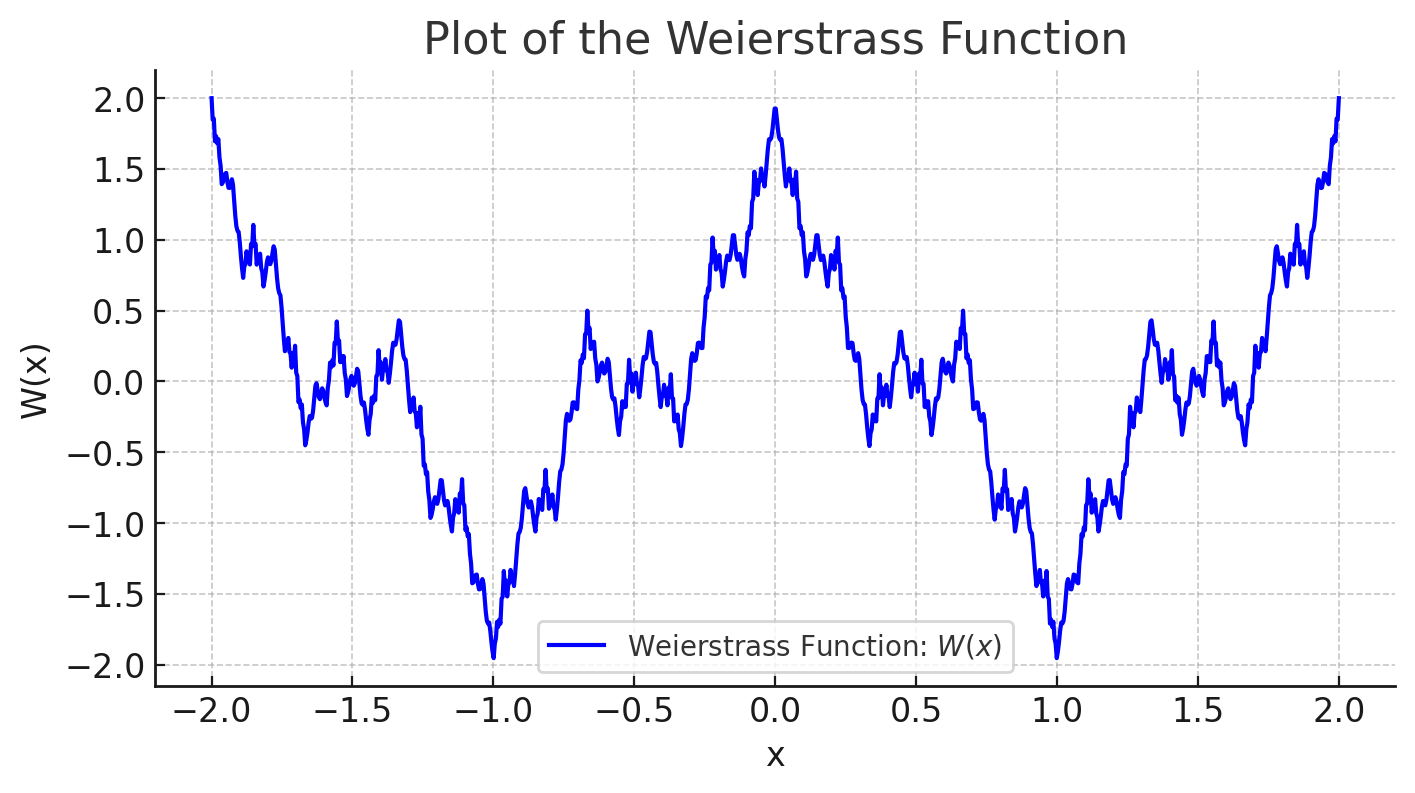
… and later about the Weierstrass function.

Please explain the Weierstrass function to me.

The Weierstrass function is a famous example of a continuous but nowhere differentiable function. It is defined as:

[ W(x) = \sum_{n=0}{\infty} an \cos(bn \pi x) ]

where:

  • ( 0 < a < 1 ) (controls decay)
  • ( b ) is an odd integer ( > 1 ) (controls frequency)
  • The product ( ab > 1 + \frac{3\pi}{2} ) ensures nowhere differentiability.
Learning with ChatGPT
Key Properties

Continuous Everywhere — Despite its wild oscillations, ( W(x) ) is continuous for all ( x ).

Nowhere Differentiable — No well-defined slope exists at any point, making it an early example of a function that is continuous yet "rough" at all scales.

Self-Similarity (Fractal-like Behavior) — Since it is constructed as an infinite sum of cosine waves with exponentially increasing frequencies, it exhibits self-similarity: small-scale structures resemble larger-scale patterns.

Role in Mathematics — This function was introduced by Karl Weierstrass in the 19th century as a counterexample to the assumption that "continuous functions are differentiable almost everywhere."

I have found using ChatGPT in this way to be a valuable learning tool, and I imagine there are already people out there who are repackaging instances of ChatGPT to be autonomous ‘teachers’ for students looking to learn something.

One of my jobs at The Hindu is to get explanatory articles for concepts in (pure) science. I recently attempted one on amplifiers, which required me to explain the working of a NPN bipolar junction transistor, a device I’d until then been happy to leave behind in my high school classroom. I turned to ChatGPT, asking for a visualisation of the transistor, and it obliged. I’m a visual learner and having access to the tool made a big difference.

How does an NPN bipolar junction transistor work? Please explain with a visualisation.

An NPN bipolar junction transistor (BJT) is a type of transistor that consists of three layers of semiconductor material: two n-type layers (emitter and collector) separated by a p-type layer (base). It is commonly used for switching and amplification.

How an NPN Transistor Works

Structure & Terminals:

Emitter (E): Heavily doped n-type region that emits electrons.

Base (B): Thin, lightly doped p-type region.

Collector (C): Moderately doped n-type region that collects electrons.

Operation Principles:

When a small current is applied to the base-emitter junction (forward-biased), it allows a larger current to flow from the emitter to the collector.

The base-emitter junction acts as a diode, allowing electrons to flow into the base.

Most electrons injected from the emitter into the base are swept into the collector due to the voltage difference.

Visualization
      Collector (C)
           |
           |
      |----|----|
      |    N    |   <-- Collector (N-type)
      |----|----|
           |
      |----|----|
      |    P    |   <-- Base (P-type, thin and lightly doped)
      |----|----|
           |
      |----|----|
      |    N    |   <-- Emitter (N-type, heavily doped)
      |----|----|
           |
           |
      Emitter (E)
Current Flow:

Electrons flow from Emitter (E) to Collector (C).

A small Base (B) current controls a much larger Collector (C) current.

Voltage Conditions:

V_BE (Base-Emitter voltage) > 0.7V (Forward biased)

V_CE (Collector-Emitter voltage) > V_BE (Reverse biased)

Electron Flow:

 Represents electron flow.

I_B (Base Current) is small but controls I_C (Collector Current), which is large.

( +V_C ) | | [C] ← Electrons | | | [B] → Small Base Current (I_B) | | | [E] → Large Electron Flow (I_E) | ( GND )

Working Mechanism:

The Base-Emitter junction is forward-biased, allowing electrons to move from Emitter to Base.

Most electrons are swept into the Collector due to the reverse-biased Collector-Base junction.

small Base current (I_B) controls a large Collector current (I_C), amplifying the input signal.

I have a background in engineering plus more than a decade’s experience in spotting yellow/red flags in scientific papers, and I imagine anyone with these skills will have an easier time navigating ChatGPT’s answers. For anyone else that lacks these skills, all we need is a guarantee from OpenAI that the tool doesn’t hallucinate or that it hallucinates in specific contexts, and definitely not above a certain rate.

Keep the crap going

By: VM

Have you seen the new ads for Google Gemini?

In one version, just as a young employee is grabbing her fast-food lunch, she notices her snooty boss get on an elevator. So she drops her sandwich, rushes to meet her just as the doors are about to close, and submits her proposal in the form of a thick dossier. The boss asks her for a 500-word summary to consume during her minute-long elevator ride. The employee turns to Google Gemini, which digests the report and spits out the gist, and which the employee regurgitates to the boss’s approval. The end.


Isn’t this unsettling? Google isn’t alone either. In May this year, Apple released a tactless ad for its new iPad Pro. From Variety:

The “Crush!” ad shows various creative and cultural objects — including a TV, record player, piano, trumpet, guitar, cameras, a typewriter, books, paint cans and tubes, and an arcade game machine — getting demolished in an industrial press. At the end of the spot, the new iPad Pro pops out, shiny and new, with a voiceover that says, “The most powerful iPad ever is also the thinnest.”

After the backlash, Apple bactracked and apologised — and then produced two ads in November for its Apple Intelligence product showcasing how it could help thoughtless people continue to be thoughtless.


The second video is additionally weird because it seems to suggest reaching all the way for an AI tool makes more sense than setting a reminder on the calendar that comes in all smartphones these days.

And they are now joined in spirit by Google, because bosses can now expect their subordinates to Geminify their way through what could otherwise have been tedious work or just impossible to do on punishingly short deadlines — without the bosses having to think about whether their attitudes towards what they believe is reasonable to ask of their teammates need to change. (This includes a dossier of details that ultimately won’t be read.)

If AI is going to absorb the shock that comes of someone being crappy to you, will we continue to notice that crappiness and demand they change or — as Apple and Google now suggest — will we blame ourselves for not using AI to become crappy ourselves? To quote from a previous post:

When machines make decisions, the opportunity to consider the emotional input goes away. This is a recurring concern I’m hearing about from people working with or responding to AI in some way. … This is Anna Mae Duane, director of the University of Connecticut Humanities Institute, in The Conversation: “I fear how humans will be damaged by the moral vacuum created when their primary social contacts are designed solely to serve the emotional needs of the ‘user’.”

The applications of these AI tools have really blossomed and millions of people around the world are using them for all sorts of tasks. But even if the ads don’t pigeonhole these tools, they reveal how their makers — Apple and Google — are thinking about what the tools bring to the table and what these tech companies believe to be their value. To Google’s credit at least, its other ads in the same series are much better (see here and here for examples), but they do need to actively cut down on supporting or promoting the idea that crappy behaviour is okay.

Feel the pain

By: V.M.

Emotional decision making is in many contexts undesirable – but sometimes it definitely needs to be part of the picture, insofar as our emotions hold a mirror to our morals. When machines make decisions, the opportunity to consider the emotional input goes away. This is a recurring concern I’m hearing about from people working with or responding to AI in some way. Here are two recent examples I came across that set this concern out in two different contexts: loneliness and war.

This is Anna Mae Duane, director of the University of Connecticut Humanities Institute, in The Conversation:

There is little danger that AI companions will courageously tell us truths that we would rather not hear. That is precisely the problem. My concern is not that people will harm sentient robots. I fear how humans will be damaged by the moral vacuum created when their primary social contacts are designed solely to serve the emotional needs of the “user”.

And this is from Yuval Abraham’s investigation for +972 Magazine on Israel’s chilling use of AI to populate its “kill lists”:

“It has proven itself,” said B., the senior source. “There’s something about the statistical approach that sets you to a certain norm and standard. There has been an illogical amount of [bombings] in this operation. This is unparalleled, in my memory. And I have much more trust in a statistical mechanism than a soldier who lost a friend two days ago. Everyone there, including me, lost people on October 7. The machine did it coldly. And that made it easier.”

Feel the pain

By: VM
Feel the pain

Emotional decision making is in many contexts undesirable – but sometimes it definitely needs to be part of the picture, insofar as our emotions hold a mirror to our morals. When machines make decisions, the opportunity to consider the emotional input goes away. This is a recurring concern I'm hearing about from people working with or responding to AI in some way. Here are two recent examples I came across that set this concern out in two different contexts: loneliness and war.

This is Anna Mae Duane, director of the University of Connecticut Humanities Institute, in The Conversation:

There is little danger that AI companions will courageously tell us truths that we would rather not hear. That is precisely the problem. My concern is not that people will harm sentient robots. I fear how humans will be damaged by the moral vacuum created when their primary social contacts are designed solely to serve the emotional needs of the "user".

And this is from Yuval Abraham's investigation for +972 Magazine on Israel's chilling use of AI to populate its "kill lists":

"It has proven itself," said B., the senior source. "There’s something about the statistical approach that sets you to a certain norm and standard. There has been an illogical amount of [bombings] in this operation. This is unparalleled, in my memory. And I have much more trust in a statistical mechanism than a soldier who lost a friend two days ago. Everyone there, including me, lost people on October 7. The machine did it coldly. And that made it easier."
❌