
Reading view

There are new articles available, click to refresh the page.

Running With The Foxes

I like to run with the foxes, when the city is dark and quiet, when the warmth of the day ebbs away and the coolth of the night approaches, when the path is empty and when the other people recede into bubbles of their own conscience.

I like to run in the old towns, where the route twists and turns; in the new places under construction, where the landscape changes by the month; and in the waste lands, where the places are soon not to be.

I like to run in the city, because I can run all of these.

The city is real, not a place - but a feeling. The freedom of one amongst many, the freedom to watch, to listen, to learn, to do, and where one participates solely by being.

The city is a mirror of the societies it contains, supporting, protecting, revealing and yet also inherently destroying. That is the beauty of the city, when one can look around the bricks and mortar to see the substance of the thing.

But there is more to the city, not only the reality lived and built. The city is complexity, disorder, change, and tradition; history known yet futures unknown.

I like to run in the country too, when the birds sing and when the seasons pass by, when the stars can be seen and when I leave footprints in the earth as I pass.

But the country is stability and order: where crops grow in neat monoculture lines, awaiting their own destruction, so too its human inhabitants in their neat cottages; where the old go to die. And after my footprints wash away in the rain, the grass will soon grow again.
YouTube Comment Spam and the Linking Non-Link

As somebody who quite often scrolls down to the comments section on YouTube (for my sins), I’m often faced with the innovative tactics that spammers use to get their comments through Google’s automated filtering and detection systems.

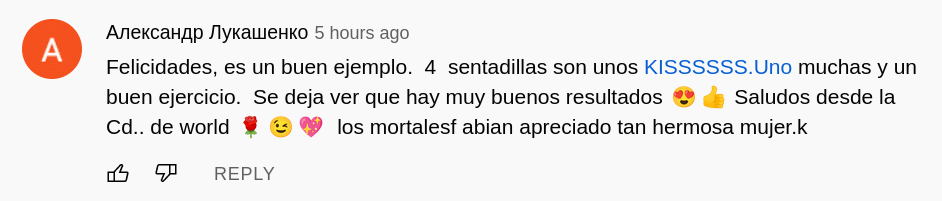
One method that’s somehow persisted for a few years is the linking non-link. YouTube doesn’t like comments with links in them and will often silently hide or sometimes outright refuse them. But the link-detection algorithm used in spam filtering isn’t the same one that’s used in the frontend to convert textual links into clickable hyperlinks!

So spammers craft their comments with unusual TLDs and mixed into normal-looking text. They aren’t detected as links by the filter, but their marks can still click on them as normal! This has been going on for quite a while with different iterations of TLDs and filters, but somehow Google hasn’t managed to stamp it out quite yet.

Here’s an example (Spanish language) spam comment, where the .uno domain is the bait:

spanish spam comment by a cyrillic account

I often wonder if there’s any real development effort put into spam filtering from the comment side; my guess is that as a centralised platform YouTube puts a lot more emphasis on filtering out spammy accounts. Some of my creator friends often complain about the lack of moderation tools to keep their comment sections clean - beyond deleting comments individually and the “naughty words list” that automatically hides comments there’s not really that much a creator can do.

You block ads in your browser, why not in your city?

Ads are annoying, right? Getting right in your face and shouting for your attention when all you want to do is something else - when you get an unskippable ad before a video to watch; when you’re reading an article and an ad pops up over the writing; when somebody you had trusted endorses something that you and they both know is bunk. This badvertising is a scourge on modern society and a manifestation of all that’s wrong about suveillance capitalism.

That’s not to say that adverts are evil, or that they have no place. But they must be in their place. When you’re reading in the hypothetical yellow pages, that’s advertising. Or when you’re walking down the high street, looking in shop windows; advertising again. Or a specialist magazine; instagram channel or even so called content marketing. They’re all adverts, but they are in their place. Both the advertiser and the viewer get value out of the interaction - enough that you seek them out yourself.

Now, in some ways technology is the great equaliser of our time: the same tech that allows ever more complicated and pervasive badvertising also allows ever more complete and simple de-badvertising. The good citizen of the net makes technology work for them: they install uBlock Origin and SponsorBlock to protect their web browser, and then set up a Pi-hole to reduce badvertising outside of the confines of the open web. The better citizen sets these same protections up for their family, and supports and contributes to the development of better tools. And they pay for services when to do so is not just to feed the beast.

Now, while this equilibrium persists on the net, in real life the badvertisers have been taking advantage of just as many technological improvemements: internet control and management; high intensity LED illumination; pervasive video, animation, and sound; smartphone and facial tracking and many more advantages alike. Our cities are being turned into a dystopian nightmare - as shopping moves online: MORE ADVERTS to sell you on existing shops; when there’s a funding crunch in local government: MORE ADVERTS to bring in the revenue; when that isn’t enough: MORE ADVERTS just for the sake of it. And with all this new technology, these ads aren’t just some posters or billboards, but rather aggressive and intrustive screens that sap the real life from the city; replacing it with an artifical reminder of the corporate landscape you live in.

Blocking ads may work online, but unless you spend your life in VR goggles, one cannot apply technical solutions alone. But don’t tell yourself that you can’t block adverts in real life - just think about how the ads got there. The good citizen in real life fights the planning applications for new adverts; they tell their local politicians about the damage badverts cause; they fund campaign groups to tell others the same. Make a conscious decision to avoid adverts, and enjoy your life more. Do the science that explains to advertisers exactly why these badverts don’t help them sell. Technologists too: use the benefits of modern technology to multiply your effort, shut down the adverts sooner.

Above all else, don’t take advertising as a given. It’s your choice, and you can help choose no for your city.

Drinking From the (Musical) Firehose on YouTube

Nowadays YouTube is a great place to listen to music, because everything is there. There’s such a wide selection of to listen to - seriously - the permissive ask-for-forgiveness1 bazaar means that if you search for it, it’ll be there. Make your own playlist, and when it’s time to add something new to you, it’ll be there. Alternatively, just be guided by the flow and don’t worry about where it’s all coming from.

And to that point, discovery is where YouTube really excels - The Algorithm knows what genres you like, and what you’ve listened to before, and there’ll always be an old favourite ready to listen again or something new, but familiar, to experience for the first time. Training time is minimal, because The Algorithm is a simple beast really (do you really think AlphaGooYou is going to waste resources on a complex model).

That said, sometimes you just want a change, and it’s hard to switch off completely. If you log out and clear your cookies, you’ll get music, sure; but it’ll be the worst dregs of contemporary nongenre, optimised for the dying radio sector. Not worth it! What you need is a quick way to jump out of your filter bubble: a random mode, a shuffle play, to say. And floating there in the aether, an odd edge case at the margins of the beast, it actually exists:

Here it is, the snappily named: “Uploads from Various Artists - Topic” Playlist. 20000 entries, all songs just recently uploaded to YouTube in the past week or so. Go ahead: break into a brand new song with 0 lifetime views!, Enjoy a random cyrillic-lettered song you can’t understand!, Use it as an infinite radio - whole new songs being added faster than you can listen to them!

Although I don’t completely understand why this exists, it seems to be a quirk in the YouTube partner music upload programme: music rightsholders (or those who purport to be) can upload music to YouTube2 in bulk and these are arranged into “Topic Channels” for each artist. These “Channels” inhabit the half-space between a real channel and a playlist - you can subscribe but there’s no real person on the other side of the curtain; certainly there’s no community there. And it seems, on one end or the other, that in the absence of any better information everything just gets unceremoniously dumped into the “Uploads from Various Artists - Topic” topic channel playlist.

Either way, it may be quirk, and an odd one at that; but it’s fun and it should be saved. Please don’t take it away, oh wondrous BigTech…

Footnotes

  1. For all the perils of YouTube’s arbitrary Copyright system, the variety of music it allows is certainly a benefit. When videos are allowed by default, and the normal punishment after detection of your copyright infringement is a few cents from ads going to the labels, you get channels like ultradiskopanorama uploading rare classics that were never going to go on a service like Spotify. 

  2. These videos always have “Auto-generated by YouTube” in the description, and all have their comments turned off (sadly a recent change). 

❌