Reading view

There are new articles available, click to refresh the page.

Google Search Is More Useful if You Know Its Advanced Operators, to a Point

By: Nick Heer

Hana Lee Goldin:

The search bar you already have is more capable than that arrangement requires you to know. With the right syntax, it becomes a precision instrument: narrow by domain, by date, by file type, by exact phrase. We can pull up archived pages, surface open file directories, and even find what people said in forums instead of what brands want us to find. None of it requires a new tool or a paid account. The capability has been there the whole time.

Advanced search operations are something Google does better than any competitor. DuckDuckGo has its bangs and I like them very much, but Google has a vast catalogue able to be searched with such precision — to a point. If you use these advanced search operators, get ready to see a lot of CAPTCHAs. Google will slow you down and may even block you temporarily if you use it too well.

⌥ Permalink

Upgrade Presents: The Origin of Apple

By: Nick Heer

The newest episode of “Upgrade” is a wonderful retelling of a very particular history (also available as a video):

Jason and Myke tell the story of Apple’s origin. It emerged from the unique environment of the Santa Clara valley suburbs of the ’70s thanks to the particular genius of its two co-founders and some surprising help they got along the way.

Though I was familiar with much of this, I cannot think of many better people to tell it than Jason Snell. I have already seen one thinkpiece after another about what a fifty year-old — ish — Apple means in the grand scope, and there is definitely a place for that. Today’s Apple is a long way from this origin story, of course, but what a story it is.

This gives me an excuse to explain why I am fascinated by this one computer company. Though this story is great, that is not why, nor is it the history of successfully bringing the graphical user interface to the market, nor the ’90s–’00s turnaround. Those are all parts of it. But the main reason I am fascinated by Apple is that it has built such a distinct identity for itself. It has not always stuck to it but, if anything, I think that helps reinforce the existence of an Apple-y identity. Some might attribute that to a particular way of marketing itself which, while true, also emphasizes how important that identity is: when its messaging does not match the products, services, experience, or expected corporate behaviour, it is noticeable.

This is all a bit mythical, to be sure. The garage-era Steves probably would not imagine Apple celebrating its fiftieth birthday by being the second most valuable corporation in the world, nor would they think it would hire Paul McCartney for its employee party. To me, one of those things feels more Apple-y than the other. It feels right for the company to celebrate with a music legend; it probably does not need to be quite so rich or powerful to do that, though. Apple has long been a really, really big corporation, and that — in itself — does not feel very Apple-y to me. That, too, is fascinating.

⌥ Permalink

⌥ Apple’s Supposed A.I. Strategy Shift Is the Company’s Normal Strategy

By: Nick Heer

Mark Gurman, last week in Bloomberg:

Apple Inc. plans to open Siri to outside artificial intelligence assistants, a major move aimed at bolstering the iPhone as an AI platform.

The company is preparing to make the change as part of a Siri overhaul in its upcoming iOS 27 operating system update, according to people with knowledge of the matter. The assistant can already tap into ChatGPT through a partnership with OpenAI, but Apple will now allow competing services to do the same.

This is not unexpected. In the Apple Intelligence introduction at WWDC 2024, Craig Federighi said “we want you to be able to use these external models without having to jump between different tools”, and that they were “starting” with ChatGPT. Gurman points this out and also notes Federighi’s teased Google Gemini integration. Tim Cook, in an October 2025 earnings call, said much the same. (Gurman also notes that this integration is “separate from Apple’s work with Google to rebuild Siri using Gemini models”, but “the news initially weighed on shares of Google”, which I am sure is exactly the reason for them dropping 3.4% and nothing to do with an existing weeklong slide but, then again, I do not work at Bloomberg so who the hell am I to say?)

Gurman, in his “Power On” newsletter over the weekend, further explored what he calls Apple “doubl[ing] down” on a “revamped A.I. and Siri strategy”:

That reality is shaping the company’s new approach, set to be unveiled at the Worldwide Developers Conference on June 8. Rather than engaging in an AI arms race, Apple is focusing on its core strengths: selling highly profitable hardware and making money off the services that run on it.

Historically, Apple’s software — iMessage, Maps and Photos, for example — has been about driving product sales rather than generating revenue in their own right. Rivals, in contrast, are aggressively monetizing AI through subscriptions and premium apps. Apple understands that few, if any, users will pay for Siri or its other AI technology. The opportunity to turn Apple Intelligence into a moneymaker has effectively passed.

What would have been more newsworthy here is if Apple’s A.I. strategy were anything other than building software exclusively for its proprietary hardware. This does not sound like a “revamped” strategy; it sounds like Apple’s whole deal. If it can use Apple Intelligence or Siri in the future, it certainly might; it is putting ads in Apple Maps after all. Services is a money-printing machine with less risk. But it is still a hardware company.

This part made me double-take and wonder if I missed something. In February 2024, following Apple’s cancellation of its car project, Gurman predicted that hardware would continue to be Apple’s primary business “for now”, as though that will change in the near future. This has been constant since Apple Intelligence was announced at WWDC that year.

What one could argue has been a change of strategy is the rumoured development of a chatbot; Gurman called it a “strategic shift” when he broke the news. But that, too, is somewhat inaccurate in two ways: Gurman’s description of it is as an overhauled version of Siri that will let people do normal Siri stuff — setting timers, end of list — plus some of the features Apple announced in 2024 but has not yet shipped which, confusingly, were also first set to ship in an update to iOS 26 without the wholly new version of Siri but also depending on Gemini. Got it?

But even that is not much of a strategy shift. Gurman tweeted in May 2024 — before WWDC and the debut of Apple Intelligence — that “Apple isn’t building its own chatbot but knows the market wants it so it’s going elsewhere for it. It’s the same playbook as search.” So, again, it is just borrowing from its ages-old playbook. It will continue to have proprietary stuff that ostensibly works seamlessly across a user’s Apple-branded hardware, allow installation of third-party add-ons, and rely on Google for some core functionality. How, exactly, is this a “revamp”?

Anyway, here is what Gurman wrote in January after the Gemini announcement and before the first build of iOS 26.4 was released:

Today, Apple appears to be less than a month away from unveiling the results of this partnership. The company has been planning an announcement of the new Siri in the second half of February, when it will give demonstrations of the functionality.

Whether that takes the form of a major event or a smaller, tightly controlled briefing — perhaps at Apple’s New York media loft — remains unclear. Either way, Apple is just weeks away from finally delivering on the Siri promises made at its Worldwide Developers Conference back in June 2024. At long last, the assistant should be able to tap into personal data and on-screen content to fulfill tasks.

Apple today shipped the first build of iOS 26.5 to developers without any sign of those features. While they may come in a later build, Juli Clover, of MacRumors, speculates they have been kicked to iOS 27.

Does not seem like much has changed at all.

⌥ I Regret the Blood Pact I Have Made With iCloud Photos

By: Nick Heer

Sometimes, I do not recognize a trap until I am already in it. Photos in iCloud is one such situation.

When Apple launched iCloud Photo Library in 2014, I was all-in. Not only is it where I store the photos I take on my iPhone, it is where I keep the ones from my digital cameras and my film scans, and everything from my old iPhoto and Aperture libraries. I have culled a bunch of bad photos and I try not to hoard, but it is more-or-less a catalogue of every photo I have taken since mid-2007. I like the idea of a centralized database of my photos, available on all my devices, that is functionally part of my backup strategy.1

But, also, it is large. When I started putting photos in there eleven years ago with a 200 GB plan, I failed to recognize it would become an albatross. iCloud Storage says it is now 1.5 TB and, between the amount of other stuff I have in iCloud and my Family Sharing usage, I have just 82 GB of available space. 2 TB seemed like such a large amount of space until I used 1.9 of it.

Apple’s next iCloud tier is a generous 6 TB, but it costs another $324 per year. I could buy a new 6 TB hard disk annually for that kind of money. While upgrading tiers is, by far, the easiest way to solve this problem, it only kicks that can down that road, the end of which currently has whatever two terabytes’ worth of cans looks like.

A better solution is to recognize I do not need instant access to all 95,000 photos in my library, but iCloud has no room for this kind of nuance. The iCloud syncing preference is either on or off for the entire library.

Unfortunately, trying to explain what goes wrong when you try to deviate from Apple’s model of how photo libraries ought to work will become a bit of a rant. And I will preface this by saying this is all using Photos running on MacOS Ventura, which is many years behind the most recent version of MacOS. It is not possible for me to use the latest version of Photos to make these changes because upgraded libraries cannot be opened by older versions of Photos. However, in my defense, I will also note that the version on Ventura is Photos 8.0 and these are the kinds of bugs and omissions inexcusable after that many revisions.

So: the next best thing is to create a separate Photos library — one that will remain unsynced with iCloud. Photos makes this pretty easy by launching while holding the Option (⌥) key. But how does one move images from one library to the other? Photos is a single-window application — you cannot even open different images in new windows, let alone run separate libraries in separate windows. This should be possible, but it is not.

As a workaround, Apple allows you to import images from one Photos library into another — but not if the source library is synced with iCloud. You therefore need to turn off iCloud sync before proceeding, at which point you may discover that iCloud is not as dependable as you might have expected.

I have “Download Originals to this Mac” enabled, which means that Photos should — should — retain a full copy of my library on my local disk. But when I unchecked the “iCloud Photos” box in Settings, I was greeted by a dialog box informing me that I would lose 817 low-resolution local copies, something which should not exist given my settings, though reassuring me that the originals were indeed safe in iCloud. There is no way to know which photos these are nor, therefore, any way to confirm they are actually stored at full resolution in iCloud. I tried all the usual troubleshooting steps. I repaired my library, then attempted to turn off iCloud Photos; now I had 850 low-resolution local copies. I tried a neat trick where you select all the pictures in your library and select “Play Slideshow”, at which point my Mac said it was downloading 733 original images, then I tried turning off iCloud Photos again and was told I would lose around 150 low-resolution copies.

You will note none of these numbers add or resolve correctly. That is, I have learned, pretty standard for Photos. Currently, it says I have 94,529 photos and 898 videos in the “Library” view, but if I select all the items in that view, it says there are a total of 95,433 items selected, which is not the same as 94,529 + 898. It is only a difference of six items but, also, it is an inexplicable difference of six.

At this point, I figured I would assume those 150 photos were probably in iCloud, sacrifice the low-resolution local copies, and prepare for importing into the second non-synced library I had created. So I did that, switched libraries, and selected my main library for import. You might think reading one Photos library from another stored on the same SSD would be pretty quick. Yes, there are over 95,000 items and they all have associated thumbnails, but it takes only a beat to load the library from scratch in Photos.

It took over thirty minutes.

After I patiently waited that out, I selected a batch of photos from a specific event and chose to import them into an album, so they stay categorized. Oh, that is right — just because you are importing across Photos libraries, that does not mean the structure will be retained. There is no way, as far as I can tell, to keep the same albums across libraries; you need to rebuild them.

After those finished importing, I pulled up my main library again to do the next event. You might expect it to retain some memory of the import source I had only just accessed. No — it took another thirty minutes to load. It does this every time I want to import media from my main library. It is not like that library is changing; it is no longer synced with iCloud, remember. It just treats every time it is opened as the first time.

And it was at this point I realized the importer did not display my library in an organized or logical fashion. I had expected it to be sorted old-to-new since that is how Photos says it is displayed, but I saw photos from many different years all jumbled together. It is almost in order, at times, but then I would notice sequential photos scattered all over.

My guess — and this is only a guess — is that it sub-orders by album, but does no further sorting after that. This is a problem for me given a quirk in my organizational structure. In addition to albums for different events, I have smart albums for each of my cameras and each of my iPhone’s individual lenses. But that still does not excuse the importer’s inability to sort old-to-new. The event I spotted early on and was able to import was basically a fluke. If I continued using this cross-library importing strategy, I would not be able to keep track of which photos I could remove from my main library.

There is another option, which is to export a selection of unmodified originals from my primary library to a folder on disk, and then switch libraries, and import them. This is an imperfect solution. Most obviously, it requires a healthy amount of spare disk space, enough to store the selected set of photos thrice, at least temporarily: once in the primary library, once in the folder, and once in the new library. It also means any adjustments made using the Photos app will be discarded — but, then again, importing directly from the library only copies the edited version of a photo without any of its history or adjustments preserved.

What I would not do, under any circumstance — and what I would strongly recommend anyone avoiding — is to use the Export Photos option. This will produce a bunch of lossy-compressed photos, and you do not want that.

Anyway, on my first attempt of trying the export-originals-then-import process, I exported the 20,528 oldest photos in my library to a folder. Then I switched to the archive library I had created, and imported that same folder. After it was complete, Photos said it had imported 17,848 items, a difference of nearly 3,000 photos. To answer your question: no, I have no idea why, or which ones, or what happened here.

This sucks. And it particularly sucks because most data is at least kind of important, but photos are really important, and I cannot trust this application to handle them.

There is this quote that has stuck with me for nearly twenty years, from Scott Forstall’s introduction to Time Machine (31:30) at WWDC 2006. Maybe it is the message itself or maybe it is the perfectly timed voice crack on the word “awful”, but this resonated with me:

When I look on my Mac, I find these pictures of my kids that, to me, are absolutely priceless. And in fact, I have thousands of these photos.

If I were to lose a single one of these photos, it would be awful. But if I were to lose all of these photos because my hard drive died, I’d be devastated. I never, ever want to lose these photos.

I have this library stored locally and backed up, or at least I though I did. I thought I could trust iCloud to be an extra layer of insurance. What I am now realizing is that iCloud may, in fact, be a liability. The simple fact is that I have no idea the state my photos library is currently in: which photos I have in full resolution locally, which ones are low-resolution with iCloud originals, and which ones have possibly been lost.

The kindest and least cynical interpretation of the state of iCloud Photos is that Apple does not care nearly enough about this “absolutely priceless” data. (A more cynical explanation is, of course, that services revenue has compromised Apple’s standards.) Many of these photos are, in fact, priceless to me, which is why I am questioning whether I want iCloud involved at all. I certainly have no reason to give Apple more money each month to keep wrecking my library.

I will need to dedicate real, significant time to minimizing my iCloud dependence. I will need to check and re-check everything I do as best I can, while recognizing the difficulty I will have in doing so with the limited information I have in my iCloud account. This is undeniably frustrating. I am glad I caught this, however, as I sure had not previously thought nearly as much as I should have about the integrity of my library. Now, I am correcting for it. I hope it is not too late.


  1. It is no longer the sole place I store my photos. I have everything stored locally, too, and that gets backed up with Backblaze. Or, at least, I think I have everything stored locally. ↥︎

Bill C–22 Gives Canadian Authorities Additional Warrantless Powers

By: Nick Heer

Gabriel Hilty, Toronto Star:

Speaking alongside Chief Myron Demkiw on Thursday at Toronto police headquarters, Public Safety Minister Gary Anandasangaree said Bill C-22, the Lawful Access Act, will “create a legal framework for modernized, lawful access regime in Canada,” something that police forces have been requested “for decades.”

The bill is Prime Minister Mark Carney government’s second push to pass expanded police search powers into law. An earlier proposal on lawful access was met with widespread concerns over potential overreach.

Paula Tran, Ottawa Citizen:

“The bill effectively lowers the standard that police have to meet. Sure, law enforcement says they’re happy, but that means they need less evidence and need to do less work to get the information about subscribers, and I don’t think that’s that’s a good thing. It’s the lowest standard in Canadian criminal law,” [Michael] Geist said.

[…]

Bill C-22 also proposes new legislation that would compel telecommunication companies to store and retain client metadata, like device location, for a year and to make it available to law enforcement and CSIS with a warrant. The metadata can be used to track a person’s live location in case they pose a national security threat or are considered to be in danger.

OpenMedia is running a campaign to email Members of Parliament, though I am suspicious these form letter campaigns actually work. It is a bare minimum signal since it requires almost no commitment. My M.P. is usually opposed to anything proposed by this government, since he is in the official opposition, but his reaction to this bill’s much worse predecessor is that it contained “the most commonsensical security changes we need to make in Canada”. I expect I will be writing him and, when I do, I will be sure to adjust OpenMedia’s form letter. If you are writing to your M.P., I suggest you do the same if you can spare the time.

⌥ Permalink

Wealthsimple Clears Regulatory Hurdle to Bring ‘Prediction Markets’ to Canada

By: Nick Heer

Meera Raman, Globe and Mail:

Wealthsimple is seeking to offer prediction trading in Canada, a controversial type of betting on real-world events that has surged in popularity in the past year, and has been largely banned in this country.

[…]

The approval for Ontario-based Wealthsimple permits it only to offer contracts tied to economic indicators, financial markets and climate trends, the company confirmed – not sports or elections, which are among the most popular uses of prediction markets in the United States.

Interactive Brokers launched here last April. Why are we doing this to ourselves?

⌥ Permalink

A Different Perspective on the ‘Design Choices’ Social Media Company Verdicts

By: Nick Heer

Mike Masnick, of Techdirt, unsurprisingly opposes the verdicts earlier this week finding Meta and Google guilty of liability for how their products impact children’s safety. I think it is a perspective worth reading. Unlike the Wall Street Journal, Masnick respects your intelligence and brings actual substance. Still, I have some disagreements.

Masnick, on the “design choices” argument:

This distinction — between “design” and “content” — sounds reasonable for about three seconds. Then you realize it falls apart completely.

Here’s a thought experiment: imagine Instagram, but every single post is a video of paint drying. Same infinite scroll. Same autoplay. Same algorithmic recommendations. Same notification systems. Is anyone addicted? Is anyone harmed? Is anyone suing?

Of course not. Because infinite scroll is not inherently harmful. Autoplay is not inherently harmful. Algorithmic recommendations are not inherently harmful. These features only matter because of the content they deliver. The “addictive design” does nothing without the underlying user-generated content that makes people want to keep scrolling.

This sounds like a reasonable retort until you think about it for three more seconds and realize that the lack of neutrality in the outcomes of these decisions is the entire point. Users post all kinds of stuff on social media platforms, and those posts can be delivered in all kinds of different ways, as Masnick also writes. They can be shown in reverse-chronological order in a lengthy scroll, or they can be shown one at a time like with Stories. The source of the posts someone sees might be limited to just accounts a user has opted into, or it can be broadened to any account from anyone in the world. Twitter used to have a public “firehose” feed.

But many of the biggest and most popular platforms have coalesced around a feed of material users did not ask for. This is not like television, where each show has been produced and vetted by human beings, and there are expectations for what is on at different times of the day. This is automated and users have virtually no control within the platforms themselves. If you do not like what Instagram is serving you on your main feed, your choice is to stop using Instagram entirely — even if you like and use other features.

Platforms know people will post objectionable and graphic material if they are given a text box or an upload button. We know it is “impossible” to moderate a platform well at scale. But we are supposed to believe they have basically no responsibility for what users post and what their systems surface in users’ feeds? Pick one.

Masnick, on the risks of legal accountability for smaller platforms:

And this is already happening. TikTok and Snap were also named as defendants in the California case. They both settled before trial — not because they necessarily thought they’d lose on the merits, but because the cost of fighting through a multi-week jury trial can be staggering. If companies the size of TikTok and Snap can’t stomach the expense, imagine what this means for mid-size platforms, small forums, or individual website operators.

I am going to need a citation that TikTok and Snap caved because they could not afford continuing to fight. It seems just as plausible they could see which way the winds were blowing, given what I have read so far in the evidence that has been released.

Masnick:

One of the key pieces of evidence the New Mexico attorney general used against Meta was the company’s 2023 decision to add end-to-end encryption to Facebook Messenger. The argument went like this: predators used Messenger to groom minors and exchange child sexual abuse material. By encrypting those messages, Meta made it harder for law enforcement to access evidence of those crimes. Therefore, the encryption was a design choice that enabled harm.

The state is now seeking court-mandated changes including “protecting minors from encrypted communications that shield bad actors.”

Yes, the end result of the New Mexico ruling might be that Meta is ordered to make everyone’s communications less secure. That should be terrifying to everyone. Even those cheering on the verdict.

This is undeniably a worrisome precedent. I will note Raúl Torrez, New Mexico’s Attorney General and the man who brought this case against Meta, says he wants to do so for minors only. The implementation of this is an obvious question, though one that mandated age-gating would admittedly make straightforward.

Meta cited low usage when it announced earlier this month that it would be turning off end-to-end encryption in Instagram. If it is a question of safety or liability, it is one Meta would probably find difficult to articulate given end-to-end encryption remains available and enabled by default in Messenger and WhatsApp. An executive raised concerns about the feature when it was being planned, drawing a distinction between it and WhatsApp because the latter “does not make it easy to make social connections, meaning making Messenger e2ee will be far, far worse”.

I think Masnick makes some good arguments in this piece and raises some good questions. It is very possible or even likely this all gets unwound when it is appealed. I, too, expect the ripple effects of these cases to create some chaos. But I do not think the correct response to a lack of corporate accountability — or, frankly, standards — is, in Masnick’s words, “actually funding mental health care for young people”. That is not to say mental health should not be funded, only that it is a red herring response. In the U.S., total spending on children’s mental health care rose by 50% between 2011 and 2017; it continued to rise through the pandemic, of course. Perhaps that is not enough. But, also, it is extraordinary to think that we should allow companies to do knowingly harmful things and expect everyone else to correct for the predictable outcomes.

⌥ Permalink

Apple Discontinues the Mac Pro

By: Nick Heer

Chance Miller, of 9to5Mac, serving here as Apple’s official bad news launderer:

It’s the end of an era: Apple has confirmed to 9to5Mac that the Mac Pro is being discontinued. It has been removed from Apple’s website as of Thursday afternoon. The “buy” page on Apple’s website for the Mac Pro now redirects to the Mac’s homepage, where all references have been removed.

Apple has also confirmed to 9to5Mac that it has no plans to offer future Mac Pro hardware.

Mark Gurman reported last year that it was “on the back burner”.

The Mac Pro was, realistically, killed off when the Apple Silicon era ended support for expandability and upgradability. The Mac Studio effectively takes its place, and is strategically similar to the “trash can” Mac Pro with all expandability offloaded to external peripherals. Unfortunate, but I think it was dishonest to keep selling this version of a “pro” Macintosh.

⌥ Permalink

Meta Loses Two Landmark Cases Regarding Product Safety and Children’s Use; Google Loses One

By: Nick Heer

Morgan Lee, Associated Press:

A New Mexico jury found Tuesday that social media conglomerate Meta is harmful to children’s mental health and in violation of state consumer protection law.

The landmark decision comes after a nearly seven-week trial. Jurors sided with state prosecutors who argued that Meta — which owns Instagram, Facebook and WhatsApp — prioritized profits over safety. The jury determined Meta violated parts of the state’s Unfair Practices Act on accusations the company hid what it knew [about] the dangers of child sexual exploitation on its platforms and impacts on child mental health.

Meta communications jackass Andy Stone noted on X his company’s delight to be liable for “a fraction of what the State sought”. The company says it will appeal the verdict.

Stephen Morris and Hannah Murphy, Financial Times:

Meta and Google were found liable in a landmark legal case that social media platforms are designed to be addictive to children, opening up the tech giants to penalties in thousands of similar claims filed around the US.

A jury in the Los Angeles trial on Wednesday returned a verdict after nine days of deliberation, finding Meta’s platforms such as Instagram and Google’s YouTube were harmful to children and teenagers and that the companies failed to warn users of the dangers.

Dara Kerr, the Guardian:

To come to its liability decision, the jury was asked whether the companies’ negligence was a substantial factor in causing harm to KGM [the plaintiff] and if the tech firms knew the design of their products was dangerous. The 12-person panel of jurors returned a 10-2 split answering in favor of the plaintiff on every single question.

Meta says it will also appeal this verdict.

Sonja Sharp, Los Angeles Times:

Collectively, the suits seek to prove that harm flowed not from user content but from the design and operation of the platforms themselves.

That’s a critical legal distinction, experts say. Social media companies have so far been protected by a powerful 1996 law called Section 230, which has shielded the apps from responsibility for what happens to children who use it.

For its part, the Wall Street Journal editorial board is standing up for beleaguered social media companies in an editorial today criticizing everything about these verdicts, including this specific means of liability, which it calls a “dodge” around Section 230.

But it is not. The principles described by Section 230 are a good foundation for the internet. This law, while U.S.-centric, has enabled the web around the world to flourish. Making companies legally liable for the things users post will not fix the mess we are in, but it would cause great damage if enacted.

Product design, though, is a different question. It would be a mistake, I think, to read Section 230 as a blanket allowance for any way platforms wish to use or display users’ posts. (Update: In part, that is because it is a free speech question.) From my entirely layman perspective, it has never struck me as entirely reasonable that the recommendations systems of these platforms should have no duty or expectation of care.

The Journal’s editorial board largely exists to produce rage bait and defend the interests of the powerful, so I am loath to give it too much attention, but I thought this paragraph was pretty rich:

Trial lawyers and juries may figure that Big Tech companies can afford to pay, but extorting companies is certain to have downstream consequences. Meta and Google are spending hundreds of billions of dollars on artificial intelligence this year, which could have positive social impacts such as accelerating treatments for cancer.

Do not sue tech companies because they could be finding cancer treatments — why should I take this editorial board seriously if its members are writing jokes like these? They think you are stupid.

As for the two cases, I am curious about how these conclusions actually play out. I imagine other people who feel their lives have been eroded by the specific way these platforms are designed will be able to test their claims in court, too, and that it will be complicated by the inevitably lengthy appeals and relitigation process.

I am admittedly a little irritated by both decisions being reached by jury instead of a judge; I would have preferred to see reasoning instead of overwhelming agreement among random people. However, it sends a strong signal to big social media platforms that people saw and heard evidence about how these products are designed, and they agreed it was damaging. This is true of all users, not just children. Meta tunes its feeds (PDF) for maximizing engagement across the board, and it surely is not the only one. There are a staggering number of partially redacted exhibits released today to go through, if one is so inclined.

If these big social platforms are listening, the signals are out there: people may be spending a lot of time with these products, but that is not a good proxy for their enjoyment or satisfaction. Research indicates a moderate amount of use is correlated with neutral or even positive outcomes among children, yet there are too many incentives in these apps to push past self-control mechanisms. These products should be designed differently.

⌥ Permalink

Meta Laid Off Several Hundred People Today

By: Nick Heer

Ashley Capoot and Jonathan Vanian, CNBC:

Meta is laying off several hundred employees on Wednesday, CNBC confirmed.

The cuts are happening across several different organizations within the company, including Facebook, global operations, recruiting, sales and its virtual reality division Reality Labs, according to a source familiar with the company’s plans who asked not to be named because they are confidential.

Some impacted employees are being offered new roles within the company, the person said. In some cases, those new positions will require relocation.

“Several hundred” employees is a long way off from the numbers reported earlier this month. Perhaps Reuters got it all wrong but, more worryingly for employees, perhaps those figures were correct and this is only the beginning.

⌥ Permalink

Talking Liquid Glass With Apple

By: Nick Heer

Danny Bolella attended one of Apple’s “Let’s Talk Liquid Glass” workshops:

Let’s address the elephant in the room. If you read the comments on my articles or browse the iOS subreddits, there is a vocal contingent of developers betting that Apple is going to roll back Liquid Glass.

The rationale usually points to the initial community backlash, the slower adoption rate of iOS 26, and the news that Alan Dye left Apple for Meta. The prevailing theory has been: “Just wait it out. They’ll revert to flat design.”

I shared this exact sentiment with the Apple team.

Their reaction? Genuine shock. They were actually concerned that developers were holding onto this position. They made it emphatically clear that Liquid Glass is absolutely moving forward, evolving, and expanding across the ecosystem.

Unsurprising. Though I expect a number of people reading this will be disappointed, I cannot imagine a world in which Apple would either revert to its previous design language or whip together something new. It is going to ride Liquid Glass and evolve it for a long time; if history is a good rule of thumb, assume ten years.

In theory, this is a good thing. Even on MacOS, I can find things I prefer to its predecessor, though admittedly they are few and far between. This visual design feels much more at home on iOS. The things that cause me far more frustration on a daily basis are the unrelenting bugs across Apple’s ecosystem, like how I just finished listening to an album with my headphones and then, when I clicked “play” on a new album, Music on MacOS decided it should AirPlay to my television instead of continuing through my headphones. That kind of stuff.

Regardless of whatever one thinks the visual qualities of Liquid Glass, the software quality problem is notable there, too. We are now on the OS 26.4 set of releases and I am still running into plenty of instances with bizarre and distracting compositing problems. On my iPhone, the gradients that are supposed to help with legibility in the status bar and toolbar appear, disappear, and change colour with seemingly little relevance to what is underneath them. Notification Centre remains illegible until it is fully pulled down. Plus, I still see the kinds of graphics bugs and Auto Layout problems I have seen for a decade.

I hope to see a more fully considered version of the Liquid Glass design language at WWDC this year, and not merely from a visual perspective. This user interface is software, just like dedicated applications, and it is chockablock full of bugs.

Bolella, emphasis mine:

I plan to share an article soon where I break down the exact physics, z-axis rules, and “Barbell Layouts” of this hierarchy. But the high-level takeaway from the NYC labs is crystal clear: maximize your content, push your controls to the poles, and never let the interface compete with the information.

If you say so, Apple.

⌥ Permalink

OpenAI to Discontinue Sora App, Video Platform

By: Nick Heer

Berber Jin, Wall Street Journal:

CEO Sam Altman announced the changes to staff on Tuesday, writing that the company would wind down products that use its video models. In addition to the consumer app, OpenAI is also discontinuing a version of Sora for developers and won’t support video functionality inside ChatGPT, either.

OpenAI is not shutting this down because it has ethical qualms with what it has created, despite good reasons to do just that. It is because it is expensive without any clear reason for it to exist other than because OpenAI wants to be everywhere.

If you are desperate for a completely synthetic social media feed, Meta’s Vibes is apparently still around. Users are readily abusing it, of course, because that is what happens if you give people a text input box.

Update: In a tweet, OpenAI has confirmed it is shutting down Sora. But, while it originally announced “We’re saying goodbye to Sora”, it changed that about an hour later to read “We’re saying goodbye to the Sora app“, emphasis mine. The Journal has not changed its report to retract claims about shutting down the platform altogether, though, while OpenAI continues to promote Sora API pricing.

⌥ Permalink

Ads Are Coming to Apple Maps Later This Year

By: Nick Heer

Apple, in a press release with the title “Introducing Apple Business — a new all‑in‑one platform for businesses of all sizes”, buried in a section tucked in the middle labelled “Enhanced Discoverability in Apple Maps”, both of which are so anodyne as to encourage missing this key bit of news:

Every day, users choose Apple Maps to discover and explore places and businesses around them. Beginning this summer in the U.S. and Canada, businesses will have a new way to be discovered by using Apple Business to create ads on Maps. Ads on Maps will appear when users search in Maps, and can appear at the top of a user’s search results based on relevance, as well as at the top of a new Suggested Places experience in Maps, which will display recommendations based on what’s trending nearby, the user’s recent searches, and more. Ads will be clearly marked to ensure transparency for Maps users.

The way they are “clearly marked” is with a light blue background and a small “Ad” badge, though it is worth noting Apple has been testing an even less obvious demarcation for App Store ads. In the case of the App Store, I have found the advertising blitz junks up search results more than it helps me find things I am interested in.

This is surely not something users are asking for. I would settle for a more reliable search engine, one that prioritizes results immediately near me instead of finding places in cities often hundreds of kilometres away. There are no details yet on what targeting advertisers will be allowed to use, but it will be extremely frustrating if the only reason I begin seeing more immediately relevant results is because a local business had to pay for the spot.

Update: I have this one little nagging thought I cannot shake. Maps has been an imperfect — to be kind — app for nearly fifteen years, but it was ultimately a self-evident piece of good software, at least in theory. It was a directory of points-of-interest, and a means of getting directions. With this announcement, it becomes a container for advertising. Its primary function feels corrupted, at least a little bit, because what users care about is now subservient to the interests of the businesses paying Apple.

⌥ Permalink

Someone Has Publicly Leaked an Exploit Kit That Can Hack Millions of iPhones

By: Nick Heer

Lorenzo Franceschi-Bicchierai and Zack Whittaker, TechCrunch:

Last week, cybersecurity researchers uncovered a hacking campaign targeting iPhone users that used an advanced hacking tool called DarkSword. Now someone has leaked a newer version of DarkSword and published it on the code-sharing site GitHub.

Researchers are warning that this will allow any hacker to easily use the tools to target iPhone users running older versions of Apple’s operating systems who have not yet updated to its latest iOS 26 software. This likely affects hundreds of millions of actively used iPhones and iPads, according to Apple’s own data on out-of-date devices.

This is an entirely different exploit chain to the “Coruna” one which also surfaced earlier this month — so now there are two massive security exploits just floating around in the wild affecting a large number of iPhones. Apple is apparently concerned enough about these vulnerabilities that it is issuing patches as far back as iOS 15 though, disappointingly, only for devices that do not support newer major versions. If you have a device that can run iOS 26, you will be safer if it is running iOS 26.

It is, I should say, pretty brazen for the developers of this exploit chain to call the JavaScript file “rce_loader.js”. RCE stands for remote code execution. It is basically like calling the file “hacking_happens_here.js”.

⌥ Permalink

In a ‘Test’, Google Is Automatically Rewriting News Headlines in Its Search Results

By: Nick Heer

Sean Hollister, the Verge:

Since roughly the turn of the millennium, Google Search has been the bedrock of the web. People loved Google’s trustworthy “10 blue links” search experience and its unspoken promise: The website you click is the website you get.

Now, Google is beginning to replace news headlines in its search results with ones that are AI-generated. After doing something similar in its Google Discover news feed, it’s starting to mess with headlines in the traditional “10 blue links,” too. We’ve found multiple examples where Google replaced headlines we wrote with ones we did not, sometimes changing their meaning in the process.

As I noted when I linked to Hollister’s article about Discover back in December, this is not new in search results; it has been happening for years.

Danny Goodwin, Search Engine Land:

Dig deeper. Google changed 76% of title tags in Q1 2025 – Here’s what that means […]

According to the Google Search Central section on title links, originally published in 2021:

I am not arguing this is good or normal — the examples Hollister shows are extremely poor reflections of the articles in question — but I do not understand why it is only gaining traction now, nor how it meaningfully differs from what Google has been doing all along. It is indeed frustrating.

Many of the results you see in Google Search misrepresent the source material and are misleading. But that has been true for a while — which is a problem unto itself. People should not trust the results they see as represented by Google Search. The visual tone Google has maintained, however, is that it is a neutral directory. The summaries in A.I. Overview are delivered with an unearned dry authority, and the ten links below it are there because of a tense truce between Google’s goals and those of search optimization professionals.

Also, I had no idea that Search Engine Land had been acquired at some point by Semrush which, in turn, was bought by Adobe.

⌥ Permalink

Lobbying Firms Funded by Apple and Meta Are Duelling on Age Verification

By: Nick Heer

Emily Birnbaum, writing for Bloomberg in July:

Meta is also helping to fund the Digital Childhood Alliance, a coalition of conservative groups leading efforts to pass app-store age verification, according to three people familiar with the funding.

The App Store Accountability Act is based on model legislation written by the Digital Childhood Alliance. The lobbying group also publishes marketing pieces, including one (PDF) that calls Apple’s age verification frameworks “ineffective”. Specifically, it points to the lack of parental consent required “for kids to enter into complex contracts”, with “no way to verify that parental consent has been obtained”.

Meta, for its part, requires users to self-report their birthday and click a button that says “I agree” to create an Instagram account. In fairness, the title of that page says “read and agree to our terms” and, on the terms page, Meta does say you need to be 13 years old. This is pretty standard stuff but, if Meta actually cared about this, it could voluntarily implement the stricter controls at sign-up without a legislative incentive.

Though this article was published last year, I am linking to it now because something called the TBOTE Project recently resurfaced these findings and added some of its own in an open source investigation. Unlike similar investigations from sources like Bellingcat, it does not appear that the person or people behind TBOTE have editors or fact-checkers to verify their interpretation of this information. That does not mean it is useless; it is simply worth exercising some caution. Regardless, their findings show a massive amount of lobbyist spending on Meta’s part to try and get these laws passed.

Birnbaum continues:

The App Association, a group backed by Apple, has been running ads in Texas, Alabama, Louisiana and Ohio arguing that the app store age verification bills are backed by porn websites and companies. The adult entertainment industry’s main lobby said it is not pushing for the bills; pornography is mostly banned from app stores.

This is obviously bad faith, but also flawed in the opposite direction: the porn industry wants device-level verification.

⌥ Permalink

Tech CEOs and Investors Are Just Saying Stuff

By: Nick Heer

Jacob Silverman, Business Insider:

The growing bloat of popular tech rhetoric could serve as evidence for how the tech industry, having conquered so much of daily life, work, and entertainment, has begun to exhaust its imaginative capacities. Industry leaders promised that the mammoth capital for AI outlay would lead to the creation of a smarter-than-human intelligence that would serve as a universal solvent, fixing climate change, poverty, and even the problem of death itself. But that horizon — which we are supposed to reach by pumping out more fossil-fuel emissions and destabilizing labor and education — remains impossibly far away.

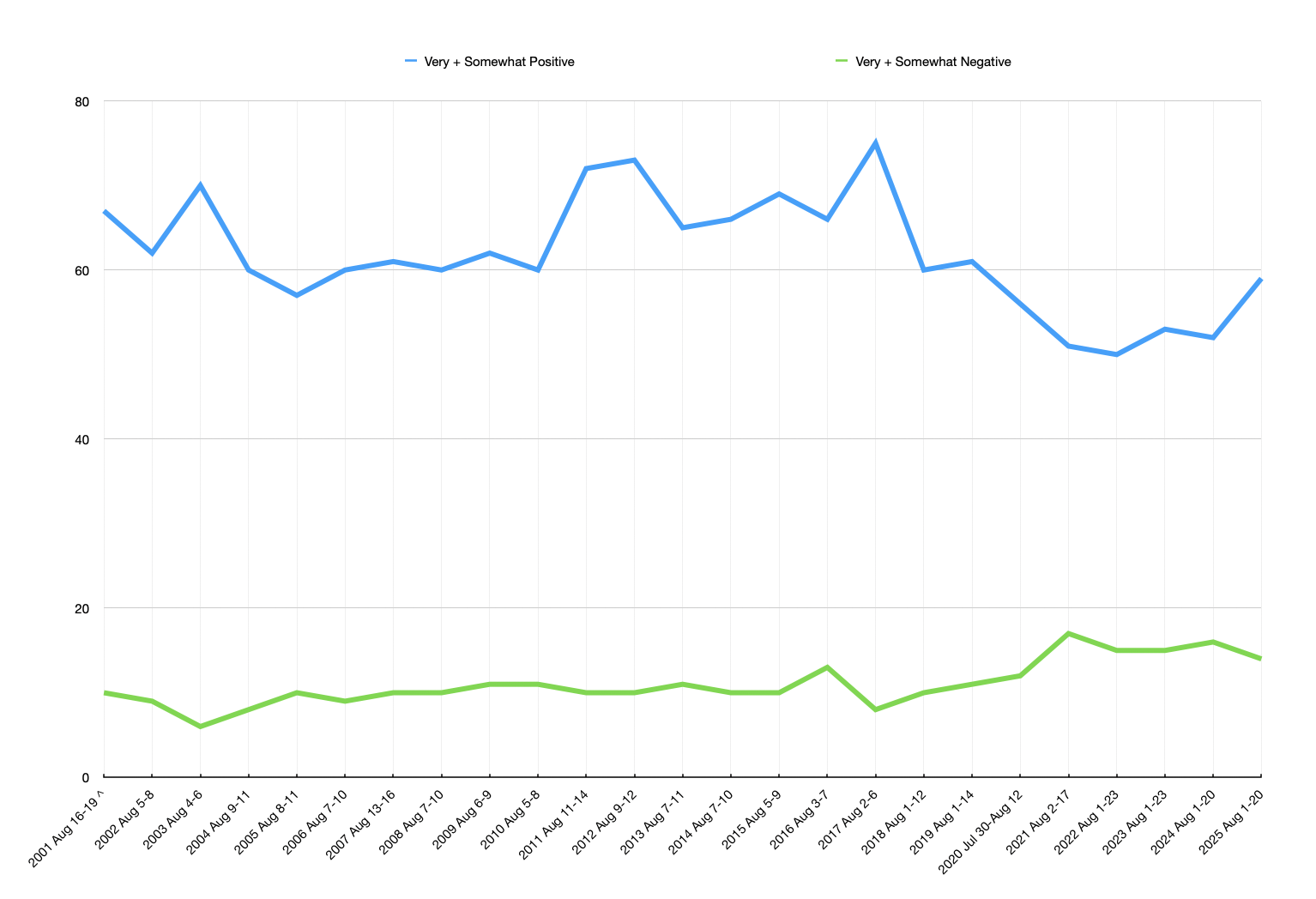
Gallup’s polling on views of different business sectors has, frustratingly, no ability to permalink to a particular industry and its historical rankings; so, you will need to go down to “Industry and Business Sector Ratings, B Through E” and then click the pagination arrow to get to “Computer Industry” on the second page. Once there, you will find what seem at first glance to be some remarkably stable figures.

Look a little closer, though, and the numbers tell a different story. Summing the “very” and “somewhat” figures for each type of response shows a marked decline in positive reception since a high in 2017, and a steady climb in negative reception. There are lots of reasons for this; many of them I have written about. But I do not think these loudmouth executives are doing the industry any favours by bullshitting their way through interviews and promising nonsense.

That is the data-driven answer. These guys also just sound really stupid when they say stuff like “it also takes a lot of energy to train a human” or “the long-term vision is to […] create a tradeable asset out of any difference in opinion” or “I bought Twitter […] to try to help humanity, whom I love”. I know I am writing this on a website called Pixel Envy and I am, well, me, but these barons sound comical and dorky.

⌥ Permalink

Adobe Pays Early Termination Fee, or ‘Settlement’, in U.S. Lawsuit Over Hidden Fees

By: Nick Heer

When the United States Federal Trade Commission and Department of Justice jointly filed a lawsuit in 2024 against Adobe, I commented on the similarities between that complaint and the one against Amazon. Both are about the ease of entering into subscriptions that are later difficult or expensive to leave, both had alleged personal liability by executives — and, now, both have been settled out of court.

Michael Kan, PC Magazine:

Adobe has settled a 2024 lawsuit from the US government that alleged the company used hidden fees to trap users into paying for subscriptions.

On Friday, Adobe “finalized” an agreement with the Justice Department, which accused the software vendor of failing to inform new customers about payment terms or early termination fees. “While we disagree with the government’s claims and deny any wrongdoing, we are pleased to resolve this matter,” Adobe says.

I am sure Adobe has learned its lesson. Let us go and check its work. In its statement, Adobe says it has “made [its] sign-up and cancellation processes even more streamlined and transparent”. Here is how it describes its annual pricing, billed monthly, on its U.S. website:

Fee applies of half your remaining annual commitment if you cancel after Mar 31.

This is not the most direct sentence, but it is an accurate explanation of how much the fee will be, and when that fee takes effect — fourteen days from when I am writing this. It is followed by a little “i” informational icon. Clicking on it will display a callout noting when service will be cut off. For comparison, here is the equivalent disclaimer on its Canadian site:

Fee applies if you cancel after 14 days.

Here, too, there is a little informational icon. When you hover over it, Adobe says the same thing about cancellation, and adds that cancelling will incur an early termination fee. It is the same on the U.K. site.

What is the answer here? Does each country need to sue Adobe for its billing flow to disclose a reasonable amount of information?

⌥ Permalink

Meta Realizes Horizon Worlds on Quest Never Had Legs, Will Shut It Down in June

By: Nick Heer

A few weeks ago, Meta published an update from Samantha Ryan, of Reality Labs, announced a “renewed focus” and a “doubling down” on virtual reality. It planned to achieve this by “almost exclusively” betting its future on the smartphone Horizon Worlds app.

In an announcement today, Meta shifted its definition of “almost exclusively” to simply “exclusively”:

Earlier this year, we shared an update on our renewed focus for VR and Horizon. We are separating the two platforms so each can grow with greater focus, and the Horizon Worlds platform will become a mobile-only experience. This separation will extend across our ecosystem, including our mobile app. To support this vision, we are making the following changes to streamline your Quest experience throughout 2026.

This opening paragraph is opaque and, though the announcement goes on to explain exactly what is happening, it is not nearly as clear as the email sent to Horizon Worlds users. I really think Meta is looking to exit from its pure V.R. efforts, especially with the sales success of the perv glasses.

As I write this, the Horizon app for iOS is the sixty-ninth most popular free game in the Canadian App Store, just behind Wordscapes and ahead of Perfect Makeover Cleaning ASMR. Nice?

⌥ Permalink

A Roadmap for Currency Symbol Implementation

By: Nick Heer

The Unicode Consortium would like to remind you to work closely with them if you are introducing a new symbol for your currency:

Such public usage leads to a need for the symbol to be encoded in the Unicode Standard and supported in commercial software and services. Standardization of a new character and subsequent support by vendors takes time: typically, at least one year, and often longer. All too often, however, monetary authorities announce creation of a new currency symbol anticipating immediate public adoption, then later discover there will be an unavoidable delay before the new symbol is widely supported in products and services.

I had no idea so many currency symbols had been introduced recently. Then again, before I read this, I had not given much thought to the one we use: $.

Hephzibah Anderson, for the BBC, in 2019:

The most widely accepted theory does in fact involve Spanish coinage, and it goes like this: in the colonies, trade between Spanish Americans and English Americans was lively, and the peso, or peso de ocho reales, was legal tender in the US until 1857. It was often shortened, so historians tell us, to the initial ‘P’ with an ‘S’ hovering beside it in superscript. Gradually, thanks to the scrawl of time-pressed merchants and scribes, that ‘P’ merged with the ‘S’ and lost its curve, leaving the vertical stroke like a stake down the centre of the ‘S’. A Spanish dollar was more or less worth an American dollar, so it’s easy to see how the sign might have transferred.

Not only the explanation for why all the world’s dollars have the same symbol, but also why we share it with the peso.

⌥ Permalink

Online Age Verification Tools for Child Safety Are Surveilling Adults

By: Nick Heer

Barbara Booth, CNBC:

Civil liberties’ advocates warn that concentrating large volumes of identity data among a small number of verification vendors can create attractive targets for hackers and government demands. Earlier this year, Discord disclosed a data breach that exposed ID images belonging to approximately 70,000 users through a compromised third-party service, highlighting the security risks associated with storing sensitive identity information.

[…]

According to Tandy, as more states adopt age-verification mandates and companies race to comply, the infrastructure behind those systems is likely to become a permanent fixture of online life. Taken together, industry leaders say the rapid spread of age-verification laws may push platforms toward systems that verify age once and reuse that credential across services.

The hurried implementation of age verification sounds fairly terrible, counterproductive, illegal in the U.S., and discriminatory, but we should not pretend that we are only now being subject to risky and overbearing surveillance on the web. The ecosystem powering behavioural ad targeting — including data brokers, the biggest of which have reported staggering data breaches for a decade — has all but ensured our behaviour on popular websites and in mobile apps is already tracked and tied to some proxy for our identity.

That is not an excuse for the poor implementation of age verification, nor justification for its existence. If anything, it is a condemnation of the current state of the web that this barely moves the needle on privacy. If I had to choose whether to compromise for commerce or for the children, it would be the latter, but the correct answer is, likely, neither.

⌥ Permalink

Grammarly’s ‘Expert Review’ Feature Presents Fake Advice in the Names of Real Journalists and Authors

By: Nick Heer

Casey Newton, Platformer:

On Friday I learned to my surprise that I had become an editor for Grammarly. The subscription-based writing assistant has introduced a feature named “expert review” that, in the company’s words, “is designed to take your writing to the next level — with insights from leading professionals, authors, and subject-matter experts.”

Read a little further, though, and you’ll learn that these “insights” are not actually “from” leading professionals, or any human person at all. Rather, they are AI-generated text, which may or may not reflect whichever “leading professional” Grammarly slapped their names on.

Miles Klee, Wired:

As advertised on a support page, Grammarly users can solicit tips from virtual versions of living writers and scholars such as Stephen King and Neil deGrasse Tyson (neither of whom responded to a request for comment) as well as the deceased, like the editor William Zinsser and astronomer Carl Sagan. Presumably, these different AI agents are trained on the oeuvres of the people they are meant to imitate, though the legality of this content-harvesting remains murky at best, and the subject of many, many copyright lawsuits.

I do not think a disclaimer explaining it does “not indicate any affiliation with Grammarly or endorsement by those individuals or entities” will sufficiently distance the company from its claim of providing “insights from leading professionals, authors, and subject-matter experts” attributed to the names of people who did not agree to participate in this. Apparently, it is incumbent upon them to opt out by emailing expertoptout@superhuman.com. Most people will obviously not do this — because why would anyone realize they need to opt out? — but especially those who are dead yet are still being called upon for their expertise. Let Carl Sagan rest.

⌥ Permalink

Apple Used to Design Its Laptops for Repairability

By: Nick Heer

Charlie Sorrel, of iFixit:

Apple’s MacBooks haven’t always been monolithic, barely repairable slabs of aluminum, glass, and glue. They used to be almost delightful in their repairable features, from their batteries to their Wi-Fi cards. Powerbooks, iBooks, and especially early MacBooks showed what happens when Apple applies its design skills directly to repairability and maintenance, instead of to thinness above all. Today we’re going to take a look at the best repairability features that Apple has ditched.

These four complaints range from the somewhat quaint — swappable Wi-Fi cards — to the stuff I actually miss, which is everything else. RAM and disk upgrades are a gimme since the cost-per-gigabyte (generally) declines over time, and I would love easily swappable batteries. But right now, nearly four years into owning this MacBook Pro, I would also really like to be able to swap in a new keyboard in the future. Not only are the keycaps unintentionally becoming polished, some oft-used keys feel a little mushy. Not much, and barely enough to notice, but I imagine their clickiness will not improve over time.

One quibble, emphasis mine:

[…] I have an old 2012 MacBook Air running Linux. I swapped the HDD for an SSD, maxed out the RAM, and dropped in a new battery, and I see no reason it wouldn’t easily keep rolling for another 10 years.

Unlikely. The 2012 MacBook Air only came with an SSD; a standard hard disk was not an option.

⌥ Permalink

Another Appearance Control Is Coming to Accessibility Settings in iOS 26.4

By: Nick Heer

Juli Clover, MacRumors:

Apple renamed the prior Reduce Highlighting Effects Accessibility setting to “Reduce Bright Effects,” and explained what it does.

Apple says the feature “minimizes highlighting and flashing when interacting with onscreen elements, such as buttons or the keyboard.

In my testing, this does exactly what you would expect. In places like toolbar buttons — or the buttons in the area of what is left of a toolbar, anyhow — the passcode entry screen, and Control Centre, the glowing tap effects are minimized or removed.

I do not find those effects particularly distracting, and I think turning them off saps some of the life out of the Liquid Glass design language, but I can see why some would be bothered by them. It is not the case that iOS 26 would be better if none of these appearance controls were present, only that they should not be necessary.

⌥ Permalink

Minister for Innovation, Science, and Economic Development Announces ‘Guardrails’ for TikTok Canada Operations

By: Nick Heer

There are three agreed-upon policies which, in the airy language of a government press release, seem reasonable enough to apply to all social platforms, yet are only relevant to TikTok. The first is exceedingly vague:

TikTok will implement enhanced protection for Canadians’ personal information, including new security gateways and privacy-enhancing technologies to control access to Canadian user data in order to reduce the risk of unauthorized or prohibited access.

There are no details about what the “new security gateways and privacy-enhancing technologies” are, nor why the sole goal is preventing “prohibited access” rather than “exploitative access”.

The second — complying with the recommendations of the Privacy Commissioner — was already underway, and the third is an “independent third-party monitor”, which seems fine.

⌥ Permalink

Sponsor: Magic Lasso Adblock: Effortlessly Block Ads on Your iPhone, iPad, Mac, and Apple TV

By: Nick Heer

Do you want an all-in-one solution to block ads, trackers, and annoyances across all your Apple devices?

Then download Magic Lasso Adblock — the ad blocker designed for you.

Sponsor: Magic Lasso Adblock

With Magic Lasso Adblock you can effortlessly block ads on your iPhone, iPad, Mac, and Apple TV.

Magic Lasso is a single, native app that includes everything you need:

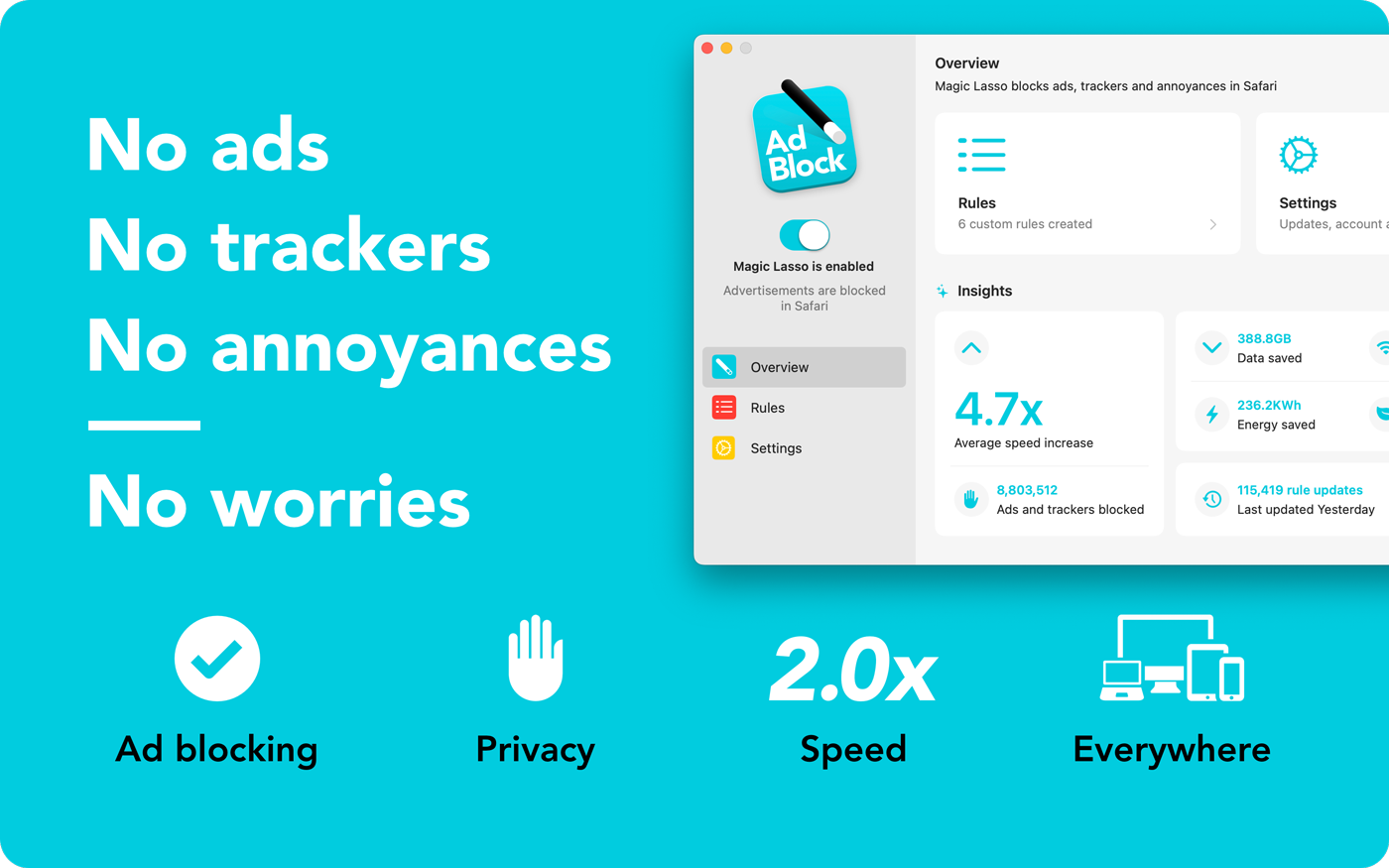
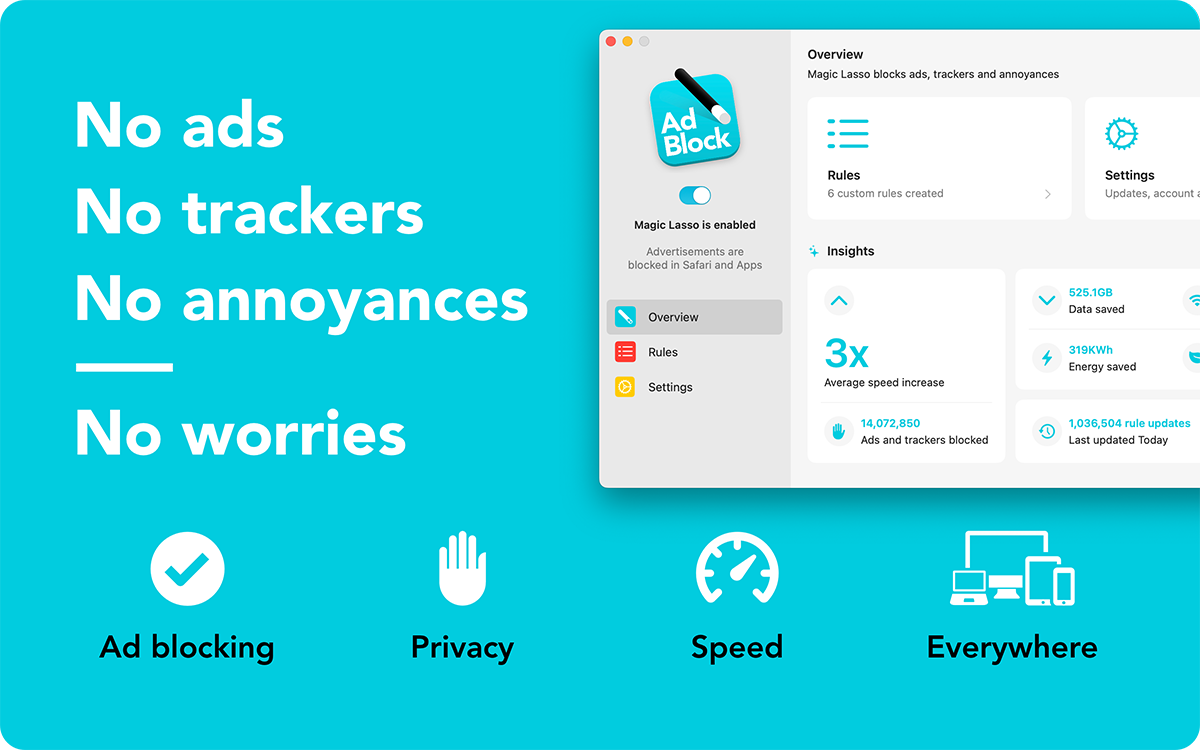
  • Safari Ad Blocking — Browse 2.0× faster in Safari by blocking all ads, with no annoying distractions or pop ups

  • YouTube Ad Blocking — Block all YouTube ads in Safari, including all video ads, banner ads, search ads, plus many more

  • App Ad Blocking — Block ads and trackers across the news, social media, and game apps on your device, including other browsers such as Chrome and Firefox

  • Apple TV Ad Blocking — Watch your favourite TV shows with less interruptions and protect your privacy from in-app ad tracking with Magic Lasso on your Apple TV

Best of all, with Magic Lasso Adblock, all ad blocking is done directly on your device, using a fast, efficient Swift-based architecture that follows our strict zero data collection policy.

With over 5,000 five star reviews, it’s simply the best ad blocker for your iPhone, iPad, Mac, and Apple TV.

And unlike some other ad blockers, Magic Lasso Adblock respects your privacy, doesn’t accept payment from advertisers, and is 100% supported by its community of users.

So, ensure your browsing history, app usage, and viewing habits stay private with Magic Lasso Adblock.

Join over 400,000 users and download Magic Lasso Adblock today.

⌥ Permalink

Mixing News Coverage and ‘Prediction Markets’ Is a Dangerous Gamble

By: Nick Heer

Nilay Patel and Liz Lopatto discussed “prediction markets” on the Verge’s “Decoder” podcast; here is Patel’s summary:

Insider trading is supposed to be illegal, and so is operating an unregulated sports book. So you’re now starting to see Kalshi and Polymarket getting hit from both sides of this broader regulatory debate, and 2026 is shaping up to be the year that all of this really comes to a head. To what end? It’s hard to say, especially as these companies cozy up to the Trump administration.

But it’s also becoming increasingly untenable for prediction markets to sit in the middle of the tension between gambling on the news and trying to self-regulate such that they don’t encourage insider trading.

A little under a month after Gallup announced it would stop polling for presidential approval, the Associated Press said it would begin integrating Kalshi bets into its election coverage. As Patel and Lopatto say, however, election betting is among the least problematic news gambling.

⌥ Permalink

The Central Lie of Prediction Markets

By: Nick Heer

Charlie Warzel, the Atlantic (gift link):

Prediction markets claim to harness the wisdom of crowds to provide reliable public data: Because people are putting real money behind their opinions, they are expressing what they actually believe is most likely to happen, which, according to the reasoning of these platforms, means that events will unfold accordingly. Many news organizations, and Substack, now have partnerships with prediction markets — the subtext being that they provide some kind of news-gathering function. Some users who distrust mainstream media turn to the markets in place of traditional journalism.

But in reality, prediction markets produce the opposite of accurate, unbiased information. They encourage anyone with an informational edge to use their knowledge for personal financial gain. In this way, prediction markets are the perfect technology for a low-trust society, simultaneously exploiting and reifying an environment in which believing the motives behind any person or action becomes harder.

I had no idea so-called “prediction markets” like Kalshi and Polymarket were promoting themselves as forecasters of real information, let alone that anyone believed them. I always assumed “prediction markets” was a euphemism.

A spokesperson for Kalshi told Warzel that betting on current events is a way to “create accurate, unbiased forecasts”, and that is something we can verify. If this were true, bettors should have been able to forecast, for example, the popular vote split of the 2024 U.S. presidential election. Polls had Harris and Trump neck and neck, but on election day, 75.8% of Kalshi bettors believed Harris would prevail. There is not much granularity to Kalshi’s charts, but the forecast on Polymarket was favourable to Harris at 5:00 PM on November 5 — election day — and it flips to a Trump lead at the next available data point, 5:00 AM the following day, and well after it was obvious Trump won the popular vote.

This is just a way to gamble on current events, which is tragic and pathetic. We do not need to pretend these sites are anything more substantial than that.

⌥ Permalink

Google and Epic Games Announce Settlement

By: Nick Heer

Sameer Samat, Google’s president of Android Ecosystem:

Today we are announcing substantial updates that evolve our business model and build on our long history of openness globally.  We’re doing that in three ways: more billing options, a program for registered app stores, and lower fees and new programs for developers.

Epic Games CEO Tim Sweeney on X:

Google is opening up Android all the way with robust support for competing stores, competing payments, and a better deal for all developers. So, we’ve settled all of our disputes worldwide. THANKS GOOGLE!

Simon Sharwood, the Register:

Epic Games approved of the changes.

“These changes will evolve Android into a true open platform with competition among stores,” the company stated. “Globally, developers will have choices in how they make payments using Google Play’s payment system and competing payment systems, with reduced fees and the ability to point users outside apps to make purchases.

Epic also said “Google will take steps to support the future open metaverse,” a probable reference to the deal that will see games made with the Unity engine made available within Fortnite.

Neither Sweeney nor Epic Games can express anything less than elation with this outcome in no small part because they signed away their ability to do that. It still amazes me that concession ended up in the final agreement. It seems like the kind of thing that Google’s very expensive lawyers would pitch as leverage with Epic Games’ not-quite-as-expensive lawyers. In an interview with Dean Takahashi, of GamesBeat, it seems like Epic was eager to settle with terms that apply worldwide:

Asked why Sweeney decided to settle rather than litigate in every court in the world, he said, “This is just a really important thing that people should understand. The Epic versus Google court decision in the United States only has effect in the United States. It does nothing about the rest of the world. And the United States is about 30% of Google Play revenue and about 5% of Google Play users.”

He said it was never going to be a complete worldwide solution, and the court, throughout the proceedings, very clearly, said that the court wanted to establish competition among stores and competition among payments without setting prices in the market.

Curiously, not long before this settlement, Google announced it would begin requiring Android developers to be verified for their software to be installable, even by side-loading. I am curious if the combination of these changes meaningfully impacts users’ security or privacy. At a glance, the changes that settled this lawsuit seem like a welcome set of improvements that, sure, was assuredly not an altruistic fight by Epic Games, and will probably result in Sweeney getting even richer.

Regardless, it is notable for these sweeping changes to be brought to Android phones worldwide in the coming years, while Apple’s App Store is a patchwork of region-specific policies difficult for developers to navigate. It is too bad there is not really competition between these stores. Most people who buy smartphones choose the platform as a whole and accept whatever software experience they are provided. They do not need to bother themselves with the business terms of each store. With the improvements to third-party stores on Android, it sets up the possibility for greater competition within that platform. Apple should do the same.

⌥ Permalink

Apple’s New Studio Displays, Plural

By: Nick Heer

In hardware terms alone, Apple has been delivering an incredible run of Macs arguably since 2020, and easily since 2021. There are quibbles, sure — the display notch still bugs some people, the keyboard material wears poorly, and repairability has declined — but these are, overall, pretty sweet machines. The Macs announced this week seem like they will continue that hot streak.

I happen to be in the market for a new Mac, perhaps this year, and I should be spoiled for choice. I kind of am — the Mac Mini and Mac Studio are both alluring. But I am sadly attached to the room offered by my beloved 27-inch iMac, and Apple’s new lineup of displays is a sore point.

Stephen Hackett, 512 Pixels:

Yes, those are two different products, but they both feature 27-inch, 5K displays in the same enclosure as the previous Studio Display.

Starting at $1599, the new Studio Display is a slight upgrade to the 2022 model.

[…]

The much more interesting of the pair is the $3299 Studio Display XDR.

Those prices are, respectively, $2,100 and $4,500 in Canada. I am not a stranger to spending a lot of money on a screen — I bought a Thunderbolt Display at $1,000 — but that is a lot of money for even the basest of base models, especially since I have no idea whether the sketchy firmware issues have been resolved.

It is not that these displays are bad — far from it — but it is extraordinary that we are ten years removed from 27-inch Retina iMacs that started at just $200 more than the Studio Display is today. Only recently are we seeing more choice in 27-inch 5K displays at considerably lower prices, though without Apple’s very nice stand and quality of materials. At least the XDR has a seemingly new panel.

Three of the seven models in the Mac lineup require an external display. Apple has two choices: one really advanced one that costs as much as a generously-specced Mac Studio, and another that feels like it is stumbling along.

Anyway, here I go again looking for a sick deal I will not find on a Pro Display XDR. Those things really hold their value. Pity.

⌥ Permalink

Tim Sweeney Is Contractually Prohibited from Criticizing Google’s Developer Terms for Years

By: Nick Heer

Sean Hollister, the Verge:

But Google has finally muzzled Tim Sweeney. It’s right there in a binding term sheet for his settlement with Google.

On March 3rd, he not only signed away Epic’s rights to sue and disparage the company, he signed away his right to advocate for any further changes to Google’s app store polices. He can’t criticize Google’s app store practices. In fact, he has to praise them.

The terms (PDF) helpfully clarify that Epic is still allowed to “advocat[e] changes to the policies or practices of […] other companies, including Apple”. This does not mean future criticism of Apple’s business practices — or past criticism, for that matter — is unwarranted or invalid, but it now carries the blunted quality of someone who is not allowed to make the same complaints about Google.

⌥ Permalink

A Toolkit for Hacking iPhones, Possibly Created for the U.S. Government, Has Leaked

By: Nick Heer

Google’s Threat Intelligence Group:

Google Threat Intelligence Group (GTIG) has identified a new and powerful exploit kit targeting Apple iPhone models running iOS version 13.0 (released in September 2019) up to version 17.2.1 (released in December 2023). The exploit kit, named “Coruna” by its developers, contained five full iOS exploit chains and a total of 23 exploits. The core technical value of this exploit kit lies in its comprehensive collection of iOS exploits, with the most advanced ones using non-public exploitation techniques and mitigation bypasses.

The Coruna exploit kit provides another example of how sophisticated capabilities proliferate. Over the course of 2025, GTIG tracked its use in highly targeted operations initially conducted by a customer of a surveillance vendor, then observed its deployment in watering hole attacks targeting Ukrainian users by UNC6353, a suspected Russian espionage group. We then retrieved the complete exploit kit when it was later used in broad-scale campaigns by UNC6691, a financially motivated threat actor operating from China. […]

Andy Greenberg, Wired:

Conspicuously absent from Google’s report is any mention of who the original surveillance company “customer” that deployed Coruna may have been. But the mobile security company iVerify, which also analyzed a version of Coruna it obtained from one of the infected Chinese sites, suggests the code may well have started life as a hacking kit built for or purchased by the US government. Google and iVerify both note that Coruna contains multiple components previously used in a hacking operation known as “Triangulation” that was discovered targeting Russian cybersecurity firm Kaspersky in 2023, which the Russian government claimed was the work of the NSA. (The US government didn’t respond to Russia’s claim.)

I am so curious to know how this thing made it outside the carefully guarded digital walls of the U.S. government or a contractor. While a rare event, it is not the first time the classified weapons of espionage have become public.

⌥ Permalink

U.S. Immigration Police Bought Real-Time Ad Bidding Data for Automated Tracking System

By: Nick Heer

Joseph Cox, 404 Media:

Customs and Border Protection (CBP) bought data from the online advertising ecosystem to track peoples’ precise movements over time, in a process that often involves siphoning data from ordinary apps like video games, dating services, and fitness trackers, according to an internal Department of Homeland Security (DHS) document obtained by 404 Media.

[…]

Although CBP described the move as a pilot, the DHS Office of the Inspector General (OIG) later found both CBP and ICE did not limit themselves to non-operational use. The OIG found that CBP, ICE, and the Secret Service all illegally used the smartphone location data, and found a CBP official used the data to track coworkers with no investigative purpose. CBP and ICE went on to repeatedly purchase access to location data.

There are people out there who will insist, to this day, that behaviourally targeted advertising is not actually a mechanism for surveillance despite all the evidence showing it is, in fact, an essential component.

⌥ Permalink

Annotators in Kenya Describe How They Review Sensitive Data Captured by Meta’s Ray-Bans

By: Nick Heer

Naipanoi Lepapa, Ahmed Abdigadir, and Julia Lindblom, Svenska Dagbladet:

The workers in Kenya say that it feels uncomfortable to go to work. They tell us about deeply private video clips, which appear to come straight out of Western homes, from people who use the glasses in their everyday lives.

Several describe video material showing bathroom visits, sex and other intimate moments.

Another worker talks about people coming out of bathrooms.

It is appalling that massively rich corporations like Meta continue to offload critical tasks like these onto people who receive little support or pay. I recently finished “Ghost Work” by Mary L. Gray and Siddharth Suri and, while not my favourite book nor surfacing anything conceptually new, is worth your time. Meta can and should be doing far better, but can avoid association with labour atrocities better than, say, Nike in the 1990s in part because I doubt most people think too much about human intervention in artificial intelligence. Meta does not celebrate the hard work of its contract labour in Kenya; it does not even acknowledge them.

Speaking of not acknowledging the human labour involved, this story is the obvious nightmare you would expect. Some of these incidents of sensitive video recordings appear to be accidental, while others are seemingly deliberate. Without excusing the people who seem to be recording creepy videos on purpose, I assume few people would have believed it would be seen by someone at a company they probably have not heard about.

At first glance, it appears that we have significant control over our data. It states that voice recordings may only be saved and used for improvement or training of other Meta products if the user actively agrees.

But for the AI assistant to function, voice, text, image and sometimes video must be processed and may be shared onwards. This data processing is done automatically and cannot be turned off.

This is the kind of thing I would expect would be bundled into the additional diagnostic information Meta asks if you would like to opt into sharing. But Meta says this “does not include the photos and videos captured by your glasses”. That is, as this investigation found, part of the mandatory data collection.

This is offensive on behalf of users who might be less likely to consent if they had this full information. But it is also offensive to their romantic partners, friends, acquaintances, and passers-by, none of whom agreed to have their image or conversations adjudicated by these contractors.

⌥ Permalink

⌥ The Window Chrome of Our Discontent

By: Nick Heer

In a WWDC 2011 session, Dan Schimpf explained some of the goals of the refreshed design for Aqua in Mac OS X Lion were “meant to focus the user attention on the active window content”. This sentiment was echoed by John Siracusa in his review of Lion for Ars Technica:

Apple says that its goal with the Lion user interface was to highlight content by de-emphasizing the surrounding user interface elements.

When Apple redesigned Mac OS X again in 2014 with Yosemite, it promised…

[…] a fresh modern look where controls are clearer, smarter and easier to understand, and streamlined toolbars put the focus on your content without compromising functionality.

Then, when it revealed the Big Sur redesign in 2020, it explained:

The entire experience feels more focused, fresh, and familiar, reducing visual complexity and bringing users’ content front and centre.

And you will never guess what it promised in 2025 with the announcement of MacOS Tahoe and Liquid Glass, as introduced by Alan Dye:

Our goal is a beautiful new design that brings joy and delight to every user experience. One that’s more personal, and puts greater focus on your content — all while still feeling instantly familiar.

It is not just Apple, either. Here is Microsoft’s Jensen Harris at Build 2011 describing a key goal for the company’s then-new Metro design language:

Metro-style apps have room to breathe. They’re not about the chrome, they’re about the content. […] For years, Windows was always about adding stuff. We added bars, and panes, and doodads, and widgets, and gadgets, and bars — and stuff everywhere. And that’s how we defined our U.I., based on what new widgets we added. Now, we’ve receded into the background, and the app is sitting out there on the stage.

And later, as Microsoft rolled out app updates with its Fluent Design language, it described them in familiar terms:

With the updated OneDrive, your content takes center stage. The improved visual design reduces clutter and distractions, allowing you to focus on what’s important – your content.

This is a laudable goal if the opposite is, I assume, increasing the amount of clutter in user interfaces and making them more distracting. Nobody wants that. Then again, while the objective may be quite reasonable, there are surely different ways of achieving it — but Apple has embraced a single strategy: make the interface blend into the document. (I will be focusing on MacOS here as it is the platform I am most familiar with.)

Here is what a Pages document looks like running under Mac OS X Lion:

Click to expand (except on mobile).
A screenshot of Pages running under Mac OS X Lion

Here is that same document in a newer version of Pages running on MacOS Catalina, with the Yosemite-era design language that replaced the one that came before:

Click to expand (except on mobile).
A screenshot of Pages running under MacOS Catalina

Here it is in the last version of Pages on MacOS Tahoe, using the design language introduced with Big Sur:

Click to expand (except on mobile).
A screenshot of Pages running under MacOS Tahoe

And, finally, the newest version of Pages on MacOS Tahoe using the current Liquid Glass visual design language:

Click to expand (except on mobile).
A screenshot of Pages running under MacOS Tahoe

There are welcome improvements in newer versions of this comparison, like the introduction of the “Format” panel on the right-hand side, which makes better use of widescreen landscape-oriented displays, and allows for larger controls. While I admire the density of the Lion-era screenshot, the mini-sized controls in that formatting menu are harder to click.1

Overall, however, what Apple has done to Pages over this period of time is representative of a broader trend of minimizing the delineation of user interface elements from each other and the document itself. This is the only tool in the toolbox, and I am skeptical it achieves what Apple intends.

Compare again the two more recent screenshots against the ones that came before, and focus on the toolbar at the top of each. In the older two, there is a well-defined separation between the toolbar — the window itself — and the document. In the Big Sur visual language, however, the toolbar is the same bright white as the document. By Tahoe and the Liquid Glass language, there is barely a distinction; the buttons simply float over the document. And, bizarrely, that degrades further with the “Reduce Transparency” accessibility preference enabled:

Click to expand (except on mobile).
A screenshot of Pages running under MacOS Tahoe with the Reduce Transparency setting enabled

(Also, no, your eyes do not deceive you: the icons in the drop cap menu, barely visible in the lower-right, are indeed pixellated.)

For me, this means a constant distraction from my document because the whole window has a similar visual language. As the toolbar and its buttons become one with the document, they lose their ability to fade into the background. In the two older examples, the contrast of the well-defined toolbar allows me to treat them as an entirely separate thing I do not need to pay attention to.

This is further justified by the lower contrast within those two older toolbars. In Lion, the grey background and moderately saturated colours are a quiet reminder of tools that are available without them being intrusive. The mix of shapes is a sufficient differentiator, something Apple threw away in the following screenshot. By making all the buttons literal and with the same bright background, the toolbar becomes a little more distracting — but at least it does not blend into the document. Without the context of the previous screenshot, the colours of each icon seem almost random, and I find the yellow-on-white “Table” button difficult to distinguish at a glance from the black-on-yellow-on-white “Comment” button.

The Big Sur-era design language is, frankly, an atrocious regression. The heterogeneous shapes may have returned, but in the form of monochromatic medium-grey icons set against a uniform white background. The icons are not bad, per se — though putting “Add Page” and “Insert” next to each other in this default toolbar layout, both represented by a plus sign, is a little confusing. But I will bet you would not guess that some of these are buttons, while others are pop-up buttons with a submenu.

Finally, there is Liquid Glass which, in its default form, has more contrast than the previous example; with “Reduce Transparency” enabled, which is how I use MacOS, it has even less. The buttons themselves have a greater amount of internal contrast with bigger, darker grey icons on a white background. This is preferential within the context of the toolbar compared to the thin, small, and low-contrast buttons in the past example, but it also means this toolbar has similar contrast to the document itself.

I would not go so far as to argue that Pages ’09 has a perfect user interface and that everything since has been a regression. The average colours used for the icon fill in both older toolbars generally fails accessibility contrast checks which, remarkably, the Big Sur design will pass. The icons in Pages ’09 rely on dark outlines and unique shapes to have sufficient contrast with the toolbar background. However, Apple has since discarded most variables it could change to design these interfaces. Every button contains an icon of a single uniform colour, within barely defined holding containers of the same shape, and without text labels by default.

This monochromatic look means any splash of colour is distracting. The yellow accent used in Pages is garish — though, thankfully, something that can mostly be mitigated by changing the Theme Colour in System Settings, under Appearance. (Unfortunately, the yellow background remains on the “Update” button in the most recent version of Pages regardless of the system accent colour.) But perhaps you also noticed the purple icon in the Liquid Glass screenshot above. Here is the full toolbar:

Click to expand (except on mobile).
A screenshot of the full Pages toolbar featuring monochromatic dark grey icons except for a few purple ones

Those purple icons signify features that are part of Apple Creator Studio, a paid subscription to Pages and other applications that allows you to — in the order they are presented above — generate an image, artificially boost the resolution of an image, and access a stock image library. If you would like to insert one of your own images into your Pages document, that feature has been moved to the paperclip icon. Yes, it is a menu and not a button, despite lacking the disclosure triangle of the zoom menu right beside it, and it also reminds you about the “Content Hub” and “Generate Image” features. In Pages under Lion, colour was used in the icons to help guide the user as they complete a task — click the green thing to add a shape; click the darker yellow thing to add a table. Colour is not being used in the newer version to signify these are A.I. features, as the “Writing Tools” icon remains dark grey. In this version, the coloured icons are there to guide the user to premium add-ons regardless of whether they are currently paying for them.

I decided to focus on Pages for this comparison because it has lived so many different lives in MacOS. However, it is perhaps an imperfect representation for the rest of the system. Across Mac OS X Lion, for example, the toolbars of first-party applications like Finder and Preview almost exclusively use monochromatic icons. This has been true since Mac OS X Leopard, which also introduced barely differentiated folder icons. Some toolbars in Tiger, introduced two years prior, featured icons inside uniform capsule shapes. These were questionable ideas at the time, but they still retained defining characteristics. The capsules, for example, may have had a uniform shape, but contained within were full-colour icons. Most importantly, they were all clearly controls that were differentiated from the document.

Perhaps Apple has some user studies that suggest otherwise, but I cannot see how dialling back the lines between interface and document is supposed to be beneficial for the user. It does not, in my use, result in less distraction while I am working in these apps. In fact, it often does the opposite. I do not think the prescription is rolling back to a decade-old design language. However, I think Apple should consider exploring the wealth of variables it can change to differentiate tools within toolbars, and to more clearly delineate window chrome from document.


  1. These screenshots are a bit limited as, to capture a high-resolution interface, I switched my mid-2012 MacBook Air to a 720 × 450 display output, which shrank the available space for Pages in the Lion and Catalina screenshots. ↥︎

Software Quality Postscript and Clarification

By: Nick Heer

I have a document open in BBEdit right now named “2025-06-22 – MacOS SaaS.markdown”. I started drafting this thing last year about how Apple has transitioned its operating systems to something closer to a software-as-a-service model. I was trying to describe how the difference between major versions has become generally more modest since many features are rolled out across the year, and how — particularly on Apple’s non-Mac platforms — updates are more-or-less forced since the company stops digitally certifying older versions.

It is not a perfect comparison and not quite a fully-developed idea — note the difference between the filename and the last sentence above — but I thought it was going somewhere. Of course, you had no idea about this because I never published, which is why it must have seemed strange when I dropped a reference to software-as-a-service in the middle of my piece about software quality:

There was a time when remaining on an older major version of an operating system or some piece of software meant you traded the excitement of new features for the predictability of stability. That trade-off no longer exists; software-as-a-service means an older version is just old, not necessarily more reliable.

Riccardo Mori was understandably confused by this:

[…] I very much enjoy using older Mac OS versions, but not being able to browse the Web properly and securely, not being able to correctly sign in to check a Gmail account, not being able to fetch some RSS feeds because you can’t authenticate securely or establish a secure connection is very frustrating. Not having Dropbox work on my 2009 MacBook Pro running OS X 10.11 El Capitan is a minor annoyance and means I just won’t have access to certain personal files and that I’ll have to sync manually whatever I do on this other machine.

But if I put these two factors aside, there’s nothing about those older Macs, nothing about the older Mac OS versions they run that makes them less reliable. […]

What Mori explains as this paragraph continues is what I had meant to write at the time. What I should have written was this (emphasis mine):

There was a time when remaining on an older major version of an operating system or some piece of software meant you traded the excitement of new features for the predictability of stability. That trade-off no longer exists; an operating system on a software-as-a-service treadmill means an older version is just old, not necessarily more reliable.

The cycle of having a major new version ready to preview by June and shipping in September means the amount of time Apple spends focusing on the current version must necessarily shrink. How many teams at the company do you suppose are, right now, working on MacOS 26 when WWDC is a little over three months away? Engineering efforts are undoubtably beginning to prioritize MacOS 27. There are new features to prepare, after all.

So, yes, what Mori writes is what I was trying to express. I wish I had given that sentence a little more thought. Do read Mori’s piece — the second part, “On Software Frugality”, is thought-provoking.

⌥ Permalink

The Perfect Music App

By: Nick Heer

Jon Hicks, last year:

Music apps leave me wanting.

While I collect albums both physically (Vinyl + CD) and digitally (from Bandcamp), there are still missing pieces that streaming services provide: discovering new music, sharing playlists and seeing what friends are playing so that I can try their recommendations. They’re a valuable part of my listening habits, but none of them feel like ‘the one’. […]

I only stumbled across this today, but it remains a wonderful encapsulation of the state of music apps today. I share Hicks’ criteria, though I would add three things for myself:

  1. More expansive metadata. I would like genres that work more like tags. An artist may generally make records in one genre, but different albums have different influences. Even individual songs may considerably differ in sound and style. This is the kind of thing that would help me make playlists or find songs that sound better together.

    This would be a management challenge across the tens of thousands of songs in my library, but I feel like integration with RateYourMusic and other databases might help partially automate this.

  2. iPhone syncing over a wire. One of Hicks’ criteria is streaming and local library in the same app, and I completely agree. But I do not want anything — especially iPhone syncing — to be predicated on an assumption I have Apple’s first-party iCloud Music stuff turned on.

  3. No lock-in. I want to be able to point it at my existing library and for things to just work. I would like to be able to import my entire setup from Music — all my playlists, including smart playlists, plus all my stats and ratings — and I would like it to be stored in a format some other application could read if I ever need to move to a different client in the future.

There are many indie apps that get close to this. I checked out Radiccio recently, but it unfortunately does not work with the iMac on which my music library is stored. Maybe that is the fourth criteria: backwards compatibility as far as possible.

Nobody has ever said I am easy to please.

⌥ Permalink

The Political Effects of Twitter’s Feed Algorithm

By: Nick Heer

Germain Gauthier, et al., in a recent peer-reviewed paper in Nature:

Feed algorithms are widely suspected to influence political attitudes. However, previous evidence from switching off the algorithm on Meta platforms found no political effects. Here we present results from a 2023 field experiment on Elon Musk’s platform X shedding light on this puzzle. We assigned active US-based users randomly to either an algorithmic or a chronological feed for 7 weeks, measuring political attitudes and online behaviour. Switching from a chronological to an algorithmic feed increased engagement and shifted political opinion towards more conservative positions, particularly regarding policy priorities, perceptions of criminal investigations into Donald Trump and views on the war in Ukraine. In contrast, switching from the algorithmic to the chronological feed had no comparable effects. Neither switching the algorithm on nor switching it off significantly affected affective polarization or self-reported partisanship. […]

One can be pedantic about the use of “algorithmic” and “the algorithm” to describe a particular set of rules for recommending tweets, given that you could also say a reverse-chronological timeline is its own kind of algorithm. A simple one, to be sure, but an algorithm. I will not quibble with this.

Here is one thing I will be pedantic about, though: this study is not an examination of the “political effects of X’s feed algorithm”, as the title of the study suggests. It was conducted in 2023 — just a little bit after Elon Musk bought the platform and when it was still named Twitter. That is a long time ago in online platform terms, and the recommendations engine has probably changed a lot since — but almost certainly not in the direction of political even-handedness — even though the GitHub commit log suggests it has not been.

This study’s design seems better to me than a report published shortly after the 2024 U.S. presidential election, which I found limited and unconvincing.

There should always be a way for users to set a reverse-chronological timeline, and to opt out of recommendations features. We should be suspicious of any platform that refuses to trust us with control over our own experience.

⌥ Permalink

It Sure Looks to Me Like Meta Is Winding Down Its V.R. Efforts

By: Nick Heer

Samantha Ryan, “VP of Content” at Meta’s Reality Labs:

We’ve recently made some pretty big changes, including right-sizing our Reality Labs investment to ensure that our efforts remain sustainable over time. We’ve been in this space for over a decade, and we aren’t going anywhere. We’re in it for the long haul.

By “right-sizing”, Ryan means laying off ten percent of the Reality Labs workforce, and pouring money into the Ray-Ban partnership instead of metaverse initiatives. By “in it for the long haul”, Ryan means shifting the definition of the “metaverse” to meet Mark Zuckerberg’s latest obsession. They did not whiff by renaming the entire company around a crappy update to Second Life; you just are not getting it.

Ryan:

Our goal remains constant: to empower developers and creators as they build long-term, sustainable businesses. We used to have a pretty well-defined audience for VR, but as we’ve grown, we’ve attracted new audiences — who want different things — and the onus is on us to make sure that each of these distinct groups can find the apps and games that appeal to them.

That’s why we’re changing our roadmaps to increase your chances for success. We’re explicitly separating our Quest VR platform from our Worlds platform in order to create more space for both products to grow. We’re doubling down on the VR developer ecosystem while shifting the focus of Worlds to be almost exclusively mobile. By breaking things down into two distinct platforms, we’ll be better able to clearly focus on each.

Meta can say it is “doubling down on the V.R. developer ecosystem” all it wants, but it announced in January it would be shutting down its work-focused V.R. app with only a month’s notice, and it has cancelled third-party headsets. Now, it is saying Horizon Worlds is basically a phone app. Last February, Andrew Bosworth wrote in a memo about the importance of this very strategy:

[…] And Horizon Worlds on mobile absolutely has to break out for our long term plans to have a chance. […]

As I write this, Meta Horizon is the fifty-seventh most popular free game in the Canadian App Store, just two spots behind Hole.io, “the most addictive black hole game”. Maybe people do not, in general, want to wear a computer on their entire head — not for the thousands of dollars Apple is charging, and not for the hundreds Meta is.

⌥ Permalink

Personal (Computer) Assistants

By: Nick Heer

Omar Shahine:

For years, I’ve wanted a personal assistant. Someone who knows my preferences, manages my inbox, tracks my packages, and helps my family stay organized. The problem? Good assistants are expensive, require training, and still need constant direction.

So I built one. His name is Lobster. 🦞

The key insight that made this work wasn’t technical—it was conceptual. I stopped thinking “AI chatbot” and started thinking “new hire.”

I think this analogy is downright perfect.

When I first read this piece, my mind started to spin with all the things I could offload to my own digital personal assistant. Imagine how much time I could save by… wait. What could I use it for? Shahine says it helps summarize recent emails, figure out travel details, find event tickets, and more, all through iMessage conversations. This is a remarkable technical achievement. But what it drove home for me is how little I could ultimately relate to the scenarios presented by Shahine, even as I am trying to plan dinner with friends and a couple of trips later in the year.

Perhaps the same is true for you, too. Take a moment and think about what tasks you would give a personal assistant that can only work through software. Is it a long list? Is delegating checking your email saving you time? If you automate your vacation planning, does it make you happier than figuring that out alongside your partner or family? I am not saying Shahine is wrong or misguided. I just cannot see my life in this, and I do not think I am alone.

⌥ Permalink

Meta Plans Deep Cuts to Metaverse Efforts

By: Nick Heer

Kurt Wagner, Bloomberg:

Meta Platforms Inc.’s Mark Zuckerberg is expected to meaningfully cut resources for building the so-called metaverse, an effort that he once framed as the future of the company and the reason for changing its name from Facebook Inc.

Executives are considering potential budget cuts as high as 30% for the metaverse group next year, which includes the virtual worlds product Meta Horizon Worlds and its Quest virtual reality unit, according to people familiar with the talks, who asked not to be named while discussing private company plans. Cuts that high would most likely include layoffs as early as January, according to the people, though a final decision has not yet been made.

Wagner’s reporting was independently confirmed by Mike Isaac, of the New York Times, and Meghan Bobrowsky and Georgia Wells, of the Wall Street Journal, albeit in slightly different ways. While Wagner wrote it “would most likely include layoffs as early as January”, Isaac apparently confirmed the budget cuts are likely large-scale personnel cuts, which makes sense:

The cuts could come as soon as next month and amount to 10 to 30 percent of employees in the Metaverse unit, which works on virtual reality headsets and a V.R.-based social network, the people said. The numbers of potential layoffs are still in flux, they said. Other parts of the Reality Labs division develop smart glasses, wristbands and other wearable devices. The total number of employees in Reality Labs could not be learned.

Alan Dye is just about to join Reality Labs. I wonder if this news comes as a fun surprise for him.

At Meta Connect a few months ago, the company spent basically the entire time on augmented reality glasses, but it swore up and down it was all related to its metaverse initiatives:

We’re hard at work advancing the state of the art in augmented and virtual reality, too, and where those technologies meet AI — that’s where you’ll find the metaverse.

The metaverse is whatever Meta needs it to be in order to justify its 2021 rebrand.

Our vision for the future is a world where anyone anywhere can imagine a character, a scene, or an entire world and create it from scratch. There’s still a lot of work to do, but we’re making progress. In fact, we’re not far off from being able to create compelling 3D content as easily as you can ask Meta AI a question today. And that stands to transform not just the imagery and videos we see on platforms like Instagram and Facebook, but also the possibilities of VR and AR, too.

You know, whenever I am unwinding and chatting with friends after a long day at work, I always get this sudden urge to create compelling 3D content.

⌥ Permalink

Lisa Jackson and Kate Adams Out at Apple, Jennifer Newstead to Join

By: Nick Heer

Apple:

Apple today announced that Jennifer Newstead will become Apple’s general counsel on March 1, 2026, following a transition of duties from Kate Adams, who has served as Apple’s general counsel since 2017. She will join Apple as senior vice president in January, reporting to CEO Tim Cook and serving on Apple’s executive team.

In addition, Lisa Jackson, vice president for Environment, Policy, and Social Initiatives, will retire in late January 2026. The Government Affairs organization will transition to Adams, who will oversee the team until her retirement late next year, after which it will be led by Newstead. Newstead’s title will become senior vice president, General Counsel and Government Affairs, reflecting the combining of the two organizations. The Environment and Social Initiatives teams will report to Apple chief operating officer Sabih Khan.

What will tomorrow bring, I wonder?

Newstead has spent the past year working closely with Joel Kaplan, and fighting the FTC’s case against Meta — successfully, I should add. Before that, she was a Trump appointee at the U.S. State Department. Well positioned, then, to fight Apple’s U.S. antitrust lawsuit against a second-term Trump government that has successfully solicited Apple’s money.

John Voorhees, MacStories:

Although Apple doesn’t say so in its press release, it’s pretty clear that a few things are playing out among its executive ranks. First, a large number of them are approaching retirement age, and Apple is transitioning and changing roles internally to account for those who are retiring. Second, the company is dealing with departures like Alan Dye’s and what appears to be the less-than-voluntary retirement of John Giannandrea. Finally, the company is reducing the number of Tim Cook’s direct reports, which is undoubtedly to simplify the transition to a new CEO in the relatively near future.

A careful reader will notice Apple’s newsroom page currently has press releases for these departures and, from earlier this week, John Giannandrea’s, but there is nothing about Alan Dye’s. In fact, even in the statement quoted by Bloomberg, Dye is not mentioned. In fairness, Adams, Giannandrea, and Jackson all have bios on Apple’s leadership page. Dye’s was removed between 2017 and 2018.

Starting to think Mark Gurman might be wrong about that FT report.

⌥ Permalink

Waymo Data Indicates Dramatic Safety Improvements Over Human Drivers, So It Is Making Its Cars More Human

By: Nick Heer

Jonathan Slotkin, a surgeon and venture capital investor, wrote for the New York Times about data released by Waymo indicating impressive safety improvements over human drivers through June 2025:

If Waymo’s results are indicative of the broader future of autonomous vehicles, we may be on the path to eliminating traffic deaths as a leading cause of mortality in the United States. While many see this as a tech story, I view it as a public health breakthrough.

[…]

There’s a public health imperative to quickly expand the adoption of autonomous vehicles. […]

We should be skeptical of all self-reported stats, but these figures look downright impressive.

Slotkin responsibly notes several caveats, though neglects to mention the specific cities in which Waymo operates: Austin, Los Angeles, Phoenix, and San Francisco. These are warm cities with relatively low annual precipitation, almost none of which is ever snow. Slotkin’s enthusiasm for widespread adoption should be tempered somewhat by this narrow range of climate data. Still, its data is compelling. These cars seem to crash less often than those driven by people in the same cities and, in particular, avoid causing serious injuries at an impressive rate.

It is therefore baffling to me that Waymo appears to be treating this as a cushion for experimentation.

Katherine Bindley, in a Wall Street Journal article published the very same day as Slotkin’s Times piece:

The training wheels are off. Like the rule-following nice guy who’s tired of being taken advantage of, Waymos are putting their own needs first. They’re bending traffic laws, getting impatient with pedestrians and embracing the idea that when it comes to city driving, politeness doesn’t pay: It’s every car for itself.

[…]

Waymo has been trying to make its cars “confidently assertive,” says Chris Ludwick, a senior director of product management with Waymo, which is owned by Google parent Alphabet. “That was really necessary for us to actually scale this up in San Francisco, especially because of how busy it gets.”

A couple years ago, Tesla’s erroneously named “Full Self-Driving” feature began cruising through crosswalks if it judged it could pass a crossing pedestrian in time, and I wrote:

Advocates of autonomous vehicles often say increased safety is one of its biggest advantages over human drivers. Compliance with the law may not be the most accurate proxy for what constitutes safe driving, but not to a disqualifying extent. Right now, it is the best framework we have, and autonomous vehicles should follow the law. That should not be a controversial statement.

I stand by that. A likely reason for Waymo’s impressive data is that its cars behave with caution and deference. Substituting that with “confidently assertive” driving is a move in entirely the wrong direction. It should not roll through stop signs, even if its systems understand nobody is around. It should not mess up the order of an all-way stop intersection. I have problems with the way traffic laws are written, but it is not up to one company in California to develop a proprietary interpretation. Just follow the law.

Slotkin:

This is not a call to replace every vehicle tomorrow. For one thing, self-driving technology is still expensive. Each car’s equipment costs $100,000 beyond the base price, and Waymo doesn’t yet sell cars for personal use. Even once that changes, many Americans love driving; some will resist any change that seems to alter that freedom.

[…]

There is likely to be some initial public trepidation. We do not need everyone to use self-driving cars to realize profound safety gains, however. If 30 percent of cars were fully automated, it might prevent 40 percent of crashes, as autonomous vehicles both avoid causing crashes and respond better when human drivers err. Insurance markets will accelerate this transition, as premiums start to favor autonomous vehicles.

Slotkin is entirely correct in writing that “Americans love driving” — the U.S. National Household Travel Survey, last conducted in 2022, found 90.5% of commuters said they primarily used a car of some kind (table 7-2, page 50). 4.1% said they used public transit, 2.9% said they walked, and just 2.5% said they chose another mode of transportation in which taxicabs are grouped along with bikes and motorcycles. Those figures are about the same in 2017, though with an unfortunate decline in the number of transit commuters. Commuting is not the only reason for travelling, of course, but this suggests to me that even if every taxicab ride was in an autonomous Waymo, there would still be a massive gap to achieve that 30% adoption rate Slotkin wants. And, if insurance companies begin incentivizing autonomous vehicles, it really means rich people will reap the reward of being able to buy a new car.

Any argument about road safety has to be more comprehensive than what Slotkin is presenting in this article. Regardless of how impressive Waymo’s stats are, it is a vision of the future that is an individualized solution to a systemic problem. I have no specialized knowledge in this area, but I am fascinated by it. I read about this stuff obsessively. The things I want to see are things everyone can benefit from: improvements to street design that encourage drivers to travel at lower speeds, wider sidewalks making walking more comfortable, and generous wheeling infrastructure for bicycles, wheelchairs, and scooters. We can encourage the adoption of technological solutions, too; if this data holds up, it would seem welcome. But we can do so much better for everyone, and on a more predictable timeline.

This is, as Slotkin writes, a public health matter. Where I live, record numbers of people are dying, in part because more people than ever are driving bigger and heavier vehicles with taller fronts while they are distracted. Many of those vehicles will still be on the road in twenty years’ time, even if we accelerate the adoption pace of more autonomous vehicles. We do not need to wait for a headline-friendly technological upgrade. There are boring things cities can start doing tomorrow that would save lives.

⌥ Permalink

Alan Dye Out at Apple

By: Nick Heer

Mark Gurman, Bloomberg:

Meta Platforms Inc. has poached Apple Inc.’s most prominent design executive in a major coup that underscores a push by the social networking giant into AI-equipped consumer devices.

The company is hiring Alan Dye, who has served as the head of Apple’s user interface design team since 2015, according to people with knowledge of the matter. Apple is replacing Dye with longtime designer Stephen Lemay, according to the people, who asked not to be identified because the personnel changes haven’t been announced.

Big week for changes in Apple leadership.

I am sure more will trickle out about this, but one thing notable to me is that Lemay has been a software designer for over 25 years at Apple. Dye, on the other hand, came from marketing and print design. I do not want to put too much weight on that — someone can be a sufficiently talented multidisciplinary designer — but I am curious to see what Lemay might do in a more senior role.

Admittedly I also have some (perhaps morbid) curiosity about what Dye will do at Meta.

One more note from Gurman’s report:

Dye had taken on a more significant role at Apple after Ive left, helping define how the company’s latest operating systems, apps and devices look and feel. The executive informed Apple this week that he’d decided to leave, though top management had already been bracing for his departure, the people said. Dye will join Meta as chief design officer on Dec. 31.

Let me get this straight: Dye personally launches an overhaul of Apple’s entire visual interface language, then leaves. Is that a good sign for its reception, either internally or externally?

⌥ Permalink

Microsoft Lowers A.I. Software Growth Targets

By: Nick Heer

Benj Edwards, Ars Technica:

Microsoft has lowered sales growth targets for its AI agent products after many salespeople missed their quotas in the fiscal year ending in June, according to a report Wednesday from The Information. The adjustment is reportedly unusual for Microsoft, and it comes after the company missed a number of ambitious sales goals for its AI offerings.

Based on Edwards’ summary — I still have no interest in paying for the Information — it sounds like this mostly affects sales of A.I. “agents”, a riskier technology proposition for businesses. This sounds to me like more concrete evidence of a plateau in corporate interest than the surveys reported on by the Economist.

⌥ Permalink

‘Mad Men’ on HBO Max, in 4K, Somehow Lacking VFX

By: Nick Heer

Todd Vaziri:

As far as I can tell, Paul Haine was the first to notice something weird going on with HBO Max’ presentation. In one of season one’s most memorable moments, Roger Sterling barfs in front of clients after climbing many flights of stairs. As a surprise to Paul, you can clearly see the pretend puke hose (that is ultimately strapped to the back side of John Slattery’s face) in the background, along with two techs who are modulating the flow. Yeah, you’re not supposed to see that.

It appears as though this represents the original photography, unaltered before digital visual effects got involved. Somehow, this episode (along with many others) do not include all the digital visual effects that were in the original broadcasts and home video releases. It’s a bizarro mistake for Lionsgate and HBO Max to make and not discover until after the show was streaming to customers.

Eric Vilas-Boas, Vulture:

How did this happen? Apparently, this wasn’t actually HBO Max’s fault — the streamer received incorrect files from Lionsgate Television, a source familiar with the exchange tells Vulture. Lionsgate is now in the process of getting HBO Max the correct files, and the episodes will be updated as soon as possible.

It just feels clumsy and silly for Lionsgate to supply the wrong files in the first place, and for nobody at HBO to verify they are the correct work. An amateur mistake, frankly, for an ostensibly premium service costing U.S. $11–$23 per month. If I were king for a day, it would be illegal to sell or stream a remastered version of something — a show, an album, whatever — without the original being available alongside it.

⌥ Permalink

John Giannandrea Out at Apple

By: Nick Heer

Apple:

Apple today announced John Giannandrea, Apple’s senior vice president for Machine Learning and AI Strategy, is stepping down from his position and will serve as an advisor to the company before retiring in the spring of 2026. Apple also announced that renowned AI researcher Amar Subramanya has joined Apple as vice president of AI, reporting to Craig Federighi. Subramanya will be leading critical areas, including Apple Foundation Models, ML research, and AI Safety and Evaluation. The balance of Giannandrea’s organization will shift to Sabih Khan and Eddy Cue to align closer with similar organizations.

When Apple hired Giannandrea from Google in 2018, the New York Times called it a “major coup”, given that Siri was “less effective than its counterparts at Google and Amazon”. The world changed a lot in the past six-and-a-half years, though: Siri is now also worse than a bunch of A.I. products. Of course, Giannandrea’s role at Apple was not limited to Siri. He spent time on the Project Titan autonomous car, which was cancelled early last year, before moving to generative A.I. projects. The first results of that effort were shown at WWDC last year; the most impressive features have yet to ship.

I feel embarrassed and dumb for hoping Giannandrea would help shake the company out of its bizarre Siri stupor. Alas, he is now on the Graceful Executive Exit Express, where he gets to spend a few more months at Apple in a kind of transitional capacity — you know the drill. Maybe Subramanya will help move the needle. Maybe this ex-Googler will make it so. Maybe I, Charlie Brown, will get to kick that football.

⌥ Permalink

⌥ A Questionable A.I. Plateau

By: Nick Heer

The Economist:

On November 20th American statisticians released the results of a survey. Buried in the data is a trend with implications for trillions of dollars of spending. Researchers at the Census Bureau ask firms if they have used artificial intelligence “in producing goods and services” in the past two weeks. Recently, we estimate, the employment-weighted share of Americans using AI at work has fallen by a percentage point, and now sits at 11% (see chart 1). Adoption has fallen sharply at the largest businesses, those employing over 250 people. Three years into the generative-AI wave, demand for the technology looks surprisingly flimsy.

[…]

Even unofficial surveys point to stagnating corporate adoption. Jon Hartley of Stanford University and colleagues found that in September 37% of Americans used generative AI at work, down from 46% in June. A tracker by Alex Bick of the Federal Reserve Bank of St Louis and colleagues revealed that, in August 2024, 12.1% of working-age adults used generative AI every day at work. A year later 12.6% did. Ramp, a fintech firm, finds that in early 2025 AI use soared at American firms to 40%, before levelling off. The growth in adoption really does seem to be slowing.

I am skeptical of the metrics used by the Economist to produce this summary, in part because they are all over the place, and also because they are mostly surveys. I am not sure people always know they are using a generative A.I. product, especially when those features are increasingly just part of the modern office software stack.

While the Economist has an unfortunate allergy to linking to its sources, I wanted to track them down because a fuller context is sometimes more revealing. I believe the U.S. Census data is the Business Trends and Outlook Survey though I am not certain because its charts are just plain, non-interactive images. In any case, it is the Economist’s own estimate of falling — not stalling — adoption by workers, not an estimate produced by the Census Bureau, which is curious given two of its other sources indicate more of a plateau instead of a decline.

The Hartley, et al. survey is available here and contains some fascinating results other than the specific figures highlighted by the Economist — in particular, that the construction industry has the fourth-highest adoption of generative A.I., that Gemini is shown in Figure 9 as more popular than ChatGPT even though the text on page 7 indicates the opposite, and that the word “Microsoft” does not appear once in the entire document. I have some admittedly uninformed and amateur questions about its validity. At any rate, this is the only source the Economist cites which indicates a decline.

The data point attributed to the tracker operated by the Federal Reserve Bank of St. Louis is curious. The Economist notes “in August 2024, 12.1% of working-age adults used generative A.I. every day at work. A year later 12.6% did”, but I am looking at the dashboard right now, and it says the share using generative A.I. daily at work is 13.8%, not 12.6%. In the same time period, the share of people using it “at least once last week” jumped from 36.1% to 46.9%. I have no idea where that 12.6% number came from.

Finally, Ramp’s data is easy enough to find. Again, I have to wonder about the Economist’s selective presentation. If you switch the chart from an overall view to a sector-based view, you can see adoption of paid subscriptions has more than doubled in many industries compared to October last year. This is true even in “accommodation and food services”, where I have to imagine use cases are few and far between.

After finding the actual source of the Economist’s data, it has left me skeptical of the premise of this article. However, plateauing interest — at least for now — makes sense to me on a gut level. There is a ceiling to work one can entrust to interns or entry-level employees, and that is approximately similar for many of today’s A.I. tools. There are also sector-level limits. Consider Ramp’s data showing high adoption in the tech and finance industries, with considerably less in sectors like healthcare and food services. (Curiously, Ramp says only 29% of the U.S. construction industry has a subscription to generative A.I. products, while Hartley, et al. says over 40% of the construction industry is using it.)

I commend any attempt to figure out how useful generative A.I. is in the real world. One of the problems with this industry right now is that its biggest purveyors are not public companies and, therefore, have fewer disclosure requirements. Like any company, they are incentivized to inflate their importance, but we have little understanding of how much they are exaggerating. If you want to hear some corporate gibberish, OpenAI interviewed executives at companies like Philips and Scania about their use of ChatGPT, but I do not know what I gleaned from either interview — something about experimentation and vague stuff about people being excited to use it, I suppose. It is not very compelling to me. I am not in the C-suite, though.

The biggest public A.I. firm is arguably Microsoft. It has rolled out Copilot to Windows and Office users around the world. Again, however, its press releases leave much to be desired. Levi Strauss employees, Microsoft says, “report the devices and operating system have led to significant improvements in speed, reliability and data handling, with features like the Copilot key helping reduce the time employees spend searching and free up more time for creating”. Sure. In another case study, Microsoft and Pantone brag about the integration of a colour palette generator that you can use with words instead of your eyes.

Microsoft has every incentive to pretend Copilot is a revolutionary technology. For people actually doing the work, however, its ever-nagging presence might be one of many nuisances getting in the way of the job that person actually knows how to do. A few months ago, the company replaced the familiar Office portal with a Copilot prompt box. It is still little more than a thing I need to bypass to get to my work.

All the stats and apparent enthusiasm about A.I. in the workplace are, as far as I can tell, a giant mess. A problem with this technology is that the ways in which it is revolutionary are often not very useful, its practical application in a work context is a mixed bag that depends on industry and role, and its hype encourages otherwise respectable organizations to suggest their proximity to its promised future.

The Economist being what it is, much of this article revolves around the insufficiently realized efficiency and productivity gains, and that is certainly something for business-minded people to think about. But there are more fundamental issues with generative A.I. to struggle with. It is a technology built on a shaky foundation. It shrinks the already-scant field of entry-level jobs. Its results are unpredictable and can validate harm. The list goes on, yet it is being loudly inserted into our SaaS-dominated world as a top-down mandate.

It turns out A.I. is not magic dust you can sprinkle on a workforce to double their productivity. CEOs might be thrilled by having all their email summarized, but the rest of us do not need that. We need things like better balance of work and real life, good benefits, and adequate compensation. Those are things a team leader cannot buy with a $25-per-month-per-seat ChatGPT business license.

An App Named Alan

By: Nick Heer

Tyler Hall:

Maybe it’s because my eyes are getting old or maybe it’s because the contrast between windows on macOS keeps getting worse. Either way, I built a tiny Mac app last night that draws a border around the active window. I named it “Alan”.

A good, cheeky name. The results are not what I would call beautiful, but that is not the point, is it? It works well. I wish it did not feel understandable for there to be an app that draws a big border around the currently active window. That should be something made sufficiently obvious by the system.

Unfortunately, this is a problem plaguing the latest versions of MacOS and Windows alike, which is baffling to me. The bar for what constitutes acceptable user interface design seems to have fallen low enough that it is tripping everyone at the two major desktop operating system vendors.

⌥ Permalink

Threads Continues to Reward Rage Bait

By: Nick Heer

Hank Green was not getting a lot of traction on a promotional post on Threads about a sale on his store. He got just over thirty likes, which does not sound awful, until you learn that was over the span of seven hours and across Green’s following of 806,000 accounts on Threads.

So he tried replying to rage bait with basically the same post, and that was far more successful. But, also, it has some pretty crappy implications:

That’s the signal that Threads is taking from this: Threads is like oh, there’s a discussion going on.

It’s 2025! Meta knows that “lots of discussion” is not a surrogate for “good things happening”!

I assume the home feed ranking systems are similar for Threads and Instagram — though they might not be — and I cannot tell you how many times my feed is packed with posts from many days to a week prior. So many businesses I frequent use it as a promotional tool for time-bound things I learn about only afterward. The same thing is true of Stories, since they are sorted based on how frequently you interact with an account.

Everyone is allowed one conspiracy theory, right? Mine is that a primary reason Meta is hostile to reverse-chronological feeds is because it requires businesses to buy advertising. I have no proof to support this, but it seems entirely plausible.

⌥ Permalink

⌥ Moraine Luck

By: Nick Heer

You have seen Moraine Lake. Maybe it was on a postcard or in a travel brochure, or it was on Reddit, or in Windows Vista, or as part of a “Best of California” demo on Apple’s website. Perhaps you were doing laundry in Lucerne. But I am sure you have seen it somewhere.

Moraine Lake is not in California — or Switzerland, for that matter. It is right here in Alberta, between Banff and Lake Louise, and I have been lucky enough to visit many times. One time I was particularly lucky, in a way I only knew in hindsight. I am not sure the confluence of events occurring in October 2019 is likely to be repeated for me.

In 2019, the road up to the lake would be open to the public from May until about mid-October, though the closing day would depend on when it was safe to travel. This is one reason why so many pictures of it have only the faintest hint of snow capping the mountains behind — it is only really accessible in summer.

I am not sure why we decided to head up to Lake Louise and Moraine Lake that Saturday. Perhaps it was just an excuse to get out of the house. It was just a few days before the road was shut for the season.

We visited Lake Louise first and it was, you know, just fine. Then we headed to Moraine.

I posted a higher-quality version of this on my Glass profile.
A photo of Moraine Lake, Alberta, frozen with chunks of ice and rocks on its surface.

Walking from the car to the lakeshore, we could see its surface was that familiar blue-turquoise, but it was entirely frozen. I took a few images from the shore. Then we realized we could just walk on it, as did the handful of other people who were there. This is one of several photos I took from the surface of the lake, the glassy ice reflecting that famous mountain range in the background.

I am not sure I would be able to capture a similar image today. Banff and Lake Louise have received more visitors than ever in recent years, to the extent private vehicles are no longer allowed to travel up to Moraine Lake. A shuttle bus is now required. The lake also does not reliably freeze at an accessible time and, when it does, it can be covered in snow or the water line may have receded. I am not arguing this is an impossible image to create going forward. I just do not think I am likely to see it this way again.

I am very glad I remembered to bring my camera.

OpenAI’s House Counsel to Be Deposed Over Deleted Pirated Material

By: Nick Heer

Winston Cho, the Hollywood Reporter:

To rewind, authors and publishers have gained access to Slack messages between OpenAI’s employees discussing the erasure of the datasets, named “books 1 and books 2.” But the court held off on whether plaintiffs should get other communications that the company argued were protected by attorney-client privilege.

In a controversial decision that was appealed by OpenAI on Wednesday, U.S. District Judge Ona Wang found that OpenAI must hand over documents revealing the company’s motivations for deleting the datasets. OpenAI’s in-house legal team will be deposed.

Wang’s decision (PDF), to the extent I can read it as a layperson, examines OpenAI’s shifting story about why it erased the books 1 and books2 data sets — apparently, the only time possible training materials were deleted.

I am not sure it has yet been proven OpenAI trained its models on pirated books. Anthropic settled a similar suit in September, and Meta and Apple are facing similar accusations. For practical purposes, however, it is trivial to suggest it did use pirated data in general: if you have access to its Sora app, enter any prompt followed by the word “camrip”.

What is a camrip?, a strictly law-abiding person might ask. It is a label added to a movie pirated in the old-fashioned way: by pointing a video camera at the screen in a theatre. As a result, these videos have a distinctive look and sound which is reproduced perfectly by Sora. It is very difficult for me to see a way in which OpenAI could have trained this model to understand what a camrip is without feeding it a bunch of them, and I do not know of a legitimate source for such videos.

⌥ Permalink

Internet Archive Wayback Machine Link Fixer

By: Nick Heer

The Internet Archive released a WordPress plugin not too long ago:

Internet Archive Wayback Machine Link Fixer is a WordPress plugin designed to combat link rot—the gradual decay of web links as pages are moved, changed, or taken down. It automatically scans your post content — on save and across existing posts — to detect outbound links. For each one, it checks the Internet Archive’s Wayback Machine for an archived version and creates a snapshot if one isn’t available.

Via Michael Tsai:

The part where it replaces broken links with archive links is implemented in JavaScript. I like that it doesn’t modify the post content in your database. It seems safe to install the plug-in without worrying about it messing anything up. However, I had kind of hoped that it would fix the links as part of the PHP rendering process. Doing it in JavaScript means that the fixed links are not available in the actual HTML tags on the page. And the data that the JavaScript uses is stored in an invisible <div> under the attribute data-iawmlf-post-links, which makes the page fail validation.

I love the idea of this plugin, but I do not love this implementation. I think I understand why it works this way: for the nondestructive property mentioned by Tsai, and also to account for its dependence on a third-party service of varying reliability. I would love to see a demo of this plugin in action.

⌥ Permalink

Investigating a Possible Scammer in Journalism’s A.I. Era

By: Nick Heer

Nicholas Hune-Brown, the Local:

Every media era gets the fabulists it deserves. If Stephen Glass, Jayson Blair and the other late 20th century fakers were looking for the prestige and power that came with journalism in that moment, then this generation’s internet scammers are scavenging in the wreckage of a degraded media environment. They’re taking advantage of an ecosystem uniquely susceptible to fraud—where publications with prestigious names publish rickety journalism under their brands, where fact-checkers have been axed and editors are overworked, where technology has made falsifying pitches and entire articles trivially easy, and where decades of devaluing journalism as simply more “content” have blurred the lines so much it can be difficult to remember where they were to begin with.

This is likely not the first story you have read about a freelancer managing to land bylines in prestigious publications thanks to dependency on A.I. tools, but it is one told very well.

⌥ Permalink

Web Development Tip: Disable Pointer Events on Link Images

By: Nick Heer

Good tip from Jeff Johnson:

My business website has a number of “Download on the App Store” links for my App Store apps. Here’s an example of what that looks like:

[…]

The problem is that Live Text, “Select text in images to copy or take action,” is enabled by default on iOS devices (Settings → General → Language & Region), which can interfere with the contextual menu in Safari. Pressing down on the above link may select the text inside the image instead of selecting the link URL.

I love the Live Text feature, but it often conflicts with graphics like these. There is a good, simple, two-line CSS trick for web developers that should cover most situations. Also, if you rock a user stylesheet — and I think you should — it seems to work fine as a universal solution. Any issues I have found have been minor and not worth noting. I say give it a shot.

Update: Adding Johnson’s CSS to a user stylesheet mucks up the layout of Techmeme a little bit. You can exclude it by adding div:not(.ii) > before a:has(> img) { display: inline-block; }.

⌥ Permalink

‘The iPad’s Software Problem Is Permanent’

By: Nick Heer

Quinn Nelson:

[…] at a moment when the Mac has roared back to the centre of Apple’s universe, the iPad feels closer than ever to fulfilling its original promise. Except it doesn’t, not really, because while the iPad has gained windowing and external display support, pro apps, all the trappings of a “real computer”, underneath it all, iPadOS is still a fundamentally mobile operating system with mobile constraints baked into its very DNA.

Meanwhile, the Mac is rumoured to be getting everything the iPad does best: touchscreens, OLED displays, thinner designs.

There are things I quibble with in Nelson’s video, including the above-quoted comparison to mere rumours about the Mac. The rest of the video is more compelling as it presents comparisons with the same or similar software on each platform in real-world head-to-head matches.

Via Federico Viticci, MacStories:

I’m so happy that Apple seems to be taking iPadOS more seriously than ever this year. But now I can’t help but wonder if the iPad’s problems run deeper than windowing when it comes to getting serious work done on it.

Apple’s post-iPhone platforms are only as good as Apple will allow them to be. I am not saying it needs to be possible to swap out Bluetooth drivers or monkey around with low-level code, but without more flexibility, platforms like the iPad and Vision Pro are destined to progress only at the rate Apple says is acceptable, and with the third-party apps it says are permissible. These are apparently the operating systems for the future of computers. They are not required to have similar limitations to the iPhone, but they do anyway. Those restrictions are holding back the potential of these platforms.

⌥ Permalink

Polarization in the United States Has Become the World’s Side Hustle

By: Nick Heer

Marina Dunbar, the Guardian:

Many of the most influential personalities in the “Make America great again” (Maga) movement on X are based outside of the US, including Russia, Nigeria and India, a new transparency feature on the social media site has revealed.

The new tool, called “about this account”, became available on Friday to users of the Elon Musk-owned platform. It allows anyone to see where an account is located, when it joined the platform, how often its username has been changed, and how the X app was downloaded.

This is a similar approach to adding labels or notes to tweets containing misinformation in that it is adding more speech and context. It is more automatic, but the function and intent is comparable, which means Musk’s hobbyist P.R. team must be all worked up. But I checked, and none seem particularly bothered. Maybe they actually care about trust and safety now, or maybe they are lying hacks.

Mike Masnick, Techdirt:

For years, Matt Taibbi, Michael Shellenberger, and their allies have insisted that anyone working on these [trust and safety] problems was part of a “censorship industrial complex” designed to silence political speech. Politicians like Ted Cruz and Jim Jordan repeated these lies. They treated trust & safety work as a threat to democracy itself.

Then Musk rolled out one basic feature, and within hours proved exactly why trust & safety work existed in the first place.

Jason Koebler, 404 Media, has been covering the monetization of social media:

This has created an ecosystem of side hustlers trying to gain access to these programs and YouTube and Instagram creators teaching people how to gain access to them. It is possible to find these guide videos easily if you search for things like “monetized X account” on YouTube. Translating that phrase and searching in other languages (such as Hindi, Portuguese, Vietnamese, etc) will bring up guides in those languages. Within seconds, I was able to find a handful of YouTubers explaining in Hindi how to create monetized X accounts; other videos on the creators’ pages explain how to fill these accounts with AI-generated content. These guides also exist in English, and it is increasingly popular to sell guides to make “AI influencers,” and AI newsletters, Reels accounts, and TikTok accounts regardless of the country that you’re from.

[…]

Americans are being targeted because advertisers pay higher ad rates to reach American internet users, who are among the wealthiest in the world. In turn, social media companies pay more money if the people engaging with the content are American. This has created a system where it makes financial sense for people from the entire world to specifically target Americans with highly engaging, divisive content. It pays more.

The U.S. market is a larger audience, too. But those of us in rich countries outside the U.S. should not get too comfortable; I found plenty of guides similar to the ones shown by Koebler for targeting Australia, Canada, Germany, New Zealand, and more. Worrisome — especially if you, say, are somewhere with an electorate trying to drive the place you live off a cliff.

Update: Several X accounts purporting to be Albertans supporting separatism appear to be from outside Canada, including a “Concerned 🍁 Mum”, “Samantha”, “Canada the Illusion”, and this “Albertan” all from the United States, and a smaller account from Laos. I tried to check more, but X’s fragile servers are aggressively rate-limited.

I do not think people from outside a country are forbidden from offering an opinion on what is happening within it. I would be a pretty staggering hypocrite if I thought that. Nor do I think we should automatically assume people who are stoking hostile politics on social media are necessarily external or bots. It is more like a reflection of who we are now, and how easily that can be exploited.

⌥ Permalink

Meta’s Accounting of Its Louisiana Data Centre ‘Strains Credibility’

By: Nick Heer

Jonathan Weil, Wall Street Journal:

It seems like a marvel of financial engineering: Meta Platforms is building a $27 billion data center in Louisiana, financed with debt, and neither the data center nor the debt will be on its own balance sheet.

That outcome looks too good to be true, and it probably is.

The phrase “marvel of financial engineering” does not seem like a compliment. In addition to the evidence from Weil’s article, Meta is taking advantage of a tax exemption created by Louisiana’s state legislature. But, in its argument, it is merely a user of this data centre.

Also, colour me skeptical this data centre will truly be “the size of Manhattan” before the bubble bursts, despite the disruption to life in the area.

Update: Paris Martineau points to Weil’s bio noting he was “the first reporter to challenge Enron’s accounting practices”.

⌥ Permalink

A.I. Mania Looks and Feels Bigger Than the .Com Bubble

By: Nick Heer

Fred Vogelstein, Crazy Stupid Tech — which, again, is a compliment:

We’re not only in a bubble but one that is arguably the biggest technology mania any of us have ever witnessed. We’re even back reinventing time. Back in 1999 we talked about internet time, where every year in the new economy was like a dog year – equivalent to seven years in the old.

Now VCs, investors and executives are talking about AI dog years – let’s just call them mouse years – which is internet time divided by five? Or is it by 11? Or 12? Sure, things move way faster than they did a generation ago. But by that math one year today now equals 35 years in 1995. Really?

A sobering piece that, unfortunately, is somewhat undercut since it lacks a single mention of layoffs, jobs, employment, or any other indication that this bubble will wreck the lives of people far outside its immediate orbit. In fairness, few of the related articles linked at the bottom mention that, either. Articles in Stratechery, the Brookings Institute, and the New York Times want you to think a bubble is just a sign of building something new and wonderful. A Bloomberg newsletter mentions layoffs only in the context of changing odds in predictions markets — I chuckled — while M.G. Siegler notes all the people who are being laid off while new A.I. hires get multimillion-dollar employment packages. Maybe all the pain and suffering that is likely to result from the implosion of this massive sector is too obvious to mention for the MBA and finance types. I think it is worth stating, though, not least because it acknowledges other people are worth caring about at least as much as innovation and growth and all that stuff.

⌥ Permalink

Conservapedia Still Exists

By: Nick Heer

I am not sure it is worth writing at length about Grokipedia, the Elon Musk-funded effort to quite literally rewrite history from the perspective of a robot taught to avoid facts upsetting to the U.S. far right. Perhaps it will be an unfortunate success — the Fox News of encyclopedias, giving ideologues comfortable information as they further isolate themselves.

It is less a Wikipedia competitor than it is a machine-generated alternative to Conservapedia. Founded by Andy Schlafly, an attorney and son of Phyllis Schlafly, the Wikipedia alternative was an attempt to make an online encyclopedia from a decidedly U.S. conservative and American exceptionalism perspective. Seventeen years ago, Schlafly’s effort was briefly profiled by Canadian television and, somehow, the site is still running. Perhaps that is the fate of Grokipedia: a brief curiosity, followed by traffic coming only from a self-selecting mix of weirdos and YouTubers needing material.

⌥ Permalink

A Profile of Setlist.fm

By: Nick Heer

Marc Hogan, New York Times (gift link):

Enter Setlist.fm. The wikilike site, where users document what songs artists play each night on tour, has grown into a vast archive, updated in real time but also reaching back into the historical annals. From the era of Mozart (seriously!) to last night’s Chappell Roan show, Setlist.fm offers reams of statistics — which songs artists play most often, when they last broke out a particular tune. In recent years, the site has begun posting data about average concert start times and set lengths.

Good profile. I had no idea it was owned by Live Nation.

I try to avoid Setlist.fm ahead of a show, but I check it immediately when I get home and for the days following. I might be less familiar with an artist’s catalogue, and this is particularly true of an opener, so it lets me track down particular songs that were played. It is one of the internet’s great resources.

⌥ Permalink

Zoom CEO Eric Yuan Lies About A.I. Leading to Shorter Work Weeks

By: Nick Heer

Sarah Perez, TechCrunch:

Zoom CEO Eric Yuan says AI will shorten our workweek

[…]

“Today, I need to manually focus on all those products to get work done. Eventually, AI will help,” Yuan said.

“By doing that, we do not need to work five days a week anymore, right? … Five years out, three days or four days [a week]. That’s a goal,” he said.

So far, technological advancements have not — in general — produced a shorter work week; that was a product of collective labour action. We have been promised a shorter week before. We do not need to carry water for people who peddle obvious lies. We will always end up being squeezed for greater output.

⌥ Permalink

Colorado Police Officer Caught on Doorbell Camera Talking About Surveillance Powers

By: Nick Heer

Andrew Kenney, Denverite:

It was Sgt. Jamie Milliman [at the door], a police officer with the Columbine Valley Police Department who covers the town of Bow Mar, which begins just south of [Chrisanna] Elser’s home.

[…]

“You know we have cameras in that jurisdiction and you can’t get a breath of fresh air, in or out of that place, without us knowing, correct?” he said.

“OK?” Elser, a financial planner in her 40s, responded in a video captured by her smart doorbell and viewed by Denverite.

“Just as an example,” the sergeant told her, she had “driven through 20 times the last month.”

This story is a civil liberties rollercoaster. Milliman was relying on a nearby town’s use of Flock license plate cameras and Ring doorbells — which may also be connected to the Flock network — to accuse Elser of theft and issue a summons. Elser was able to get the summons dropped by compiling evidence from, in part, the cameras and GPS system on her truck. Milliman’s threats were recorded by a doorbell camera, too. The whole thing is creepy, and all over a $25 package stolen off a doorstep.

I have also had things stolen from me, and I wish the police officers I spoke to had a better answer for me than shrugging their shoulders and saying, in effect, this is not worth our time. But this situation is like a parallel universe ad for Amazon and its Ring subsidiary. Is this the path toward “very close to zero[ing] out crime”? It is not worth it.

⌥ Permalink

Apple’s Tedious and Expensive Procedure for Replacing the Battery in the New MacBook Pro

By: Nick Heer

Carsten Frauenheim and Elizabeth Chamberlain, iFixit:

Apple’s official replacement process requires swapping the entire top case, keyboard and all, just to replace this single consumable component. And it has for a long time. That’s a massive and unreasonable job, requiring complete disassembly and reassembly of the entire device. We’re talking screws, shields, logic board, display, Touch ID, trackpad, everything. In fact, the only thing that doesn’t get transferred are the keyboard and speakers. The keyboard is more or less permanently affixed to this top aluminum, and the speakers are glued in — which, I guess, according to Apple means that the repair is out of the scope of DIY (we disagree).

At least one does not need to send in their laptop for a mere battery replacement. Still, I do not understand why this — the most predictable repair — is so difficult and expensive.

I hate to be that guy, but the battery for a mid-2007 15-inch MacBook Pro used to cost around $150 (about $220 inflation-adjusted) and could be swapped with two fingers. The official DIY solution for replacing the one in my M1 MacBook Pro is over $700, though there is a $124 credit for returning the replaced part. The old battery was, of course, a little bit worse: 60 watt-hours compared to 70 watt-hours in the one I am writing this with. I do not even mind the built-in-ness of this battery. But it should not cost an extra $500 and require swapping the rest of the top case parts.

[…] But for now, this tedious and insanely expensive process is the only offering they make for changing out a dead battery. Is it just a byproduct of this nearly half-a-decade-old chassis design, something that won’t change until the next rethink? We don’t know.

“Nearly half-a-decade-old” is a strange way of writing “four years”, almost like it is attempting to emphasize the age of this design. Four years old does not seem particularly ancient to me. I thought iFixit’s whole vibe was motivating people to avoid the consumerist churn encouraged by rapid redesigns.

⌥ Permalink

Reddit Sues Perplexity and Three Data Scraping Companies Because They Crawled Google

By: Nick Heer

Matt O’Brien, Associated Press:

Social media platform Reddit sued the artificial intelligence company Perplexity AI and three other entities on Wednesday, alleging their involvement in an “industrial-scale, unlawful” economy to “scrape” the comments of millions of Reddit users for commercial gain.

[…]

Also named in the lawsuit are Lithuanian data-scraping company Oxylabs UAB, a web domain called AWMProxy that Reddit describes as a “former Russian botnet,” and Texas-based startup SerpApi, which lists Perplexity as a customer on its website.

Mike Masnick, Techdirt:

Most reporting on this is not actually explaining the nuances, which require a deeper understanding of the law, but fundamentally, Reddit is NOT arguing that these companies are illegally scraping Reddit, but rather that they are illegally scraping… Google (which is not a party to the lawsuit) and in doing so violating the DMCA’s anti-circumvention clause, over content Reddit holds no copyright over. And, then, Perplexity is effectively being sued for linking to Reddit.

This is… bonkers on so many levels. And, incredibly, within their lawsuit, Reddit defends its arguments by claiming it’s filing this lawsuit to protect the open internet. It is not. It is doing the exact opposite.

I am glad Masnick wrote about this despite my disagreement with his views on how much control a website owner ought to have over scraping. This is a necessary dissection of the suit, though I would appreciate views on it from actual intellectual property lawyers. They might be able to explain how a positive outcome of this case for Reddit would have clear rules delineating this conduct from the ways in which artificial intelligence companies have so far benefitted from a generous reading of fair use and terms of service documents.

⌥ Permalink

Apple Threatens to Withdraw App Tracking Transparency in Europe

By: Nick Heer

Andrej Sokolow, Deutsche Presse Agentur:

Apple could switch off a function that prevents users’ apps from tracking their behaviour across various services and websites for advertising purposes in Germany and other European countries.

The iPhone manufacturer on Wednesday complained that it has experienced constant headwinds from the tracking industry.

“Intense lobbying efforts in Germany, Italy and other countries in Europe may force us to withdraw this feature to the detriment of European consumers,” Apple said in a statement.

It is a little rich for Apple to be claiming victimhood in the face of “intense lobbying efforts” by advertising companies when it is the seventh highest spender on lobbying in the European Union. Admittedly, it spends about one-third as much as Meta in Germany, but that is not because Apple cannot afford to spend more. Apple’s argument is weak.

In any case, this is another case where Apple believes it should have a quasi-regulatory role. As I wrote last month:

[…] Apple seems to believe it is its responsibility to implement technical controls to fulfill its definition of privacy and, if that impacts competition and compatibility, too bad. E.U. regulators seem to believe it has policy protections for user privacy, and that users should get to decide how their private data is shared.

I believe there are people within Apple who care deeply about privacy. However, when Apple also gets to define privacy and tracking, it is no coincidence it found an explanation allowing it to use platform activity and in-app purchases for ad targeting. This is hardly as sensitive as the tracking performed by Google and Meta, and Apple does not use third-party data for targeting.

But why would it? Apple owns the platform and, if it wanted, could exploit far more user information without it being considered “tracking” since it is all first-party data. That it does not is a positive reflection of self-policing and, ideally, something it will not change. But it could.

What E.U. authorities are concerned about is this self-serving definition of privacy and the self-policing that results, conflicting with the role of European regulators and privacy laws, and its effects on competition. I think those are reasonable grounds for questioning the validity of App Tracking Transparency. Furthermore, the consequences emanating from violations of privacy law are documented; Meta was penalized €1.2 billion as a result of GDPR violations. Potential violations of App Store policy, on the other hand, are handled differently. If Meta has, as a former employee alleges, circumvented App Tracking Transparency, would the penalties be handled by similar regulatory bodies, or would it — like Uber before — be dealt with privately and rather quietly?

The consequences of previous decisions have been frustrating. They result in poorer on-device privacy controls for users in part because Apple is a self-interested party. It would be able to make its case more convincingly if it walked away from the advertising business altogether.

Sokolow:

Apple argues that it has proposed various solutions to the competition authorities, but has not yet been able to dispel their concerns.

The company wants to continue to offer ATT to European users. However, it argued that the competition authorities have proposed complex solutions that would effectively undermine the function from Apple’s point of view.

Specificity would be nice. It would be better if these kinds of conversations could be had in public instead of in vague statements provided on background to select publications.

⌥ Permalink

The Verge Delivers a Bad Article About Amazon’s Ring

By: Nick Heer

Jennifer Pattison Tuohy, of the Verge, interviewed Ring founder Jamie Siminoff about a new book — which Tuohy has not read — written with Andrew Postman about the success of the company. During this conversation, Tuohy stumbled into Siminoff making a pretty outrageous claim:

While research suggests that today’s video doorbells do little to prevent crime, Siminoff believes that with enough cameras and with AI, Ring could eliminate most of it. Not all crime — “you’ll never stop crime a hundred percent … there’s crimes that are impossible to stop,” he concedes — but close.

“I think that in most normal, average neighborhoods, with the right amount of technology — not too crazy — and with AI, that we can get very close to zero out crime. Get much closer to the mission than I ever thought,” he says. “By the way, I don’t think it’s 10 years away. That’s in 12 to 24 months … maybe even within a year.”

If this sounds ridiculous to you, congratulations, you are thinking harder than whomever wrote the headline on this article:

Ring’s CEO says his cameras can almost ‘zero out crime’ within the next 12 months

The word “almost” and the phrase “very close” are working very hard to keep the core of Siminoff’s claim intact. What he says is that, by this time next year, “normal” communities with enough Ring cameras and a magic dusting of A.I. will have virtually no crime. The caveats are there to imply more nuance, but they are merely an escape hatch for when someone revisits this next year.

The near-complete elimination of crime in “normal” areas — whatever that means — will very obviously not happen. Tuohy cites a 2023 Scientific American story which, in turn, points to articles in MIT Technology Review and CNet. The first debunks a study Ring likes to promote claiming its devices drove a 55% decline in burglaries in Wilshire Park, Los Angeles in 2015, with cameras on about forty homes. Not only does the public data does not support this dramatic reduction, but:

Even if the doorbells had a positive effect, it seemed not to last. In 2017, Wilshire Park suffered more burglaries than in any of the previous seven years.

The CNet article collects a series of reports from other police departments indicating Ring cameras have questionable efficacy at deterring crime on a city-wide level.

This is also something we can know instinctually, since we already have plenty of surveillance cameras. A 2019 meta analysis (PDF) by Eric Piza, et al., found CCTV adoption decreased crime by about 13%. That is not nothing, but it is also a long way from nearly 100%. One could counter that these tests did not factor in Ring’s A.I. features, like summaries of what the camera saw — we have spent so much energy creating summary-making machines — and finding lost dogs.

The counterargument to all of this, however, is that Ring’s vision is a police state enforced by private enterprise. A 2022 paper (PDF) by Dan Calacci, et al., found race was, unsurprisingly, a motivating factor in reports of suspicious behaviour, and that reports within Ring’s Neighbors app was not correlated with the actual frequency of those crimes. Ring recently partnered with Flock, adding a further layer of creepiness.

I will allow that perhaps an article about Siminoff’s book is not the correct place to litigate these claims. By the very same logic, however, the Verge should be more cautious in publishing them, and should not have promoted them in a headline.

⌥ Permalink

App Store Restrictions Face Scrutiny in China, U.K.

By: Nick Heer

Liam Mo and Brenda Goh, Reuters:

A group of 55 Chinese iPhone and iPad users filed a complaint with China’s market regulator on Monday, a lawyer representing the group said, alleging that Apple abuses its market dominance by restricting app distribution and payments to its own platforms while charging high commissions.

[…]

This marks the second complaint against Apple led by Wang. A similar case filed in 2021 was dismissed by a Shanghai court last year.

Imran Rahman-Jones, BBC News:

But the Competition and Markets Authority (CMA) has designated both Apple and Google as having “strategic market status” – effectively saying they have a lot of power over mobile platforms.

The ruling has drawn fury from the tech giants, with Apple saying it risked harming consumers through “weaker privacy” and “delayed access to new features”, while Google called the decision “disappointing, disproportionate and unwarranted”.

The CMA said the two companies “may be limiting innovation and competition”.

Pretty soon it may be easier to list the significant markets in which Apple is still able to exercise complete control over iOS app distribution.

⌥ Permalink

OpenAI Launches ChatGPT Atlas

By: Nick Heer

Maxwell Zeff, TechCrunch:

OpenAI announced Tuesday the launch of its AI-powered browser, ChatGPT Atlas, a major step in the company’s quest to unseat Google as the main way people find information online.

The company says Atlas will first roll out on macOS, with support for Windows, iOS, and Android coming soon. OpenAI says the product will be available to all free users at launch.

Atlas, like Perplexity’s Comet, is a Chromium-based browser. You cannot use it without signing in to ChatGPT. As I was completing the first launch experience, shimmering colours radiated from the setup window and — no joke — it looked like my computer’s screen was failing.

OpenAI:

As you use Atlas, ChatGPT can get smarter and more helpful, too. Browser memories let ChatGPT remember context from the sites you visit and bring that context back when you need it. This means you can ask ChatGPT questions like: “Find all the job postings I was looking at last week and create a summary of industry trends so I can prepare for interviews.” Browser memories in Atlas are completely optional, and you’re always in control: you can view or archive them at any time in settings, and deleting browsing history deletes any associated browser memories.

I love the idea of this. So often, I need to track down something I remember reading, but have only the haziest recollection of what, exactly, it is. I want this in my life. Yet I have zero indication I can trust OpenAI with retaining and synthesizing useful information from my browsing history.

The company says it only retains pages until they have been summarized, and I am sure it thinks it is taking privacy as seriously as it can. But what about down the road? What could it do with all of this data it does retain — information that is tied to your ChatGPT account? OpenAI wants to be everywhere, and it wants to know everything about you to an even greater extent than Google or Meta have been able to accomplish. Why should I trust it? What makes the future of OpenAI look different than the trajectories of the information-hungry businesses before it?

⌥ Permalink

Federico Viticci’s M5 iPad Pro Review

By: Nick Heer

Even if you are not interested in the iPad or Apple product news generally, I recommend making time for Federico Viticci’s review, at MacStories, of the new iPad Pro. Apple claims 3.5× performance gains with A.I. models, so Viticci attempted to verify that number. Unfortunately, he ran into some problems.

Viticci (emphasis his):

This is the paradox of the M5. Theoretically speaking, the new Neural Accelerator architecture should lead to notable gains in token generation and prefill time that may be appreciated on macOS by developers and AI enthusiasts thanks to MLX (more on this below). However, all these improvements amount to very little on iPadOS today because there is no serious app ecosystem for local AI development and tinkering on iPad. That ecosystem absolutely exists on the Mac. On the iPad, we’re left with a handful of non-MLX apps from the App Store, no Terminal, and the untapped potential of the M5.

In case it’s not clear, I’m coming at this from a perspective of disappointment, not anger. […]

Viticci’s frustration with the state of A.I. models on the iPad Pro is palpable. Ideally and hopefully, it is a future-friendly system, but that is not usually the promise of Apple’s products. It usually likes to tell a complete story with the potential for sequels. To get even a glimpse of what that story looks like, Viticci had to go to great lengths, as documented in his review.

In the case of this iPad Pro, it is marketing leaps-and-bounds boosts in A.I. performance — though those claims appear to be optimistic — while still playing catch-up on last year’s Apple intelligence announcements, and offering little news for a user who wants to explore A.I. models directly on their iPad. It feels like a classic iPad story: incredible hardware, restricted by Apple’s software decisions.

Update: I missed a followup post from Viticci in which he points to a review from Max Weinbach of Creative Strategies. Weinbach found the M5 MacBook Pro does, indeed, post A.I. performance gains closer to Apple’s claims.

As an aside, I think it is curious for Apple to be supplying review units to Creative Strategies. It is nominally a research and analysis firm, not a media outlet. While there are concerns about the impartiality of reviewers granted access to prerelease devices, it feels to me like an entirely different thing for a broad-ranging research organization for reasons I cannot quite identify.

⌥ Permalink

Long Lines for Election Day in Alberta

By: Nick Heer

Ken MacGillivray and Karen Bartko, Global News:

“All electors are legislatively required to complete a Statement of Eligibility form (Form 13) at the voting station. This form is a declaration by an elector that they meet the required legislated criteria to receive and cast ballots,” Elections Edmonton said.

[…]

Those casting ballots say confirming voters are on the register or completing the necessary paperwork takes three to five minutes per voter.

I was lucky to be in and out of my polling place in about fifteen minutes, but the longest part was waiting for the person to diligently copy my name, address, and date-of-birth from my driver’s license to a triplicate form, immediately after confirming the same information on the printed voter roll. It is a silly requirement coming down as part of a larger unwanted package from our provincial government for no clear reason. The same legislation also prohibits electronic tabulation, so all the ballots are slowly being counted by hand. These are the kinds of measures that only begin to make sense if you assume someone with influence in our provincial government watches too much Fox News.

I wonder if our Minister of Red Tape Reduction has heard about all the new rules and restrictions implemented by his colleagues.

⌥ Permalink

The Blurry Future of Sora

By: Nick Heer

Jason Parham, Wired:

The uptick in artificial social networks, [Rudy] Fraser tells me, is being driven by the same tech egoists who have eroded public trust and inflamed social isolation through “divisive” algorithms. “[They] are now profiting on that isolation by creating spaces where folks can surround themselves with sycophantic bots.”

I saw this quote circulating on Bluesky over the weekend and it has been rattling around my head since. It cuts to the heart of one reason why A.I.-based “social” networks like Sora and Meta’s Vibes feel so uncomfortable.

Unfortunately, I found the very next paragraph from Parham uncompelling:

In the many conversations I had with experts, similar patterns of thought emerged. The current era of content production prioritizes aesthetics over substance. We are a culture hooked on optimization and exposure; we crave to be seen. We live on our phones and through our screens. We’re endlessly watching and being watched, submerged in a state of looking. With a sort of all-consuming greed, we are transforming into a visual-first society — an infinite form of entertainment for one another to consume, share, fight over, and find meaning through.

Of course our media reflects aesthetic trends and tastes; it always has. I do not know that there was a halcyon era of substance-over-style media, nor do I believe there was a time since celebrity was a feasible achievement in which at least some people did not desire it. In a 1948 British survey of children 10–15 years old, one-sixth to one-third of respondents aspired to “‘romantic’ [career] choices like film acting, sport, and the arts”. An article published in Scouting Magazine in 2000 noted children leaned toward high-profile careers — not necessarily celebrity, but jobs “every child is exposed to”. We love this stuff because we have always loved this stuff.

Among the bits I quibble with in the above, however, this stood out as a new and different thing: “[w]e’re endlessly watching and being watched”. That, I think, is the kind of big change Fraser is quoted as speaking about, and something I think is concerning. We already worried about echo chambers, and platforms like YouTube responded by adjusting recommendations to less frequently send users to dark places. Let us learn something, please.

Cal Newport:

A company that still believes that its technology was imminently going to run large swathes of the economy, and would be so powerful as to reconfigure our experience of the world as we know it, wouldn’t be seeking to make a quick buck selling ads against deep fake videos of historical figures wrestling. They also wouldn’t be entertaining the idea, ​as [Sam] Altman did last week​, that they might soon start offering an age-gated version of ChatGPT so that adults could enjoy AI-generated “erotica.”

To me, these are the acts of a company that poured tens of billions of investment dollars into creating what they hoped would be the most consequential invention in modern history, only to finally realize that what they wrought, although very cool and powerful, isn’t powerful enough on its own to deliver a new world all at once.

I do not think Sora smells of desperation, but I do think it is the product of a company that views unprecedented scale as its primary driver. I think OpenAI wants to be everywhere — and not in the same way that a consumer electronics company wants its smartphones to be the category’s most popular, or anything like that. I wonder if Ben Thompson’s view of OpenAI as “the Windows of A.I.” is sufficient. I think OpenAI is hoping to be a ubiquitous layer in our digital world; or, at least, it is behaving that way.

⌥ Permalink

I Bet Normal Users Will Figure Out Which Power Adapter to Buy

By: Nick Heer

John Gruber, responding to my exploration of the MacBook Pro A.C. adapter non-issue:

The problem I see with the MacBook power adapter situation in Europe is that while power users — like the sort of people who read Daring Fireball and Pixel Envy — will have no problem buying exactly the sort of power adapter they want, or simply re-using a good one they already own, normal users have no idea what makes a “good” power adapter. I suspect there are going to be a lot of Europeans who buy a new M5 MacBook Pro and wind up charging it with inexpensive low-watt power adapters meant for things like phones, and wind up with a shitty, slow charging experience.

Maybe. I think it is fair to be concerned about this being another thing people have to think about when buying a laptop. But, in my experience, less technically adept people still believe they need specific cables and chargers, even when they do not.

When I was in college, a friend forgot to bring the extension cable for their MacBook charger. There was an unused printer in the studio, though, so I was able to use the power cable from that because it is an interchangeable standard plug. I see this kind of thing all the time among friends, family members, and colleagues. It makes sense in a world frequently populated by proprietary adapters.

Maybe some people will end up with underpowered USB-C chargers. I bet a lot of people will just go to the Apple Store and buy the one recommended by staff, though.

⌥ Permalink

Latest Beta of Apple’s Operating Systems Adds Another Translucency Control

By: Nick Heer

Chance Miller, 9to5Mac:

You can find the new option [in 26.1 beta 4] on iPhone and iPad by going to the Settings app and navigating to the Display & Brightness menu. On the Mac, it’s available in the “Appearance” menu in System Settings. Here, you’ll see a new Liquid Glass menu with “Clear” and “Tinted” options.

“Choose your preferred look for Liquid Glass. Clear is more transparent, revealing the content beneath. Tinted increases opacity and adds more contrast,” Apple explains.

After Apple made the menu bar translucent in Mac OS X Leopard, it added a preference to make the bar solid after much pushback. When it refreshed the design of Mac OS X in Yosemite with more frosted glass effects, it added controls to Reduce Transparency and Increase Contrast, which replaced the menu bar-specific setting.

Here we are with yet another theme built around translucency, and more complaints about legibility and contrast — Miller writes “Apple says it heard from users throughout the iOS 26 beta testing period that they’d like a setting to manage the opaqueness of the Liquid Glass design”. Now, as has become traditional, there is another way to moderate the excesses of Apple’s new visual language. I am sure there are some who will claim this undermines the entire premise of Liquid Glass, and I do not know that they are entirely wrong. Some might call it greater personalization and customization, too. I think it feels unfocused. Apple keeps revisiting translucency and finding it needs to add more controls to compensate.

⌥ Permalink

NSO Group Banned From Using or Supplying WhatsApp Exploits

By: Nick Heer

Carly Nairn, Courthouse News Service:

U.S. District Judge Phyllis Hamilton said in a 25-page ruling that there was evidence NSO Group’s flagship spyware could still infiltrate WhatApp users’ devices and granted Meta’s request for a permanent injunction.

However, Hamilton, a Bill Clinton appointee, also determined that any damages would need to follow a ratioed amount of compensation based on a legal framework designed to proportion damages. She ordered that the jury-based award of $167 million should be reduced to a little over $4 million.

Once again, I am mystified by Apple’s decision to drop its suit against NSO Group. What Meta won is protection from WhatsApp being used as an installation vector for NSO’s spyware; importantly, high-value WhatsApp users won a modicum of protection from NSO’s customers. And, as John Scott-Railton of Citizen Lab points out, NSO has “an absolute TON of their business splashed all over the court records”. There are several depositions from which an enterprising journalist could develop a better understanding of this creepy spyware company.

Last week, NSO Group confirmed it had been acquired by U.S. investors. However, according to its spokesperson, its “headquarters and core operations remain in Israel [and] continues to be fully supervised and regulated by the relevant Israeli authorities”.

Lorenzo Franceschi-Bicchierai, TechCrunch:

NSO has long claimed that its spyware is designed to not target U.S. phone numbers, likely to avoid hurting its chances to enter the U.S. market. But the company was caught in 2021 targeting about a dozen U.S. government officials abroad.

Soon after, the U.S. Commerce Department banned American companies from trading with NSO by putting the spyware maker on the U.S. Entities List. Since then, NSO has tried to get off the U.S. government’s blocklist, as recently as May 2025, with the help of a lobbying firm tied to the Trump administration.

I have as many questions about what this change in ownership could mean for its U.S. relationship as I do about how it affects possible targets.

⌥ Permalink

Sponsor: Magic Lasso Adblock: Incredibly Private and Secure Safari Web Browsing

By: Nick Heer

My thanks to Magic Lasso Adblock for sponsoring Pixel Envy this week.

With over 5,000 five star reviews, Magic Lasso Adblock is simply the best ad blocker for your iPhone, iPad, and Mac.

Designed from the ground up to protect your privacy, Magic Lasso blocks all intrusive ads, trackers, and annoyances. It stops you from being followed by ads around the web and, with App Ad Blocking, it stops your app usage being harvested by ad networks.

So, join over 350,000 users and download Magic Lasso Adblock today.

⌥ Permalink

The New MacBook Pro Is €35 Less Expensive in E.U. Countries, Ships Without a Charger

By: Nick Heer

Are you outraged? Have you not heard? Apple updated its entry-level MacBook Pro with a new M5 chip, and across Europe, it does not ship with an A.C. adapter in the box as standard any more. It still comes with a USB-C to MagSafe cable, and you can add an adapter at checkout, but those meddling E.U. regulators have forced Apple to do something stupid and customer-unfriendly again. Right?

William Gallagher, of AppleInsider, gets it wrong:

Don’t blame Apple this time — if you’re in the European Union or the UK, your new M5 14-inch MacBook Pro or iPad Pro may cost you $70 extra because Apple isn’t allowed to bundle a charger.

First of all, the dollar is not the currency in any of these countries. Second, the charger in European countries is €65, which is more like $76 right now. Third, Apple is allowed to bundle an A.C. adapter, it just needs to offer an option to not include it. Fourth, and most important, is that the new MacBook Pro is less expensive in nearly every region in which the A.C. adapter is now a configure-to-order option — even after adding the adapter.

In Ireland, the MacBook Pro used to start at €1,949; it now starts at €1,849; in France, it was €1,899, and it is now €1,799. As mentioned, the adapter is €65, making these new Macs €35 less with a comparable configuration. The same is true in each Euro-currency country I checked: Germany, Italy, and Spain all received a €100 price cut if you do not want an A.C. adapter, and a €35 price cut if you do.

It is not just countries that use the Euro receiving cuts. In Norway, the new MacBook Pro starts at 2,000 krone less than the one it replaces, and a charger is 849 krone. In Hungary, it is 50,000 forint less, with a charger costing about 30,000 forint. There are some exceptions, too. In Switzerland, the new models are 50 francs less, but a charger is 59 francs. And in the U.K., there is no price adjustment, even though the charger is a configure-to-order option there, too.

Countries with a charger in the box, on the other hand, see no such price adjustment, at least for the ones I have checked. The new M5 model starts at the same price as the M4 it replaces in Canada, Japan, Singapore, and the United States. (For the sake of brevity and because not all of these pages have been recently crawled by the Internet Archive, I have not included links to each comparison. I welcome checking my work, however, and would appreciate an email if I missed an interesting price change.)

Maybe Apple was already planning a €100 price cut for these new models. The M4 was €100 less expensive than the M3 it replaced, for example, so it is plausible. That is something we simply cannot know. What we do know for certain is that these new MacBook Pros might not come with an A.C. adapter, but even if someone adds one at checkout, it still costs less in most places with this option.

Gallagher:

It doesn’t appear that Apple has cut prices of the MacBook Pro or iPad Pro to match, either. That can’t be proven, though, because at least with the UK, Apple generally does currency conversion just by swapping symbols.

It can be proven if you bother to put in thirty minutes’ work.

Joe Rossignol, of MacRumors, also gets it a little wrong:

According to the European Union law database, Apple could have let customers in Europe decide whether they wanted to have a charger included in the box or not, but the company has ultimately decided to not include one whatsoever: […]

A customer can, in fact, choose to add an A.C. adapter when they order their Mac.

⌥ Permalink

OpenAI and Nvidia Are at the Centre of a Trillion-Dollar Circular Investment Economy

By: Nick Heer

Tabby Kinder in New York and George Hammond, Financial Times:

OpenAI has signed about $1tn in deals this year for computing power to run its artificial intelligence models, commitments that dwarf its revenue and raise questions about how it can fund them.

Emily Forgash and Agnee Ghosh, Bloomberg:

For much of the AI boom, there have been whispers about Nvidia’s frenzied dealmaking. The chipmaker bolstered the market by pumping money into dozens of AI startups, many of which rely on Nvidia’s graphics processing units to develop and run their models. OpenAI, to a lesser degree, also invested in startups, some of which built services on top of its AI models. But as tech firms have entered a more costly phase of AI development, the scale of the deals involving these two companies has grown substantially, making it harder to ignore.

The day after Nvidia and OpenAI announced their $100 billion investment agreement, OpenAI confirmed it had struck a separate $300 billion deal with Oracle to build out data centers in the US. Oracle, in turn, is spending billions on Nvidia chips for those facilities, sending money back to Nvidia, a company that is emerging as one of OpenAI’s most prominent backers.

I possess none of the skills most useful to understand what all of this means. I am not an economist; I did not have a secret life as an investment banker. As a layperson, however, it is not comforting to read from some People With Specialized Knowledge that this is similar to historically good circular investments, just at an unprecedented scale, while other People With Specialized Knowledge say this has been the force preventing the U.S. from entering a recession. These articles might be like one of those prescient papers from before the Great Recession. Not a great feeling.

⌥ Permalink

The New ‘Foreign Influence’ Scare

By: Nick Heer

Emmanuel Maiberg, 404 Media:

Democratic U.S. Senators Richard Blumenthal and Elizabeth Warren sent letters to the Department of Treasury Secretary Scott Bessent and Electronic Arts CEO Andrew Wilson, raising concerns about the $55 billion acquisition of the giant American video game company in part by Saudi Arabia’s Public Investment Fund (PIF).

Specifically, the Senators worry that EA, which just released Battlefield 6 last week and also publishes The Sims, Madden, and EA Sports FC, “would cease exercising editorial and operational independence under the control of Saudi Arabia’s private majority ownership.”

“The proposed transaction poses a number of significant foreign influence and national security risks, beginning with the PIF’s reputation as a strategic arm of the Saudi government,” the Senators wrote in their letter. […]

In the late 1990s and early 2000s, the assumption was that it would be democratic nations successfully using the web for global influence. But I think the 2016 U.S. presidential election, during which Russian operatives worked to sway voters’ intentions, was a reality check. Fears of foreign influence were then used by U.S. lawmakers to justify banning TikTok, and to strongarm TikTok into allowing Oracle to oversee its U.S. operations. Now, it is Saudi Arabian investment in Electronic Arts raising concerns. Like TikTok, it is not the next election that is, per se, at risk, but the general thoughts and opinions of people in the United States.

U.S. politicians even passed a law intended to address “foreign influence” concerns. However, Saudi Arabia is not one of the four “covered nations” restricted by PAFACA.

Aside from xenophobia, I worry “foreign influence” is becoming a new standard excuse for digital barriers. We usually associate restrictive internet policies with oppressive and authoritarian regimes that do not trust their citizens to be able to think for themselves. This is not to say foreign influence is not a reasonable concern, nor that Saudi Arabia has no red flags, nor still that these worries are a purely U.S. phenomenon. Canadian officials are similarly worried about adversarial government actors covertly manipulating our policies and public opinion. But I think we need to do better if we want to support a vibrant World Wide Web. U.S. adversaries are allowed to have big, successful digital products, too.

⌥ Permalink

That Secret Service SIM Farm Story Is Bogus

By: Nick Heer

Robert Graham, clarifying the bad reporting of the big SIM farm bust in New York:

The Secret Service is lying to the press. They know it’s just a normal criminal SIM farm and are hyping it into some sort of national security or espionage threat. We know this because they are using the correct technical terms that demonstrate their understanding of typical SIM farm crimes. The claim that they will likely find other such SIM farms in other cities likewise shows they understand this is a normal criminal activity and not any special national security threat.

One of the things we must always keep in mind is that press releases are written to persuade. That is as true for businesses as it is for various government agencies. In this case, the Secret Service wanted attention, so they exaggerated the threat. And one wonders why public trust in institutions is falling.

⌥ Permalink

Google Provides Feedback on the Digital Markets Act

By: Nick Heer

Something I missed in posting about Apple’s critical appraisal of the Digital Markets Act is its timing. Why now? Well, it turns out the European Commission sought feedback beginning in July, and with a deadline of just before midnight on 24 September. That is why it published that statement, and why Google did the same.

Oliver Bethell, Google’s “senior director, competition”, a job title which implies a day spent chuckling to oneself:

Consider the DMA’s impact on Europe’s tourism industry. The DMA requires Google Search to stop showing useful travel results that link directly to airline and hotel sites, and instead show links to intermediary websites that charge for inclusion. This raises prices for consumers, reduces traffic to businesses, and makes it harder for people to quickly find reliable, direct booking information.

Key parts of the European tourism industry have already seen free, direct booking traffic from Google Search plummet by up to 30%. A recent study on the economic impact of the DMA estimates that European businesses across sectors could face revenue losses of up to €114 billion.

The study in question, though published by Copenhagen Business School, was funded by the Computer & Communications Industry Association, a tech industry lobbying firm funded in part by Google. I do not have the background to assess if the paper’s conclusions are well-founded, but it should be noted the low-end of the paper’s estimates was a loss of €8.5 billion, or just 0.05% of total industry revenue (page 45). The same lobbyists also funded a survey (PDF) conducted online by Nextrade Group.

Like Apple, Google clearly wants this law to go away. It might say it “remain[s] committed to complying with the DMA” and that it “appreciate[s] the Commission’s consistent openness to regulatory dialogue”, but nobody is fooled. To its credit, Google posted the full response (PDF) it sent the Commission which, though clearly defensive, has less of a public relations sheen than either of the company’s press releases.

⌥ Permalink

U.S. Federal Trade Commission Settles With Amazon Just Two Days Into Trial

By: Nick Heer

In 2023 Lina Khan, then-chair of the U.S. Federal Trade Commission, sued Amazon over using (PDF) “manipulative, coercive, or deceptive user-interface designs known as ‘dark patterns’ to trick consumers into enrolling in automatically-renewing Prime subscriptions” and “knowingly complicat[ing] the cancellation process”. Some people thought this case was a long-shot, or attempted to use Khan’s scholarship against her.

Earlier this week, the trial began to adjudicate the government’s claims which, in addition to accusing Amazon itself, also involved charges against company executives. It was looking promising for the FTC.

Annie Palmer, CNBC:

The FTC notched an early win in the case last week when U.S. District Court Judge John Chun ruled Amazon and two senior executives violated the Restore Online Shoppers’ Confidence Act by gathering Prime members’ billing information before disclosing the terms of the service.

Chun also said that the two senior Amazon executives would be individually liable if a jury sides with the FTC due to the level of oversight they maintained over the Prime enrollment and cancellation process.

Then, just two days into the trial, the FTC announced it had reached a settlement:

The Federal Trade Commission has secured a historic order with Amazon.com, Inc., as well as Senior Vice President Neil Lindsay and Vice President Jamil Ghani, settling allegations that Amazon enrolled millions of consumers in Prime subscriptions without their consent, and knowingly made it difficult for consumers to cancel. Amazon will be required to pay a $1 billion civil penalty, provide $1.5 billion in refunds back to consumers harmed by their deceptive Prime enrollment practices, and cease unlawful enrollment and cancellation practices for Prime.

As usual for settlements like these, Amazon will admit no wrongdoing. The executives will not face liability, something Adam Kovacevich, head of the Chamber of Progress, a tech industry lobbying group, said today was a “wild … theory” driven by “Khan’s ego”. Nonsense. The judge in the case, after saying Amazon broke the law, gave credence to the concept these executives were personally liable for the harm they were alleged to have caused.

Former FTC commissioner Alvaro Bedoya on X:

Based on my initial read, do the executives need to do anything separate from that? Do they pay any fines? Are they being demoted? Are they subject to extra monitoring? Do they need to admit any guilt whatsoever? The answers, as far as I can tell are no, no, no, no, and no. What’s worse, the order applies to the executives for only three years — seven years less than the company.

Two-and-a-half billion is a lot of dollars in the abstract. CIRP estimates there are 197 million U.S. subscribers to Amazon Prime, which costs anywhere from $7 to $15 per month. For the sake of argument, assume everyone is — on average — on the annual plan of $11.58 per month. It will take barely more than one billing cycle for Amazon to recoup that FTC settlement. The executives previously charged will bear little responsibility for this outcome.

Those million-dollar inauguration “investments”, as CBS News put it, sure are paying off.

⌥ Permalink

Privacy Commissioner of Canada Releases Findings of Investigation Into TikTok

By: Nick Heer

Catharine Tunney, CBC News:

The immensely popular social media app TikTok has been collecting sensitive information from hundreds of thousands of Canadians under 13 years old, a joint investigation by privacy authorities found.

[…]

The privacy commissioners said TikTok agreed to enhance its age verification and provide up-front notices about its wide-ranging collection of data.

Off the top, the Privacy Commissioner’s report was limited in scope and did not examine “perceived risks to national security” since they were not related to “privacy in the context of commercial activity” and have been adjudicated elsewhere. The results of national security reviews by other agencies have not been published. However, the Commissioner’s review of the company’s privacy practices is still comprehensive for what was in scope.

TikTok detects and removes about 500,000 accounts of Canadian children under 13 annually. Yet even though the company has dedicated significant engineering efforts to estimating users’ ages for advertising and to produce recommendations, it has not developed similar capabilities for restricting minors’ access.

Despite my skepticism of the Commissioner’s efficacy in cases like these, this investigation produced a number of results. TikTok made several changes as the investigation progressed, including restricting ad targeting to minors:

As an additional measure, in its response to the Offices’ Preliminary Report of Investigation, TikTok committed to limit ad targeting for users under 18 in Canada. TikTok informed the Offices that it implemented this change on April 1st, 2025. As a result, advertisers can no longer deliver targeted ads to users under 18, other than according to generic data (such as language and approximate location).

This is a restriction TikTok has in place for some regions, but not everywhere. It is not unique to TikTok, either; Meta and Google targeted minors, and Meta reportedly guessed teens’ emotional state for ad targeting purposes. This industry cannot police itself. All of these companies say they have rules against ad targeting to children and have done so for years, yet all of them have been found to ignore those rules when they are inconvenient.

⌥ Permalink

Apple Attempts to Rally Users Against E.U. Digital Markets Act

By: Nick Heer

Apple issued a press release criticizing the E.U.’s Digital Markets Act in a curious mix of countries. It published it on its European sites — of course — and in Australia, Canada, New Zealand, and the United States, all English-speaking. It also issued the same press release in Brazil, China, Guinea-Bissau, Indonesia, and Thailand — and a handful of other places — but not in Argentina, India, Japan, Mexico, or Singapore. Why this mix? Why did Apple bother to translate it into Thai but not Japanese? It is a fine mystery. Read into it what you will.

Anyway, you will be amazed to know how Apple now views the DMA:

It’s been more than a year since the Digital Markets Act was implemented. Over that time, it’s become clear that the DMA is leading to a worse experience for Apple users in the EU. It’s exposing them to new risks, and disrupting the simple, seamless way their Apple products work together. And as new technologies come out, our European users’ Apple products will only fall further behind.

[…]

That’s why we’re urging regulators to take a closer look at how the law is affecting the EU citizens who use Apple products every day. We believe our users in Europe deserve the best experience on our technology, at the same standard we provide in the rest of the world — and that’s what we’ll keep fighting to deliver.

It thinks the DMA should disappear.

Its reasoning is not great; Michael Tsai read the company’s feature delays more closely and is not convinced. One of the delayed features is Live Translation, about which I wrote:

This is kind of a funny limitation because fully half the languages Live Translation works with — French, German, and Spanish — are the versions spoken in their respective E.U. countries and not, for example, Canadian French or Chilean Spanish. […]

Because of its launch languages, I think Apple expects this holdup will not last for long.

I did not account for a cynical option: Apple is launching with these languages as leverage.

The way I read Apple’s press release is as a fundamental disagreement between the role each party believes it should play, particularly when it comes to user privacy. Apple seems to believe it is its responsibility to implement technical controls to fulfill its definition of privacy and, if that impacts competition and compatibility, too bad. E.U. regulators seem to believe it has policy protections for user privacy, and that users should get to decide how their private data is shared.

Adam Engst, TidBits:

Apple’s claim of “the same standard we provide in the rest of the world” rings somewhat hollow, given that it often adjusts its technology and services to comply with local laws. The company has made significant concessions to operate in China, doesn’t offer FaceTime in the United Arab Emirates, and removes apps from the still-functional Russian App Store at the Russian government’s request. Apple likely pushed back in less public ways in those countries, but in the EU, this public statement appears aimed at rallying its users and influencing the regulatory conversation.

I know what Engst is saying here, and I agree with the sentiment, but this is a bad group of countries to be lumped in together with. That does not mean the DMA is equal to the kinds of policies that restrict services in these other countries. It remains noteworthy how strict Apple is in restricting DMA-mandated features only to countries where they are required, but you can just change your region to work around the UAE FaceTime block.

⌥ Permalink

Australian Opposition Parties Encourage Migration to Forthcoming U.S. Version of TikTok

By: Nick Heer

Oscar Godsell, Sky News:

The opposition’s shadow finance minister James Paterson has since urged the Australian Labor government to follow suit.

Mr Paterson told Sky News if the US was able to create a “safer version” of TikTok, then Australia should liaise with the Trump administration to become part of that solution.

“It would be an unfortunate thing if there was a safe version of TikTok in the United States, but a version of TikTok in Australia which was still controlled by a foreign authoritarian government,” he said.

I am not sure people in Australia are asking for yet more of the country’s media to be under the thumb of Rupert Murdoch. Then again, I also do not think the world needs more social media platforms controlled by the United States, though that is very clearly the wedge the U.S. government is creating: countries can accept the existing version of TikTok, adopt the new U.S.-approved one, or ban them both. The U.S. spinoff does not resolve user privacy problems and it raises new concerns about the goals of its government-friendly ownership and management.

⌥ Permalink

Patreon Will Automatically Enable Audience Irritation Features Next Week

By: Nick Heer

Do you manage a Patreon page as a “creator”? I do; it is where you can give me five dollars per month to add to my guilt over not finishing my thoughts about Liquid Glass.1 You do not have to give me five dollars. I feel guilty enough as it is.

Anyway, you might have missed an email Patreon sent today advising you that Autopilot will be switched on beginning October 1 unless you manually turn it off. According to Patreon’s email:

Autopilot is a growth engine that automatically sends your members and potential members strategic, timely offers which encourage them to join, upgrade, or retain your membership — without you having to lift a finger.

As an extremely casual user, I do not love this; I think it is basically spam. I am sympathetic toward those who make their living with Patreon. I turned this off. If you have a Patreon creator page and missed this email, now you know.

And if you are a subscriber to anyone on Patreon and begin receiving begging emails next week, please be gracious. They might not be aware this feature was switched on.


  1. I am most looking forward to reading others’ reviews when I am done, which I have so far avoided so my own piece is not tainted. ↥︎

⌥ Permalink

Setting Up a New Apple TV Is Still Not Good

By: Nick Heer

Tonight, I set up a new Apple TV — well, as “new” as a refurbished 2022-though-still-current-generation model can be — and it was not a good time. I know Apple might be releasing a new model later this year, but any upgrades are probably irrelevant for how I have used my existing ten-year-old model. I do not even have a 4K television.

My older model has some drawbacks. It is pretty slow, and the storage space is pitiful — I think it is the 32 GB model — so it keeps offloading apps. What I wanted to do was get a new one and bump the old Apple TV to my kitchen, where I have a receiver and a set of speakers I have used with Bluetooth, and then I would be able to AirPlay music in all my entertaining spaces. Real simple stuff.

Jason Snell, in a sadly still-relevant Six Colors article:

The setup starts promisingly: You can bring your iPhone near the Apple TV, and it will automatically log your Apple ID in. If you’ve got the One Home Screen feature turned on, all your apps will load and appear in all the right places. It will feel like you’ve done a data transfer.

But it’s all a mirage.

One Home Screen is a nice feature, but it’s not an iCloud backup of your Apple TV, nor is it the Apple TV equivalent of Migration Assistant. It is exactly what its name suggests — a home-screen-syncing feature and nothing more.

I went into this upgrade realizing my wife and I would need to set up all our streaming apps again. (She was cool with it.) That is not great, but at least I had that expectation.

But even the “promising” parts of the setup experience did not work for me. When I brought my iPhone near the new Apple TV, it spun before throwing a mysterious error. After setting it up manually, it thought it was not connected to Wi-Fi — even though it was — and then it tried syncing the home screen. Some of the apps are right, but it has not synced all of them, and none of them are in the correct position.

Then I opened Music on my phone to try and AirPlay to both Apple TVs, only to find it was not listed. It turns out that is a separate step. I had to add it to my Home, which again involved me bringing my iPhone into close proximity and tapping a button. This failed the three times I tried it. So I restarted my Apple TV and my phone, and then Settings told me I needed to complete my Home setup. I guess it worked but somehow did not move to the next step. At last, AirPlay worked — and, frankly, it is pretty great.

I know bugs happen about as often as blog posts complaining about bugs. This thing is basically an appliance, though. I am glad Apple ultimately did not make a car.

⌥ Permalink

U.S. Secret Service Busts Giant SIM Farm in New York

By: Nick Heer

The U.S. Secret Service:

The U.S. Secret Service dismantled a network of electronic devices located throughout the New York tristate area that were used to conduct multiple telecommunications-related threats directed towards senior U.S. government officials, which represented an imminent threat to the agency’s protective operations.

This protective intelligence investigation led to the discovery of more than 300 co-located SIM servers and 100,000 SIM cards across multiple sites.

That sure is a lot of SIM cards, and a scary-sounding mix of words in the press release:

  • “[…] telecommunications-related threats directed towards senior U.S. government officials […]”

  • “[…] these devices could be used to conduct a wide range of telecommunications attacks […]”

  • “These devices were concentrated within 35 miles of the global meeting of the United Nations General Assembly […]”

Reporters pounced. The New York Times, NBC News, CBS News, and even security publications like the Record seized on dramatic statements like those, and another said by the special agent in a video the Service released: “this network had the potential to […] essentially shut down the cellular network in New York City”. Scary stuff.

When I read the early reports, it sure looked to me like some reporters were getting a little over their skis.

For a start, emphasizing the apparent proximity to the U.N. in New York seems to me like a stretch. A thirty-five mile area around the U.N. looks like this — and that is diameter, not radius. If you cannot see that or this third-party website goes away at some point, that is a circle encompassing just about the entire island of Manhattan, going deep into Brooklyn and Queens, stretching all the way up to Chappaqua, and out into Connecticut and New Jersey. That is a massive area. One could just as easily say it was within thirty-five miles of any number of New York-based landmarks and be just as accurate.

Second, the ability to “facilitat[e] anonymous, encrypted communication between potential threat actors and criminal enterprises” is common to basically any internet-connected device. The scale of this one is notable, but you do not need a hundred-thousand SIM cards to make criminal plans. And the apparent possibility of “shut[ting] down the cellular network in New York” is similarly common to any large-scale installation. This is undeniably peculiar, huge, and it seems to be nefarious, but a lot of this seems to be a red herring.

Andy Greenberg, Lily Hay Newman, and Matt Burgess, Wired:

Despite speculation in some reporting about SIM farm operation that suggests it was created by a foreign state such as Russia or China and used for espionage, it’s far more likely that the operation’s central focus was scams and other profit-motivated forms of cybercrime, says Ben Coon, who leads intelligence at the cybersecurity firm Unit 221b and has carried out multiple investigations into SIM farms. “The disruption of cell services is possible, flooding the network to the degree that it couldn’t take any more traffic,” Coon says. “My gut is telling me there was some type of fraud involved here.”

These reporters point to a CNN article by John Miller and Celina Tebor elaborating on the threat to “senior U.S. government officials”: they were swatting calls targeting various lawmakers. Not nothing and certainly dangerous, but this is not looking anything like how many reporters have described it, nor what the U.S. Secret Service is suggesting through its word choices.

⌥ Permalink

‘How A.I. Helped Locate a Viral Video’s True Origin’ Was by Ignoring A.I.

By: Nick Heer

This story of how Full Fact geolocated a viral video claiming to be shot in London is intriguing because it disproves its own headline’s claim that “A.I. helped”.

Charlotte Green, Full Fact:

But in this case, directly reverse image searching through Google took me to a TikTok video with a location marker for ‘Pondok Pesantren Al Fatah Temboro’, in Indonesia.

This is enough information to give the Full Fact team a great start: translated, it is a school in Temboro.

Green:

We found a slightly different compilation of similar videos on Facebook, seemingly from the same area, also with women in Islamic dress, but with more geographical features visible, such as a sign and clearer views of buildings.

Using stills from this video as references, we asked the AI chatbot ChatGPT if it could provide coordinates to the location, using the possible location of the Al Fatah school in Indonesia.

Up to the point where ChatGPT was invoked, there is no indication any A.I. tools were used. After that — and I do not intend to be mean — it is unclear to me why anyone would ask ChatGPT for coordinates to a known, named location when you can just search Google Maps. It is the third one down in my searches; the first two would quickly be eliminated when comparing to either video.

Green:

But this did not match the location of the original video we were trying to fact check—or anywhere in the near vicinity. While we were very confident the video had been filmed in Temboro, we needed to investigate further to prove this.

After this, no A.I. tools were used. ChatGPT was only able to do as much as a basic Google Maps search. After that, Full Fact had to do some old-fashioned comparative geolocation, and were ultimately successful.

I found this via Charles Arthur, who writes:

And thus we see the positive uses of geolocation by chatbots.

On the contrary, this proved little about the advantages of A.I. geolocation. These tools can certainly be beneficial; Green links to an experiment in Bellingcat in comparison to Google’s reverse image search tools.

I think Full Fact did great work in geolocating this video and deflating its hateful context in that tweet. But a closer reading of the actual steps taken shows any credit to ChatGPT or A.I. is overblown.

⌥ Permalink

Amazon to End Inventory Commingling

By: Nick Heer

Allison Smith, Modern Retail (via Michael Tsai):

Amazon revealed at its annual Accelerate seller conference in Seattle that it is shutting down its long-running “commingling” program — a move that drew louder applause from sellers than any other update of the morning.

The decision marks the end of a controversial practice in which Amazon pooled identical items from different sellers under one barcode. The system, intended to speed deliveries and save warehouse space, had also allowed counterfeit or expired goods to be mixed in with authentic ones, according to The Wall Street Journal. For years, brands complained that commingling made it difficult to trace problems back to specific sellers and left their reputations vulnerable when customers received knockoffs. In 2013, Johnson & Johnson temporarily pulled many of its consumer products from Amazon, arguing the retailer wasn’t doing enough to curb third-party sales of damaged or expired goods.

I had no idea Amazon did this until I complained on Mastodon about how terrible its shopping experience is, and Ben replied referencing this practice, nor did I know it has been doing so for at least twelve years. I am certain I have received counterfeit products more than once from Amazon, and I think this is how it happened.

⌥ Permalink

Meta’s Steak Sauce Demo Should Have Been Dumber

By: Nick Heer

John Walker, Kotaku

Rather than because of wifi, the reason this happened is because these so-called AIs are just regurgitating information that has been parsed from scanning the internet. It will have been trained on recipes written by professional chefs, home cooks and cookery sites, then combined this information to create something that sounds a lot like a recipe for a Korean sauce. But it, not being an intelligence, doesn’t know what Korean sauce is, nor what recipes are, because it doesn’t know anything. So it can only make noises that sound like the way real humans have described things. Hence it having no way of knowing that ingredients haven’t already been mixed — just the ability to mimic recipe-like noises. The recipes it will have been trained on will say “after you’ve combined the ingredients…” so it does too.

I would love to know how this demo was supposed to go. In an ideal world, is it supposed to walk you through the preparation ingredient-by-ingredient? If Jack Mancuso had picked up the soy sauce, would it have guided the recipe-suggested amount? That would be impressive, if it had worked. The New York Times’ tech reporters got to try the glasses for about thirty minutes and, while they shared no details, said it was “as spotty as Mr. Zuckerberg’s demonstration”.

I think Walker is too hard on the faux off-the-cuff remarks, though they are mock-worthy in the context of the failed demo. But I think the diagnosis of this is entirely correct: what we think of as “A.I.” is kind of overkill for this situation. I can see some utility. For example, I could not find a written recipe that exactly matched the ingredients on Mancuso’s bench, but perhaps Meta’s A.I. software can identify the ingredients, and assume the lemons are substituting for rice vinegar. Sure. After that, what would actually be useful is a straightforward recitation of a specific recipe: measure out a quarter-cup of soy sauce and pour it into a bowl; next, stir in one tablespoon of honey — that kind of thing. This is pretty basic text-to-speech stuff, though it would be cool if it can respond to questions like how much ginger?, and did I already add the honey?, too.

Also, I would want to know which recipe it was following. A.I. has a terrible problem with not crediting its sources of information in general, and it is no different here.

Also — and this probably goes without saying — even if these glasses worked as well as Meta suggests they should, there is no way I would buy a pair. You are to tell me that I should strap a legacy of twenty years of privacy violations and user hostility to my face? Oh, please.

⌥ Permalink

U.S. Federal Trade Commission Sues Live Nation and Ticketmaster

By: Nick Heer

In 2018, the Toronto Star and CBC News jointly published an investigation into Ticketmaster’s sales practices:

Data journalists monitored Ticketmaster’s website for seven months leading up to this weekend’s show at Scotiabank Arena, closely tracking seats and prices to find out exactly how the box-office system works.

Here are the key findings:

  • Ticketmaster doesn’t list every seat when a sale begins.

  • Hikes prices mid-sale.

  • Collects fees twice on tickets scalped on its site.

Dave Seglins, Rachel Houlihan, Laura Clementson, CBC News:

Posing as scalpers and equipped with hidden cameras, the journalists were pitched on Ticketmaster’s professional reseller program.

[…]

TradeDesk allows scalpers to upload large quantities of tickets purchased from Ticketmaster’s site and quickly list them again for resale. With the click of a button, scalpers can hike or drop prices on reams of tickets on Ticketmaster’s site based on their assessment of fan demand.

Ticketmaster, of course, disputed these journalists’ findings. But the very existence of TradeDesk — owned by Ticketmaster — seems to be in direct opposition to Ticketmaster’s obligations to purchasers. One part of the company is ostensibly in the business of making sure legitimate buyers acquire no more than their fair share of tickets to a popular show, while another part facilitates easy reselling at massive scale. The TradeDesk platform is not something accessible by just anyone; you cannot create an account on demand. Someone from Ticketmaster has to set up your TradeDesk account for you.

These stories have now become a key piece of evidence in a lawsuit filed by the U.S. Federal Trade Commission against Live Nation, the owner of Ticketmaster:

The FTC alleges that in public, Ticketmaster maintains that its business model is at odds with brokers that routinely exceed ticket limits. But in private, Ticketmaster acknowledged that its business model and bottom line benefit from brokers preventing ordinary Americans from purchasing tickets to the shows they want to see at the prices artists set.

The complaint’s description (PDF) of the relationship between Ticketmaster and TradeDesk, beginning at paragraph 84 and continuing through paragraph 101, is damning. If true, Ticketmaster must be aware of the scalper economy it is effectively facilitating through TradeDesk.

⌥ Permalink

Sponsor: Magic Lasso Adblock: Incredibly Private and Secure Safari Web Browsing

By: Nick Heer

My thanks to Magic Lasso Adblock for sponsoring Pixel Envy this week.

With over 5,000 five star reviews, Magic Lasso Adblock is simply the best ad blocker for your iPhone, iPad, and Mac.

Magic Lasso Adblock: No ads, no trackers, no annoyances, no worries

Designed from the ground up to protect your privacy, Magic Lasso blocks all intrusive ads, trackers, and annoyances. It stops you from being followed by ads around the web and with App Ad Blocking it stops your app usage being harvested by ad networks.

So, join over 350,000 users and download Magic Lasso Adblock today.

⌥ Permalink

Meta’s Whiffed Its Live Demos at Connect

By: Nick Heer

Rani Molla, Sherwood News:

While the prerecorded videos of the products in use were slick and highly produced, some of the live demos simply failed.

“Glasses are the ideal form factor for personal superintelligence because they let you stay present in the moment while getting access to all of these AI capabilities to make you smarter, help you communicate better, improve your memory, improve your senses,” CEO Mark Zuckerberg reiterated at the start of the event, but the ensuing bloopers certainly didn’t make it feel that way.

I like that Meta took a chance with live demos but, in addition to the bloopers, Connect felt like another showcase of an inspiration-bereft business. The opening was a more grounded — figuratively and literally — version of the Google Glass skydive from 2012. Then, beginning at about 52 minutes, Zuckerberg introduced the wrist-based control system, saying “every new computing platform has a new way to interact with it”, summarizing a piece of the Macworld 2007 iPhone introduction. It is not that I am offended by Meta cribbing others’ marketing. What I find amusing, more than anything, is Zuckerberg’s clear desire to be thought of as an inventor and futurist, despite having seemingly few original ideas.

⌥ Permalink

Reviewing the iPhone 17 Models as Cameras

By: Nick Heer

If you want reviews of the iPhone 17 — mostly the Pro — from the perspective of photography, two of the best come from Chris Niccolls and Jordan Drake of PetaPixel and Tyler Stalman. Coincidentally, both from right here in Calgary. I am not in the market for an upgrade, but I think these are two of the most comprehensive and interesting reviews I have seen specifically about the photo and video features. Alas, both are video-based reviews, so if that is not your bag, sorry.

Niccolls and Drake walk you through the typical PetaPixel review, just as you want it. The Portrait Mode upgrades they show are obvious to me. Stalman’s test of Action Mode plus the 8× zoom feature is wild. He also took a bunch of spectacular photos at the Olds Rodeo last week. Each of these reviews focuses on something different, with notably divergent opinions on some video features.

⌥ Permalink

WSJ Says TikTok Divestiture of U.S. Operations Nears Completion, I Say It Will Make Everyone Mad

By: Nick Heer

Raffaele Huang, Lingling Wei, and Alex Leary, Wall Street Journal:

The arrangement, discussed by U.S. and Chinese negotiators in Madrid this week, would create a new U.S. entity to operate the app, with U.S. investors holding a roughly 80% stake and Chinese shareholders owning the rest, the people said.

It must be at least an 80% stake. That is the letter of the law this administration has been failing to enforce.

This new company would also have an American-dominated board with one member designated by the U.S. government.

A golden share, perhaps?

Existing users in the U.S. would be asked to shift to a new app, which TikTok has built and is testing, people familiar with the matter said. […]

“Asked”?

[…] TikTok engineers will re-create a set of content-recommendation algorithms for the app, using technology licensed from TikTok’s parent ByteDance, the people said. U.S. software giant Oracle, a longtime TikTok partner, would handle user data at its facilities in Texas, they said. […]

And I am sure this will satisfy everyone who has found TikTok’s success alarming. Oracle already has access to TikTok’s source code and — at best — will allow TikTok employees to rewrite it to get a “Made in the USA” stamp. It is possible the recommendations system will be unchanged.

Of course, Chinese investors will still have a stake in the U.S. company and, unless the U.S. company is entirely siloed from TikTok everywhere else, users will still be recommended videos the U.S. government framed as a national security threat. But now the U.S. app will seem suspicious to anyone who has been skeptical of the country’s increasing state involvement in the tech industry.

Some TikTok users are going to be furious about this. Some people who viewed its Chinese ownership as inherently problematic are not going to be satisfied by this. It is going to make everyone a little bit upset. It is unclear if it will solve any of the pressing concerns, either. From a distance and in summary, what it looks like is the U.S. government panicked over the only massively successful social media app not based in the U.S., then wrested control of the app and gave it to people friendlier to this government. That is too simplified but, also, not inaccurate.

⌥ Permalink

Liquid Glass Pours Out to Apple Devices Today

By: Nick Heer

Craig Grannell, Wired:

Apple revealed Liquid Glass as part of its WWDC announcement this June, with all the pomp usually reserved for shiny new gear. The press release promised a “delightful and elegant new software design” that “reflects and refracts its surroundings while dynamically transforming to bring greater focus to content.” Today it launches globally onto compatible Apple devices.

If you haven’t encountered it yet, brace yourself. Inspired by visionOS — the software powering the Apple Vision Pro mixed reality headset — Liquid Glass infuses every Apple platform with a layered glass aesthetic. This is paired with gloopy animations and a fixation on hiding interface components when possible—and showing content through them when it isn’t.

Grannell interviewed several developers for this piece, which is ultimately quite critical of Liquid Glass.

I, too, have thoughts, but life got in the way of completing anything by today’s release. Luckily, there is no shortage of people with opinions about this new material and the broader redesign across Apple’s family of operating systems. I trust you will find their commentary adequate, and I hope you will still be interested in mine whenever I can finish.

In the meantime, I think a chunk of Dan Moren’s iOS 26 review, for Six Colors, is quite good:

Apple has designed extensive rules to try and minimize some of the most distracting impacts of Liquid Glass. For example, if you’re viewing black-on-white content and suddenly scroll past a darker image, the UI widgets will only flip from light to dark mode based on the speed of your scrolling: scroll past it quickly and they won’t flip; it’s only if you slow down or stop with the widgets over the image that they’ll shift into dark mode.

While clever, this also feels remarkably over-engineered to work around the fundamental nature of these devices. It’s a little reminiscent of the old apocryphal story about how the American space industry spent years and millions of dollars designing a pen that could write in space while the Soviets used a pencil. Perhaps they should have used a design that doesn’t require adjusting its look on the fly.

Also, Federico Viticci has published his extraordinary annual review. In addition to the section on design, I am also looking forward to his thoughts in particular on iPadOS 26. Lots to read and lots to discover.

⌥ Permalink

Embargoed Reviews for New Apple Stuff Begin With the AirPods Pro 3

By: Nick Heer

Nicole Nguyen, Wall Street Journal:

My husband, who grew up in Switzerland, helped me test: He spoke French, which turned into English audio in my ears. I responded in English, and he read the French translation on-screen.

There was a delay between his speech and my in-ear translation, which made the conversation stilted. This is par for the course for real-time translators, including the Google Meet and Google Pixel versions I’ve tried. But the AirPods delay was long and it didn’t always transcribe speech correctly, leading to nonsensical translations. (“Down” became “done,” “smoothie” became “movie,” etc.)

Live Translation is still in beta, so I’ll try it again down the line.

Kate Kozuch, Tom’s Guide:

The AirPods Pro 3 are the first AirPods to include a dedicated heart rate sensor.

You can start about 50 different workouts from the iOS 26 fitness app on your iPhone, and your AirPods Pro 3 become the heart rate source, no Apple Watch required. They even sync with Workout Buddy for Apple Intelligence-based workout guidance and Apple Music to launch a workout playlist automatically.

I do not use an Apple Watch, so this feature is compelling for tracking my cycling trips more comprehensively. A similar sensor is in the Beats Powerbeats Pro 2; I wonder if the workout tracking features will work with those, too.

Apple’s AirPods remain, for me, the most difficult product not to buy. I enjoyed my AirPods 2 while they lasted, and using a set of wired headphones afterwards does not feel quite right. But these new models still do not have replaceable batteries. It is hard to write this without sounding preachy, so just assume this is my problem, not yours. I continue to be perplexed by treating perfectly good speaker drivers, microphones, and chips as disposable simply because they are packaged with a known consumable part. The engineering for swappable batteries would be, I assume, diabolical, but I still cannot get to a point where I am okay with spending over three hundred Canadian dollars every few years because of this predictable limitation.

It is difficult to resist, though.

⌥ Permalink

Sponsor: Magic Lasso Adblock: Block Ads in iPhone, iPad, and Mac Apps

By: Nick Heer

Do you want to block ads and trackers across all apps on your iPhone, iPad, or Mac — not just in Safari?

Then download Magic Lasso Adblock — the ad blocker designed for you.

Magic Lasso: No ads, No trackers, No annoyances, No worries

The new App Ad Blocking feature in Magic Lasso Adblock v5.0 builds upon our powerful Safari and YouTube ad blocking, extending protection to:

  • News apps

  • Social media

  • Games

  • Other browsers like Chrome and Firefox

All ad blocking is done directly on your device, using a fast, efficient Swift-based architecture that follows our strict zero data collection policy.

With over 5,000 five star reviews, it’s simply the best ad blocker for your iPhone, iPad, and Mac.

And unlike some other ad blockers, Magic Lasso Adblock respects your privacy, doesn’t accept payment from advertisers, and is 100% supported by its community of users.

So, join over 350,000 users and download Magic Lasso Adblock today.

⌥ Permalink

❌