I cannot tell you how much it disgusts me that so much of the archival footage from September 11 has now been age-gated and restricted as “mature” or “sensitive or adult” content, as in this example from this Reddit film archive.
It’s history. It’s archival footage of history. It’s a thing that happened.
If you were in school in 2001, there were probably televisions playing live news coverage in your classroom or in the hallways. There were in mine.
I am with Burns, and with the greatest of respect — she was there that day. But that particular subreddit is an unfortunate example as, while I do not think it should be age-gated, it should be moderated far better. So many of the users there are not treating it as an archive or a way of learning, but as a puzzle where they can play detective.
What’s striking about the Intel Mac era is that Apple switched to and away from Intel chips for basically the same reason: It was looking for a more compelling processor roadmap and the best possible performance-per-Watt for its chips. When Intel was executing well—and during the decade between the mid-00s and mid-2010s, Intel was executing exceptionally well—Apple wanted in. It was only after years of watching Intel struggle that Apple wanted out.
Apple used Motorola CPUs for ten years, PowerPC processors for eleven, and Intel for fifteen. Unbelievably, we are already six years into the Apple Silicon Mac era.
Given the kinds of things made possible by the ARM-based processors in today’s Macs, it is difficult not to imagine this transition was inevitable, though perhaps catalyzed by the Intel models in the mid-to-late-2010s. I harbour a small fascination with the culmination of issues in that generation of Macs not limited to the processors; Cunningham points to a former Intel engineer’s comments that Skylake generation processors were a key point of friction. If you know a lot about the engineering story behind those Macs, like the keyboards, I would love to hear from you, perhaps on Signal.
You probably know the gist. Predictions and dire warnings of a future lived in an immersive virtual world had been around for decades before Neal Stephenson solidified the concept in his 1992 novel “Snow Crash”, but Stephenson called it the “metaverse”, and that was important. It was a cautionary tale. Not everyone understood that. The video game Second Life, launched in 2003, provided an early glimpse of the concept in a P.C. environment. Another piece of the puzzle, consumer-grade virtual reality, began to take shape when Oculus was founded in 2012, and shipped a developer-centric version of its virtual reality headset in 2013. The company was acquired by Facebook a year later. Oculus released a few more headsets while Facebook figured out what to do to “truly transform the way we live, work and connect with each other”.
Despite this goal, “metaverse” was not yet part of Facebook’s lingo, though it was in Oculus’vocabulary. A 2015 internal memo from Mark Zuckerberg does not once contain the word despite describing the strategy it was developing. Even “Oculus” was barely mentioned in the company’s quarterly earnings calls around this time. But in the Q1 2018 call (PDF), Zuckerberg laid out a “10-year journey” for why Facebook bought Oculus, saying “every 10 to 15 years or so, there’s a major new computing paradigm”, and it is “very likely that the next one is going to be around virtual and augmented reality”. “One of my great regrets in how we’ve run the company so far is I feel like we didn’t get to shape the way that mobile platforms developed,” Zuckerberg said, explaining that it was important to spend vast sums of money now “in order to build some of the muscles to be competitive” later. Facebook was training for a major battle that would never materialize.
In the weeks after Meta announced it was retreating from its metaverse efforts earlier this year, I revisited this and other earnings calls, plus presentations and other documentation, as I tried to better understand what the metaverse was pitched as compared to what it ultimately became. I wanted to know how something so silly was treated by executive and media figures alike as a sincere directional shift for one of the world’s biggest companies in particular. In hindsight, it feels like a particularly narrow period of hype coinciding with — and, I think, benefitting from — the most urgent years of the COVID-19 pandemic. As enthusiasm deflated, it was almost unnoticeable despite forecasters labelling it an essential next step of the internet — a necessary next frontier.
The obsession with the metaverse seems to have solidified in Silicon Valley after Matthew Ball published an essay in January 2020 in which he forecasted that, at the very least…
…it is likely to produce trillions in value as a new computing platform or content medium. But in its full vision, the Metaverse becomes the gateway to most digital experiences, a key component of all physical ones, and the next great labor platform.
Ball admits “we don’t really know how to describe the Metaverse”, but sets seven criteria that, in general, portray it as an expansion and continuation of our blended physical and digital worlds, without the constraints of a physical space and with its own economy. Most notably, he says it will offer “unprecedented interoperability” between platforms and providers. He also lists eight things it is not, among them: it is not just a virtual world, or virtual reality, or a digital economy, or a new app store, or a new platform. It is more about a set of protocols and ideas that, yes, incorporate all these elements, but the metaverse is not itself these qualities.
Ball published this essay with darkly fortuitous timing. A week earlier, Chinese health authorities had isolated a new strain of coronavirus aggressively spreading in Wuhan; a day before, they published its genetic sequence. Within a couple of months, the world had turned upside down and many of us were suddenly spending our days in a space that felt more virtual than physical. We may have only been working from home — or, at least, those of us who had the option and were not laid off — and socializing over Zoom, all while remembering the last concert we went to or the last time we ate a meal in a restaurant.
In July 2020, Forbes contributor and futurist Cathy Hackl imagined a world — one that was “for certain, it’s coming and it’s a big deal” — that connects augmented reality, neural interfaces, and a whole bunch of assumptions. In this environment, you could merely remember that you need to buy something, and then a virtual vending machine would materialize so you could order that thing. Hackl defines the metaverse as “a future iteration of the internet, made up of persistent, shared, 3D virtual spaces linked into a perceived virtual universe”.
In “The Future is a Dead Mall”, a video essay using Decentraland as a jumping-off point for a discussion of the metaverse, Dan Olson navigates several writers’ conflicting definitions before making the reasonable conclusion it is basically irrelevant:
If you comb through dozens and dozens of definitions of the metaverse you can assemble a web of broad attributes where some are generally agreed upon, while others border on being mutually exclusive. It’s a vague, largely incoherent cloud of ideas that’s malleable enough that basically anything can be called part of the metaverse, a proto-metaverse, or a semi-metaverse.
[…]
When you understand that the metaverse isn’t a distinct invention or construct, but merely a rhetorical proxy for The Future of Technology, then all of this becomes a lot easier to deal with.
I think Olson is largely correct; this is how the term is actually used. But, though not his intent, I think defining “metaverse” in vague terms is favourable to its boosters because it does not hold them to something specific. I think the explanation offered by Mark Zuckerberg in Facebook’s Q2 2021 earnings call (PDF) is actually pretty fair. This was two quarters before the company changed its name, and between prepared remarks and the question period, there were twenty total mentions of “metaverse” on this call.
So what is the metaverse? It’s a virtual environment where you can be present with people in digital spaces. You can kind of think about this as an embodied internet that you’re inside of rather than just looking at. We believe that this is going to be the successor to the mobile internet.
You’re going to be able to access the metaverse from all different devices in different levels of fidelity — from apps on phones and PCs to immersive virtual and augmented reality devices. Within the metaverse, you’re going to be able to hang out, play games with friends, work, create, and more. You’re basically going to be able to do everything that you can on the internet today as well as some things that don’t make sense on the internet today, like dancing.
So, in some ways, exactly like Olson’s definition: “different devices in different levels of fidelity” that let you socialize and do work, just like everything you currently do on the internet — plus dancing. It seems almost halfway toward being normalized in his head, though it feels as alien to read this today as it surely did then. Yet Zuckerberg is getting at something here. Virtual and augmented reality are ways of immersing us in unique environments that radically change how we interact with technology. And on the next quarter’s earnings call (PDF), Zuckerberg expanded:
[…] If you’re in the metaverse every day, then you’ll need digital clothes, digital tools, and different experiences. Our goal is to help the metaverse reach a billion people and hundreds of billions of dollars of digital commerce this decade. Strategically, helping to shape the next platform should also reduce our dependence on delivering our services through
competitors.
Your avatar cannot simply be a picture of you. You will “need digital clothes” for this space. Need.
In addition to building hype among investors during these earnings calls, Facebook was pumping up its metaverse efforts in more general audience settings. In May 2021, CNetpublished a transcript of a thirty-minute Zoom call between Zuckerberg and Scott Stein where the former could wax lyrical about the bonafides of where Meta was at the time — “with the fidelity of experiences that are possible today, to me that just says, wow, in five years this is going to be clearly better on almost all of these fronts for a lot of the things that we do”. Casey Newton, of the Verge, was given by Facebook a copy of an internal meeting in which Zuckerberg told employees the company’s “overarching goal across all of these initiatives is to help bring the metaverse to life”. The two then recorded a soft and cuddly episode of the Vergecast that allows Zuckerberg to play visionary and rattle off the company’s metaverse talking points. “I think over the next five years or so, in this next chapter of our company,” Zuckerberg told Newton, “I think we will effectively transition from people seeing us as primarily being a social media company to being a metaverse company.” By October, Sarah E. Needleman was relaying to readers of the Wall Street Journal the words of Unity Software’s Marc Whitten the imperative for businesses to develop a “metaverse strategy”. “The metaverse is going to be the biggest revolution in computing platforms the world has seen,” said Whitten, “bigger than the mobile revolution, bigger than the web revolution”.
It is not difficult to see the deliberate strategy here. In 2019 and 2020, Facebook was not talking about the metaverse and, though a few commentators connected the just-announced Horizon social world to the concept, it was not treated yet as the inevitable future. As 2021 rolled on, Facebook’s promotional drumbeat grew stronger. Suddenly people were talking about the metaverse, and connecting it all back to Facebook. There was, it would appear, real buzz — enough, at least, for the Journal to find corroborating voices and take it seriously.
Three days after its Q3 2021 earnings call, Facebook held its Connect conference, which is centred around its augmented and virtual reality efforts. This was a big moment. This would be the keynote where the company laid out its metaverse-centric vision, and changed its name to Meta to reflect this new focus, and because it had to. “From now on,” Zuckerberg said, “we’re going to be metaverse-first, not Facebook-first”.
Rewatching this presentation in 2026 is a bizarre experience, not least of which because of how it is shot. Most scenes appear to be green screened with composited animations. Demos are virtually nonexistent, with most representations of the metaverse carrying a disclaimer that they are “not actual product images” and they are “strictly for illustrative purposes only”. Even so, Zuckerberg and other executives at Meta are all-in on hyping up an experience that, at best, only barely resembles what it ended up shipping. In many cases, it is not even close.
There is a Jon Batiste concert visualized as something that could be attended in-person by someone in Los Angeles and in the metaverse by someone in Kyoto, presumably through the glasses each person is wearing. We do not see the performance from their perspective, but the implication is that the virtual viewer would see it from the same or similar perspective to the in-person attendee. Both get invited to a virtual after-party where they can buy NFT-based digital merch and meet Batiste or, at the very least, his avatar. The reality of metaverse concerts is quite different than this concept. In 2024, Meta showed a Sabrina Carpenter performance in Horizon Worlds. The seats were great, but even in this immersive environment, it appears more like a concert film than a unbroken show viewed from a single perspective. Also, I cannot find any record of an after-party or virtual merch.
Zuckerberg touts Horizon Worlds as the place users will go to socialize, and Horizon Workrooms as the virtual environment for their job. The latter has since been completely shut down, while the former was put on ice. In gaming, Zuckerberg was particularly excited about Rockstar’s port of “Grand Theft Auto: San Andreas” which, three years later, Rockstar cancelled before it had been released. He said “remote work is here to stay for a lot of people” in this keynote, less than two years before ordering in-office work three days per week; two years after that, Instagram demanded five days per week in-office. I guess “a lot of people” does not include the people who are building the products that let a lot of other people work remotely. That is a little weird.
The wishcast-a-thon of Connect 2021 was treated by some with an entirely unearned gravitas. Dean Takahashi, of VentureBeat, called it a “historic moment” and compared it to the Manhattan Project. He thought Meta could bring about universal basic income, with Zuckerberg “paying us to use his devices so that we can make a living in his ecosystem”. In a mostly skeptical article in the New York Times, Kevin Roose raised the possibility that Meta’s focus change “could help with the company’s demographic crisis”, and advocated taking it seriously because the company “has found what may be an escape hatch” from “Facebook’s messy, troubled present”.
To mark the occasion, Zuckerberg granted interviews to four publications, all embargoed until after the Connect 2021 video was published. Dylan Byers, for Puck, was left with the understanding that Zuckerberg “doesn’t really care” about press coverage or questions about the legitimacy of this pivot — in a good way. “[I]t’s just that he’s not so bothered by the unrelenting criticism, and near-term and collateral damage,” wrote Byers, “that he’s going to check his ambitions or think twice about whether or not he’s the right person to help usher in the next phase of the internet”. Alex Heath, of the Verge, implicitly acknowledges the role Facebook’s public relations team played in creating the impression of interest in the metaverse, writing “it wasn’t thrust into the mainstream conversation until Zuckerberg started talking about it publicly earlier this year”. Heath did not break any news of note; neither did Matthew Olson, of the Information. The latter did at least contradict Zuckerberg’s protest of the “relatively high fees”, “a nod to the 30% commission” of Apple’s App Store and Google’s Play Store, by stating that while “Zuckerberg didn’t indicate what commission Facebook would charge”, “Oculus’ Quest
Store currently takes 30%”.
The following day, Matthew Ball spoke with Zuckerberg in a live audio session that has since been pulled from Zuckerberg’s Facebook page, though clips remain available on YouTube. A transcript of the conversation reads like a context-free time capsule of that era, with praise for meme stocks, NFTs, and Web3 in concept more than in practice — and, of course, Ball’s writing on the metaverse. (Six months after this interview, the NFT market would well and truly collapse, with peak transactions occurring the month before Ball and Zuckerberg spoke.) Ball raises the subject of the company’s $10 billion annual spending on Reality Labs. Zuckerberg believes “the metaverse can reach a billion people, say, in the next decade, and that there can be supported hundreds of billions of dollars of commerce. And that if that’s the case, then even with relatively modest fees on the transactions that happen in our services, we think that could be a big business”. But Zuckerberg says he does not want to lose too much money, which is being treated as a “somewhat moderating force over the next period that will keep us from being able to make all of the fees maybe as low as we would want to”. The strategy is, to be clear, entirely dependent on a massive groundswell of public interest in a fundamentally new understanding of computing.
(Zuckerberg also takes time in this conversation to note his respect for intellectual property, at least for luxury brands: if “someone can just make a knock-off Gucci sweater, then I don’t think Gucci’s going to feel that good about being in that space, right, or participating in that system”. Just a few years later, Zuckerberg would allegedly approve the use of pirated ebooks for training the company’s artificial intelligence systems. The work of authors, it would seem, is not as concerning as the reaction of luxury brands.)
A few days later, Zuckerberg again eschewed traditional media outlets and sat down for an interview with Sara Dietschy; then, he chose a softer approach in spirit, if not in volume or cadence with professional talking guy Gary Vaynerchuk. Earlier that year, Vaynerchuk had launched his own NFT collection and, not long before speaking with Zuckerberg, had sold five of his paper doodles for $1.2 million at a completely real Christie’s auction, so you could say they are both on the same wavelength:
Vaynerchuk: The extremity of the NFT space is going to be even greater for what that means. It’s almost like our
world is all about to become the fashion industry because we communicate so much through what we wear. The digital version of that is going to have an incredible impact on society.
Zuckerberg: Oh, totally.
Totally. Just like the fashion industry.
In 2022, Meta added support for NFTs in Facebook and Instagram, a project which it discontinued less than a year later. Digital collectibles got a shoutout in the Connect 2021 presentation, had a brief moment in the sun, and were quickly forgotten about. These things are supposed to be building blocks of the metaverse and Meta barely tried.
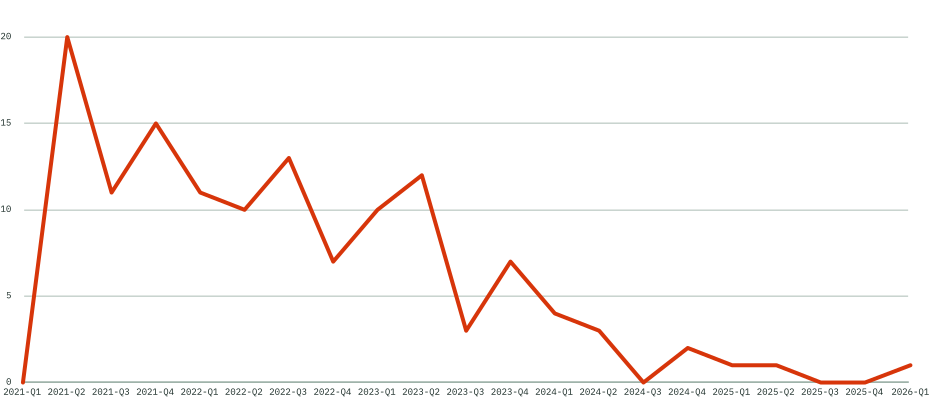
Meta’s annual commitment that Ball referenced, of $10 billion, represents all Reality Labs spending, including game development, some A.I. investments, and its EssilorLuxottica collaboration. Even so, despite a complete change in corporate priorities explicitly in the direction of the metaverse, Meta’s long-term interest did not match its investment. Here is a chart I made of mentions of “metaverse” in the transcripts of quarterly earnings calls from Q1 2021 — the quarter before its public relations push — through Q1 2026:
Mentions of “metaverse” in Facebook/Meta quarterly earnings calls. Source: company transcripts.
The highest point on that chart is the Q2 2021 earnings call I used earlier for the definition of “metaverse”; the second-highest is Q4 2021, the first earnings call after Connect 2021. The total count includes mentions in Meta’s prepared remarks, plus the question-and-answer period that follows. Investor conference calls are not a perfect proxy for a company’s priorities, but they are indicative. At the very least, for a company that entirely changed course with a new goal — “from now on, we’re going to be metaverse-first” — and a directly relevant name, one might imagine the company and analysts will be similarly eager to discuss how that is going. But no. In Q4 2022, mentions are half that of the year prior. By Q1 2024, neither Meta nor the analysts on the call seem to care all that much — while there were just four mentions of “metaverse”, there were ninety of “A.I.”.
This speaks volumes. It is the kind of thing that makes you wonder if this company was ever serious about this metaverse pivot at all. It seems like it had every intention, sure, but could it ever have executed on its vision? Of the four interviewers chosen for pieces related to Connect 2021, only Ben Thompson even thought to question its feasibility. (Thompson was also the only one to say he was permitted to view a copy of the presentation in advance. I do not know if this means the other three interviewers did not see it and, therefore, could not interrogate it more thoroughly, or if they did see it and simply did not bother to ask.) At the time, Facebook had no track record in building an operating system, barely had any credibility in hardware, and it only kind of created a platform on its “blue site”. (It arguably avoided creating platforms for developers with Instagram and WhatsApp.) This same company was claiming it was launching the successor to the smartphone and the next iteration of the internet. Every one of these chosen interviewers should have been all over this, but they were too distracted by the rebrand and Facebook’s sordid history to notice it was only a concept video more than it was any kind of real concept.
2. The Others
While Meta made itself the face and name of the metaverse, it was far from alone in promising the immersive computing platform of the near-future. Time basically acknowledged this by declaring one of the best inventions of 2021 was the Qualcomm Snapdragon XR2 — a foundational headset chip, rather than Meta’s attempt to build the platform.
In April 2020, Washington Post reporter Gene Park proclaimed the “next version of the Internet is often described as the Metaverse”, going on to confidently explain how it would be built. Of all the companies involved, Park wrote, “it’s Epic Games, with Fortnite, that has the most viable path forward in terms of creating the metaverse”, citing Ball’s seminal metaverse essay.
In April 2021, months before Facebook began asserting its commitment, Epic Games announced it had raised a billion dollars to “support [its] long-term vision for the metaverse” with $200 million of that coming from Sony. A year later, Epic raised another $2 billion, a billion of which again came from Sony, and the other billion from Lego. In 2023, a Lego game was added to Fortnite, which is not really the metaverse as much as it is a nifty Minecraft-like game-within-a-game.
Yet in Epic Games’ telling, it is basically delivering the metaverse already. CEO Tim Sweeney spoke at the 2023 Game Developers Conference about the company’s vision. Since there are around 600 million monthly active users of games, like Fortnite and Minecraft, set in virtual worlds, Sweeney reckoned “we can set aside the crazy hype cycle around NFTs and VR goggles. Yes, these technologies may play a role in the future, but they are not required. This revolution is happening right now.” Sweeney spoke of interconnectedness and open standards that would allow users to move between different spaces in a unified way. “What a user would really like is to be able to buy a cool-looking outfit in one place and take it everywhere they go” Sweeney claimed. (Why do they always mention digital clothes? My theory is because they do not view fashion as having much value beyond a basic assessment that how someone dresses is an expression of identity.) Sweeney describes Fortnite, Unreal Engine, and the Epic Games Store as “on-ramps to the metaverse”, and that the users of which already understand their in-game socialization can be extended to “going to a concert and dancing” in a virtual environment. Leaving aside the contradiction with definitions of the metaverse that mandate a more immersive environment, it is a big leap to think a brief animation of Eminem scratches the same itch as an actual performance.
Microsoft, as ever ahead of a trend without fully conceptualizing it, said it was doing metaverse stuff before Facebook started referencing it in public. Satya Nadella, defining the metaverse as “made up of digital twins, simulated environments, and mixed reality”, claimed a mix of Azure features, HoloLens, and Mesh would allow enterprises to get aboard. Last year, Microsoft said it was getting out of V.R. hardware and turning its mixed reality collaboration product into a glorified Snapchat filter in Teams.
Then there is Roblox. When Andreessen Horowitz announced its investment in the company, Marc Andreessen and David George wrote that “[w]hile pundits have been distracted by the readiness debates and questions over V.R. vs. A.R., the foundations of a global metaverse have been quietly built in the background… in Roblox”. This was in February 2020 — before Epic Games, before Microsoft, and well before Meta said anything in public about the metaverse. In January 2021, as part of Wired’s predictions for the coming year, Roblox CEO David Baszucki confidently predicted “the metaverse will experience widespread use, and start to become a human co-experience utility”. In March, the company went public at a $30 billion valuation. After Facebook changed its name to Meta, Baszucki saw that as validation of its strategy. That November, he made the rounds on business television networks like Bloomberg and CNBC to advocate for the company as a trailblazer.
In January 2022, Bernhard Warner of Fortune was getting excited about the possibilities of the metaverse, writing it “might be the most important trend in tech since the iPhone”, perhaps “a tectonic shift in tech that they [big tech and big investors] can’t afford to miss”. The way Roblox was “monetizing the metaverse” was a key piece of evidence, with virtual concerts and — most importantly — brands. “A parade of consumer brands […] have set up a presence on Roblox in the past year”, wrote Warner, citing Nike’s approach as being particularly exciting. A month earlier, it had acquired a company called RTFKT, which its press release extolled was a “leading brand that leverages cutting edge innovation to deliver next generation collectibles”. Guggenheim Securities, a subsidiary of Guggenheim Partners which has over $350 billion in assets under management, said it was the “‘best idea’ of 2022”, according to Warner. People are going to need virtual outfits, right? Yet, just three years later, Nike shut down RTFKT.
Gucci, another of the brands with a virtual presence in Roblox, sold virtual handbags for in-game currency for a limited time in 2021 and 2022; users realized they could effectively counterfeit and resell them. At least one of Zuckerberg’s predictions kind of came true. And, while Warner highlighted Disney as another company with in-game presence, it has not maintained a meaningful investment because, according to Variety, it feels Roblox is unsafe for children, a sentiment that was not helped when Baszucki appeared on the “Hard Fork” podcast. Roblox has settled lawsuits with the attorneys general of Nevada, Alabama, and West Virginia over accusations its platform features enabled child exploitation by other users. Roblox has denied any wrongdoing though it says it is enabling better parental controls and tighter restrictions on children’s accounts.
Through 2021 and 2022, the metaverse hype cycle was apparent across the tech industry. Max A. Cheney, reporting for Barron’s in August 2021, noted “[m]entions of the metaverse in earnings transcripts and other corporate documents are up five times this year compared with 2020, according to data from Sentieo”. This relative figure must have a hilariously low baseline, sure, but it is an indicator of how many businesses became briefly enchanted by this concept. There were serious financial analyses of real estate in the metaverse. Keep in mind that what is meant by “real estate” is much, much, much closer to domain names than it is land and deed. In July 2022, Technavio, a market research company, forecasted this market would be worth $5.37 billion by 2026. This report was picked up by Debra Kamin, of the New York Times, who published an article in the paper’s real estate section in February 2023 explaining this “new frontier for real estate builders and investors”. The primary anecdote in Kamin’s story is a just-completed mansion in Florida with a “twin” in a metaverse platform called the Sandbox. “As these technologies get more immersive”, the homebuilder said, “it’s going to make a lot more sense” to have a 3D virtual model of a house. Kamin was not breaking news on this specific story, as it was first reported by Emma Reynolds, of Forbes, over a year earlier. One would think that Kamin could therefore have asked some more probing questions or surveyed the actual market for NFTs which, by 2023, had fallen off a cliff. But no. Instead, the builder got the imprimatur of the Times describing the combined physical and digital sale in flattering terms. Ultimately, neither the listing nor many of the sale notices mentioned the sole marketing quirk of this house, suggesting that by 2023 the novelty of a digital model of a mansion was kind of over. I was curious if the NFT was a factor in the buyer’s decision, but did not receive a response to requests for comment I sent to a phone number associated with the current owner of the property.
Both the Times and Forbes articles are individual disasters in their own right. Sure, we might not expect a pinacle of journalistic integrity from Forbes and, to a lesser extent, the unabridged property ads that form the real estate section in prestigious newspapers including the Times. But to communicate this nonsense with the framing of “real estate” is treating wild speculation with unearned seriousness. This project was also co-signed by Sotheby’s. The whole thing is an embarrassing validation of a market that, predictably, would prove to have no substance. This was obvious by the time the metaverse mansion was being peddled. Eric Ravenscraft, in Wired in December 2021, reported that the attempts at artificial scarcity “more closely resembles early-access video games and common pump-and-dump schemes” than a real estate market. Indeed, a Coingecko analysis found metaverse “land” was worth 34% less in 2024 compared to the year prior, and 72% less than at its peak in 2022. This was an average across several platforms, and the biggest decline was in the Sandbox, the digital home of that mansion’s 3D model twin. According to a CoinDesk report published last year, the Sandbox laid off half its employees and its token has dropped in value from its peak by 90%. As of March 2026, user rights to space in Sandbox and Decentraland — another metaverse platform — that had originally sold for hundreds-of-thousands to millions of dollars were not a market totalling $5.37 billion as forecasted by Technavio. They had become basically worthless.
3. Fever Dream
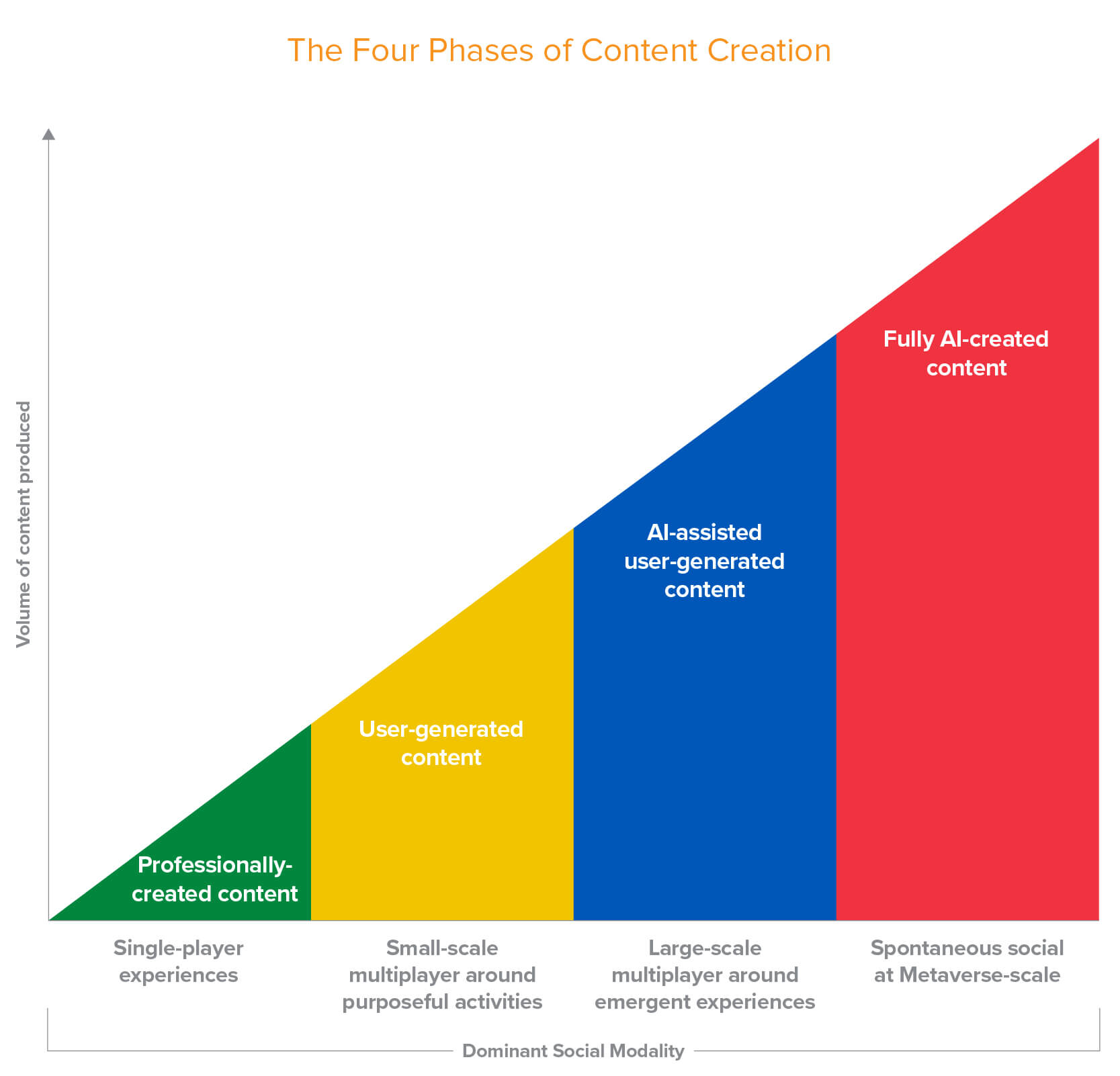
Officially, Meta is still all-in on the concept around which it pivoted the entire company in 2021. It still has a whole marketing page proclaiming its belief “in the future of connection in the metaverse”. You can go shop its lineup of Quest headsets which Meta says represent the best and most immersive metaverse experience, though its flagship model is now two-and-a-half years old. It has awkwardly promoted its Ray-Bans as “A.I. glasses” despite them becoming the company’s most successful line of mixed reality products, and it is desperately trying to connect its newest muse of A.I. with its last one. The single mention of “metaverse” on its Q1 2026 earnings call (PDF) is when Zuckerberg claimed to be “excited for more of our metaverse efforts to be powered by the A.I. models we’re training as well”. If you want to be unfairly generous in your interpretation of Zuckerberg’s brief remark, you could point to a December 2020 Andreessen Horowitz piece, in which general partner Jonathan Lai refers to this shape as a “pyramid”, and says that “fully A.I.-created content” is directly correlated with “spontaneous social at metaverse scale”. Obviously. I am not feeling generous.
Others in the space have not fared much better. Roblox has not mentioned the word “metaverse” in its quarterly or annual reports since Q1 2022 (PDF). Epic Games scarcely mentions it in recent news releases, either: since January last year, just one announcement contains the word “metaverse”, while seven are dedicated to the lawsuits Epic has been fighting against Apple and Google. Far from the inevitable next chapter of the internet, the metaverse, supposedly the future of how we live, work, and play online, is a non-event.
Near the end of the Connect 2021 presentation, Nick Clegg, then Meta’s global affairs chief, said “the metaverse isn’t something we’re building, so much as it’s something we’re building for”. Olson, in his video, wryly notes that, in the eyes of its promoters, “the metaverse cannot fail; you can only fail to make the metaverse”. The metaverse is so inevitable that “you might even already be in it”, according to Barron’s. But the metaverse is not predestined; it never has been. It is a construction of tech companies that saw in the pandemic their future — not ours.
A slightly charitable interpretation of what I think the pandemic demonstrated to Facebook executives, for example, was how invaluable technology companies were in maintaining connections even when most people could not do so in-person. They recognized how much time people were spending in front of screens already, even in years prior, and assumed that could be a more social experience.
But a more cynical view is no less fair. With the pandemic undoubtably came a realization of how much money Facebook stood to make, if only it had a platform. In 2019, there were two publicly traded companies worth over a trillion U.S. dollars; by the end of 2021, there were five, with Apple and Microsoft now worth over two trillion dollars each. This pandemic was not going to last forever — but it did not need to. Our world was permanently changed, or so it would have seemed, and we would surely want to virtually attend concerts and buy PNG files of band t-shirts with real money. And these companies would take their cut.
One thing I have mentioned but did not emphasize is just how often Zuckerberg and Sweeney mention Apple and Google platform fees as a primary justification for building the metaverse. Sweeney spent several years fighting lawsuits against both companies, mostly winning the one against Google and mostly losing the one against Apple. His efforts have, nevertheless, shined a spotlight on these grotesque practices. But it would be a mistake to assume this is an objection on ideological grounds. These guys just want to take those commissions for themselves. Sweeney spent his GDC 2023 presentation comparing the need for open standards in the metaverse to the openness of the web, but unlike the web, the Epic Games store takes a 12% commission. Meta beat that, though; it even beat Apple and Google. By the time the individual fees are added together, transactions made through Horizon Worlds could be levied a commission of up to 47.5%. The money thing is not even a secret; it was often the very first thing people like Zuckerberg and Sweeney discussed in interviews about their metaverse plans. This was a financial decision before it was a product or service people might actually want to use.
It would not be fair to characterize Meta’s endeavour as an impulsive flash in the pan. Zuckerberg laid out his vision in a 2015 internal memo in which he explained how the company “would like a stronger strategic position in the next
wave of computing”. Then, in January 2017, the Chan Zuckerberg Initiative acquired a company called Meta, I think mostly for the name; a year later, Zuckerberg floated the idea of a rebrand. The 2015 memo that effectively set this whole thing into motion gives the impression of a surprisingly cogent document if you set aside the wildly optimistic timelines — “VR/AR will be the next major computing platform after mobile in about 10 years” — and the idea that virtual and augmented reality are so compelling it will supersede the desire for phones and televisions. If anything, the unearned confidence in this memo should have been alarming at the time. As Zuckerberg himself writes, the “core social networking work is no longer new, Internet.org is extending something rather than inventing it, and A.I. is not yet tangible”. This is not a company known for doing new, and it is now stuck with a name reflecting a bungled attempt to change that. Staff are not happy after years of mass layoffs, court losses, role reassignments, and internal surveillance to feed the company’s A.I. projects. Do not get me wrong — Meta’s business of collecting vast amounts of information about its users and selling relevant ad slots is as strong as it has ever been. But Meta the ad company is not Meta the platform innovator.
And this feels like the why of it all. If tech companies can channel a meaningful sliver of our entire lived experience into a world of their creation, one where they collect a portion of revenue, it would make them inescapable. Ball, Sweeney, and Zuckerberg may have all written or spoken about the importance of interoperability and open standards, but these platforms want to exercise a degree of control more similar to native software than to the open web. The steps for migrating from Horizon Workrooms to a competitor’s product, for instance, are not what one would expect if openness were a priority.
For a brief couple of years, it seemed like there could be enough enthusiasm from reporters in the space, venture capitalists, and executives to make the metaverse happen. Then ChatGPT launched in November 2022, and the pandemic ended in the U.S. in May 2023, and any interest anyone may have had for spending more time with people in a virtual setting largely evaporated. It turns out we are okay with having meetings and playing games online, but we actually like seeing live music in-person and travelling to real places. The problems each of these things may have — high costs, environmental impact, and so on — are notable and real, but are not ones with metaverse-based solutions.
The pandemic did not make the metaverse. There was sufficient interest in developing it well before then, and it is possible all of these companies would have announced all these products and services on the same timeline. But in a world without a pandemic, I cannot imagine anyone would have treated these metaverse announcements with anything like the seriousness they did. The pandemic officially ended in the U.S. just six months after the first release of ChatGPT, so it is impossible to disentangle the influence of either. But it is notable to me that the nosedive in mentions of “metaverse” on Meta’s investor calls occurred in Q3 2023 — the quarter immediately following the declared end of the pandemic.
As for the futurists like Hackl, who confidently proclaimed the metaverse was “for certain”, they have found an out thanks to its flexible definition. Jeff Barrett, of the Shorty Awards’ “It’s No Fluke” podcast, published a glowing profile of “the Godmother of the Metaverse” earlier this year under the headline “Why Cathy Hackl Keeps Getting the Future Right”. “When enthusiasm cooled and narratives collapsed, many distanced themselves from the space”, writes Barrett, noting with seeming approval that “Hackl did the opposite. She reframed it”. Many people — perhaps everyone, come to think of it — could predict the future if they got to retcon their predictions to fit reality.
There are many open questions about the metaverse; most glaringly among them, whether it could actually become a thing for normal people. That depends a little bit on what definition we use. If it simply means the slow erosion of the boundary between our physical and digital environments, that is probably something that will continue to happen. For most people, though, that does not look like Meta’s Connect 2021 concept animations. Whatever that ends up being will probably be the result of people finding something useful and intriguing about doing something different. It will not be the product of big companies redirecting the money hose of platform fees onto themselves.
With thanks to Marquette University for granting me access to the Zuckerberg Files. A frustrating number of Zuckerberg’s post-Meta interviews are video-based, so the transcripts produced by this effort were invaluable. Where possible, I have checked these copies against the originals.
Jason and Myke tell the story of Apple’s origin. It emerged from the unique environment of the Santa Clara valley suburbs of the ’70s thanks to the particular genius of its two co-founders and some surprising help they got along the way.
Though I was familiar with much of this, I cannot think of many better people to tell it than Jason Snell. I have already seen one thinkpiece after another about what a fifty year-old — ish — Apple means in the grand scope, and there is definitely a place for that. Today’s Apple is a long way from this origin story, of course, but what a story it is.
This gives me an excuse to explain why I am fascinated by this one computer company. Though this story is great, that is not why, nor is it the history of successfully bringing the graphical user interface to the market, nor the ’90s–’00s turnaround. Those are all parts of it. But the main reason I am fascinated by Apple is that it has built such a distinct identity for itself. It has not always stuck to it but, if anything, I think that helps reinforce the existence of an Apple-y identity. Some might attribute that to a particular way of marketing itself which, while true, also emphasizes how important that identity is: when its messaging does not match the products, services, experience, or expected corporate behaviour, it is noticeable.
This is all a bit mythical, to be sure. The garage-era Steves probably would not imagine Apple celebrating its fiftieth birthday by being the second most valuable corporation in the world, nor would they think it would hire Paul McCartney for its employee party. To me, one of those things feels more Apple-y than the other. It feels right for the company to celebrate with a music legend; it probably does not need to be quite so rich or powerful to do that, though. Apple has long been a really, really big corporation, and that — in itself — does not feel very Apple-y to me. That, too, is fascinating.
The Unicode Consortium would like to remind you to work closely with them if you are introducing a new symbol for your currency:
Such public usage leads to a need for the symbol to be encoded in the Unicode Standard and supported in commercial software and services. Standardization of a new character and subsequent support by vendors takes time: typically, at least one year, and often longer. All too often, however, monetary authorities announce creation of a new currency symbol anticipating immediate public adoption, then later discover there will be an unavoidable delay before the new symbol is widely supported in products and services.
I had no idea so many currency symbols had been introduced recently. Then again, before I read this, I had not given much thought to the one we use: $.
The most widely accepted theory does in fact involve Spanish coinage, and it goes like this: in the colonies, trade between Spanish Americans and English Americans was lively, and the peso, or peso de ocho reales, was legal tender in the US until 1857. It was often shortened, so historians tell us, to the initial ‘P’ with an ‘S’ hovering beside it in superscript. Gradually, thanks to the scrawl of time-pressed merchants and scribes, that ‘P’ merged with the ‘S’ and lost its curve, leaving the vertical stroke like a stake down the centre of the ‘S’. A Spanish dollar was more or less worth an American dollar, so it’s easy to see how the sign might have transferred.
Not only the explanation for why all the world’s dollars have the same symbol, but also why we share it with the peso.
Apple’s MacBooks haven’t always been monolithic, barely repairable slabs of aluminum, glass, and glue. They used to be almost delightful in their repairable features, from their batteries to their Wi-Fi cards. Powerbooks, iBooks, and especially early MacBooks showed what happens when Apple applies its design skills directly to repairability and maintenance, instead of to thinness above all. Today we’re going to take a look at the best repairability features that Apple has ditched.
These four complaints range from the somewhat quaint — swappable Wi-Fi cards — to the stuff I actually miss, which is everything else. RAM and disk upgrades are a gimme since the cost-per-gigabyte (generally) declines over time, and I would love easily swappable batteries. But right now, nearly four years into owning this MacBook Pro, I would also really like to be able to swap in a new keyboard in the future. Not only are the keycaps unintentionally becoming polished, some oft-used keys feel a little mushy. Not much, and barely enough to notice, but I imagine their clickiness will not improve over time.
One quibble, emphasis mine:
[…] I have an old 2012 MacBook Air running Linux. I swapped the HDD for an SSD, maxed out the RAM, and dropped in a new battery, and I see no reason it wouldn’t easily keep rolling for another 10 years.
Unlikely. The 2012 MacBook Air only came with an SSD; a standard hard disk was not an option.
In a WWDC 2011 session, Dan Schimpf explained some of the goals of the refreshed design for Aqua in Mac OS X Lion were “meant to focus the user attention on the active window content”. This sentiment was echoed by John Siracusa in his review of Lion for Ars Technica:
Apple says that its goal with the Lion user interface was to highlight content by de-emphasizing the surrounding user interface elements.
[…] a fresh modern look where controls are clearer, smarter and easier to understand, and streamlined toolbars put the focus on your content without compromising functionality.
Then, when it revealed the Big Sur redesign in 2020, it explained:
The entire experience feels more focused, fresh, and familiar, reducing visual complexity and bringing users’ content front and centre.
And you will never guess what it promised in 2025 with the announcement of MacOS Tahoe and Liquid Glass, as introduced by Alan Dye:
Our goal is a beautiful new design that brings joy and delight to every user experience. One that’s more personal, and puts greater focus on your content — all while still feeling instantly familiar.
It is not just Apple, either. Here is Microsoft’s Jensen Harris at Build 2011 describing a key goal for the company’s then-new Metro design language:
Metro-style apps have room to breathe. They’re not about the chrome, they’re about the content. […] For years, Windows was always about adding stuff. We added bars, and panes, and doodads, and widgets, and gadgets, and bars — and stuff everywhere. And that’s how we defined our U.I., based on what new widgets we added. Now, we’ve receded into the background, and the app is sitting out there on the stage.
And later, as Microsoft rolled out app updates with its Fluent Design language, it described them in familiar terms:
With the updated OneDrive, your content takes center stage. The improved visual design reduces clutter and distractions, allowing you to focus on what’s important – your content.
This is a laudable goal if the opposite is, I assume, increasing the amount of clutter in user interfaces and making them more distracting. Nobody wants that. Then again, while the objective may be quite reasonable, there are surely different ways of achieving it — but Apple has embraced a single strategy: make the interface blend into the document. (I will be focusing on MacOS here as it is the platform I am most familiar with.)
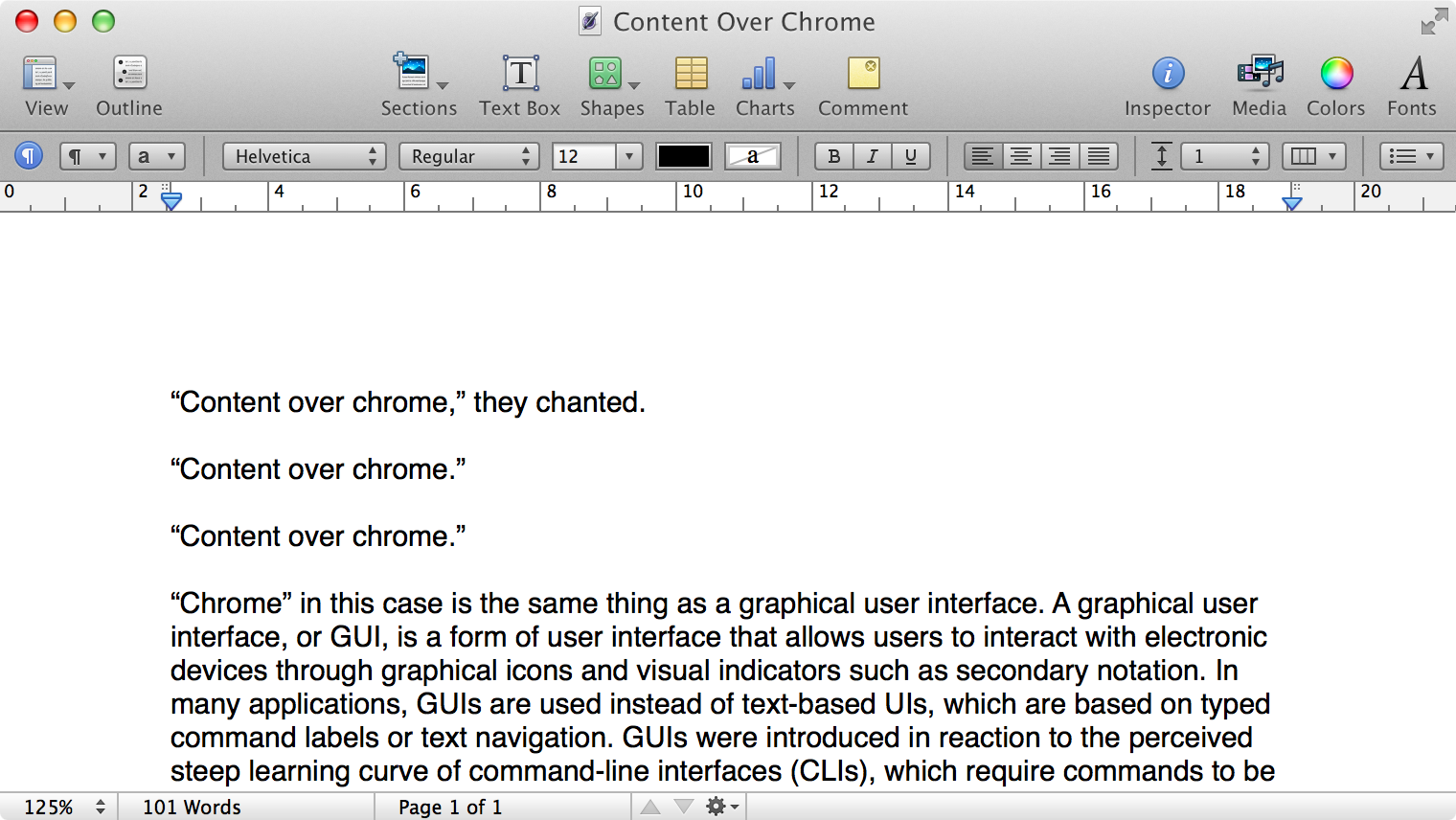
Here is what a Pages document looks like running under Mac OS X Lion:
Click to expand (except on mobile).
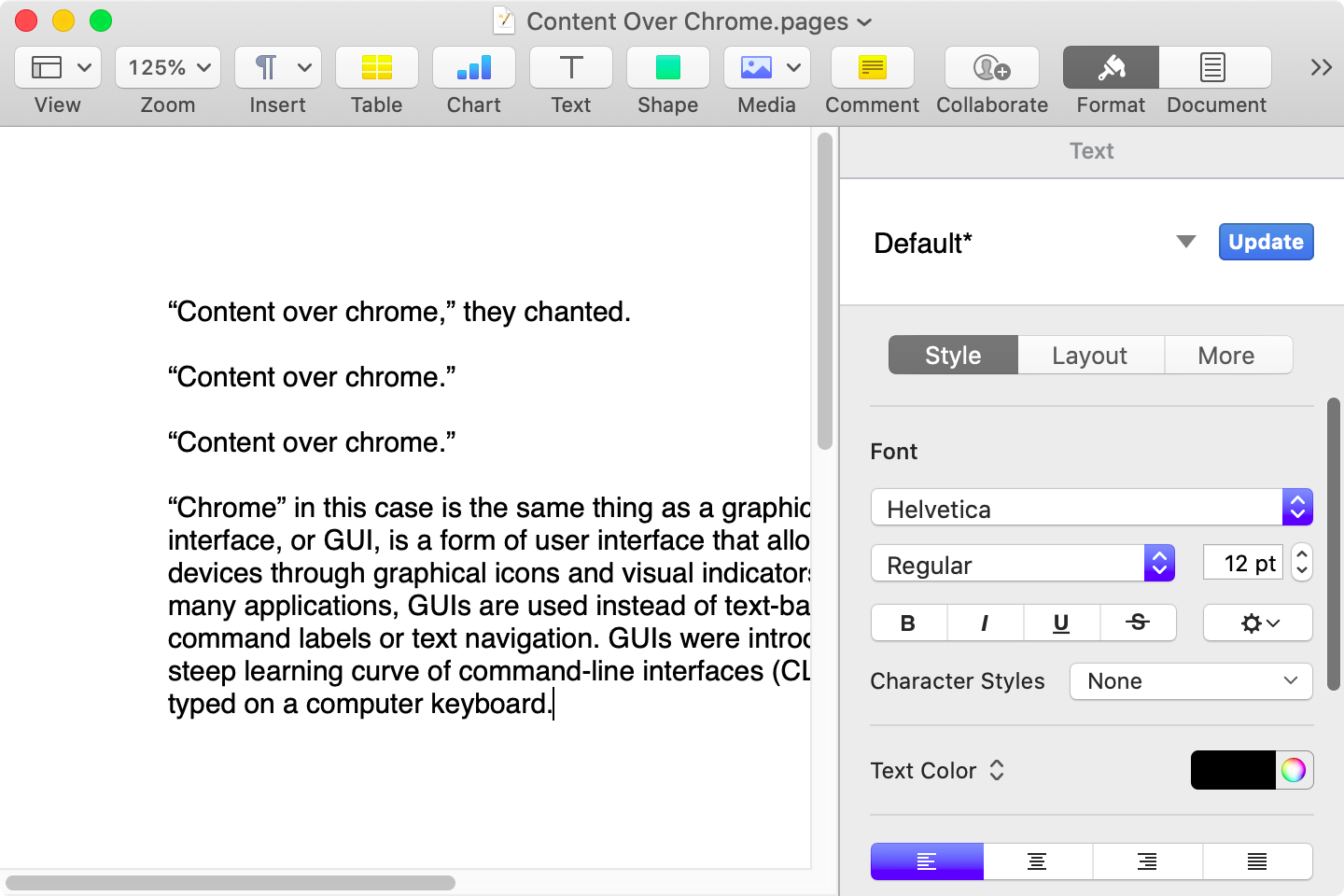
Here is that same document in a newer version of Pages running on MacOS Catalina, with the Yosemite-era design language that replaced the one that came before:
Click to expand (except on mobile).
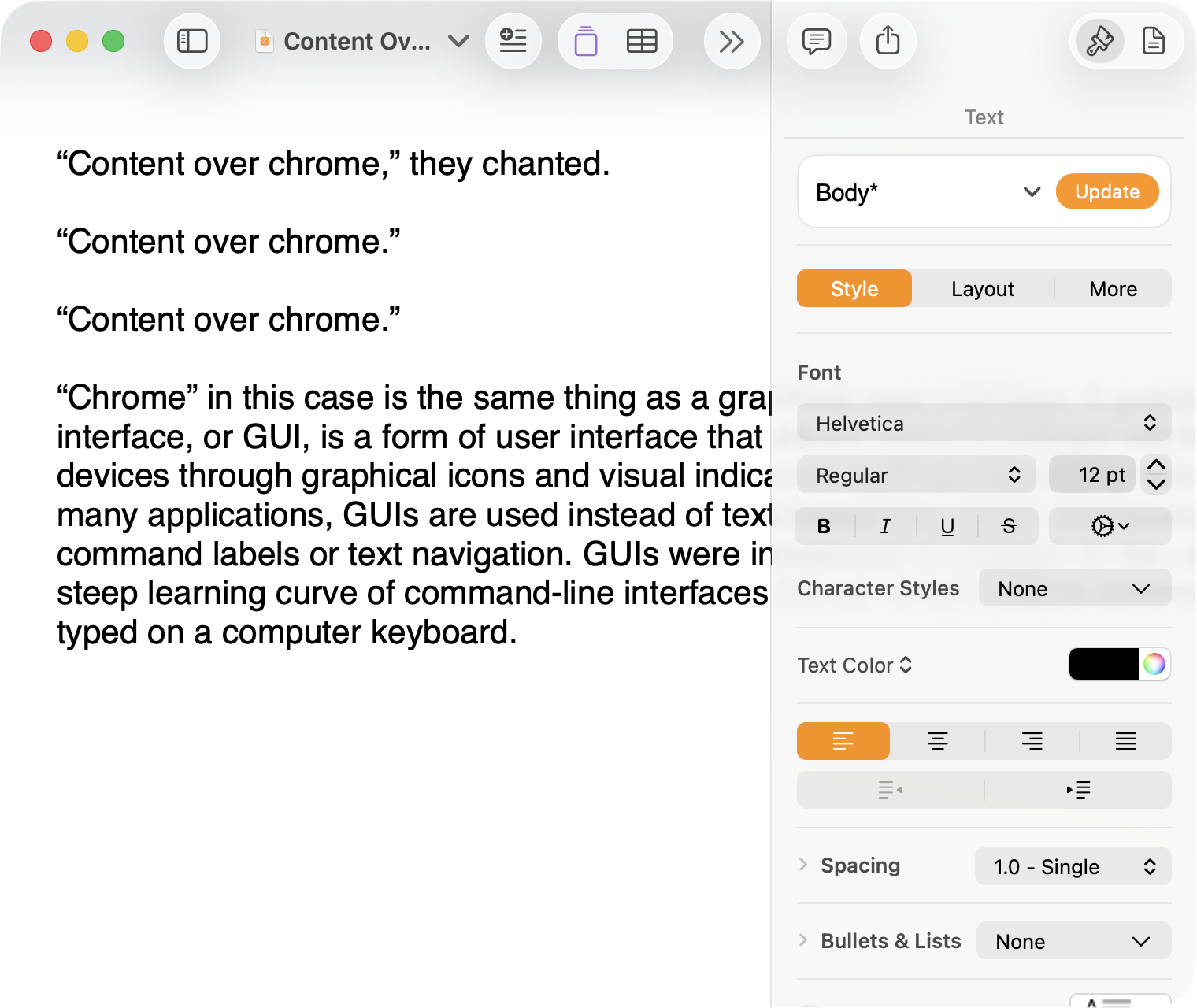
Here it is in the last version of Pages on MacOS Tahoe, using the design language introduced with Big Sur:
Click to expand (except on mobile).
And, finally, the newest version of Pages on MacOS Tahoe using the current Liquid Glass visual design language:
Click to expand (except on mobile).
There are welcome improvements in newer versions of this comparison, like the introduction of the “Format” panel on the right-hand side, which makes better use of widescreen landscape-oriented displays, and allows for larger controls. While I admire the density of the Lion-era screenshot, the mini-sized controls in that formatting menu are harder to click.1
Overall, however, what Apple has done to Pages over this period of time is representative of a broader trend of minimizing the delineation of user interface elements from each other and the document itself. This is the only tool in the toolbox, and I am skeptical it achieves what Apple intends.
Compare again the two more recent screenshots against the ones that came before, and focus on the toolbar at the top of each. In the older two, there is a well-defined separation between the toolbar — the window itself — and the document. In the Big Sur visual language, however, the toolbar is the same bright white as the document. By Tahoe and the Liquid Glass language, there is barely a distinction; the buttons simply float over the document. And, bizarrely, that degrades further with the “Reduce Transparency” accessibility preference enabled:
Click to expand (except on mobile).
(Also, no, your eyes do not deceive you: the icons in the drop cap menu, barely visible in the lower-right, are indeed pixellated.)
For me, this means a constant distraction from my document because the whole window has a similar visual language. As the toolbar and its buttons become one with the document, they lose their ability to fade into the background. In the two older examples, the contrast of the well-defined toolbar allows me to treat them as an entirely separate thing I do not need to pay attention to.
This is further justified by the lower contrast within those two older toolbars. In Lion, the grey background and moderately saturated colours are a quiet reminder of tools that are available without them being intrusive. The mix of shapes is a sufficient differentiator, something Apple threw away in the following screenshot. By making all the buttons literal and with the same bright background, the toolbar becomes a little more distracting — but at least it does not blend into the document. Without the context of the previous screenshot, the colours of each icon seem almost random, and I find the yellow-on-white “Table” button difficult to distinguish at a glance from the black-on-yellow-on-white “Comment” button.
The Big Sur-era design language is, frankly, an atrocious regression. The heterogeneous shapes may have returned, but in the form of monochromatic medium-grey icons set against a uniform white background. The icons are not bad, per se — though putting “Add Page” and “Insert” next to each other in this default toolbar layout, both represented by a plus sign, is a little confusing. But I will bet you would not guess that some of these are buttons, while others are pop-up buttons with a submenu.
Finally, there is Liquid Glass which, in its default form, has more contrast than the previous example; with “Reduce Transparency” enabled, which is how I use MacOS, it has even less. The buttons themselves have a greater amount of internal contrast with bigger, darker grey icons on a white background. This is preferential within the context of the toolbar compared to the thin, small, and low-contrast buttons in the past example, but it also means this toolbar has similar contrast to the document itself.
I would not go so far as to argue that Pages ’09 has a perfect user interface and that everything since has been a regression. The average colours used for the icon fill in both older toolbars generally fails accessibility contrast checks which, remarkably, the Big Sur design will pass. The icons in Pages ’09 rely on dark outlines and unique shapes to have sufficient contrast with the toolbar background. However, Apple has since discarded most variables it could change to design these interfaces. Every button contains an icon of a single uniform colour, within barely defined holding containers of the same shape, and without text labels by default.
This monochromatic look means any splash of colour is distracting. The yellow accent used in Pages is garish — though, thankfully, something that can mostly be mitigated by changing the Theme Colour in System Settings, under Appearance. (Unfortunately, the yellow background remains on the “Update” button in the most recent version of Pages regardless of the system accent colour.) But perhaps you also noticed the purple icon in the Liquid Glass screenshot above. Here is the full toolbar:
Click to expand (except on mobile).
Those purple icons signify features that are part of Apple Creator Studio, a paid subscription to Pages and other applications that allows you to — in the order they are presented above — generate an image, artificially boost the resolution of an image, and access a stock image library. If you would like to insert one of your own images into your Pages document, that feature has been moved to the paperclip icon. Yes, it is a menu and not a button, despite lacking the disclosure triangle of the zoom menu right beside it, and it also reminds you about the “Content Hub” and “Generate Image” features. In Pages under Lion, colour was used in the icons to help guide the user as they complete a task — click the green thing to add a shape; click the darker yellow thing to add a table. Colour is not being used in the newer version to signify these are A.I. features, as the “Writing Tools” icon remains dark grey. In this version, the coloured icons are there to guide the user to premium add-ons regardless of whether they are currently paying for them.
I decided to focus on Pages for this comparison because it has lived so many different lives in MacOS. However, it is perhaps an imperfect representation for the rest of the system. Across Mac OS X Lion, for example, the toolbars of first-party applications like Finder and Preview almost exclusively use monochromatic icons. This has been true since Mac OS X Leopard, which also introduced barely differentiated folder icons. Some toolbars in Tiger, introduced two years prior, featured icons inside uniform capsule shapes. These were questionable ideas at the time, but they still retained defining characteristics. The capsules, for example, may have had a uniform shape, but contained within were full-colour icons. Most importantly, they were all clearly controls that were differentiated from the document.
Perhaps Apple has some user studies that suggest otherwise, but I cannot see how dialling back the lines between interface and document is supposed to be beneficial for the user. It does not, in my use, result in less distraction while I am working in these apps. In fact, it often does the opposite. I do not think the prescription is rolling back to a decade-old design language. However, I think Apple should consider exploring the wealth of variables it can change to differentiate tools within toolbars, and to more clearly delineate window chrome from document.
These screenshots are a bit limited as, to capture a high-resolution interface, I switched my mid-2012 MacBook Air to a 720 × 450 display output, which shrank the available space for Pages in the Lion and Catalina screenshots. ↥︎
This article is about covert agent communication channel websites used by the CIA in many countries from the late 2000s until the early 2010s, when they were uncovered by counter intelligence of the targeted countries circa 2010-2013.
This is a pretty clever scheme in theory, but seems to have been pretty sloppy in practice. That is, many of the sites seem to share enough elements allowing an enterprising person to link the seemingly unrelated sites — even, as it turns out, years later and after they have been pulled offline. That apparently resulted in the deaths of, according to Foreign Policy, dozens of people.
Greg Storey begins this piece with a well-known quote from Plato’s “Phaedrus”, in which the invention of writing is decried as “an elixir not of memory, but of reminding”. Storey compares this to a criticism of large language models, and writes:
Even though Plato thought writing might kill memory, he still wrote it down.
If anything, I think Storey’s error in attribution actually reinforces the lesson we can draw from it. If we relied on the pessimism of Socrates, we might not know what he said today; after all, human memory is faulty. Because Plato bothered to write it down, we can learn from it. But the ability to interpret it remains ours.
What struck me most about this article, though, is this part:
The real threat to creativity isn’t a language model. It’s a workplace that rewards speed over depth, scale over care, automation over meaning. If we’re going to talk about what robs people of agency, let’s start there. […]
Thanks to new technologies — from writing to large language models, from bicycles to jets — we are able to dramatically increase the volume of work done in our waking hours and that, in turn, increases the pressure to produce even more. The economic term for this is “productivity”, which I have always disliked. It distills everything down to the ratio of input effort compared to output value. In its most raw terms, it rewards the simplistic view of what a workplace ought to be, as Storey expresses well.
When people wistfully proclaim that they wish for the next major macOS version to be a “Snow Leopard update”, they’re wishing for the wrong thing. No major update will solve Apple’s quality issues. Major updates are the cause of quality issues. The solution would be a long string of minor bug fix updates. What people should be wishing for are the two years of stability and bug fixes that occurred after the release of Snow Leopard. But I fear we’ll never see that again with Tim Cook in charge.
I read an article today from yet another person pining for a mythical Snow Leopard-style MacOS release. While I sympathize with the intent of their argument, it is largely fictional and, as Johnson writes, it took until about two years into Snow Leopard’s release cycle for it to be the release we want to remember:
It’s an iron law of software development that major updates always introduce more bugs than they fix. Mac OS X 10.6.0 was no exception, of course. The next major update, Mac OS X 10.7.0, was no exception either, and it was much buggier than 10.6.8 v1.1, even though both versions were released in the same week.
What I desperately miss is that period of stability after a few rounds of bug fixes. As I have previously complained about, my iMac cannot run any version of MacOS newer than Ventura, released in 2022. It is still getting bug and security fixes. In theory, this should mean I am running a solid operating system despite missing some features.
It is not. Apple’s engineering efforts quickly moved toward shipping MacOS Sonoma in 2023, and then Sequoia last year. It seems as though any bug fixes were folded into these new major versions and, even worse, new bugs were introduced late in the Ventura release cycle that have no hope of being fixed. My iMac seizes up when I try to view HDR media; because this Extended Dynamic Range is an undocumented enhancement, there is no preference to turn it off. Recent Safari releases have contained several bugs related to page rendering and scrolling. Weather sometimes does not display for my current location.
Ventura was by no means bug-free when it shipped, and I am disappointed even its final form remains a mess. My MacBook Pro is running the latest public release of MacOS Sequoia and it, too, has new problems late in its development cycle; I reported a Safari page crashing bug earlier this week. These are on top of existing problems, like how there is no way to change the size of search results’ thumbnails in Photos.
Alas, I am not expecting many bugs to be fixed. It is, after all, nearly April, which means there are just two months until WWDC and the first semi-public builds of another new MacOS version. I am hesitant every year to upgrade. But it does not appear much effort is being put into the maintenance of any previous version. We all get the choice of many familiar bugs, or a blend of hopefully fewer old bugs plus some new ones.
Enron is not really back. Someone managed to grab the Enron.com URL and put up an inspirational faux corporate video and a Shopify merch store. It is all very funny.
Brendan Nystedt, reporting for Wired on a new generation of admirers of crappy digital cameras from the early 2000s:
For those seeking to experiment with their photography, there’s an appeal to using a cheap, old digital model they can shoot with until it stops working. The results are often imperfect, but since the camera is digital, a photographer can mess around and get instant gratification. And for everyone in the vintage digital movement, the fact that the images from these old digicams are worse than those from a smartphone is a feature, not a bug.
Retromania? Not really. It feels more like a backlash against the excessive perfection of modern cameras, algorithms, and homogenized modern image-making. I don’t disagree — you don’t have to do much to come up with a great-looking photo these days. It seems we all want to rebel against the artistic choices of algorithms and machines — whether it is photos or Spotify’s algorithmic playlists versus manually crafted mixtapes.
I agree, though I do not see why we need to find just one cause — an artistic decision, a retro quality, an aesthetic trend, a rejection of perfection — when it could be driven by any number of these factors. Nailing down exactly which of these is the most important factor is not of particular interest to me; certainly, not nearly as much as understanding that people, as a general rule, value feeling.
I have written about this before and it is something I wish to emphasize repeatedly: efficiency and clarity are necessary elements, but are not the goal. There needs to be space for how things feel. I wrote this as it relates to cooking and cars and onscreen buttons, and it is still something worth pursuing each and every time we create anything.
I thought about this with these two articles, but first last week when Wil Shipley announced the end of Delicious Library:
Amazon has shut off the feed that allowed Delicious Library to look up items, unfortunately limiting the app to what users already have (or enter manually).
I wasn’t contacted about this.
I’ve pulled it from the Mac App Store and shut down the website so nobody accidentally buys a non-functional app.
Delicious Library was many things: physical and digital asset management software, a kind of personal library, and a wish list. But it was also — improbably — fun. Little about cataloguing your CDs and books sounds like it ought to be enjoyable, but Shipley and Mike Matas made it feel like something you wanted to do. You wanted to scan items with your Mac’s webcam just because it felt neat. You wanted to see all your media on a digital wooden shelf, if for no other reason than it made those items feel as real onscreen as they are in your hands.
Delicious Library became known as the progenitor of the “delicious generation” of applications, which prioritized visual appeal as much as utility. It was not enough for an app to be functional; it needed to look and feel special. The Human Interface Guidelines were just that: guidelines. One quality of this era was the apparently fastidious approach to every pixel. Another quality is that these applications often had limited features, but were so much fun to use that it was possible to overlook their restrictions.
I do not need to relitigate the subsequent years of visual interfaces going too far, then being reeled in, and then settling in an odd middle ground where I am now staring at an application window with monochrome line-based toolbar icons, deadpan typography, and glassy textures, throwing a heavy drop shadow. None of the specifics matter much. All I care about is how these things feel to look at and to use, something which can be achieved regardless of how attached you are to complex illustrations or simple line work. Like many people, I spend hours a day staring at pixels. Which parts of that are making my heart as happy as my brain? Which mundane tasks are made joyful?
This is not solely a question of software; it has relevance in our physical environment, too, especially as seemingly every little thing in our world is becoming a computer. But it can start with pixels on a screen. We can draw anything on them; why not draw something with feeling? I am not sure we achieve that through strict adherence to perfection in design systems and structures.
I am reluctant to place too much trust in my incomplete understanding of a foreign-to-me concept rooted in another country’s very particular culture, but perhaps the sabi is speaking loudest to me. Our digital interfaces never achieve a patina; in fact, the opposite is more often true: updates seem to erase the passage of time. It is all perpetually new. Is it any wonder so many of us ache for things which seem to freeze the passage of time in a slightly hazier form?
I am not sure how anyone would go about making software feel broken-in, like a well-worn pair of jeans or a lounge chair. Perhaps that is an unattainable goal for something on a screen; perhaps we never really get comfortable with even our most favourite applications. I hope not. It would be a shame if we lose that quality as software eats our world.
Keeping URIs so that they will still be around in 2, 20 or 200 or even 2000 years is clearly not as simple as it sounds. However, all over the Web, webmasters are making decisions which will make it really difficult for themselves in the future. Often, this is because they are using tools whose task is seen as to present the best site in the moment, and no one has evaluated what will happen to the links when things change. The message here is, however, that many, many things can change and your URIs can and should stay the same. They only can if you think about how you design them.
Links give greater meaning to our webpages. Without the link, we would lose this significant grammatical tool native the web. And as links die out and rot on the vine, what’s at stake is our ability to communicate in the proper language of hypertext.
A dead link may not seem like it means very much, even in the aggregate. But they are. One-way links, the way they exist on the web where anyone can link to anything, is what makes the web universal. In fact, the first name for URL’s was URI’s, or Universal Resource Identifier. It’s right there in the name. And as Berners-Lee once pointed out, “its universality is essential.”
In 2018, Google announced it was deprecating its URL shortener, with no new links being created after March 2019. All existing shortened links would, however, remain active. It announced this in a developer blog post which — no joke — returns a 404 error at its original URL, which I found via 9to5Google. Google could not bother to redirect posts from just six years ago to their new valid URLs.
Google’s URL shortener was in the news again this month because the company has confirmed it will turn off these links in August 2025 except for those created via Google’s own apps. Google Maps, for example, still creates a goo.gl short link when sharing a location.
In principle, I support this deprecation because it is confusing and dangerous for Google’s own shortened URLs to have the same domain as ones created by third-party users. But this is a Google-created problem because it designed its URLs poorly. It should have never been possible for anyone else to create links with the same URL shortener used by Google itself. Yet, while it feels appropriate for a Google service to be unreliable over a long term, it also should not be ending access to links which may have been created just about five years ago.
By the way, the Sophos link on the word “dangerous” in that last paragraph? I found it via a ZDNet article where the inline link is — you guessed it — broken. Sophos also could not bother to redirect this URL from 2018 to its current address. Six years ago! Link rot is a scourge.
The latest charge comes from SourceFed, a stray pop culture web and video site. It uploaded a short YouTube video on Thursday charging Google with deliberately altering search recommendations — through its function that automatically offers suggestions as a query is typed — to give positive treatment to Clinton.
Google vehemently denied the charges. “Google Autocomplete does not favor any candidate or cause,” a rep wrote. “Claims to the contrary simply misunderstand how Autocomplete works.”
A spokesperson for Google explained the search engine’s autocomplete feature will “not show a predicted query that is offensive or disparaging”, which is understandable. Eight years later, that appears to be how Google continues to work. A search for donald trump cr offers just one autocompleted suggestion: crypto. Another, for donald trump fe, presents no autocompletion suggestions even though he is a convicted felon. One can see why Google would choose to err on the safe side.
Mike Masnick, Techdirt, after a series of similar claims spread over the past few weeks:
The key point here is that some of this stuff just happens. It’s part of how algorithms work. Sometimes they make mistakes. Sometimes you disagree with why they do things. And people need to stop overreacting to it all. Most of the examples discussed in this article were just normal things that happen all the time, but which got a ton of extra attention because everyone’s on edge and amped up.
That doesn’t mean people shouldn’t be on the lookout for stuff, but don’t immediately jump to conclusions and assume malfeasance.
It is reasonable to want to hold technology companies to a high standard and expect them to be more competent, especially when it comes to election-related topics. In some cases, systems are being triggered as they should, but they are poorly explained to users by generic error messages. Others are just broken. None of this should be surprising in an era where even the largest platforms seem to be so fragile as to be held together by the software equivalent of thumbtacks and glue sticks.
SoftBank Corp. announced that it has developed voice-altering technology to protect employees from customer harassment.
The goal is to reduce the psychological burden on call center operators by changing the voices of complaining customers to calmer tones.
The company launched a study on “emotion canceling” three years ago, which uses AI voice-processing technology to change the voice of a person over a phone call.
Call center agents who have to deal with angry or perplexed customers all day tend to have through-the-roof stress levels and a high turnover rate as a result. About 53% of U.S. contact center agents who describe their stress level at work as high say they will probably leave their organization within the next six months, according to CMP Research’s 2023-2024 Customer Contact Executive Benchmarking Report.
Some think this is a problem artificial intelligence can fix. A well-designed algorithm could detect the signs that a call center rep is losing it and do something about it, such as send the rep a relaxing video montage of photos of their family set to music.
Here we have examples from two sides of the same problem: working in a call centre sucks because dealing with usually angry, frustrated, and miserable customers sucks. The representative probably understands why some corporate decision made the customer angry, frustrated, and miserable, but cannot really do anything about it.
So there are two apparent solutions here — the first reconstructs a customer’s voice in an effort to make them sound less hostile, and the second shows call centre employees a “video montage” of good memories as an infantilizing calming measure.
Brian Merchant wrote about the latter specifically, but managed to explain why both illustrate the problems created by how call centres work today:
If this showed up in the b-plot of a Black Mirror episode, we’d consider it a bit much. But it’s not just the deeply insipid nature of the AI “solution” being touted here that gnaws at me, though it does, or even the fact that it’s a comically cynical effort to paper over a problem that could be solved by, you know, giving workers a little actual time off when they are stressed to the point of “losing it”, though that does too. It’s the fact that this high tech cost-saving solution is being used to try to fix a whole raft of problems created by automation in the first place.
A thoughtful exploration of how A.I. is really being used which, combined with the previously linked item, does not suggest a revolution for anyone involved. It looks more like cheap patch on society’s cracking dam.
Based on what I can surmise from the upload dates, this collection of computer brochures has been around for years, but I was only recently made aware of it thanks to the latest issue of Web Curios. What a lovely collection of history in both technology and a very particular era in design.
At this point, I couldn’t quite believe what I was seeing because I was under the impression that the first emoji were created by an anonymous designer at SoftBank in 1997, and the most famous emoji were created by Shigetaka Kurita at NTT DoCoMo in 1999. But the Sharp PI-4000 in my hands was released in 1994, and it was chock full of recognisable emoji. Then down the rabbit hole I fell. 🕳️🐇
This article may start with this discovery from 1994, but it absolutely does not end there. What a fascinating piece of well-documented and deeply researched history.

 Login
Login