Normal view

There are new articles available, click to refresh the page.
Before yesterdayMain stream

The rise and fall of IBM's 4 Pi aerospace computers: an illustrated history

29 March 2026 at 16:06

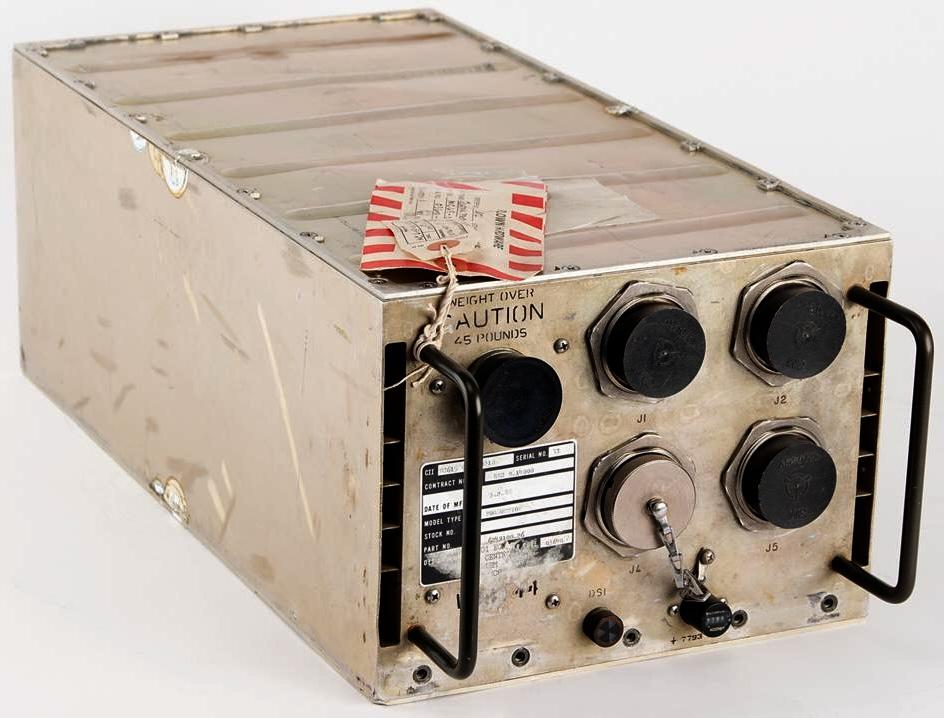
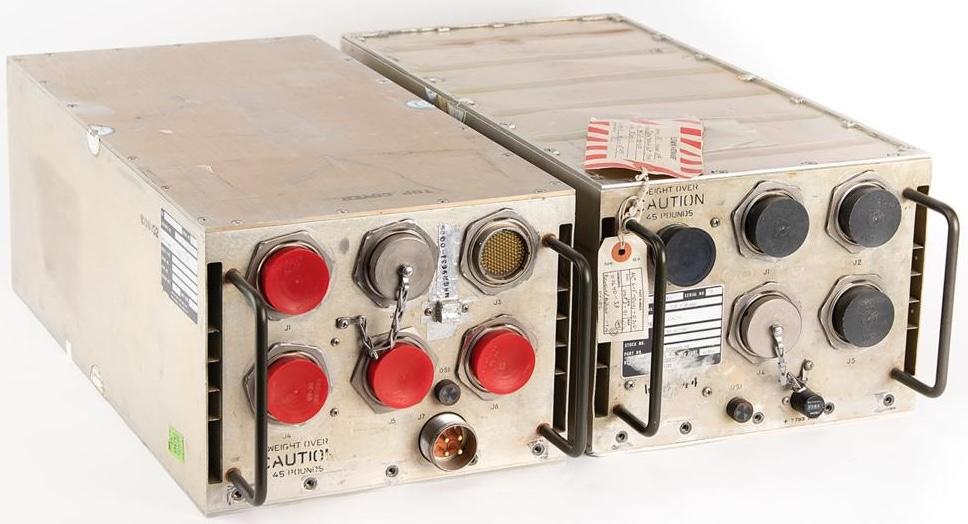
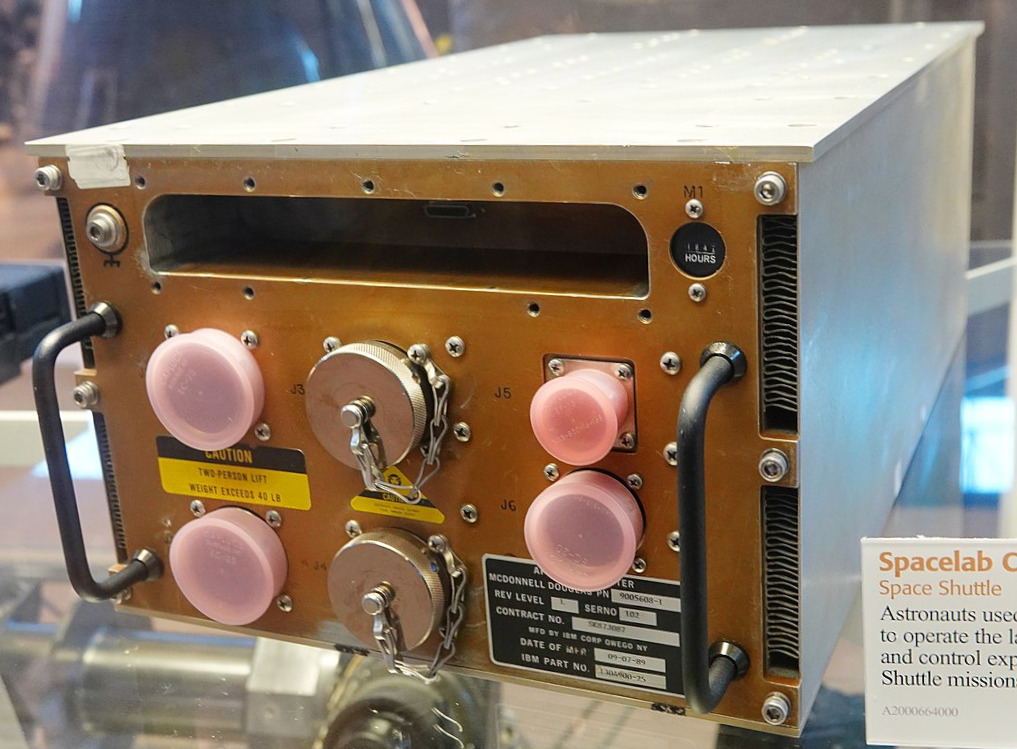
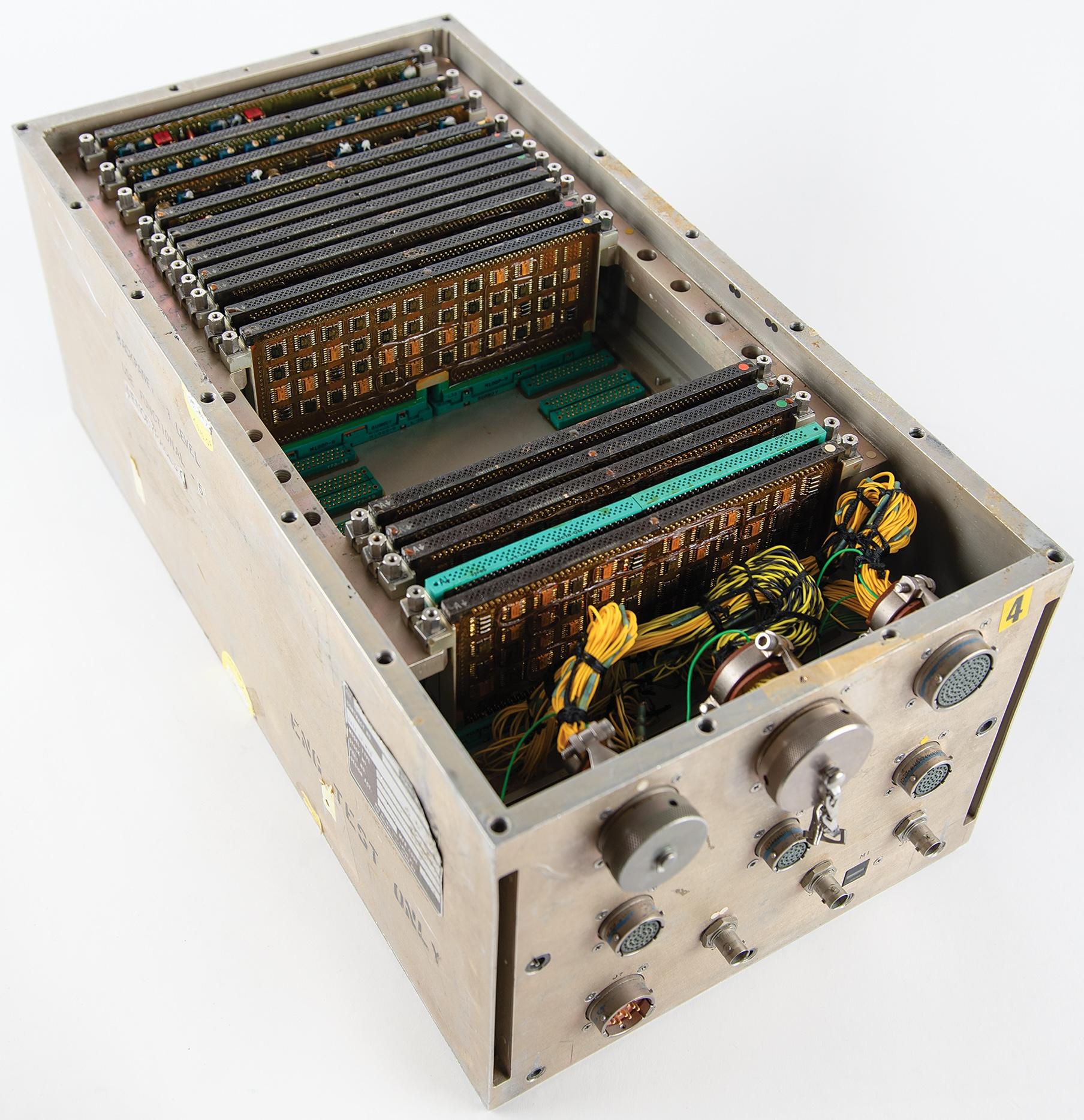
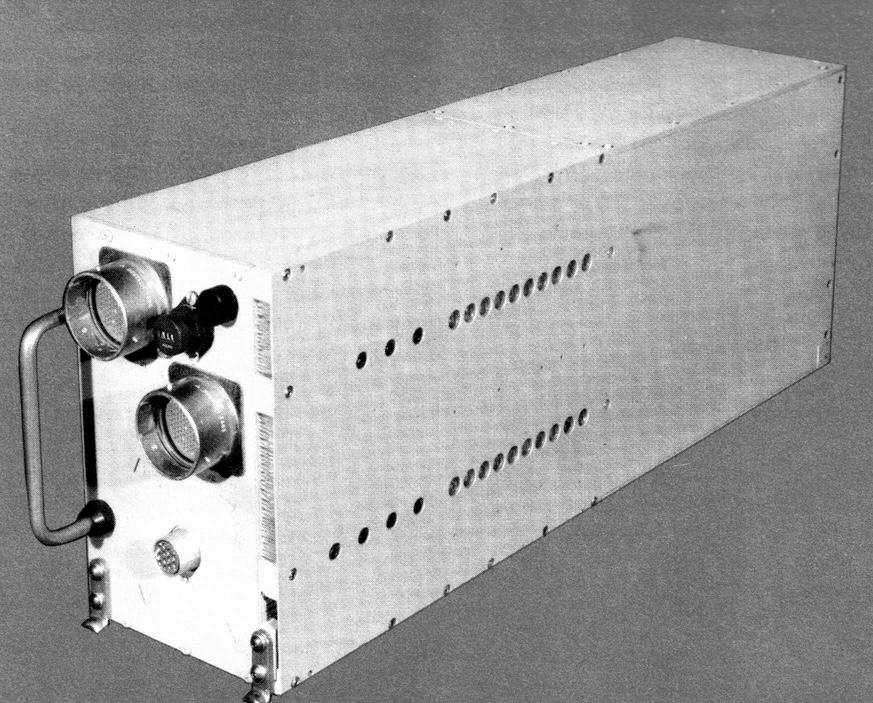
The morning of April 12, 1981, 20 years to the day after Yuri Gagarin became the first person in space, the Space Shuttle thundered into the Florida sky. Commander Young and Pilot Crippen were at the controls as the Shuttle ascended on its first flight. But the launch, like much of the flight, was really under the control of four computers in the avionics bays one deck below the crew. A fifth computer stood ready to take over in case of a catastrophic computer malfunction. These computers, Model AP-101B, were part of IBM's System/4 Pi family.

The Space Shuttle AP-101B computer. This unit flew on multiple flights, including STS-38 (1990) and STS-40 (1991). Photo courtesy of RR Auction.

The Space Shuttle AP-101B computer. This unit flew on multiple flights, including STS-38 (1990) and STS-40 (1991). Photo courtesy of RR Auction.

Introduced around 1967, the System/4 Pi family was a line of compact, powerful computers designed for avionics roles. The military used these computers in everything from the F-4 fighter and B-52 bomber to submarine sonar systems and the Harpoon anti-ship missile. Other computers in the System/4 Pi family played more peaceful roles in the development of GPS and fly-by-wire flight controls. In space, System/4 Pi computers controlled Skylab, the first American space station, as well as Spacelab, the reusable laboratory flown by the Space Shuttle.

Despite the important roles of System/4 Pi computers, information on them is hard to obtain—Wikipedia entirely omits the CC, SP, and ML models.1 However, I received a stack of 4 Pi marketing brochures and articles, so I can now fill in many gaps in the history of System/4 Pi.

The first generation

The IBM System/360 line of mainframes was introduced in 1964. System/360 revolutionized the computer industry with the concept of one family of computers for all applications: business and scientific. The name symbolized that System/360 covered the full 360º of applications. The 4 Pi name extended this idea to applications in the 3-dimensional world: 4π is the number of steradians making up a full sphere. As IBM put it, "System/4 Pi also fills a sphere—the full spectrum of military computer needs—for airborne, space, or shipboard use."

Initially, the System/4 Pi family had three models: "Model TC (tactical computer) for satellites, tactical missiles, helicopters, and other applications requiring a very small, lightweight computer; Model CP (customized processor) for real-time computing applications; and Model EP (extended performance) for applications that require real-time calculation of very large amounts of data."2

The TC Tactical Computer

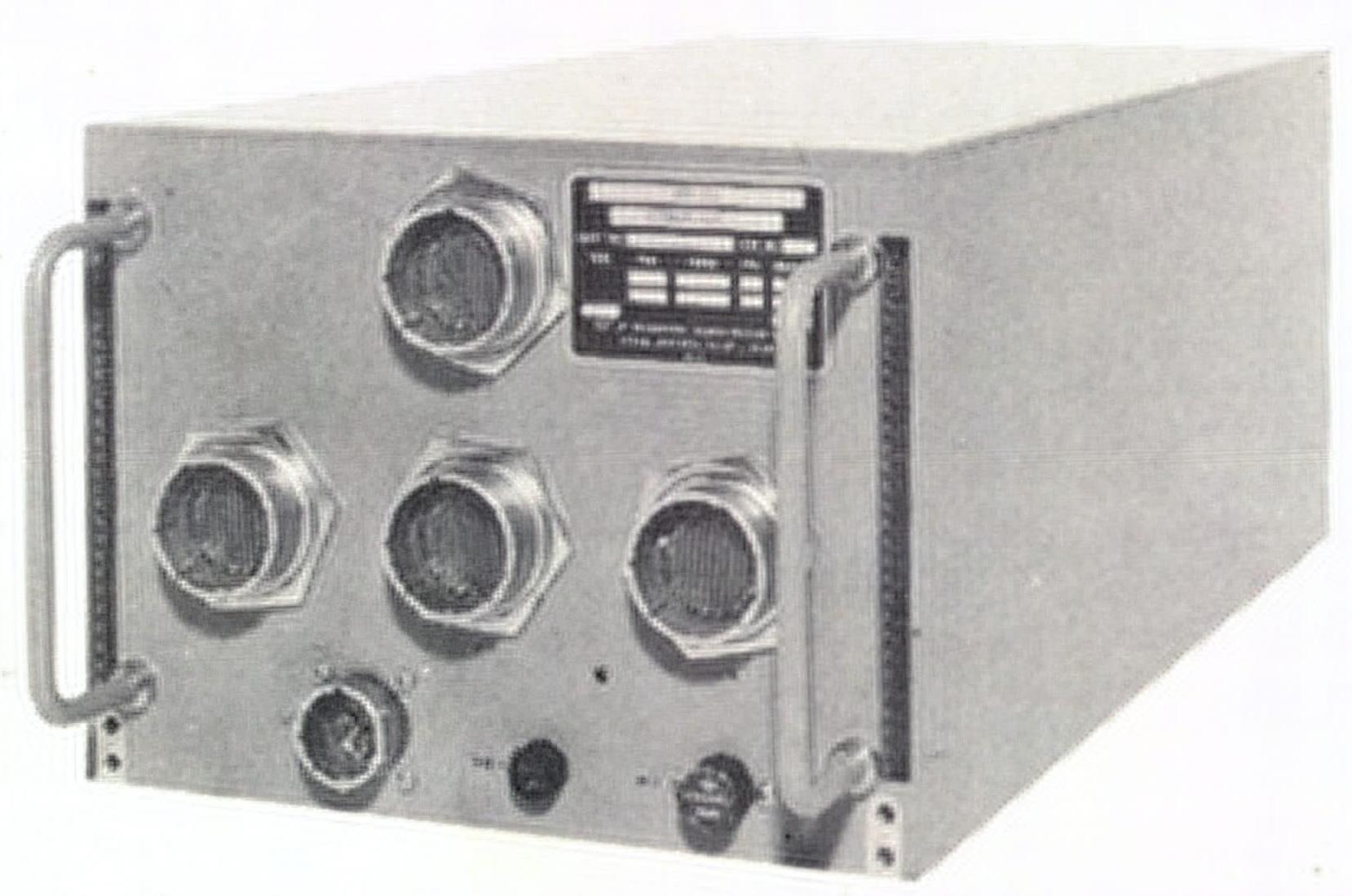
The TC Tactical Computer was a general-purpose digital computer, designed for low cost and medium-range performance (details). The TC had a 16- or 32-bit word, but used an 8-bit bus to reduce cost. It supported from 8 KB to 64 KB of magnetic core memory. It has a straightforward instruction set with 54 instructions in total, including multiply and divide. As was common at the time, it didn't have a stack for subroutine calls, but had a branch-and-store instruction instead. The original model ran 48,500 instructions per second. While this is appallingly slow by modern standards, it was mainframe-level performance at the time, comparable to a mid-range IBM 360/40 mainframe.

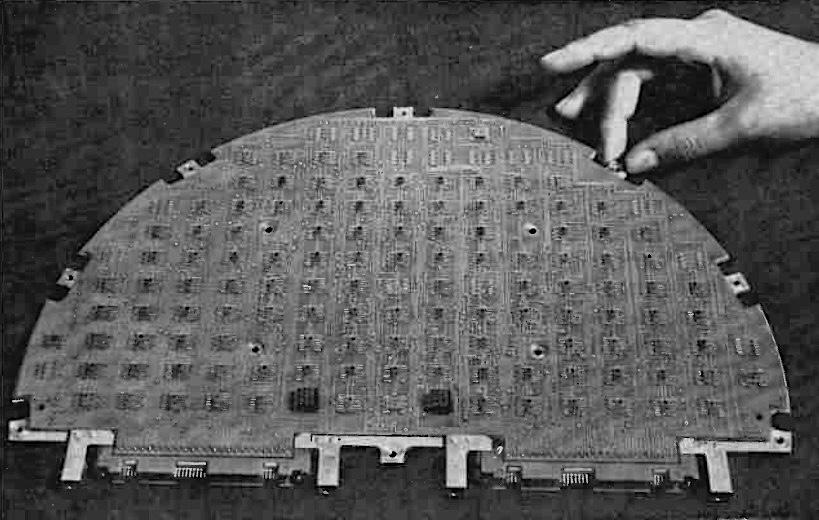
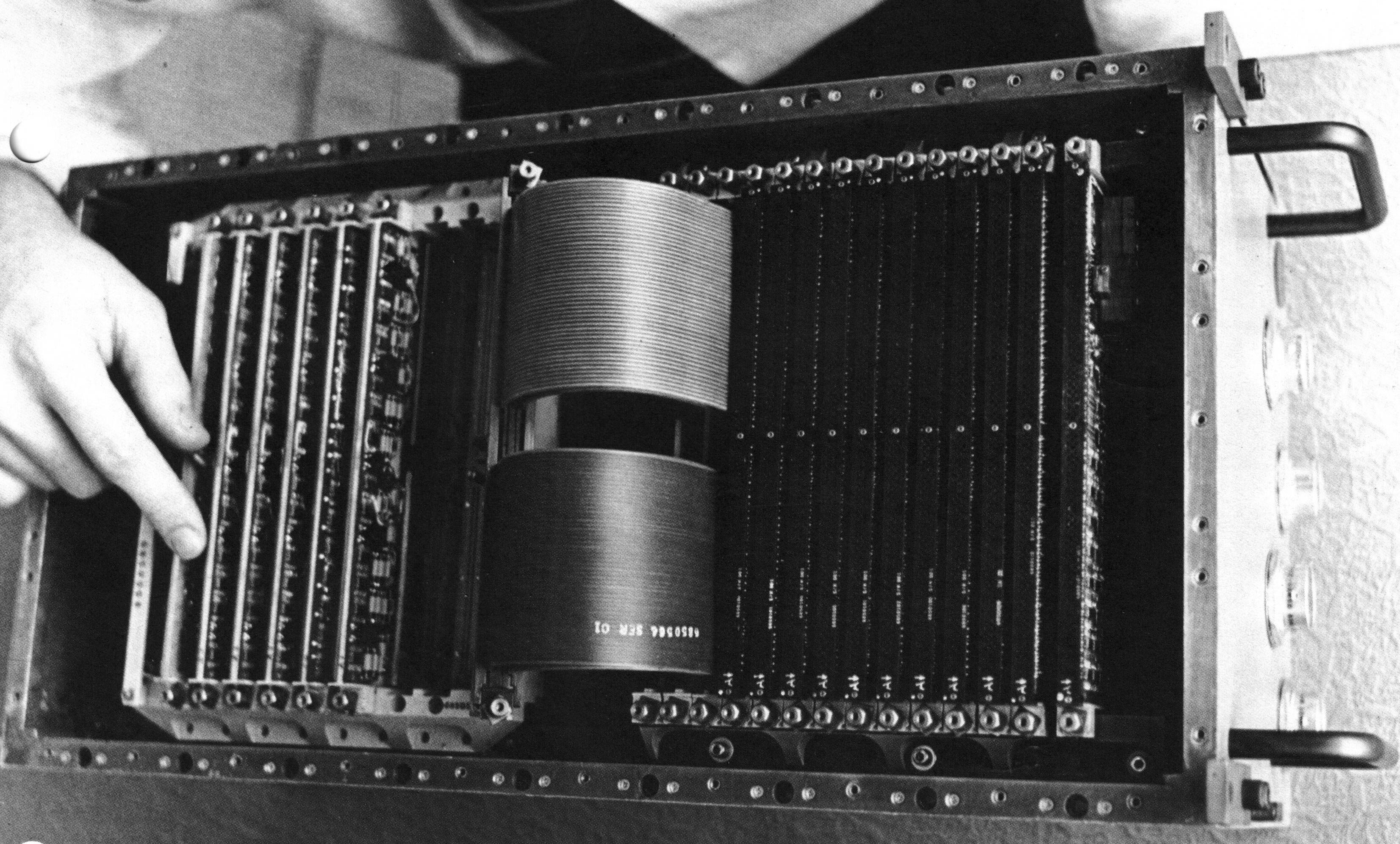
The arithmetic and control subassembly of a TC computer, configured for a tactical missile. From Electronics, March 6, 1967. Also see Electronics, Oct. 31, 1966.

The arithmetic and control subassembly of a TC computer, configured for a tactical missile. From Electronics, March 6, 1967. Also see Electronics, Oct. 31, 1966.

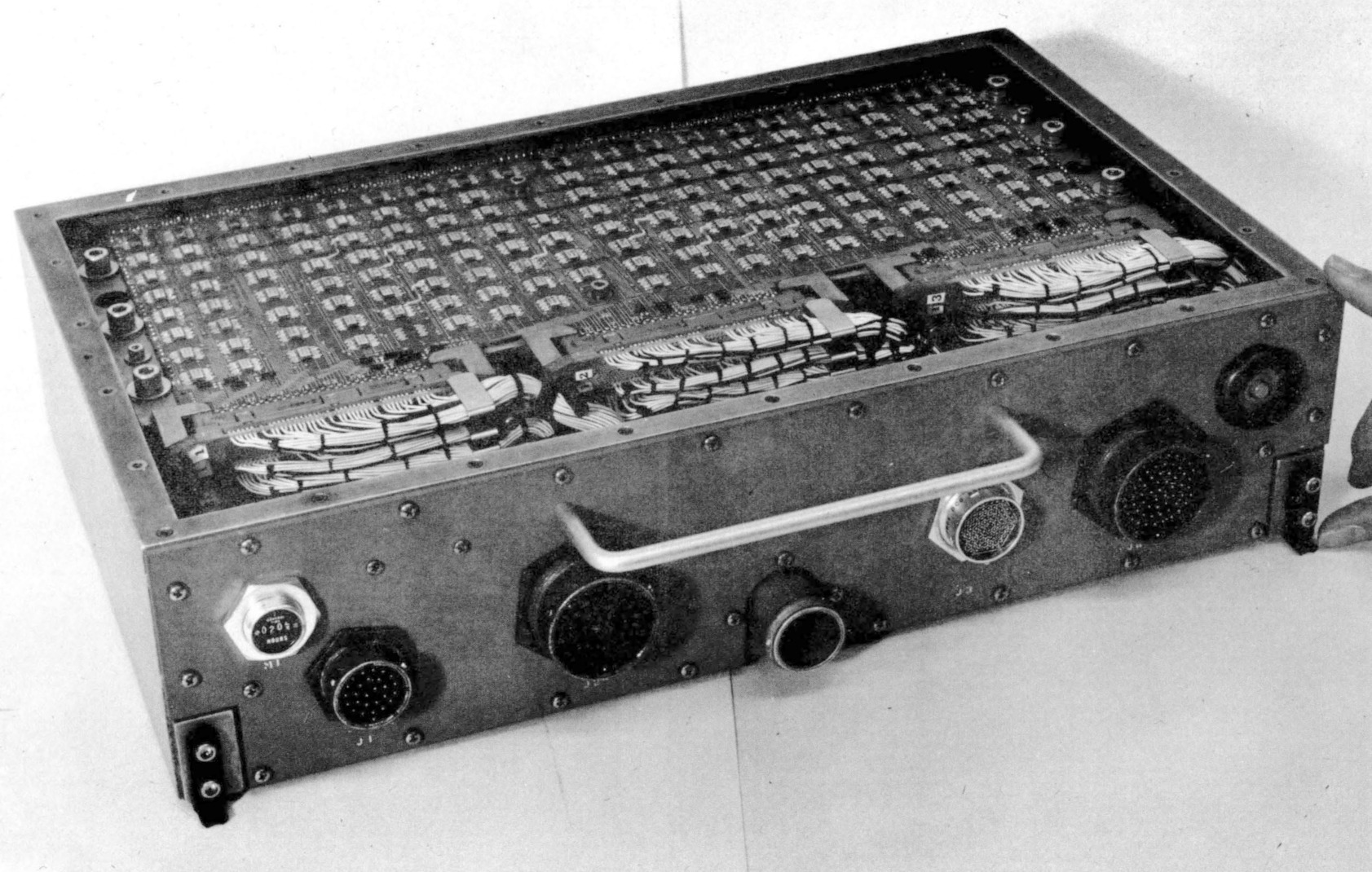
The TC was originally packaged in a briefcase-sized box (9.75" × 17.12" × 4.0") (below) that weighed 17.3 pounds, but it could be repackaged for different applications. For a tactical missile, the computer was implemented on semicircular circuit boards as shown above. The computer was constructed from TTL (Transistor-Transistor Logic)3 flatpack integrated circuits mounted on four-layer circuit boards. Two circuit boards made a sandwich around a metal structure that provided support and cooling; this three-layer assembly was called a "page". A page could hold about 300 integrated circuits, so the computer was very dense.

The IBM 4 Pi TC system. From Technical Description of IBM System 4 Pi Computers.

TC-1 computers played a critical role in Skylab, America's first space station, which was launched in 1973.4 The orientation of Skylab needed to be precisely controlled to aim its multiple telescopes. To avoid consuming propellant, Skylab was rotated by changing the speed of three massive gyroscopes, 155 pounds each. Two TC-1 computers controlled these gyroscopes, with one computer active and one computer as a backup. Each 16-bit computer had 16K words of storage that could be reloaded from magnetic tape or radio, and executed 60,000 operations per second. Each Skylab computer occupied 2.2 cubic feet (much larger than the briefcase-sized TC) and weighed 97.5 pounds. The Skylab computers are notable as the first fully digital control system on a crewed spacecraft.

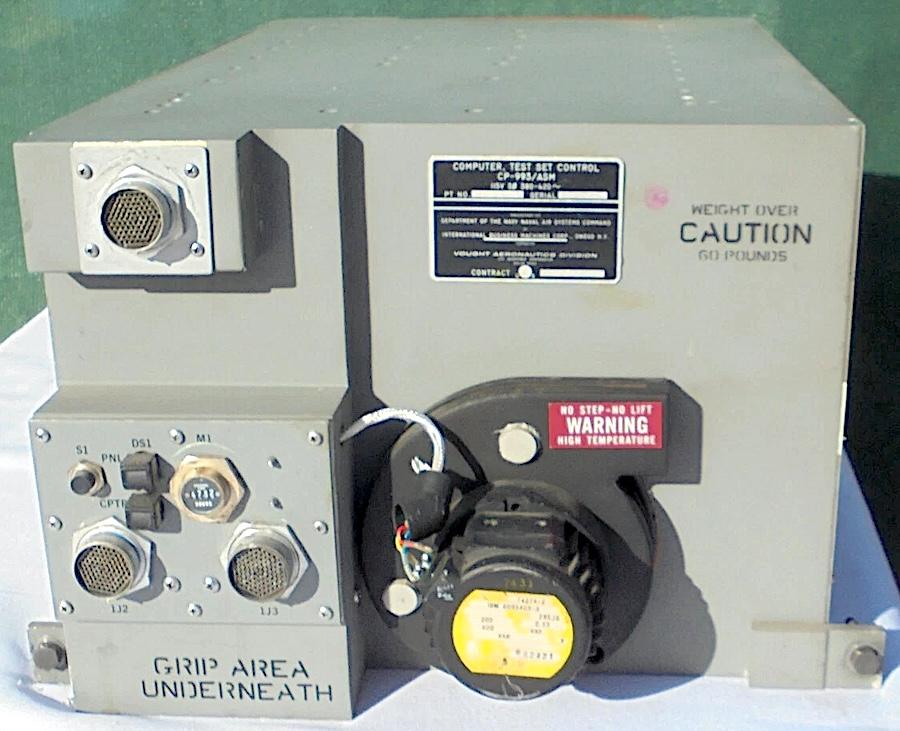
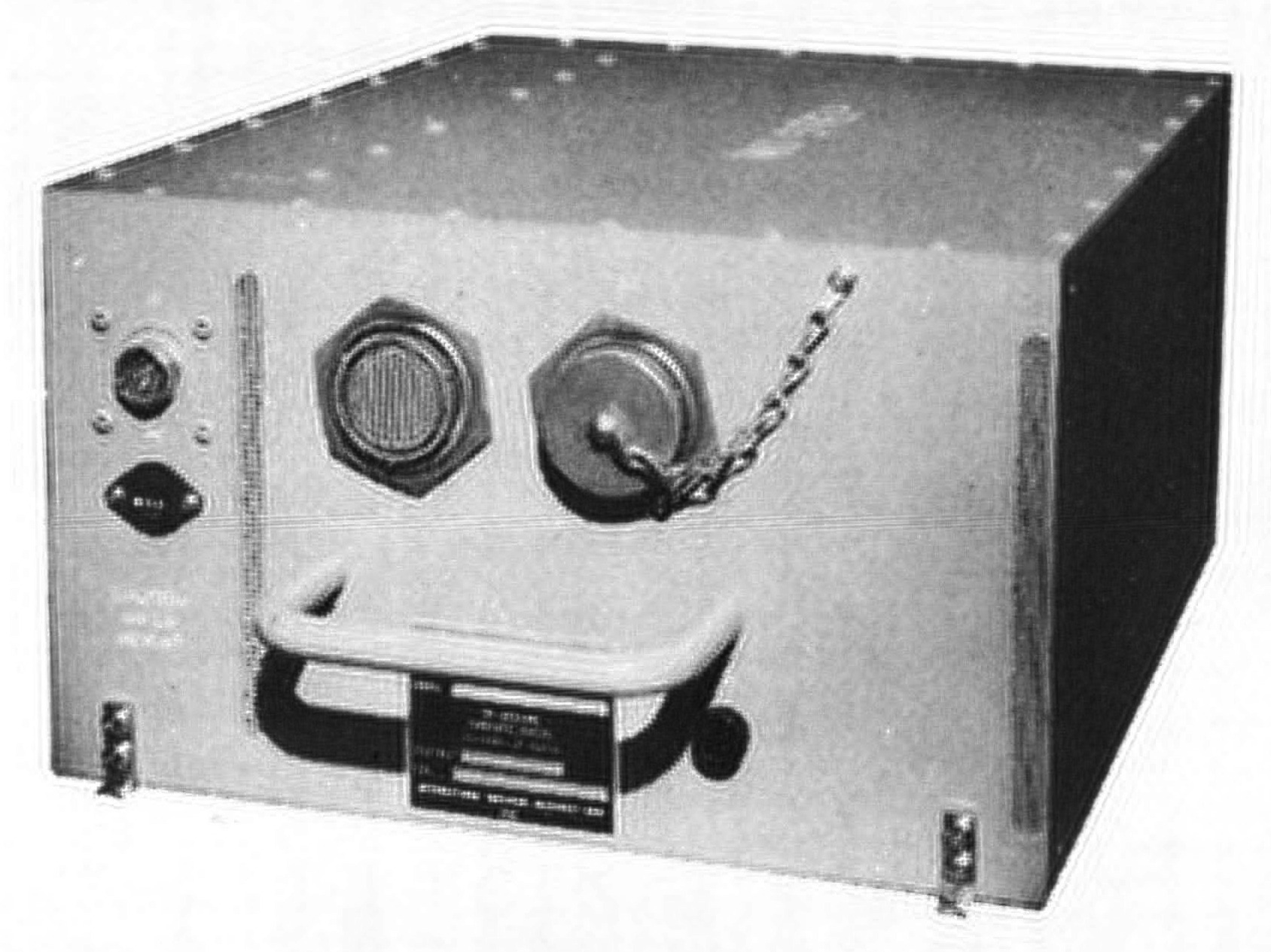
The TC-2 model (below) was much faster (125,000 operations per second) and weighed 80 pounds. It was used for Navigation/Weapons Delivery in the A-7D/E attack fighter. In 1976, it was upgraded to the TC-2A, which was still faster (454,000 operations per second), supported more memory, and added 12 more instructions.

A TC-2 computer, specifically the Test Set Control Computer CP-993/ASM. It looks the same as the A-7 aircraft's CP-952/ASN-91(V) computer.
Photo courtesy of Alex1970-14;
this computer is currently on eBay if you want it.

A TC-2 computer, specifically the Test Set Control Computer CP-993/ASM. It looks the same as the A-7 aircraft's CP-952/ASN-91(V) computer. Photo courtesy of Alex1970-14; this computer is currently on eBay if you want it.

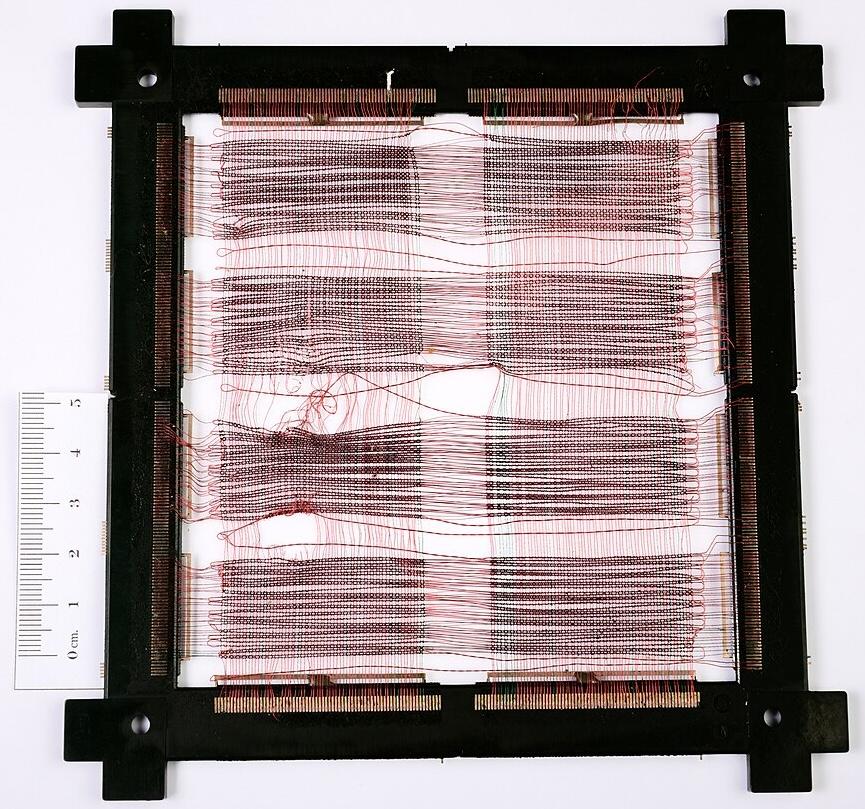
Like most computers in its era, the TC used magnetic core memory; each bit was stored in a tiny toroidal core of lithium nickel ferrite, strung onto a grid.5 The core planes in the TC and other first-generation 4 Pi computers were about 6 inches on a side. With 16,384 cores in a plane, each plane held 16 Kbits. Thus, the 8-kilobyte memory in the TC required a stack of four core planes. A significant advantage of core memory was that, because it was magnetic, the data was preserved even when the memory was not powered. It was also highly resistant to radiation.

This (somewhat damaged) core memory plane is the commercial version of the planes in the first-generation System/4 Pi computers.
Photo by José Luis Briz Velasco, CC BY-SA 4.0, cropped.

This (somewhat damaged) core memory plane is the commercial version of the planes in the first-generation System/4 Pi computers. Photo by José Luis Briz Velasco, CC BY-SA 4.0, cropped.

The CP Customized Processor

One step up from the TC series was the CP Customized Processor (briefly called Cost Performance).6 It used a 16-bit CPU, but had a wide 36-bit bus to memory for higher performance (including two parity bits and two storage protection 7 bits). Unlike the TC series, the CP series was (optionally) microcoded internally, so the instruction set could be easily customized.8 The CP system had completely different instruction formats from the TC system.10 The base model had 36 instructions and executed 91,000 instructions per second. The CP supported multiple addressing modes, more advanced than the simple addressing of the TC system. While the TC ran at 330 kHz, the CP ran at 2.4 megahertz. The CP's performance didn't improve as much as the faster clock would suggest, since both systems used slow core memory.

The IBM CP computer. from "IBM System/4 Pi Model CP" brochure, 1967.

The IBM CP computer. from "IBM System/4 Pi Model CP" brochure, 1967.

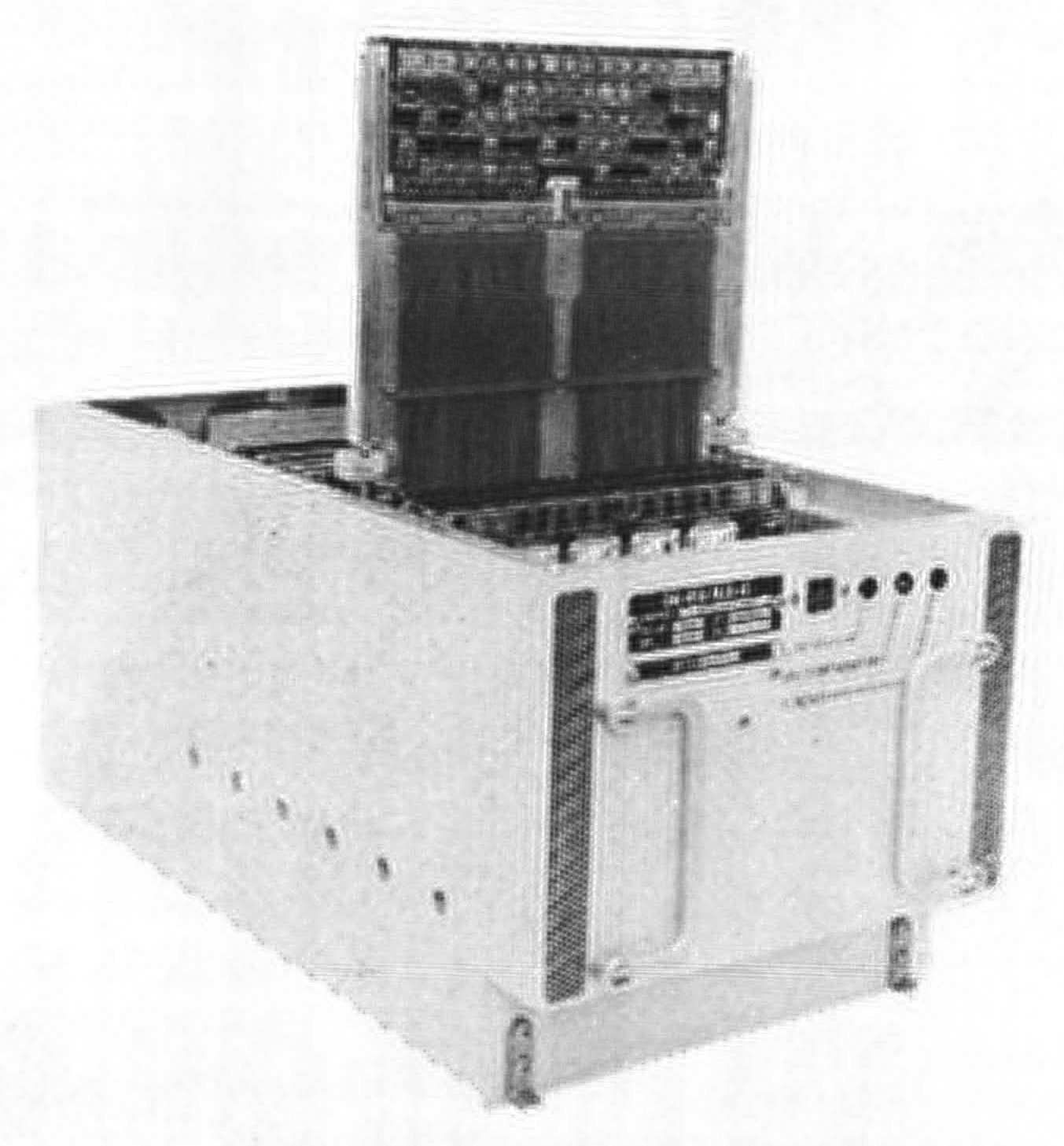
One of the strengths of System/4 Pi was input/output, allowing it to communicate with external devices in real time. The CP-1 had extensive I/O capabilities: three high-speed parallel inputs, a high-speed parallel output, a serial output, 24 discrete input lines, 144 discrete output lines, and 24 interrupt lines. To support all these I/O signals, the CP-1 was packaged in two boxes: one for the computer itself, and one for the I/O interface. The CPU box is shown below; the I/O coupler box was similar, but the front sported over a dozen connectors for I/O lines. The CP-1 was used in the navigation/threat analysis system in the EA-6B Prowler electronic-warfare aircraft.9

The CP-1 computer, designated the CP-926/AYA-6. From "IBM System/4 Pi and Advanced System/4 Pi Computers" brochure, August 1973.

The CP-1 computer, designated the CP-926/AYA-6. From "IBM System/4 Pi and Advanced System/4 Pi Computers" brochure, August 1973.

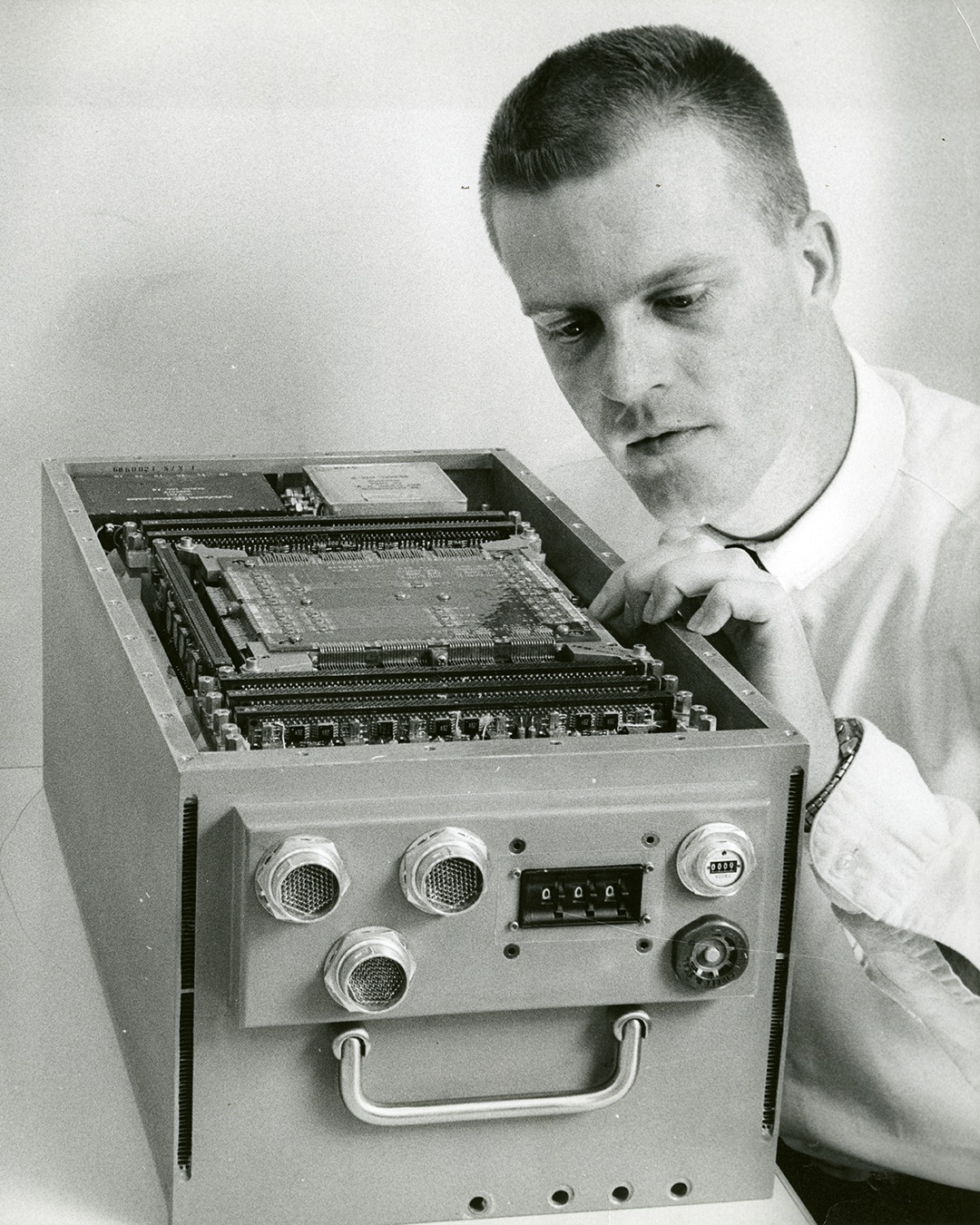
The CP-2 was the navigation/weapons delivery computer in the F-111 fighter plane, integrating radar and weapons. It was faster than the CP-1, perhaps because it was not microprogrammed, executing 150,000 instructions per second. It was also smaller, occupying one 47-pound box, although it had less I/O support. Unfortunately, this F-111 computer was said to be a disaster operationally because the computer had reliability problems and limited performance. The CP-2 was later replaced by the enhanced CP-2EX.

The CP-2 computer, designated the AN/AYK-6. The three-digit dial on the front was covered and fastened with security wire before use, so it must have been important. The core memory stack is in the middle of the computer, with 8K to 16K words of storage. The circuit pages are in front. Photo from an IBM Thread, which also shows a disassembled TC-2 computer.

The CP-2 computer, designated the AN/AYK-6. The three-digit dial on the front was covered and fastened with security wire before use, so it must have been important. The core memory stack is in the middle of the computer, with 8K to 16K words of storage. The circuit pages are in front. Photo from an IBM Thread, which also shows a disassembled TC-2 computer.

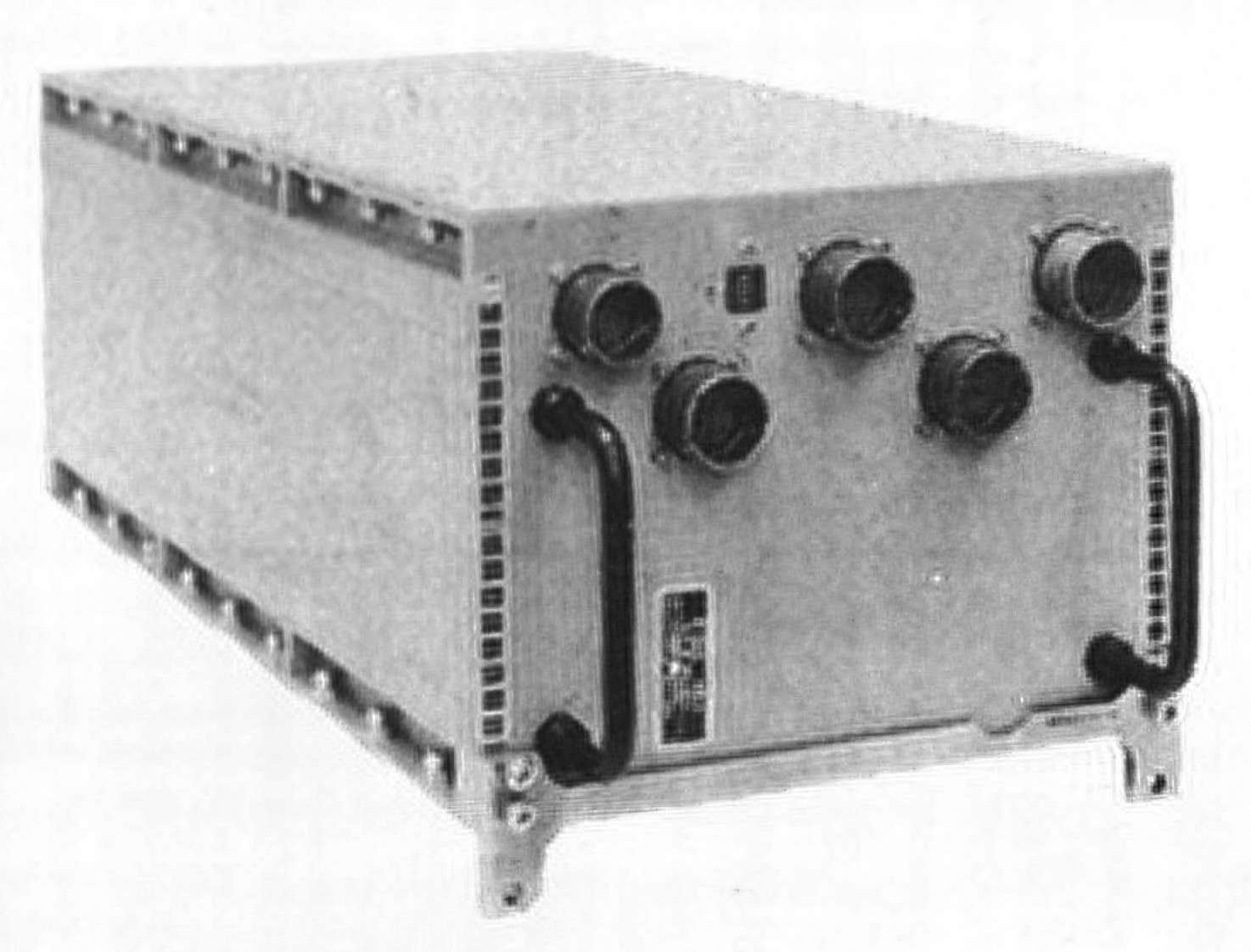
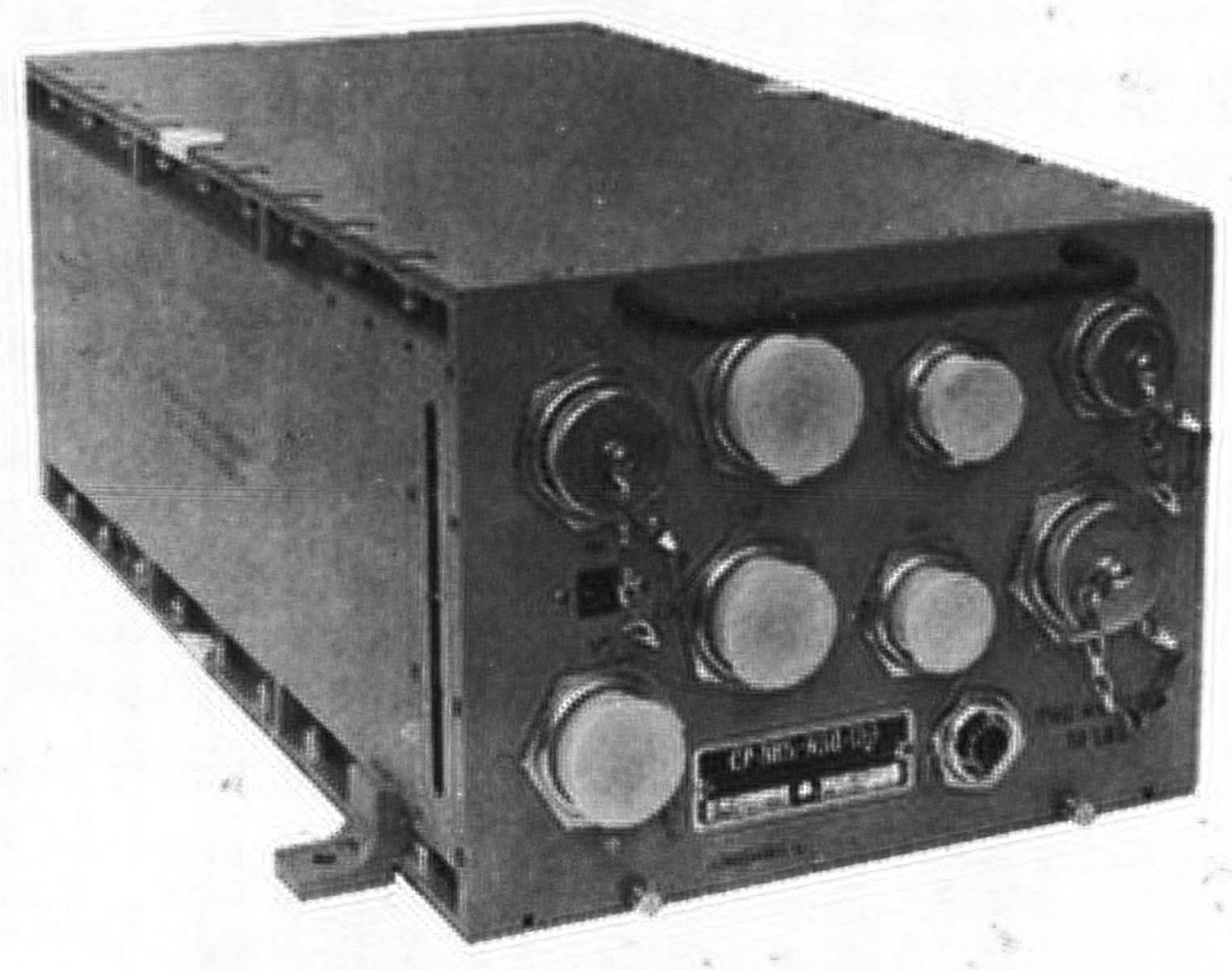
The CP-3 computer (below) was used for navigation and weapons delivery in the A-6E Intruder (1970) and other aircraft, replacing an earlier Litton computer with an unreliable drum memory. This computer could be integrated with laser-guided "smart" bombs. It was similar to the CP-2 and had the same performance, but had different I/O functions.

The CP-3 computer, designated the CP-985/ASQ-133. From "IBM System/4 Pi and Advanced System/4 Pi Computers" brochure, August 1973.

The CP-3 computer, designated the CP-985/ASQ-133. From "IBM System/4 Pi and Advanced System/4 Pi Computers" brochure, August 1973.

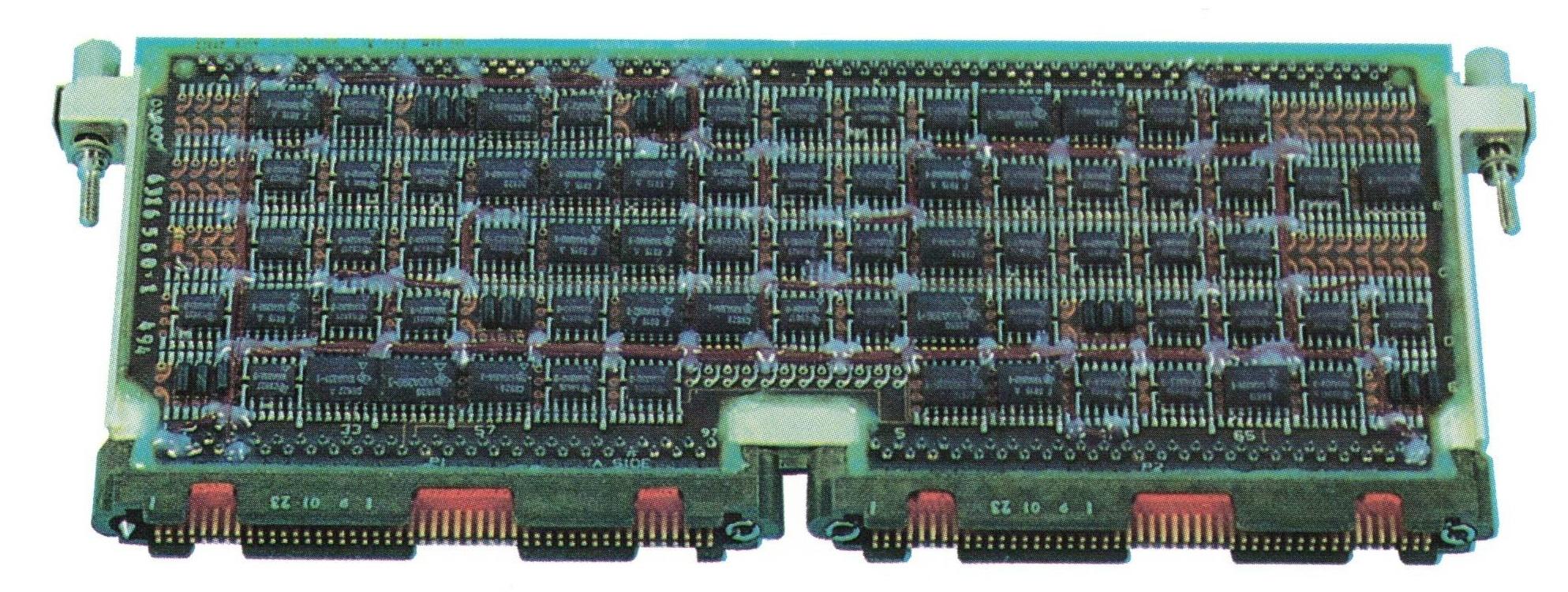
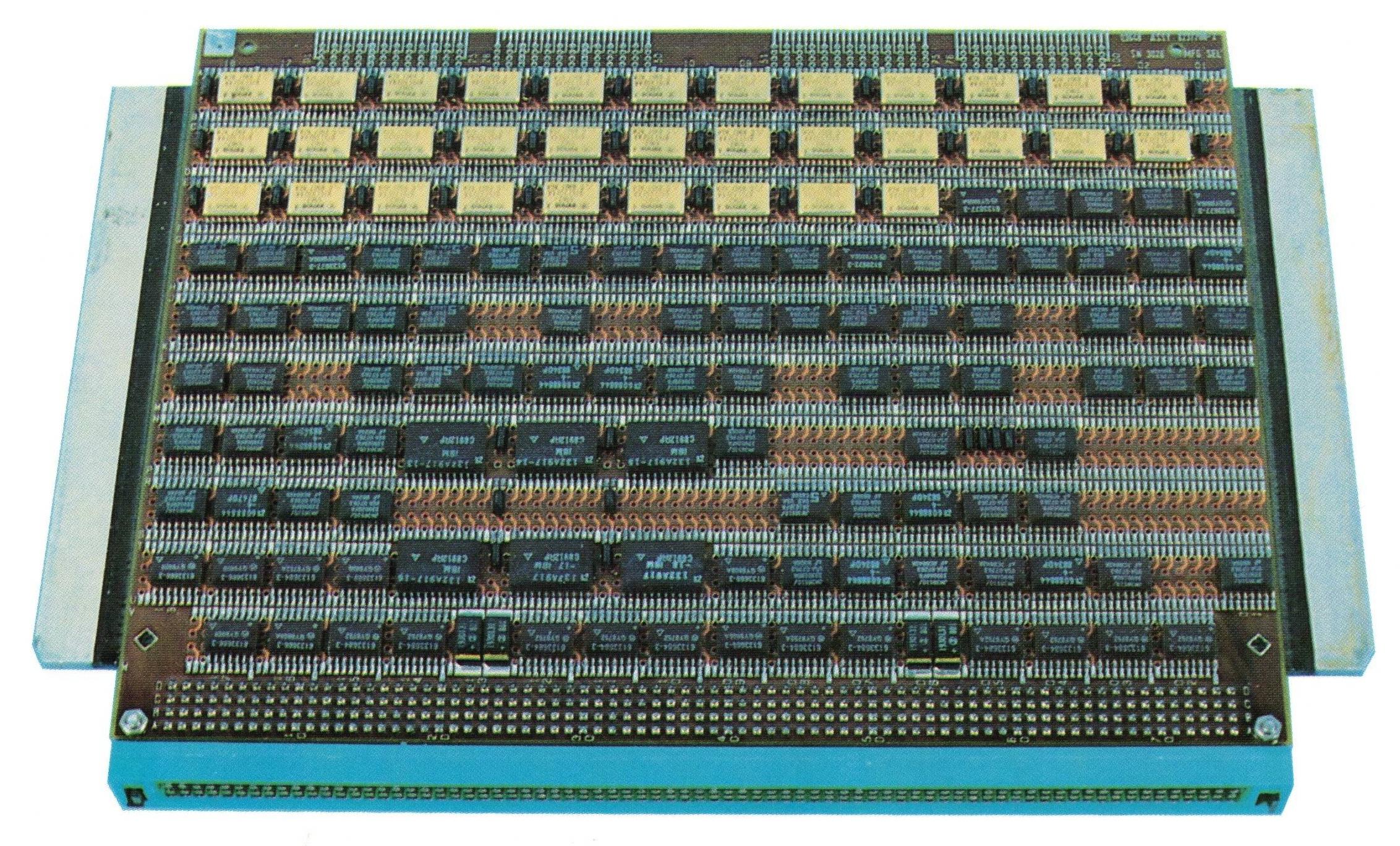
Like the TC, the CP was constructed from flat-pack TTL chips mounted on circuit boards called "pages". However, the CP used smaller pages with six layers instead of four; each double-sided page could hold up to 156 integrated circuits. Each page had two 98-pin connectors, reusing the style of connector that IBM used in Apollo for the Saturn V rocket's Launch Vehicle Digital Computer (LVDC). IBM standardized on this type of page for decades; the page below was used in the AWACS computer (1991) and is almost identical to the pages in the CP computer in 1967.

A standard IBM System/4 Pi page assembly. From "AWACS Data Processing Subsystem" brochure, 1991.

A standard IBM System/4 Pi page assembly. From "AWACS Data Processing Subsystem" brochure, 1991.

The EP (Extended Performance) computer

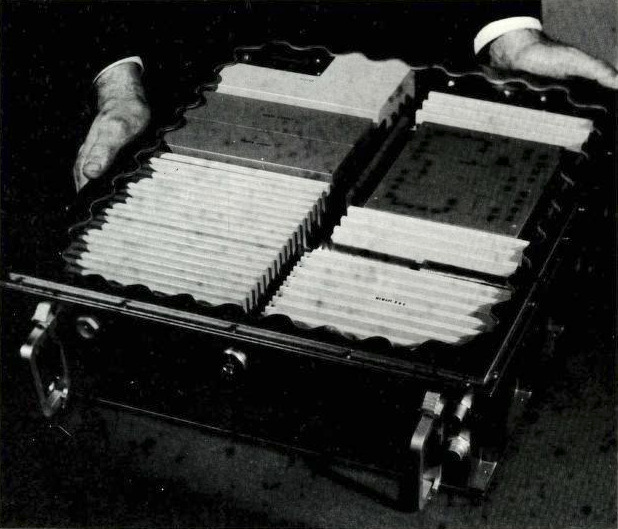
The EP was the most powerful of the original System/4 Pi computers. It was a 32-bit computer compatible with IBM System/360 mainframes, specifically the 360 Model 44.11 For input/output, the EP used the same I/O channel architecture as the System/360 mainframes. To support the complicated 360 instruction set, the EP was microcoded. It executed 190,000 instructions per second and weighed 75 pounds. Floating-point support was available as an option.

A mockup of the EP computer. The core memory is the dark box in the in the upper right, From Technical Description of IBM System 4 Pi Computers.

A mockup of the EP computer. The core memory is the dark box in the in the upper right, From Technical Description of IBM System 4 Pi Computers.

A multiprocessor version of EP, the EP/MP, supported up to three CPUs sharing memory. It was delivered for the Air Force's Manned Orbiting Laboratory (MOL), but the MOL project was canceled (details). The multiprocessor system was also used for the VS ANEW anti-submarine research project, part of the VSX program that led to the Lockheed S-3 Viking, an aircraft that used the System/4 Pi SP-0A computer instead of the EP.

The next generation: Advanced System/4 Pi

Early in 1970, IBM created the Advanced System/4 Pi family.12 These 32-bit systems were significantly faster, smaller, and more advanced than the previous System/4 Pi computers. These computers took advantage of improved integrated circuits, called Medium-Scale Integration (MSI). These integrated circuits held 10 to 100 gates per chip, compared to the earlier Small-Scale Integration (SSI) chips with 1 to 10 gates per chip, allowing a chip to implement a more complex function, such as a shift register, counter, or adder.) Moreover, these computers used faster core memory, reducing the memory cycle time from 2.5 µs to 1 µs.

This series originally consisted of three lines: Advanced Processor (AP), Subsystem Processor (SP), and Command and Control (CC). The AP line is the largest and most famous, powering the Space Shuttle as well as numerous aircraft. A few years later, IBM introduced the ML line. Although the SP, CC, and ML lines are obscure, they have some interesting features.

Advanced Processor (AP)

For the most part, the AP computers used an instruction set and architecture that was derived from the System/360, called MMP (Multipurpose Midline Processor).13 Unlike the EP computers, the AP computers were incompatible with System/360: the instruction format, the registers, the addressing modes, and the condition codes were different. Some AP computers used a 16-bit instruction set that was an Air Force Standard, called MIL-STD-1750A.

The Advanced Processor line started with the AP-1, a 32-bit processor that performed 450,000 instructions per second and weighed 36 pounds. It could be programmed in assembler or the military's JOVIAL language. It supported 16K halfwords to 64K halfwords of storage internally, and more could be added in an external box. It had four high-speed I/O channels, handling up to 15 devices per channel. Floating point was available as an option. The AP-1 is described in detail here.

The AP-1 computer, designated CP-1075/AYK. From "IBM System/4 Pi and Advanced System/4 Pi Computers" brochure, August 1973.

The AP-1 computer, designated CP-1075/AYK. From "IBM System/4 Pi and Advanced System/4 Pi Computers" brochure, August 1973.

The AP-1 computer was used in the F-15 fighter for navigation/weapon delivery and data management. It was also used by Japan in the F-4 fighter. An upgraded computer, the AP-1R, had 256K of core memory and performed over 1 million instructions per second; it was used in the F-15E aircraft in 1983. The AP-1A was used in the development of the AWACS Seek Bus tactical communication system and the Joint Tactical Information Distribution System (JTIDS).

The AP-2 computer was almost identical to the AP-1 in appearance and functionality, with some changes to its I/O capabilities. It was used in the Central Integrated Test System (CITS) on the B-1 bomber to provide real-time testing and troubleshooting (details).

The AP-101 computer expanded the AP-1's instruction set from 83 instructions to 151, as well as having slightly faster core memory. The first nine AP-101 computers were used in NASA's digital fly-by-wire research program that used the F-8 fighter (link). The AP-101 was also used for GPS development.

The AP-101 computer. From "IBM System/4 Pi and Advanced System/4 Pi Computers" brochure, August 1973.

The AP-101 computer. From "IBM System/4 Pi and Advanced System/4 Pi Computers" brochure, August 1973.

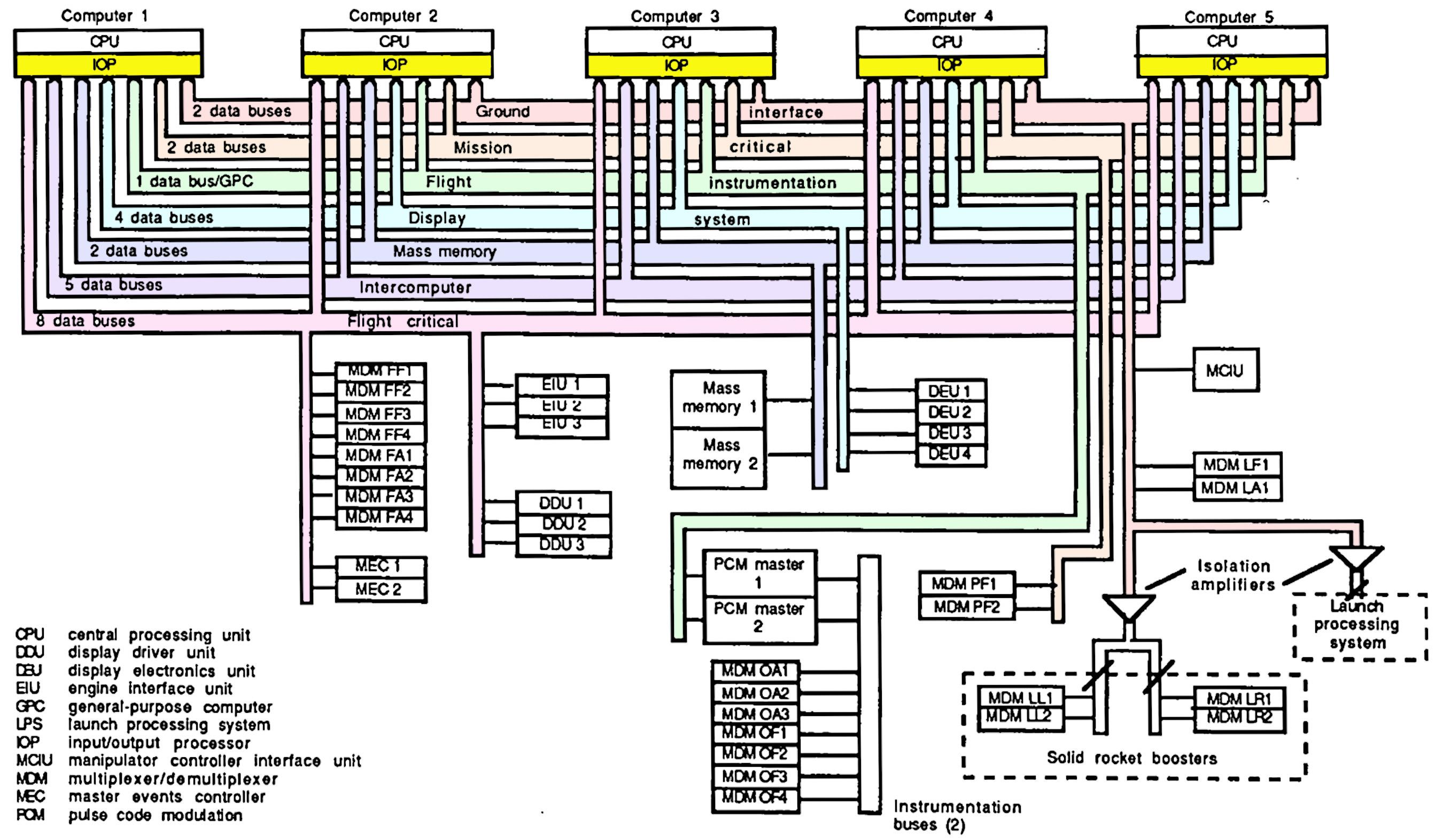
Around 1975, the AP-101B computer was developed for the Space Shuttle.14 The first step was improving the instruction set to support "high order languages" better, resulting in the AP-101A. Next, double-density core memory was used, creating the AP-101B that the Space Shuttle used for many years. The AP-101B computer was partnered with the IOP (I/O Processor), essentially a second computer that handled I/O, providing 24 data buses to the rest of the Space Shuttle. For reliability, the Space Shuttle had four redundant AP-101B computers that ran in parallel and voted on each output, so a faulty computer could be excluded. Moreover, a fifth computer was ready as a backup, using independently programmed software in case a software fault caused all four primary computers to fail.15

The Space Shuttle I/O Processor (IOP, left) and AP-101B computer (right). Photo courtesy of RR Auction.

The Space Shuttle I/O Processor (IOP, left) and AP-101B computer (right). Photo courtesy of RR Auction.

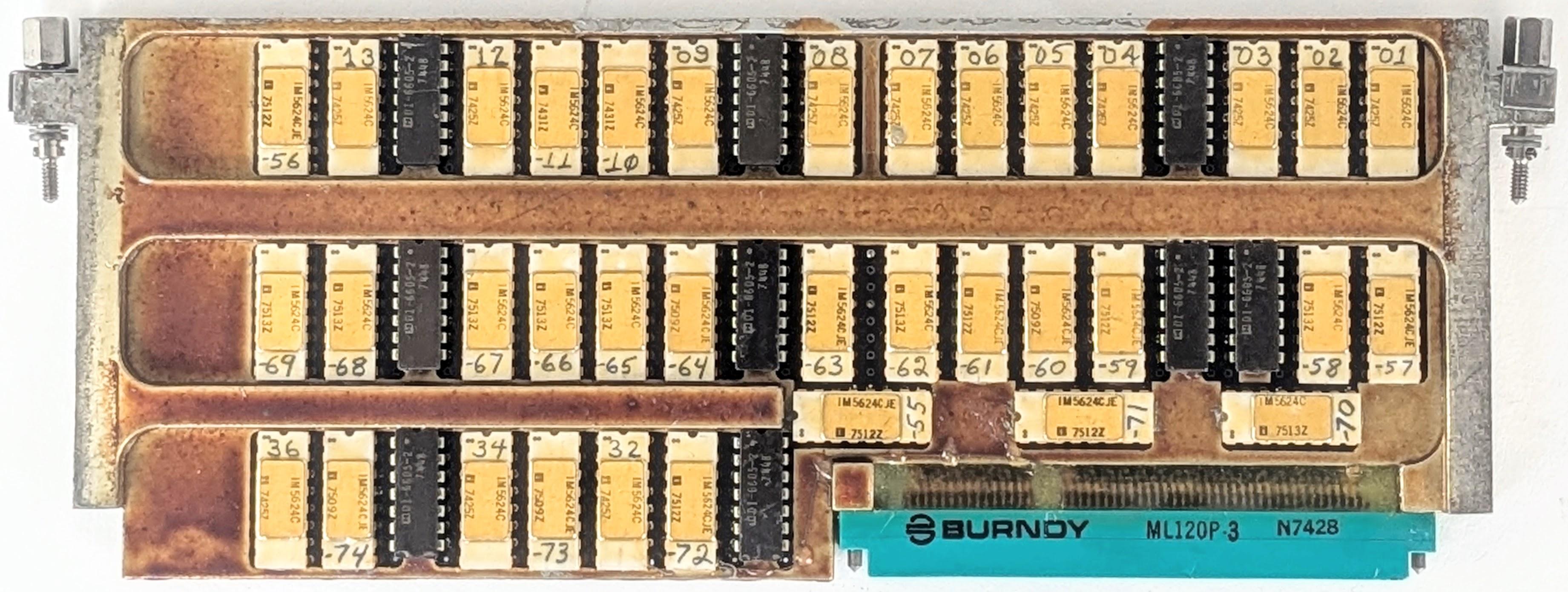
The Space Shuttle computer had 104K 32-bit words of memory. The AP-101B held ten memory pages (i.e., circuit boards), each holding 16K×18 bits, while the IOP held six pages, each holding 8K×18 bits.16 Although the memory was physically split between the two boxes, it acted as a unified shared memory.

The Space Shuttle's EP/MCM (Extended Performance/Modular Core Memory) module stores 8K by 18 bits (details). This is a lower-capacity page, either from the IOP or from an early version of the AP-101. The page unfolds, with the core planes inside. Photo from klabs.

The Space Shuttle's EP/MCM (Extended Performance/Modular Core Memory) module stores 8K by 18 bits (details). This is a lower-capacity page, either from the IOP or from an early version of the AP-101. The page unfolds, with the core planes inside. Photo from klabs.

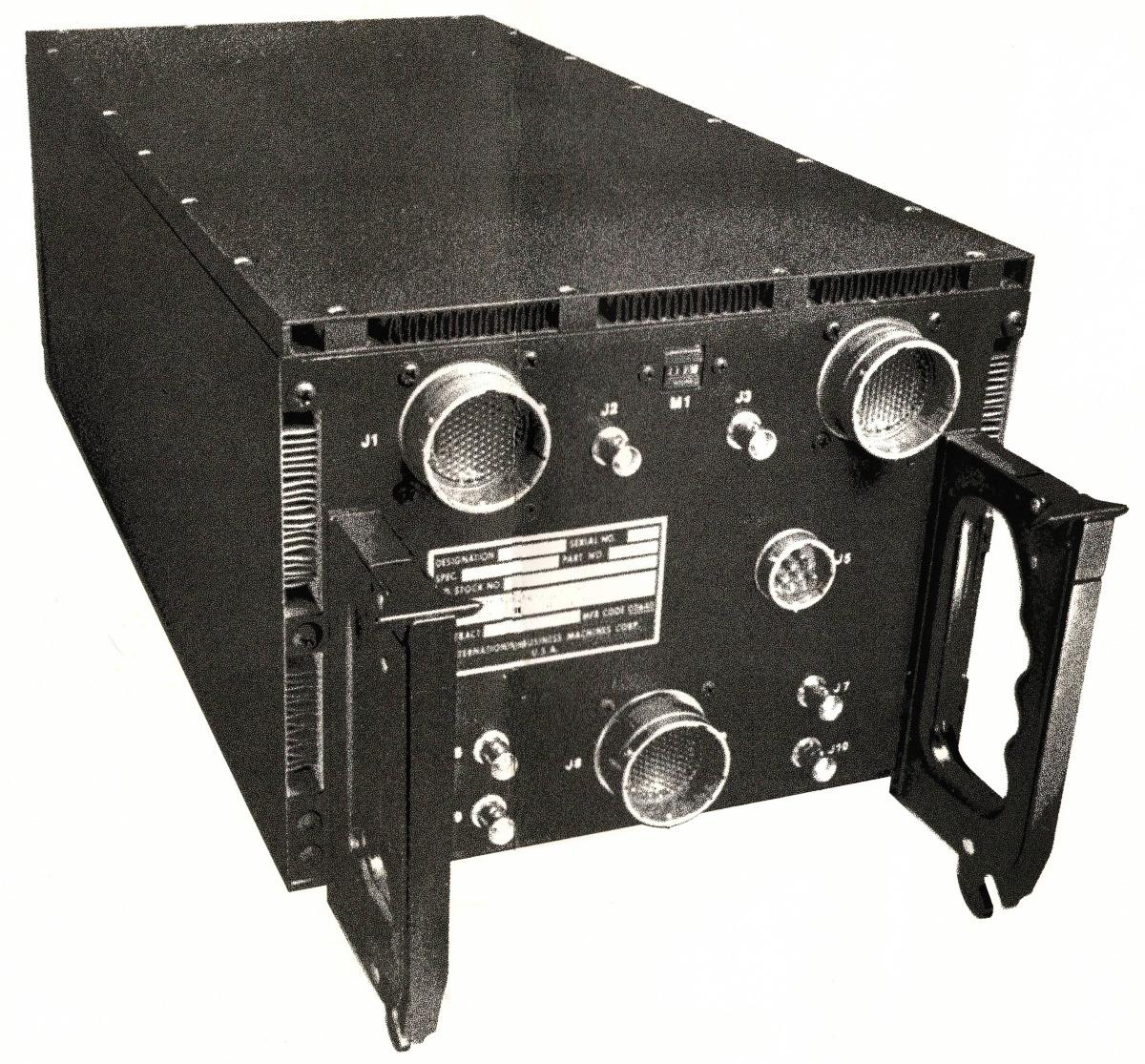
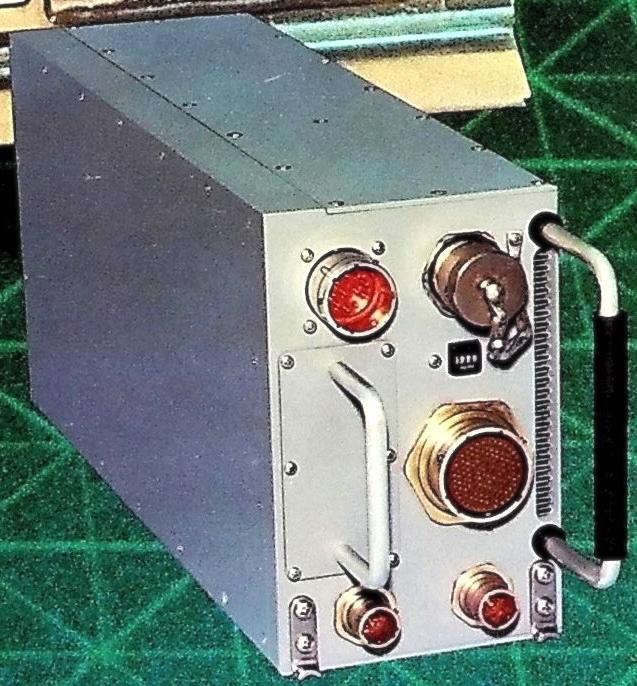
The AP-101C computer (1977) had multiple improvements: quadruple-density modular core memory, upgraded logic technology, and repackaging to reduce cost.17 The AP-101C had 32K words of storage and ran at over 500,000 operations per second.18 The AP-101C was used in the B-52D Digital Bombing and Navigation System. It was also installed in the B-52G/H bomber as part of the Offensive Avionics System. The AP-101C was designed to survive radiation and electromagnetic pulse (EMP) hazards, with radiation-hardened circuits and parity in memory. Its "nuclear circumvention" feature resumed operation 50 milliseconds after a nuclear event, probably detecting a nuclear blast and quickly rebooting to avoid harmful effects such as latchup.

The AP-101C computer. From "IBM Model AP-101C" brochure, September 1978, retouched.

The AP-101C computer. From "IBM Model AP-101C" brochure, September 1978, retouched.

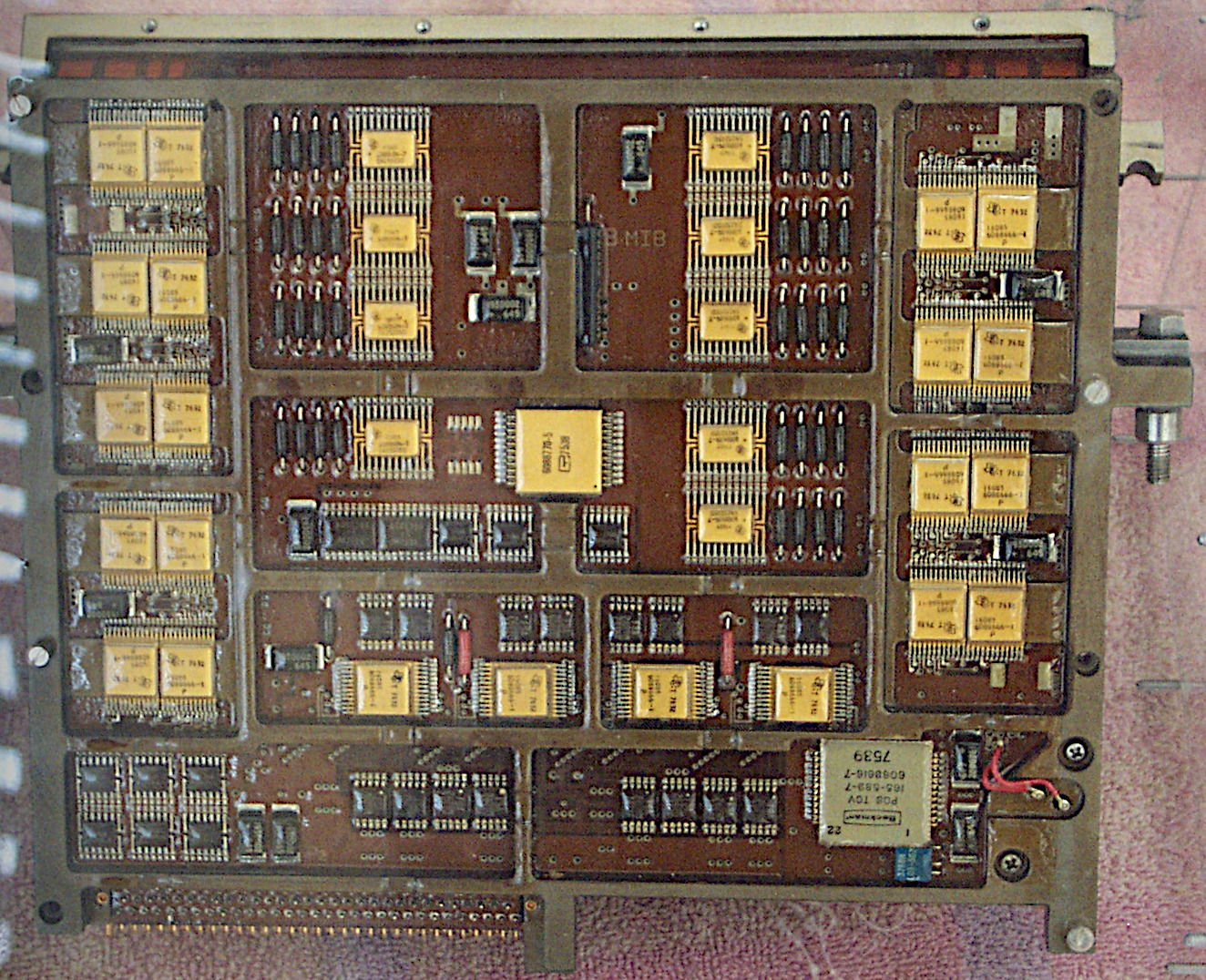
The AP-101C started the Modular Computer Series,19 which used 9"×6.4" pages, much larger than the previous pages. The MCS pages were modularized, supporting standard modules for CPU, memory, timing, power supply, testing, and a new military serial bus called MIL-STD-1553A. While previous computers were customized by changing the microcode in core-based Read Only Store (ROS), the AP-101C could be customized by changing PROMs (Programmable Read-Only Memories) and PLAs (Programmable Logic Arrays).

A Modular Computer Series (MCS) page assembly. This page is from an AWACS computer, From "AWACS Data Processing Subsystem" brochure, 1991.

A Modular Computer Series (MCS) page assembly. This page is from an AWACS computer, From "AWACS Data Processing Subsystem" brochure, 1991.

In the mid-1970s, the Air Force realized that the cost of developing software for complex military systems was a problem, partially because different computers had incompatible instruction sets. To solve this problem, the Air Force developed a standard 16-bit architecture and instruction set, releasing a standard called MIL-STD-1750A in July 1980. The Air Force made 1750A mandatory for future projects (unless there was a compelling reason not to use it), so many companies implemented computers that were compatible with 1750A. IBM developed a version of the AP-101 that ran the 1750A instruction set and called it the AP-101E.

The AP-101F (1982) was innovative in several ways. It was a dual-architecture computer that could support both the existing AP-101 instruction set (MMP) and the 1750A standard instruction set, providing a low-risk upgrade path. It was much faster, using a pipelined architecture that ran over 1 million instructions per second (MIPS). The AP-101F also used DRAM (Dynamic RAM) semiconductor memory, which was faster, denser, and used less power than core memory.20

Choosing semiconductor memory over core memory may seem like an obvious choice, but magnetic core memory had two significant advantages. First, core memory is nonvolatile: it keeps its contents when the power is off, so programs don't need to be loaded at boot. Second, core memory is resistant to nuclear radiation and cosmic rays, dangers that can easily flip bits in semiconductor memory. The volatility problem was solved by providing battery backup for the semiconductor memory. The AP-101F solved the radiation problem by using semiconductor memory backed up by "shadow" core memory. Later computers used semiconductor memory with error-correcting codes that could recover from flipped bits: each 16-bit word in memory had 6 additional bits for error correction.21 Because of the tradeoffs, some computers (such as the ML-1 discussed below) could use either core memory or semiconductor memory, depending on the application.

The B-1B bomber used eight AP-101F computers: one each for guidance and navigation, weapons delivery, controls and displays, critical task redundancy, preprocessor, and system test (CITS), while two computers provided terrain following (see Standards Application to B-1B Avionics Program). To minimize schedule risk, the B-1B initially used the AP-101C from the B-52, then transitioned to the AP-101D. Because of the need for a more powerful processor and pressure to use the standard 1750A instruction set, the B-1B moved to the dual-architecture AP-101F, gradually rewriting software from assembly to the standard JOVIAL language.

Shuttle redesign: the AP-101S

The most unrelenting enemy of a military computer is Moore's Law. Even if you start with a cutting-edge computer, it can take a decade for an aircraft to enter service, and then the plane may be flown for decades. Meanwhile, commercial computers become more than an order of magnitude more powerful every decade. The result is that military computers are constantly fighting obsolescence.

Space computers have the same problem: the Shuttle's AP-101 computer was developed in 1972 but the Shuttle didn't fly until 1981, making the Shuttle computers obsolete from the start. To improve performance, IBM started redesigning the computer the next year, creating the AP-101S. It executed 1.27 million instructions per second (MIPS), three times as fast as the AP-101B. However, this performance increase was nothing compared to the improvements in microprocessors. In 1991, when the AP-101S first flew, a Motorola 68040 microprocessor executed 44 MIPS, leaving the AP-101S in the dust. By the time the Shuttle program ended in 2011, an Intel Core i7 processor provided a blistering 100,000 MIPS. Astronauts had to use laptops to make up for the lack of computational power in the main computers; one flight carried 18 Thinkpad laptops.

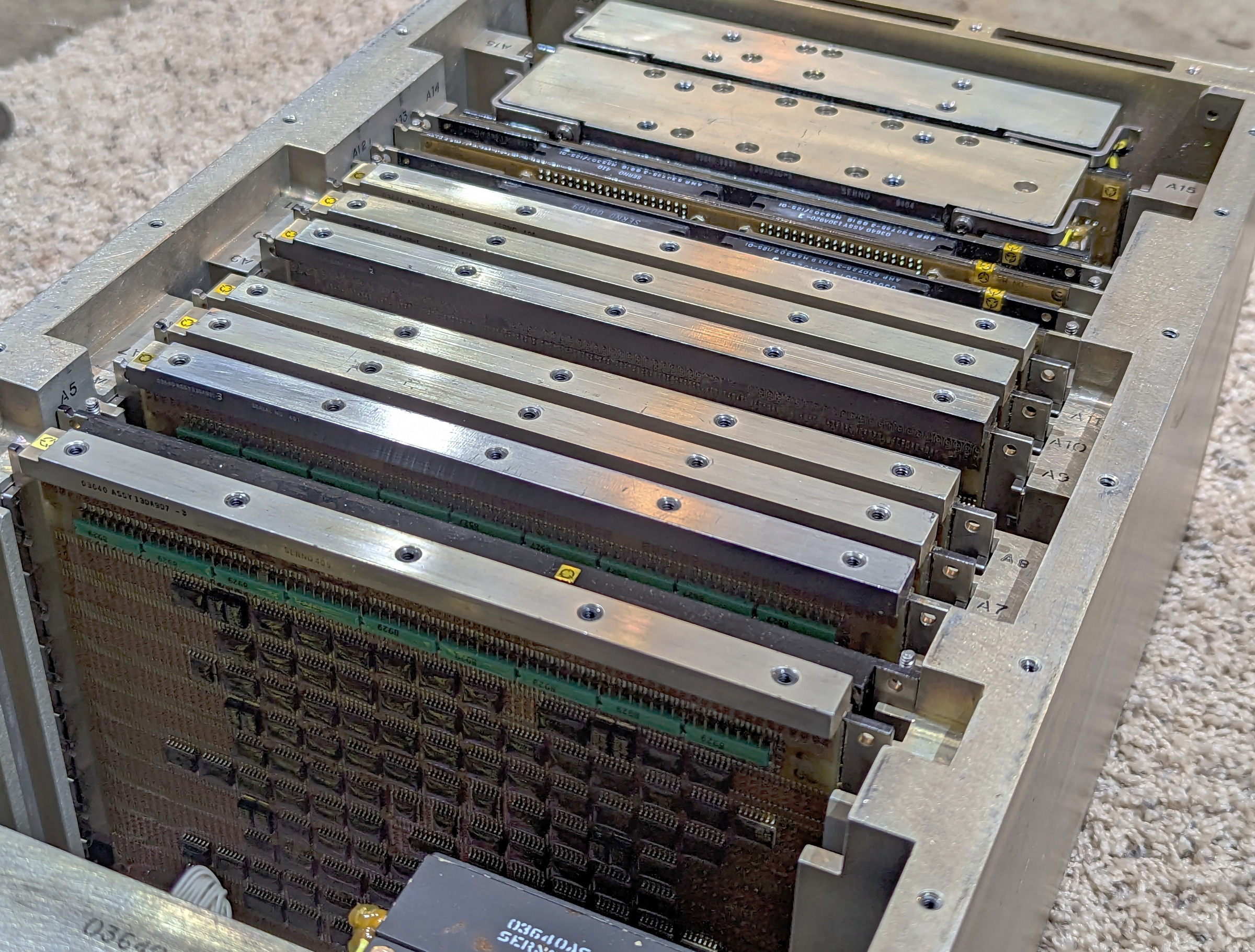
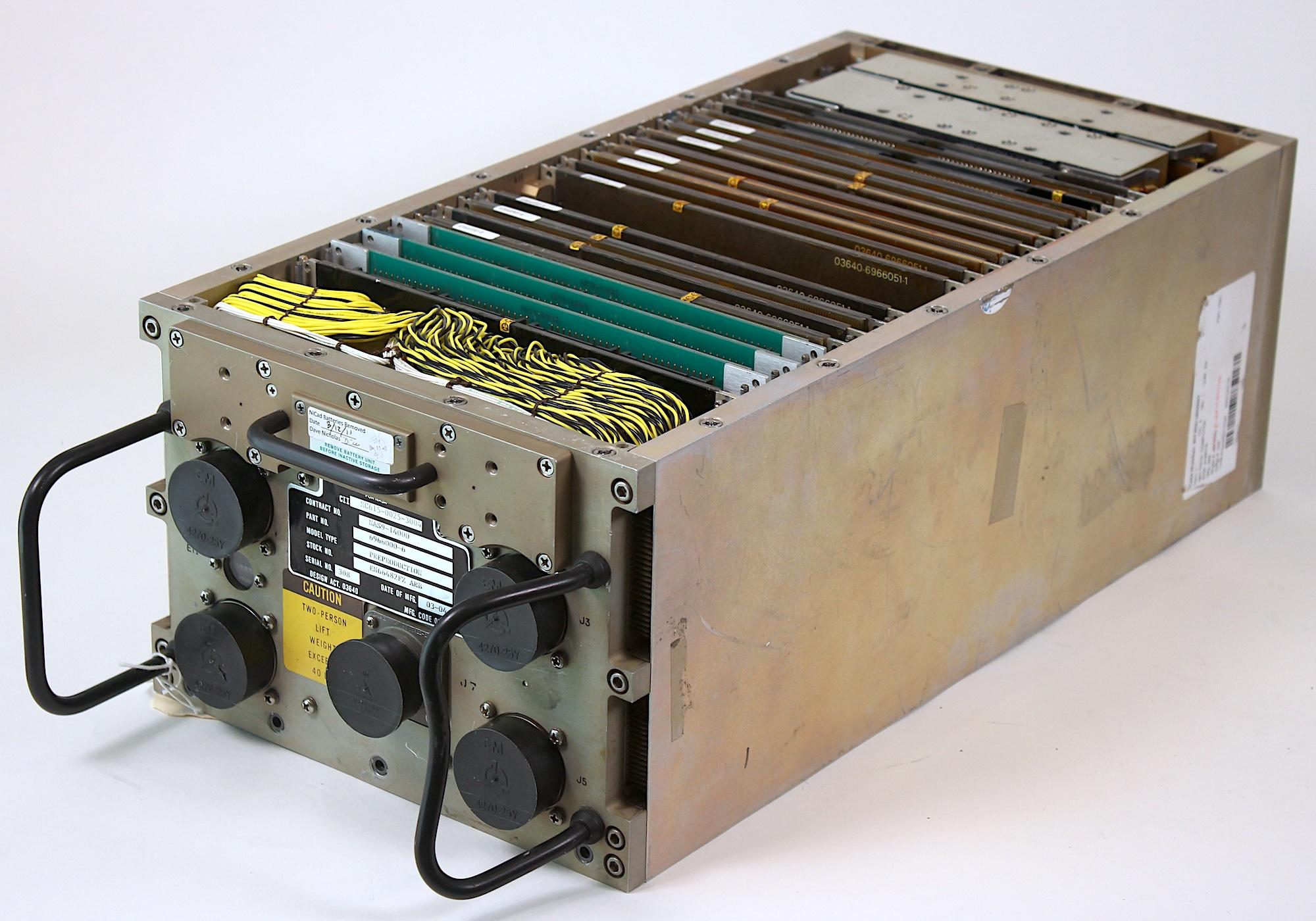
The AP-101S with its cover removed. This is a prototype; the green boards on the left are likely development boards instead of the I/O boards that are normally in these positions.

The AP-101S with its cover removed. This is a prototype; the green boards on the left are likely development boards instead of the I/O boards that are normally in these positions.

Despite its lack of absolute performance, the AP-101S was a substantial improvement over the earlier Shuttle computer. The AP-101S fit the functionality of the AP-101B computer and the IOP (I/O Processor) into one box instead of two, saving 60 pounds. With five computers on the Shuttle, this change freed up 300 pounds for payload. As well as tripling the speed, the AP-101S was more reliable, had 256K words of memory instead of 104K, and used 100 watts less of the Shuttle's limited power. The AP-101S remained plug-compatible with the old computer and could run the same software, making upgrading straightforward.

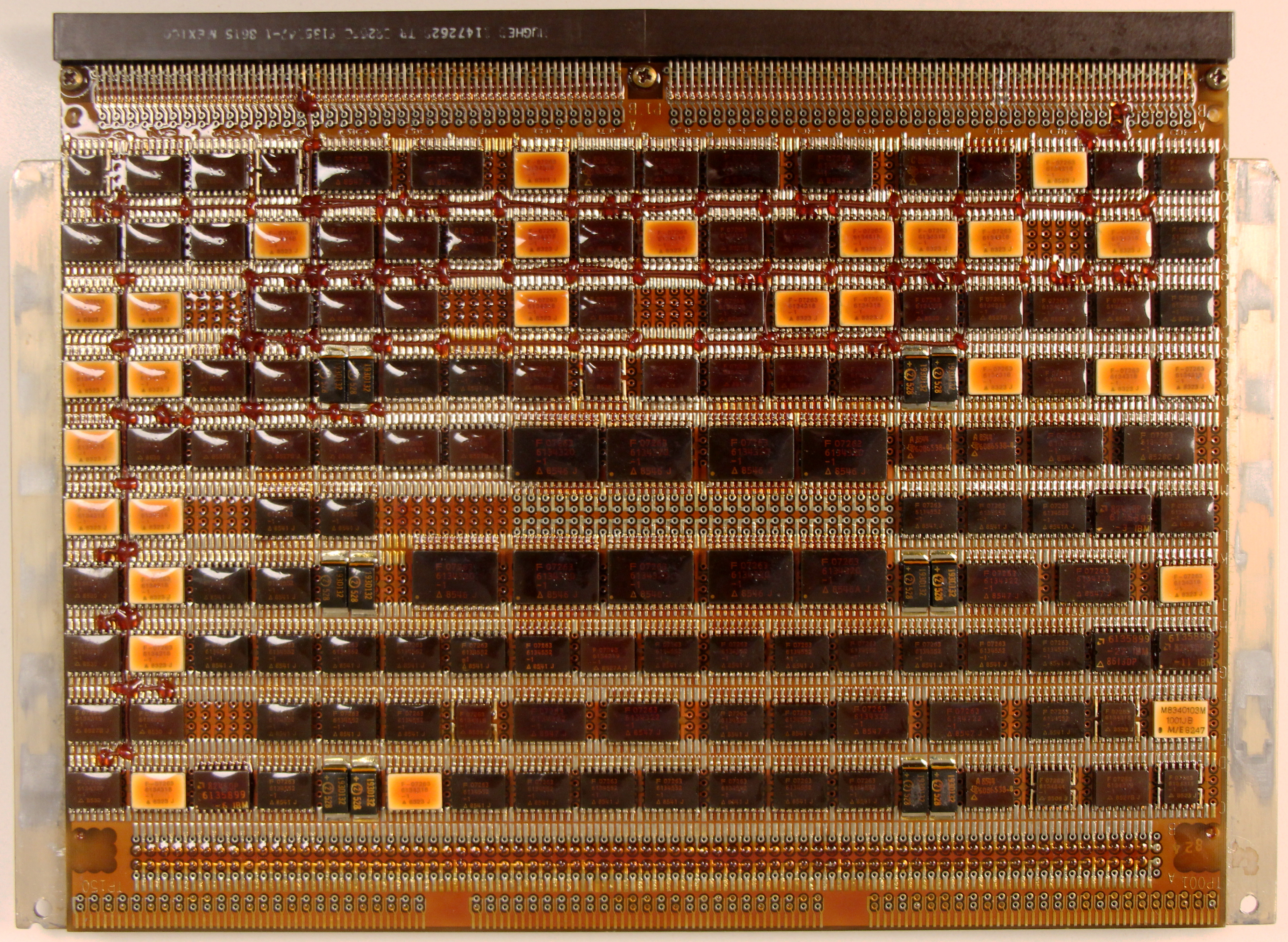
One of the CPU boards from the AP-101S, specifically the CPU1 board. If you look closely, you can see "bodge wires" that correct errors on the board. The nine large ICs in the center are four-bit arithmetic-logic unit chips (74F181) for the 36-bit "fraction" ALU. Much of the logic uses FAST (Fairchild Advanced Schottky Technology) TTL chips for improved performance. The board is covered with brown conformal coating to protect it from the environment. Click this image (or any other) for a larger version.

One of the CPU boards from the AP-101S, specifically the CPU1 board. If you look closely, you can see "bodge wires" that correct errors on the board. The nine large ICs in the center are four-bit arithmetic-logic unit chips (74F181) for the 36-bit "fraction" ALU. Much of the logic uses FAST (Fairchild Advanced Schottky Technology) TTL chips for improved performance. The board is covered with brown conformal coating to protect it from the environment. Click this image (or any other) for a larger version.

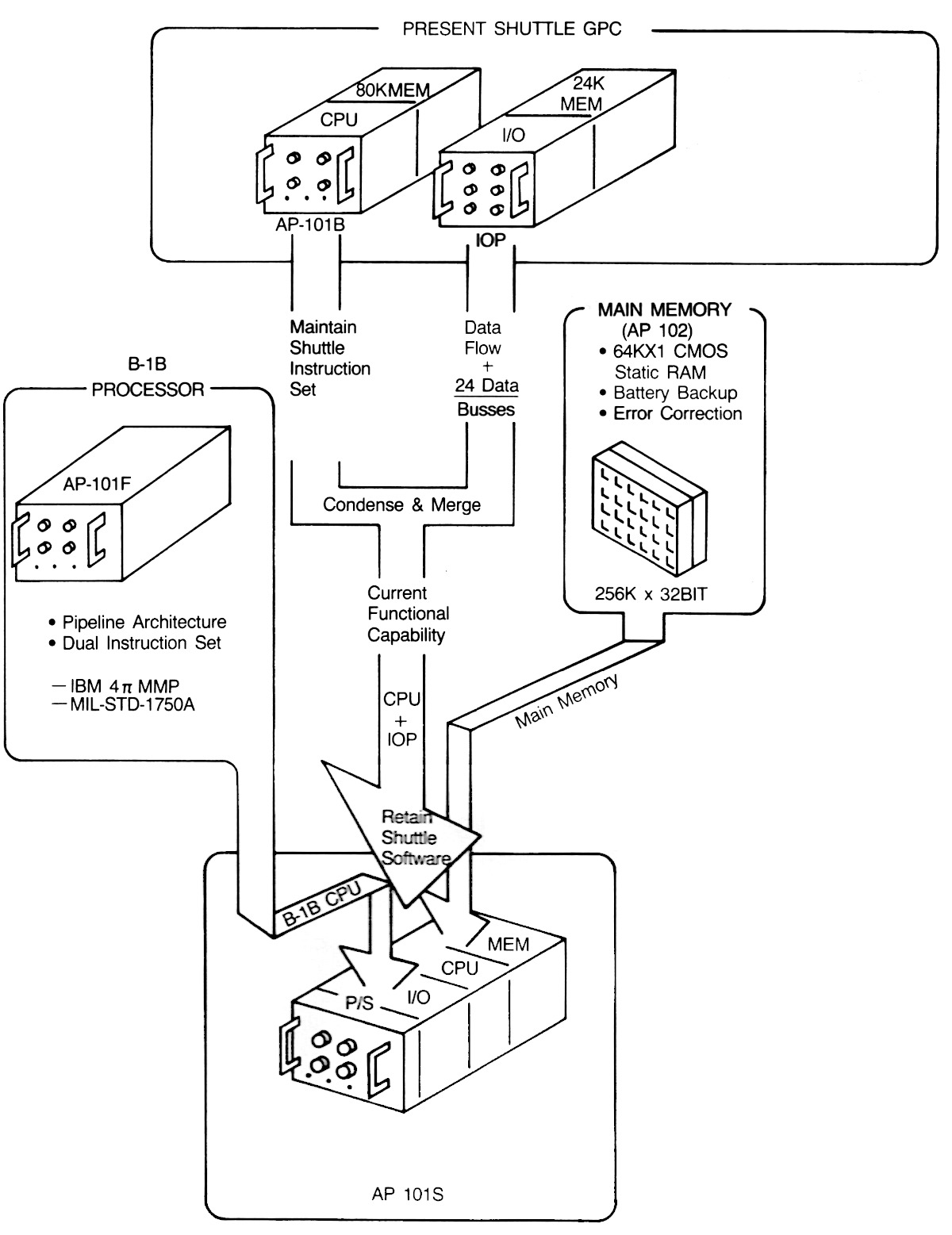
Like the previous processors, the CPU of the AP-101S was constructed from multiple pages of TTL chips. Unlike the earlier AP-101B, the AP-101S used large "MCS" pages, as shown above. The diagram below illustrates how the upgraded AP-101S computer was formed by combining the pipelined CPU22 from the high-performance AP-101F, the I/O Processor from the original Shuttle computer, and the semiconductor memory from the AP-102 (discussed in the next section).23

The upgrade path for the Space Shuttle computer. (Click this image (or any other) for a larger version.) From "A New Computer for the Space Shuttle: The AP-101S General Purpose Computer (GPC) Upgrade", IBM Technical Directions, 1986.

The upgrade path for the Space Shuttle computer. (Click this image (or any other) for a larger version.) From "A New Computer for the Space Shuttle: The AP-101S General Purpose Computer (GPC) Upgrade", IBM Technical Directions, 1986.

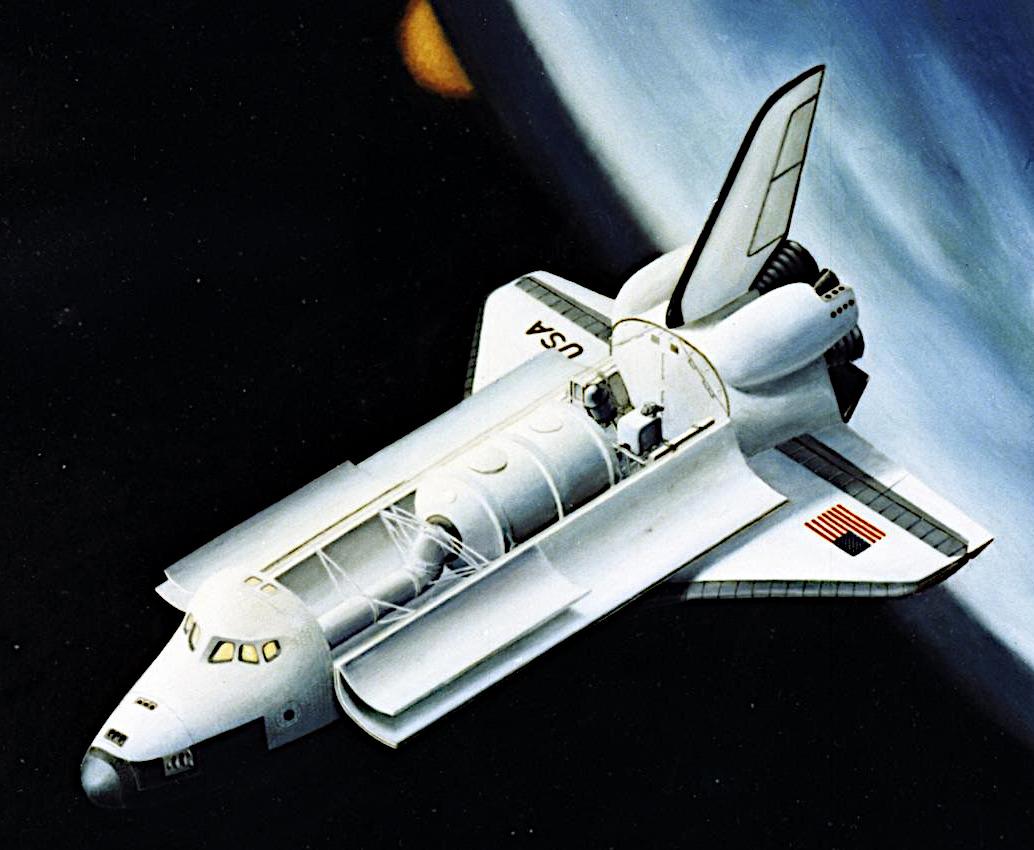
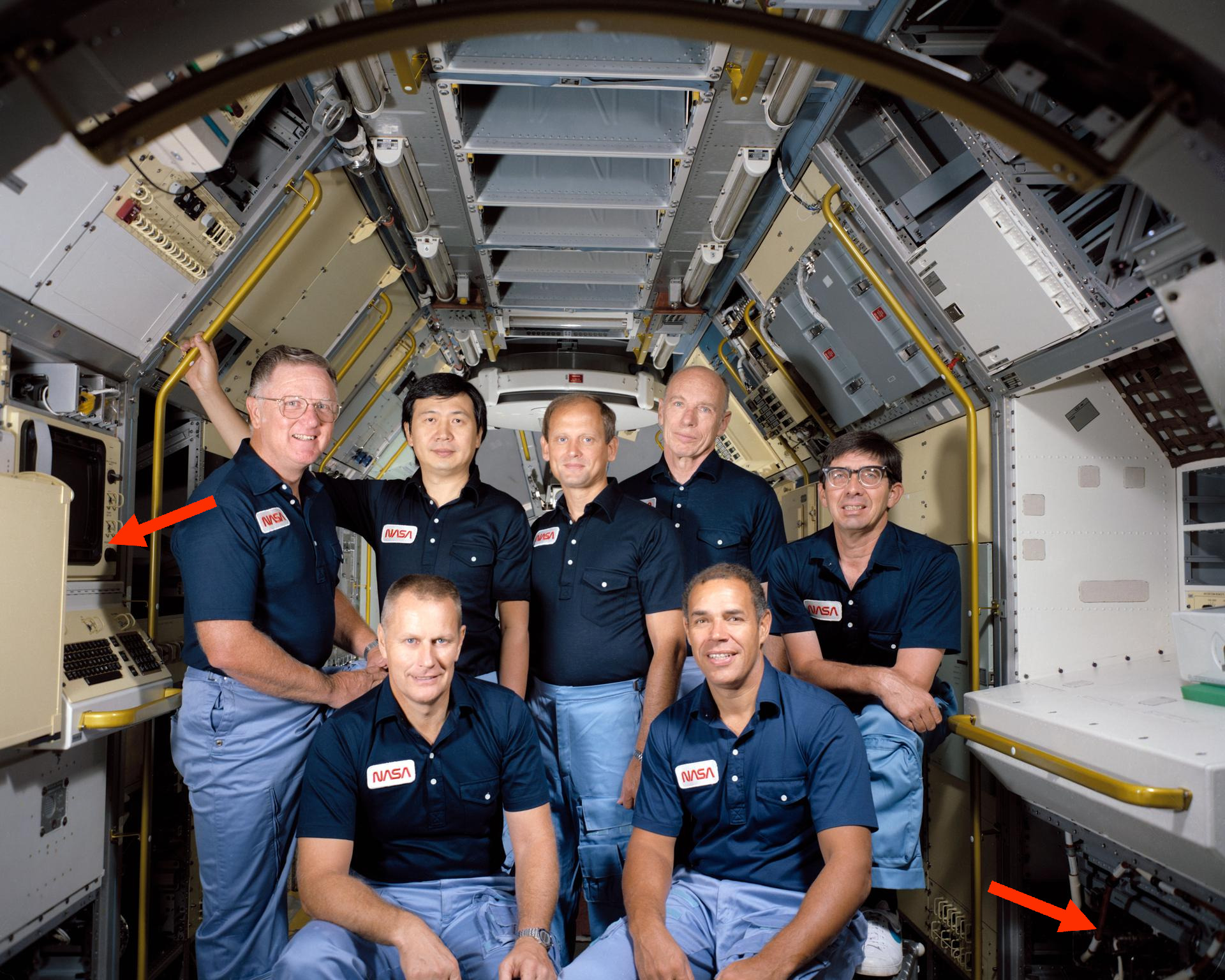
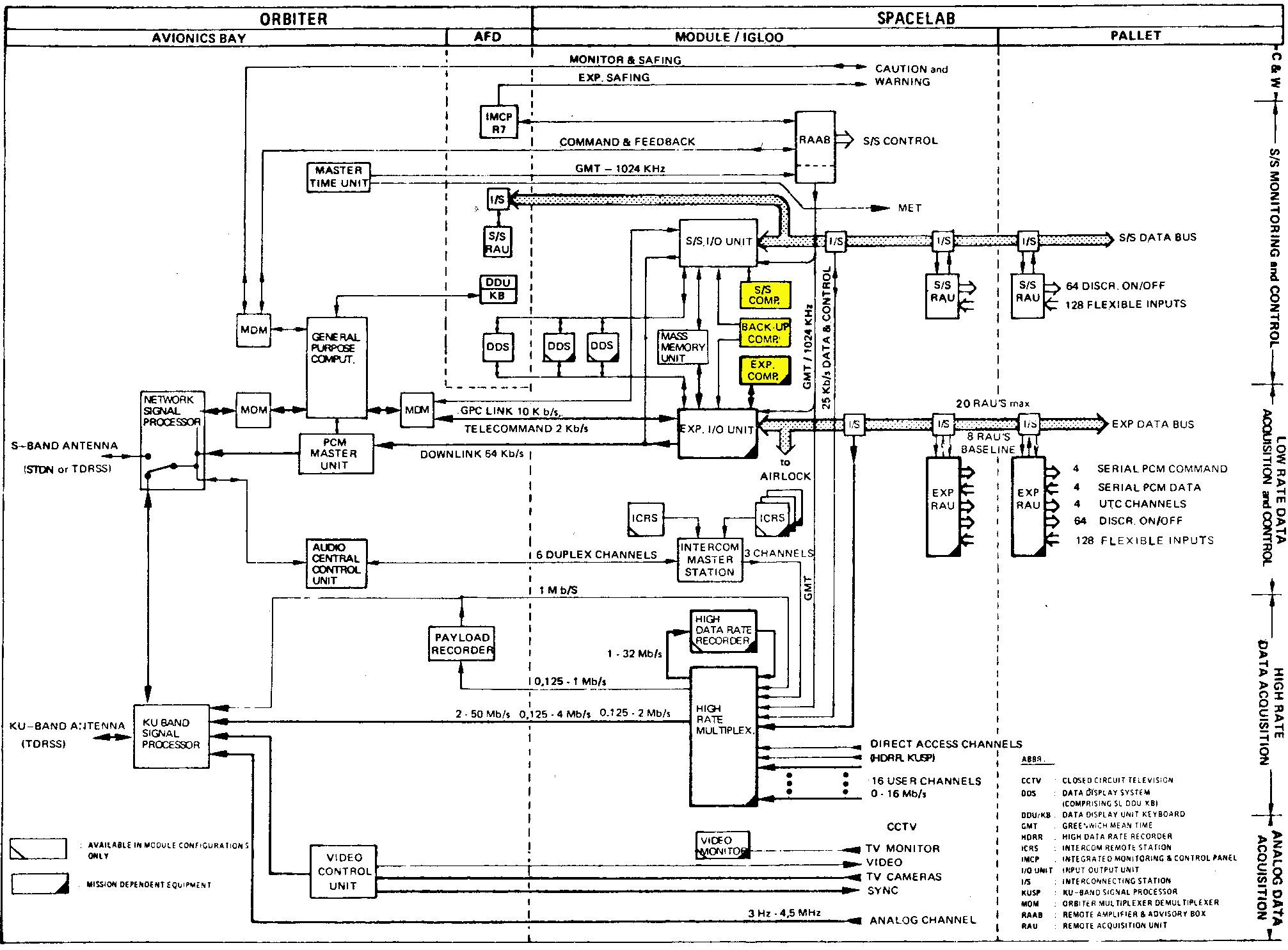
The Shuttle could carry a space laboratory called Spacelab (completely different from Skylab) in the cargo bay to provide a spacious research environment. Spacelab had independent computers from the Space Shuttle, originally French-built CIMSA 125 MS computers.24 In 1991, these Spacelab computers were replaced with IBM AP-101SL computers.25 The AP-101SL was compatible with the 16-bit CIMSA computer, so it could run "Experiment Computer Operating System" and other Spacelab software without change.

An AP-101SL computer at the National Air and Space Museum, VA. The slot at the top held nickel-cadmium batteries to preserve the contents of the CMOS memory, but the batteries were removed for safety during storage.
Photo by Sanjay Acharya, CC BY-SA 4.0, cropped.

An AP-101SL computer at the National Air and Space Museum, VA. The slot at the top held nickel-cadmium batteries to preserve the contents of the CMOS memory, but the batteries were removed for safety during storage. Photo by Sanjay Acharya, CC BY-SA 4.0, cropped.

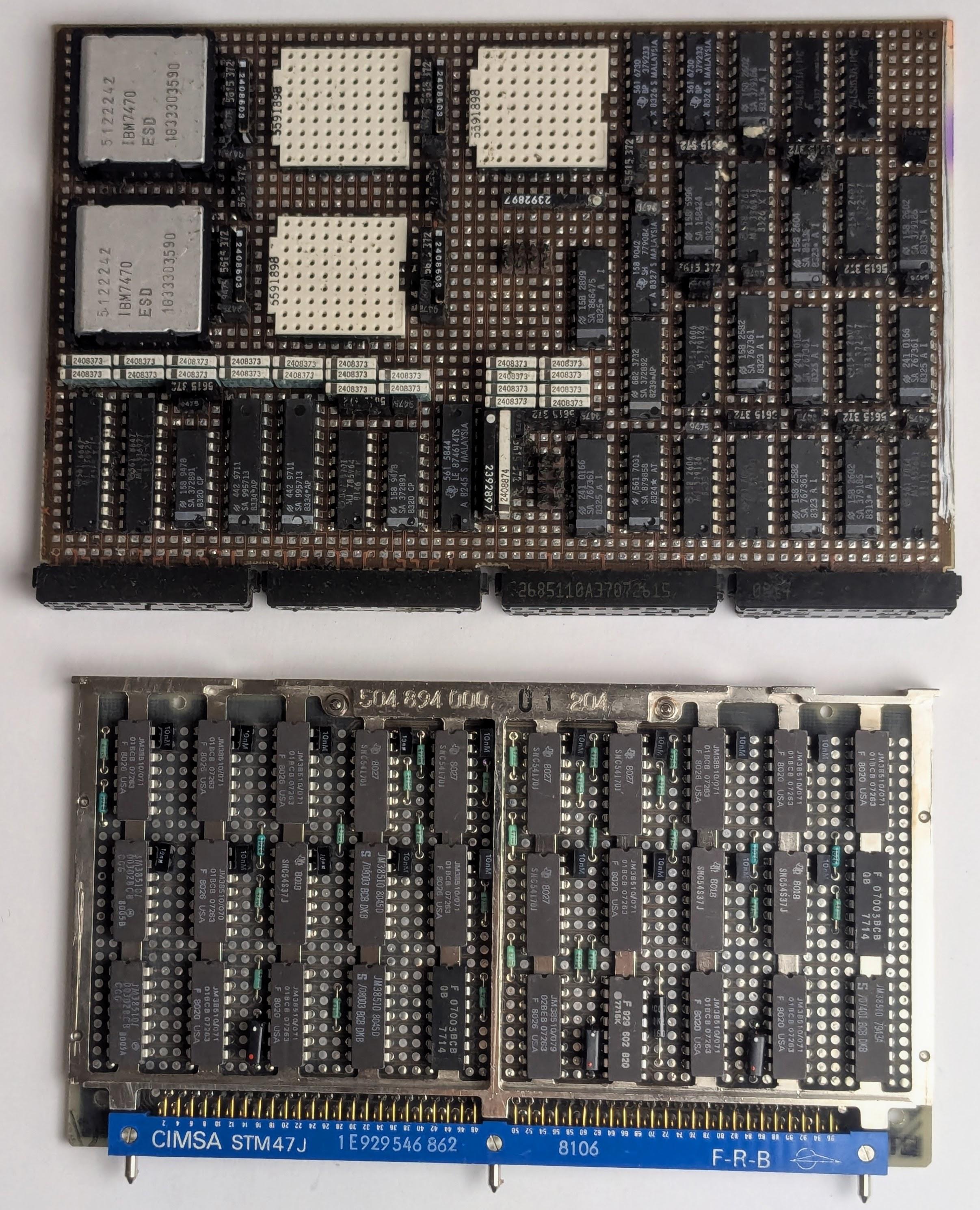
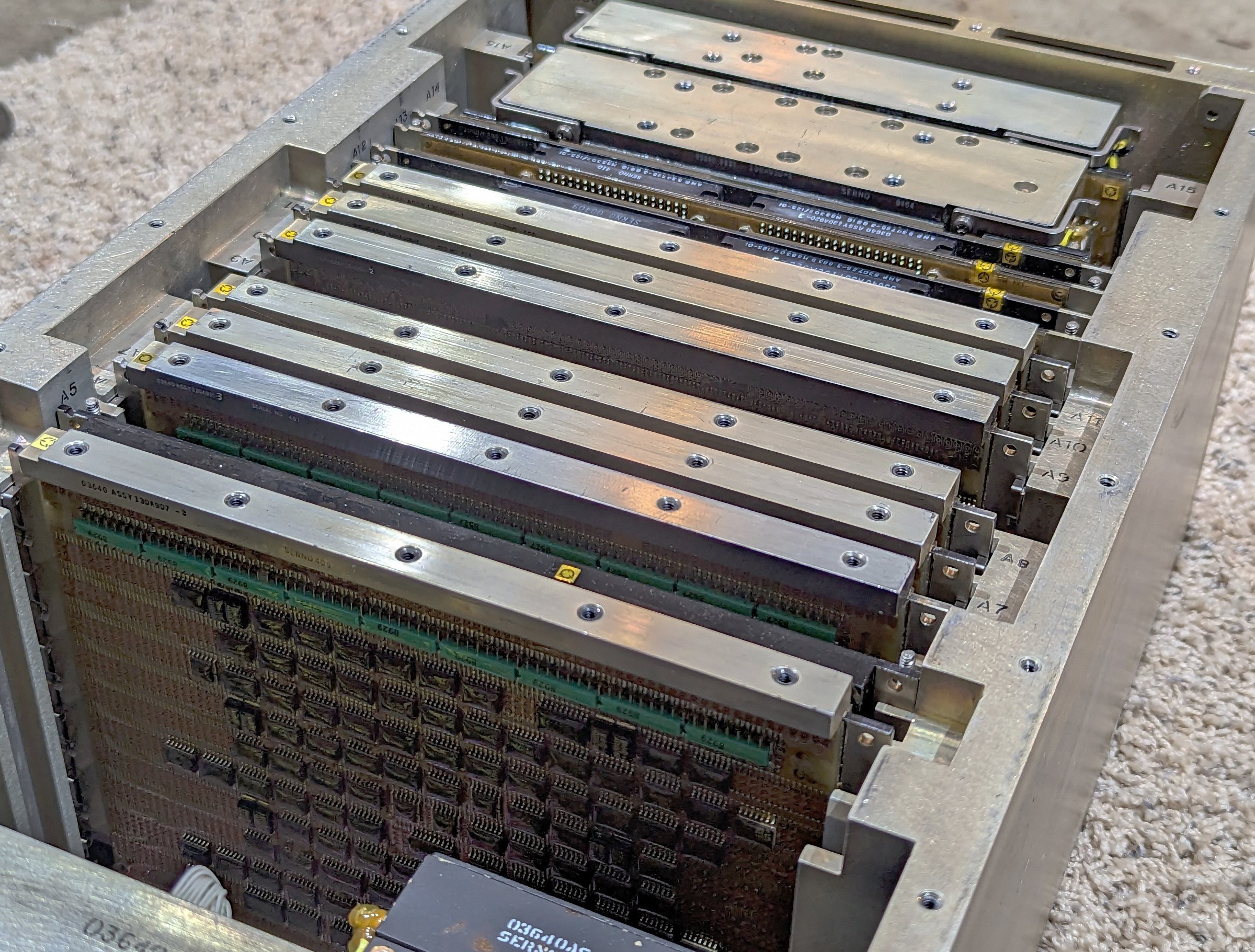
Internally, the Spacelab AP-101SL computer is very similar to the Shuttle's AP-101S. It has fewer boards than the AP-101S, since it doesn't include the Shuttle's IOP (I/O Processor). The processor boards, the semiconductor memory,26 and the power supplies are nearly identical to the Shuttle computer, while the I/O boards are different.27

The AP-101SL with the cover removed. Photo courtesy of Kyle Owen.

The AP-101SL with the cover removed. Photo courtesy of Kyle Owen.

AP-102 and VHSIC

Going back to the mid-1980s, IBM introduced the AP-102 computer. By 1992, it had become the most popular of IBM's avionics processors, with 1000 units sold. The AP-102 was a technological jump compared to the AP-101 since it used two VLSI (Very Large Scale Integration) chips, each containing 12,000 gates: one chip implemented the Instruction Processing Unit and the other chip implemented the Extended Arithmetic Unit (fixed and floating-point multiplies and divides). These chips were implemented with 2 µm NMOS technology. The AP-102 used CMOS static RAM for storage, which was much denser than core memory and used a tenth of the power. Because CMOS RAM loses its contents without electricity, the AP-102 used battery backup, lithium thionyl chloride cells that could power memory for up to seven years.

The AP-102 computer. From IBM Technical Directions, 1985 (cover).

The AP-102 computer. From IBM Technical Directions, 1985 (cover).

The AP-102 was compact, half the width of an AP-101.28 It weighed 20.8 pounds and used 95 watts. It ran the Air Force's standard 1750A instruction set, executing over 1 million instructions per second. The AP-102 was used in many aircraft in the late 1980s, including the stealth F-117A Nighthawk fighter, the MH-53J Special Operations helicopter, the F-4's Navigation & Weapon Delivery System (AN/ASQ-203), an "unspecified gunship", and a classified application.

A few years later, the AP-102 was upgraded with a new technology called VHSIC. If you've programmed an FPGA (Field-Programmable Gate Array), you've probably used the Verilog or VHDL languages. VHDL turns out to be a nested acronym, standing for VHSIC Hardware Description Language, where VHSIC stands for Very High Speed Integrated Circuit. But why this strange name?

In 1980, the Department of Defense started a billion-dollar program to help the US military keep its technological lead over the Soviet Union. This program, the Very High Speed Integrated Circuit program, was intended to get advanced, state-of-the-art integrated circuits into military usage faster. IBM was one of the contractors that developed these VHSIC "superchips." IBM created the V1750 processor, a radiation-hardened chip that ran the standardized Air Force instruction set, 1750A.29 This CMOS chip was built with 1 µm features, advanced for the time, and ran at 3 MIPS (million instructions per second).

The AP-102 mission computer was upgraded around 1992 to use the V1750 processor, resulting in the AP-102A. With the V1750 processor, IBM fit the CPU and memory onto a single card, a drop-in replacement for six cards in the existing AP-102. The result was up to 16 times as much memory and a factor of 3 improvement in performance, along with improvements in reliability, weight, and power consumption.

Subsystem Processor (SP)

The next member of the Advanced System line is the SP Subsystem Processor, intended to be a subsystem in a larger system. Compared to the AP series, the SP computers have a 16-bit word instead of a 32-bit word, and are generally smaller and slower but use less power. The SP computers are architecturally simpler, with just two or three registers.

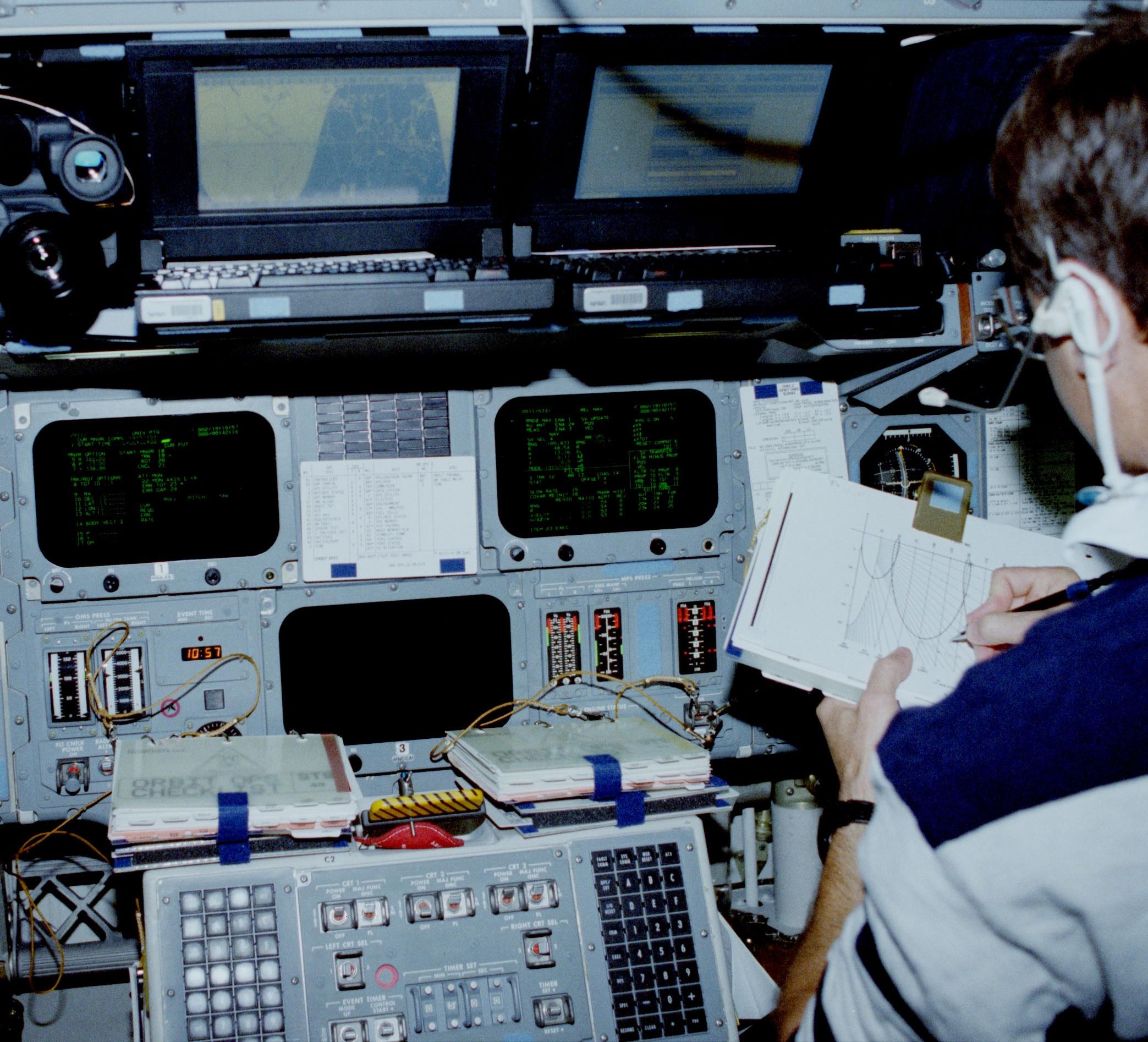
On the Space Shuttle, the astronauts received flight and control information through four screens 30 These monochrome green CRTs displayed text and primitive graphics using vectors—lines drawn on the CRT—rather than pixels. Each screen was controlled by a Display Electronics Unit (DEU).

Three of the Shuttle's CRT displays. (Click for a larger image.) The left screen shows the
Universal Pointing attitude display.
The right screen shows the Relative Navigation screen for rendezvous operations.
At the bottom of the photo are the two grid-style keyboards for communication with the computer, with the CRT controls in between.
Two laptops are sitting on top of the console. Mission Pilot Kevin Chilton is in the pilot's seat. From National Archives.

Three of the Shuttle's CRT displays. (Click for a larger image.) The left screen shows the Universal Pointing attitude display. The right screen shows the Relative Navigation screen for rendezvous operations. At the bottom of the photo are the two grid-style keyboards for communication with the computer, with the CRT controls in between. Two laptops are sitting on top of the console. Mission Pilot Kevin Chilton is in the pilot's seat. From National Archives.

Internally, the DEU looks very much like the Shuttle's AP-101B computer, a large box filled with squat pages. One of the pages is the CPU of an SP-0 computer, while other pages provided 32K words of memory, interfaced to the main computers, and drove the CRT. The SP-0 handled filtering of keyboard data, time maintenance, and health monitoring. The SP-0 received dynamic data from the Shuttle's main computers and formatted the data for the CRT display.

The Space Shuttle Display Electronics Unit (DEU). This is an engineering prototype. Photo courtesy of RR Auction.

The Space Shuttle Display Electronics Unit (DEU). This is an engineering prototype. Photo courtesy of RR Auction.

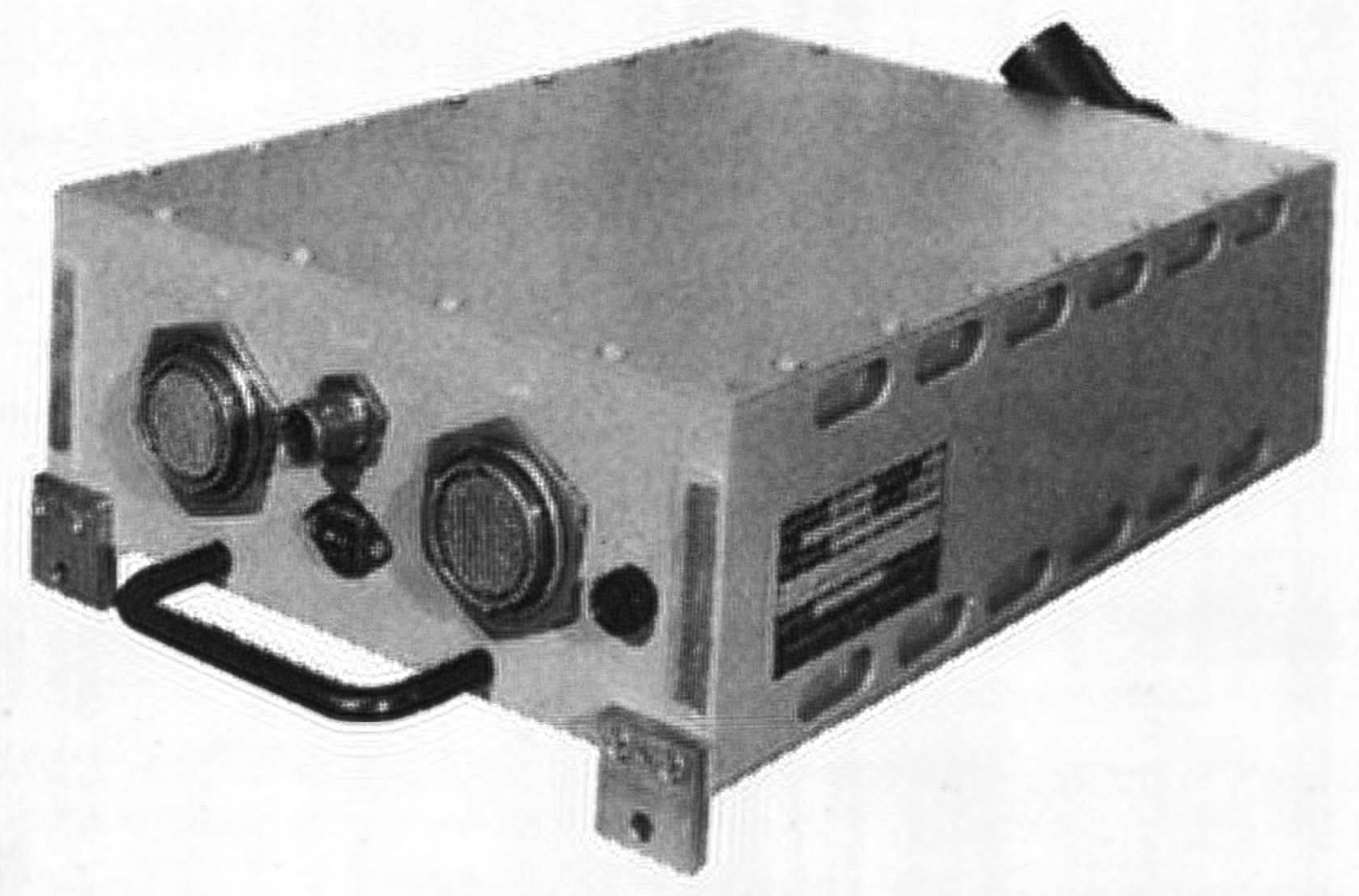
The SP-0A computer below was used in the Lockheed S-3 Viking anti-submarine aircraft, probably to detect enemy radar and communication signals in the AN/ALR-47 Electronic Support Measures system.

The SP-0A computer. From "IBM System/4 Pi and Advanced System/4 Pi Computers" brochure, August 1973.

The SP-0A computer. From "IBM System/4 Pi and Advanced System/4 Pi Computers" brochure, August 1973.

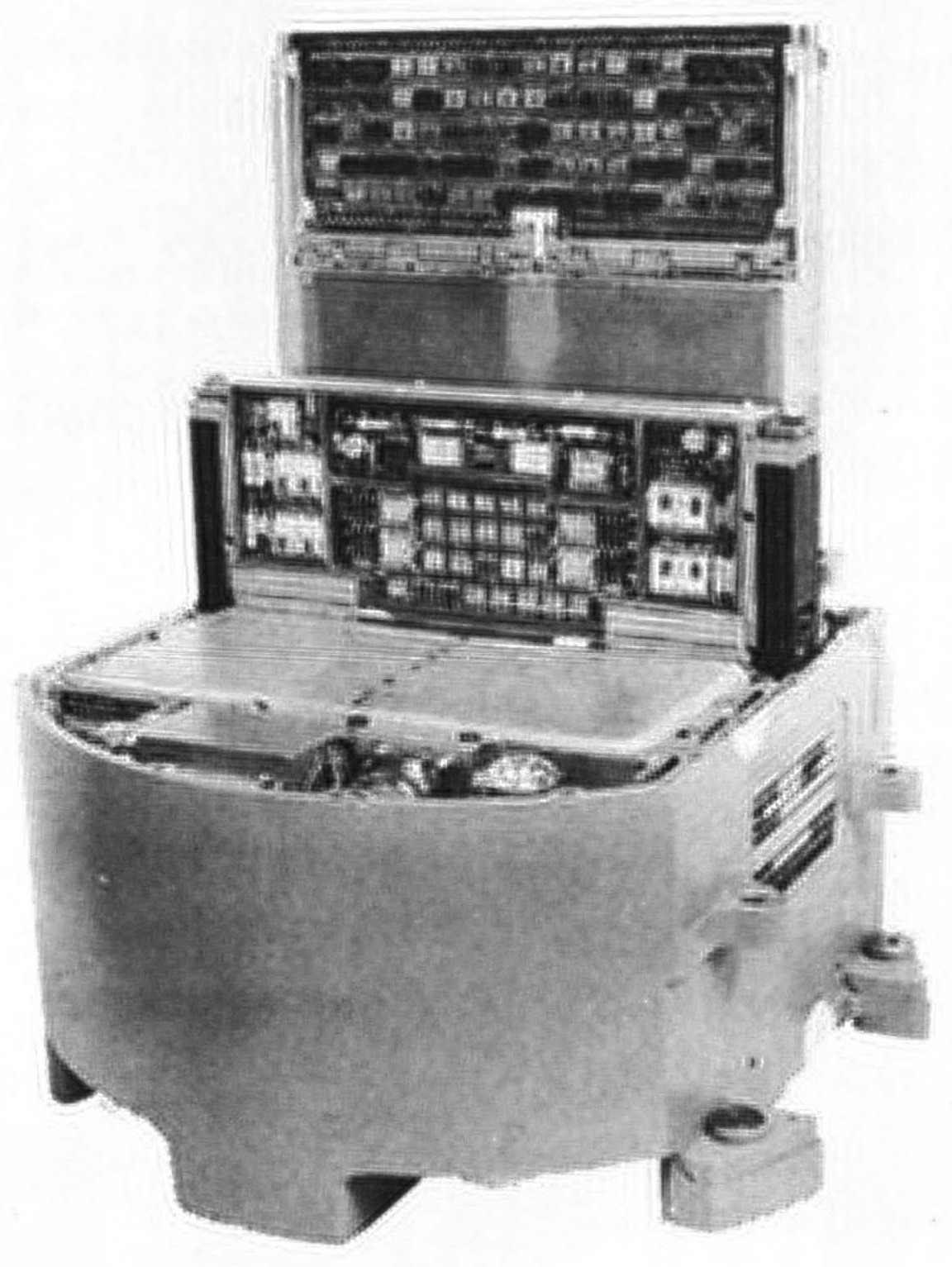
The SP-0B computer was used in the Midcourse Guidance Unit for the Harpoon anti-ship missile.31 It originally had magnetic core memory, upgraded to semiconductor memory in 1974. Note the curved packaging for the SP-0B that helps it fit inside the missile.

The SP-0B computer. From "IBM System/4 Pi and Advanced System/4 Pi Computers" brochure, August 1973.

The SP-0B computer. From "IBM System/4 Pi and Advanced System/4 Pi Computers" brochure, August 1973.

The SP-1, below, had one more register than the SP-0, as well as higher performance, running 342,500 operations per second. It was also available as the unpackaged SP-1A, weighing just 3.6 pounds. The SP-1M added a few instructions to improve performance. The much larger SP-1B weighed 200 pounds and was designed for ground usage. IBM gives a long list of applications for the SP-1: "F-4 ATIS, navigation, missile and drone stabilization and control, communications processor, torpedo stabilization and control."

The SP-1 computer. From "IBM System/4 Pi and Advanced System/4 Pi Computers" brochure, August 1973.

The SP-1 computer. From "IBM System/4 Pi and Advanced System/4 Pi Computers" brochure, August 1973.

The bulky SP-201 computer was an outlier from the rest of the SP series, since it weighed 660 pounds. Its performance was higher than the other SP models, running 450,000 instructions per second. This computer was part of the sonar system used on Los Angeles and Ohio class submarines. The bow of the submarine contained a giant sphere, 15 feet in diameter, studded with over a thousand transducers to detect underwater sounds. The SP-201 was a "post-classification signal processor"32 in the AN/BQQ-5, analyzing these sonar signals and driving scrolling "waterfall" displays with green lines indicating the presence of ships (or sometimes whales). This computer was carefully designed to be lowered through a submarine's standard 25-inch hatch.

The SP-201 computer, designated CP-1125/BQQ-5. From "IBM System/4 Pi and Advanced System/4 Pi Computers" brochure, August 1973.

The SP-201 computer, designated CP-1125/BQQ-5. From "IBM System/4 Pi and Advanced System/4 Pi Computers" brochure, August 1973.

Command and Control (CC)

Although the AP series was the star of the Advanced System/4 Pi line, massive CC computers ran the Boeing E-3A Sentry AWACS (Airborne Warning and Control System) aircraft. The AWACS is a Boeing 707 with a rotating 30-foot radar dome on top, appearing as if a giant mushroom sprouted from the fuselage. This radar tracked activity over 250 miles away, providing a comprehensive view of the battlefield. Inside the AWACS, the CC was the central mission computer, processing radar data and sending it to 14 display terminals, as well as providing command-and-control functions.

The CC-1 was developed in 1971 as the top performer of the System/4 Pi line at 740,000 operations per second. It supported the System/360 architecture—including System/360 peripherals—but also supported the optimized "CC-1 architecture".33 The CC-1 was followed by the CC-2 (1980), which boosted performance to 2 million instructions per second through the use of Super Schottky TTL.

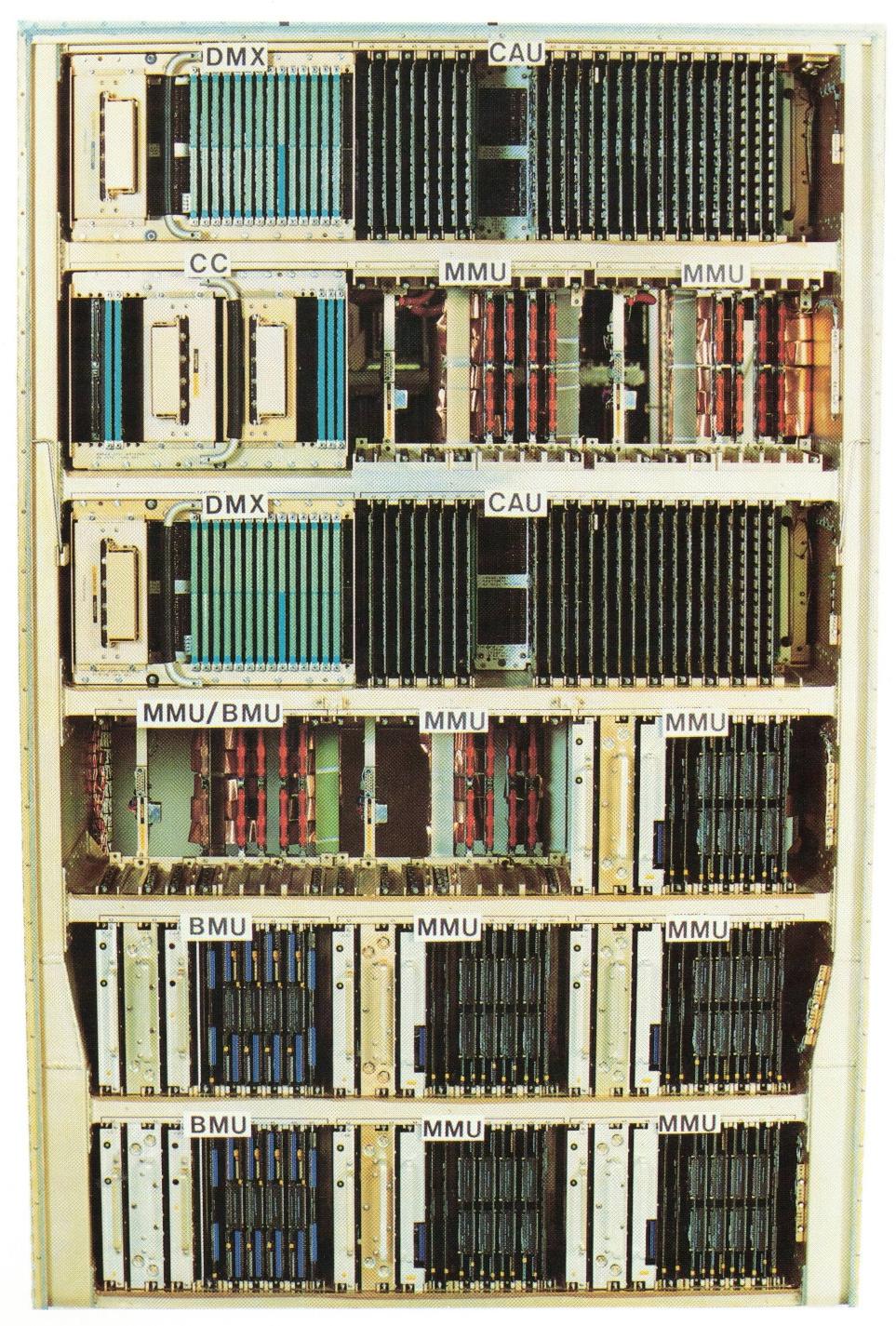
The CC-2E computer with Memory Enhancement provided four times the main storage and eight times the bulk storage. The CC-2E was massive compared to the rest of the 4 Pi line, weighing 1826 pounds and standing almost 6 feet tall. It ran over 2.7 MIPS (Million Instructions Per Second), over twice the speed of the Space Shuttle's upgraded computer. The computer was redundant to ensure reliability. It also included "nuclear event detection and survivability".

The baseline configuration for the AWACS CC-2E digital computer.
Components are Digital Multiplexer (DMX), Computer Arithmetic Unit (CAU),
Computer Control (CC),
Monolithic Memory Unit (MMU),
and Bubble Memory Unit (BMU).
From "AWACS Data Processing Subsystem" brochure, 1991.

The baseline configuration for the AWACS CC-2E digital computer. Components are Digital Multiplexer (DMX), Computer Arithmetic Unit (CAU), Computer Control (CC), Monolithic Memory Unit (MMU), and Bubble Memory Unit (BMU). From "AWACS Data Processing Subsystem" brochure, 1991.

The photo above shows the refrigerator-sized cabinet of the CC-2E. The computer is constructed from two types of boards: most of the system used the large MCS pages, while the DMX and Computer Control units used the squat pages of earlier 4 Pi systems.

The CC-2E made use of an unusual technology for mass nonvolatile storage: bubble memory. In the 1970s, bubble memory was the storage technology of the future, providing hard disk capacity at core memory speeds. It used tiny magnetic "bubbles" moving along tracks by magnetic fields. However, improvements in semiconductor memory made bubble memory uncompetitive; by 1981, the New York Times snarkily referred to The Computer Bubble that Burst. Bubble memory was popular with the military because it was insensitive to vibrations, unlike hard disks. Each bubble memory unit (BMU in the photo) in the CC-2E stored 8 megabytes, four times as much as a similarly-sized semiconductor-based monolithic memory unit (MMU). These replaced four rotating magnetic drums in the original CC-1, each storing 400,000 words. To safeguard information from falling into the wrong hands, the bubble memory modules had a "data destruct" feature.

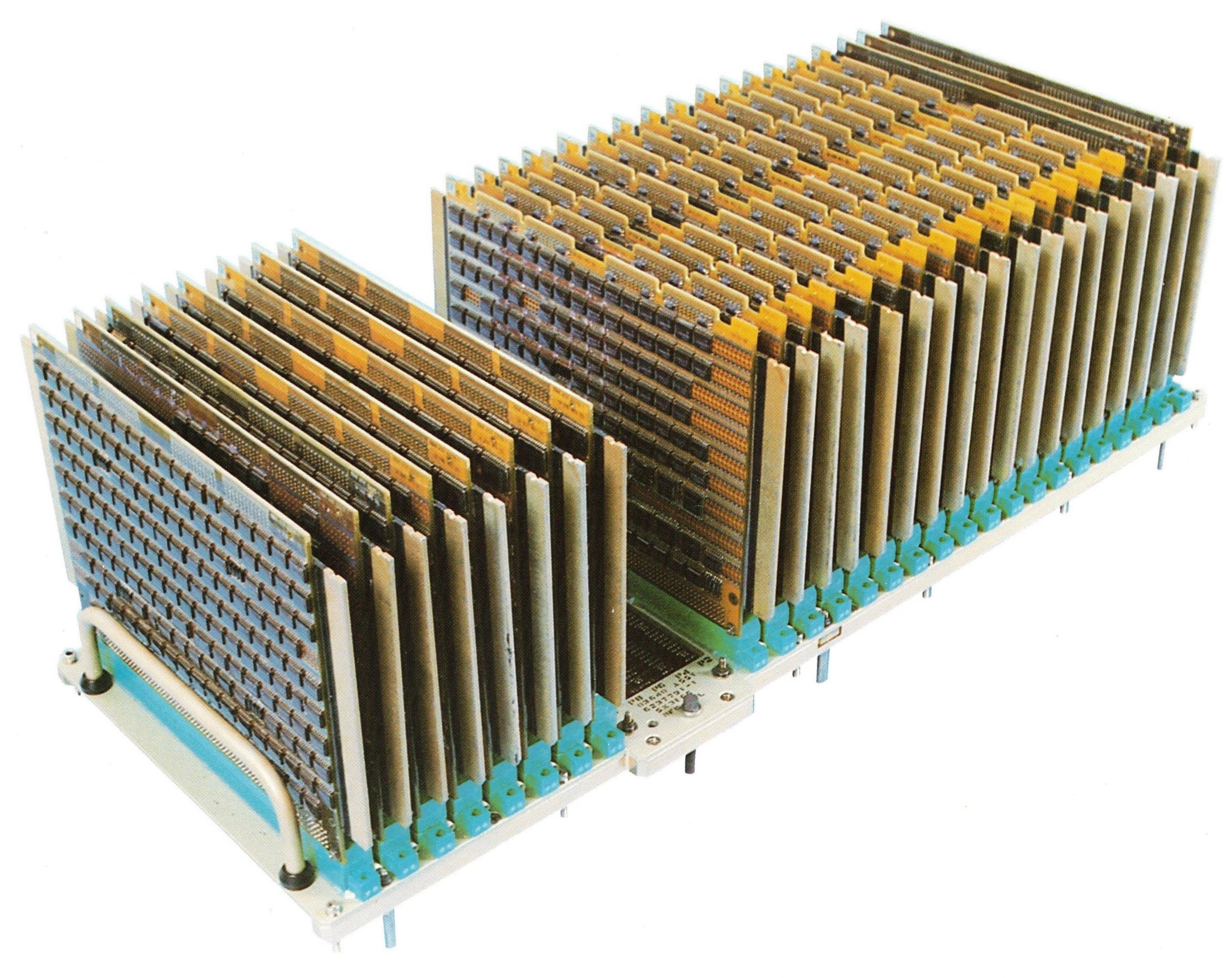
The Computer Arithmetic Unit Assembly, one of two in the AWACS computer. From "AWACS Data Processing Subsystem" brochure, 1991.

The Computer Arithmetic Unit Assembly, one of two in the AWACS computer. From "AWACS Data Processing Subsystem" brochure, 1991.

The CC-2E had two arithmetic units, each constructed from about 26 MCS pages (above). Each arithmetic unit was a 32-bit computer that implemented 182 fixed-point and floating-point instructions and had an 8K-word cache for performance. It was compatible with the System/360 mainframe and had extensions such as support for arbitrary-length bit fields.

ML-1

Around 1974, IBM introduced the compact ML-1 computer,34 half the width of the AP-101. The technological advance in the ML-1 was LSI (Large Scale Integration) chips, averaging 110 logic gates per chip. (LSI is typically defined as having 100-1000 gates, so these chips are on the very low end of LSI.) Each chip was mounted on a square ceramic substrate, 1 inch on a side, with 48 pins on the underside.35

The IBM ML-1 computer. The core memory stack is visible on the right. From an ad in Air Force Magazine, April 1975.

The IBM ML-1 computer. The core memory stack is visible on the right. From an ad in Air Force Magazine, April 1975.

The ML-1 computer used the same modular core memory as the AP-101, CC-1, and other systems. The ML-1 also supported semiconductor memory, which was volatile (i.e., lost its contents without electricity), but cost "significantly less" than magnetic core memory, was faster, weighed 8 pounds less (for a 32K-word computer), used slightly less power, and reduced the length of the computer by 7 inches.

The IBM ML-1 computer. From "Advanced System/4 Pi Model ML-1 General Purpose Computer" brochure, Dec. 1974.

The IBM ML-1 computer. From "Advanced System/4 Pi Model ML-1 General Purpose Computer" brochure, Dec. 1974.

The ML-1 had a similar architecture to the AP-101, except it used a 16-bit datapath instead of 32. It performed 550,000 operations per second, the same as the AP-101. IBM said that the ML-1 was "adaptable to a wide variety of applications such as guidance and navigation weapons delivery, digital flight control and communications." To support communication applications, the ML-1 had optional byte-handling instructions. The ML-1 was used in a terminal for the Joint Tactical Information Distribution System (JTIDS), as a bus controller in an IBM test facility, and in an airplane landing simulator.

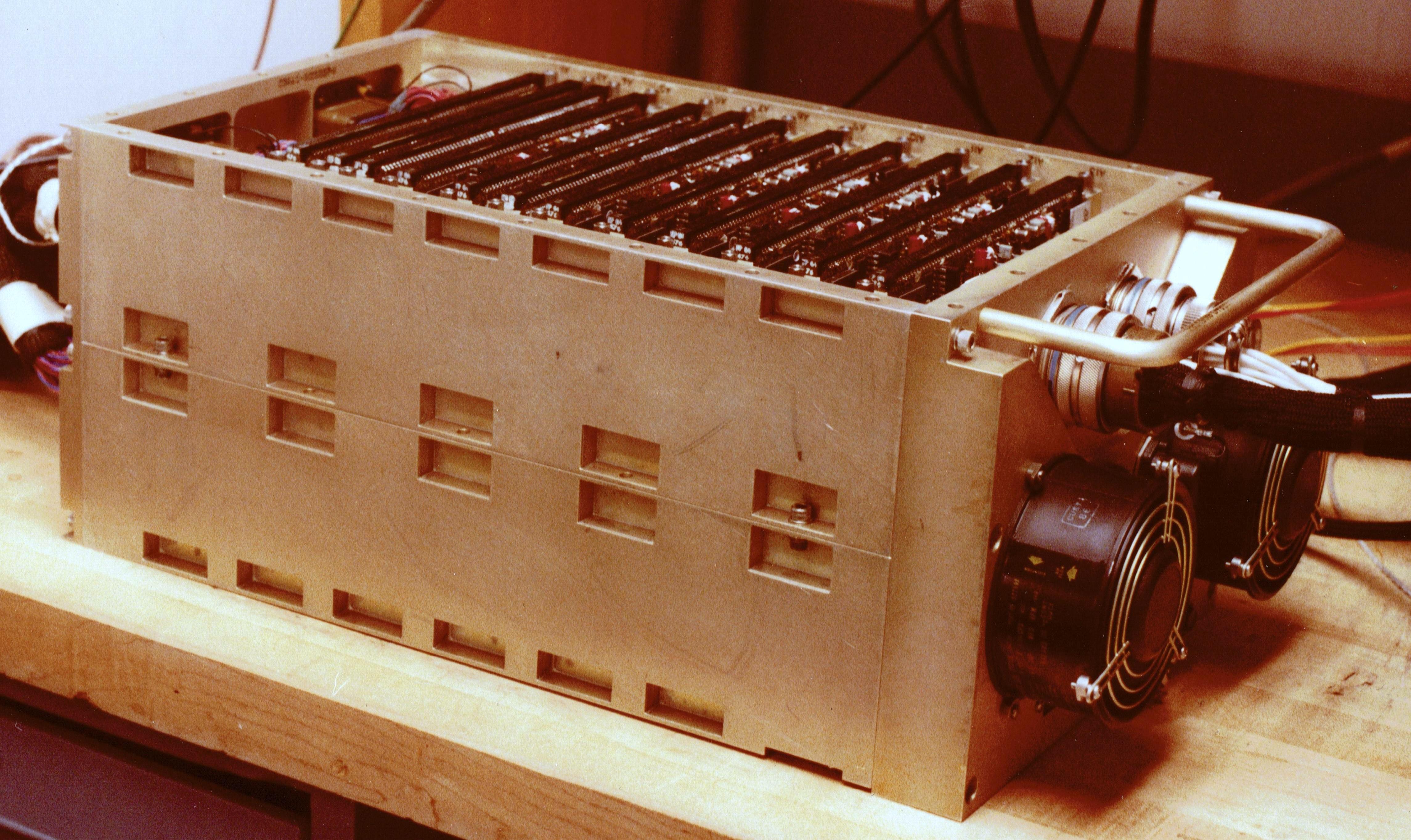
An ML-0 enclosure with the cover removed, showing the boards inside. Photo courtesy of Henry Brandt.

An ML-0 enclosure with the cover removed, showing the boards inside. Photo courtesy of Henry Brandt.

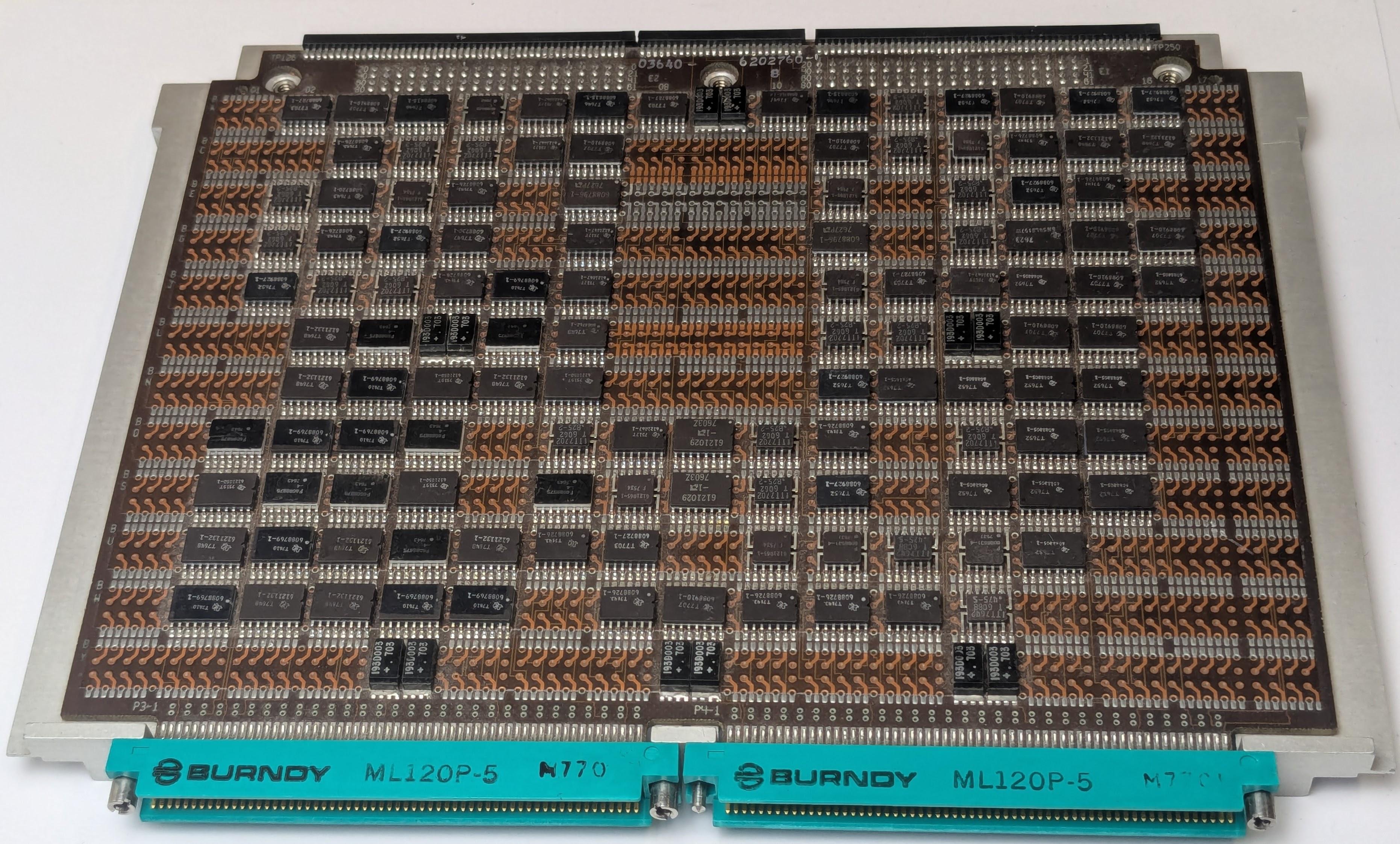
Two years later, IBM designed the less powerful ML-0 (above), briefly mentioned here. This computer was built for the Navy and Air Force's TASES and APMS systems, but the projects were canceled. Rather than the LSI chips of the ML-1, the ML-0 used simpler 5400-series TTL flatpack chips. A ML-0 board (below) is slightly different from the MCS boards in other 4 Pi computers because the ML-0 used air cooling. The back side of the board has machined metal cooling fins; two boards formed a sandwich, linked at the top by two 84-pin connectors, with air blown between the boards across the fins.

An ML-0 interface board, courtesy of Henry Brandt. This is an interface board with flip-flops, multiplexers,
and other TTL chips. The board has different edge connectors from the standard MCS boards and is a slightly different size.

An ML-0 interface board, courtesy of Henry Brandt. This is an interface board with flip-flops, multiplexers, and other TTL chips. The board has different edge connectors from the standard MCS boards and is a slightly different size.

Conclusions

The IBM System/4 Pi family of computers is best known for the Space Shuttle computers, but the family contained many lesser-known computers, ranging from the 3.6-pound SP-1A to the 1826-pound CC-2E. The 4 Pi computers illustrate the rapid progress of computer technology, from simple TTL integrated circuits, magnetic core memory, and thousands of instructions per second in the late 1960s to complex CMOS chips, dense semiconductor memory, and millions of instructions per second in the 1980s.

The 4 Pi series came to an abrupt end in 1994. IBM's best-selling avionics computer had been the AP-102, with a thousand units sold. This was a rounding error compared to the millions of PCs and PS/2 computers that IBM sold. In December 1994, IBM decided to focus on its main business and announced that it was selling the Federal Systems Division—home of the System/4 Pi—to the defense contractor Loral for $1.58 billion. Less than two years later, Loral decided to focus on satellites and sold its defense electronics business to Lockheed Martin. Nonetheless, a remnant of System/4 Pi history lives on: the low-slung brick buildings in Owego, NY36 where IBM developed the System/4 Pi are still in use by Lockheed Martin, just off a road named IBM Parkway.

For updates, follow me on Bluesky (@righto.com), Mastodon (@kenshirriff@oldbytes.space), or RSS.

Credits: Many thanks to W. Tracz for providing extensive documents. Thanks to Henry Brandt for providing an ML-0 board. Thanks to Kyle Owen, RR Auction, Marcel, Alex1970-14, Steve Jurvetson, Sanjay Acharya, José Luis Briz Velasco, Rich Katz, and bitsavers for photos.37

Notes and references

  1. AI notice: Despite the presence of the em dash, no AI was used in the writing of this article. Google Search had a few useful papers in its AI Overview, though, mixed with highly questionable conclusions. 

  2. This description of System/4 Pi is from Aircraft Yearbook, 1970. 

  3. If you're an electronics hobbyist of a certain age, you've probably used the popular 7400-series of TTL integrated circuits. The 5400 series is the military version of the 7400 series, handling a wider temperature range of -55 to 125 °C. The original System/4 Pi systems used Texas Instruments Series 2400 integrated circuits, a variant of the 5400 series built to IBM's specifications specifically for the 4 Pi family. 

  4. Skylab used numerous acronyms. The telescope observatory was called the Apollo Telescope Mount (ATM). The computers controlled the Skylab Attitude Pointing and Control System (APCS). Each TC-1 computer, with its supporting power supply and I/O interfaces, was called an Apollo Telescope Mount Digital Computer (ATMDC). For details on Skylab's computers and their software, see Computers in Spaceflight: The NASA Experience and Development of On-board Space Computer Systems

  5. The first generation of System/4 Pi computers used IBM's 13/21 toroidal cores (13 mils inner diameter and 21 mils outer diameter) made of lithium nickel ferrite. These cores operated over a wide temperature range (-55 to 100 ºC), important for a military computer. (In comparison, some IBM mainframes, such as the 7090, kept the cores in a bath of heated oil to keep the temperature constant.) These core planes were a militarized version of the core planes used in the high-end System/360 models 65, 75, and 95. One core plane held 16,384 bits and took 2.5 µs for an access cycle. (Some IBM core planes had 512 extra bits, called "bump" storage. As a result, the EP series had 8448 words of storage rather than the expected 8192.)  

  6. What does CP stand for? An early IBM document states that CP stands for "Cost Performance" but most other sources use "Customized Processor". A 1966 Electronics article gives both names. 

  7. The storage protection bits allow a word in core memory to be marked as read-only. Because core memory preserved its contents even without power, software was typically written to the core memory when the system was set up, and then the data persisted. However, if the software got corrupted in core memory, there was no easy way to reload it. Thus, the storage protect bits had the important role of protecting the software from accidental writes. 

  8. The microcode was stored in a ROM, called Read Only Storage (ROS) in IBM terminology. Read Only Storage was implemented by core memory planes where a core was present for a 1 bit and omitted for a 0 bit. This is different from the Apollo Guidance Computer's core rope memory, which stored 192 bits per core by passing wires through a core or around a core. The ROS cores were much smaller than the main memory cores, 7/12 versus 13/21 (inner diameter and outer diameter in mils). 

  9. The "AN" designation system was formerly known as the Joint Army-Navy Nomenclature System, but is now the Joint Electronics Type Designation System (details). For instance, in the TC-2 computer designation, "CP-952" indicates that the unit is a computer, model 952. The computer is part of the "ASN-91(V)" navigation/weapon delivery computer system, where "A" is for Piloted Aircraft, "S" for Special, "N" for Navigation Aid, and "V" for variable. Thus, the cryptic three-letter codes specify the type of system in detail. 

  10. It's curious that the original 4 Pi systems (TC, CP, and EP) had completely different instruction sets and hardware implementations. Having worked at Sun Microsystems, my suspicion is that competing groups inside IBM produced different products for political reasons, leaving it up to marketing to pretend that the products formed a coherent plan. 

  11. The computers in the IBM System/360 line have rational model numbers: as the model number increases, the computers are more powerful and more expensive. The Model 20 is at the low end, then model numbers increase (roughly in steps of 10) to the Model 91, with a jump in numbering to the Model 195.

    For the scientific computation market, the Model 44 was "a computer with near 360/50 performance at a 360/30 price" (ref). To achieve this, IBM made some changes to the standard 360 architecture. Specifically, the Model 44 dropped nineteen business-oriented instructions and added features such as variable-precision floating point. The Model 44 also added instructions and priority interrupts to support real-time data acquisition for scientific applications. The System/4 Pi EP system also handled real-time data—albeit for military rather than scientific applications—so basing the EP on the Model 44 was a sensible choice. 

  12. The following table summarizes IBM's AP line of computers.

    1970 AP-1 F-15 • 8K word core memory
    • Fixed point ISA
    1972 AP-101 Shuttle • Microprogrammed
    • Hexadecimal floating point
    • 16K word core memory
    1976 AP-101B B-52D • 32k word core memory
    • Binary floating point
    1978 AP-101C B-52G/H • Microcoded special functions
    • MIL-STD-1553A
    • MSI and LSI technology
    1981 AP-101D B-1B • 64K word core memory
    • MIL-STD- 1553B
    1981 AP-101E SEAFAC • MIL-STD-1750A ISA
    • SEAFAC certification
    1982 AP-101F B- 1B • Dual architecture (IBM, and MIL-STD-1750)
    • Quad 1553B
    • DRAM memory
    • > 1 MIPS performance
    1983 AP-1R F-15 • Fixed point ISA, convertible to MIL-STD- 1750A
    • > 1 MIPS performance
    1985 AP-102 Multiple programs • ½ ATR
    • Single SRU CPU
    • MIL-STD-1750A
    • > 1 MIPS performance
    • VLSI technology

    This table is from The AP-102: Applying VLSI to the Air Force standard instruction set architecture, IBM Technical Directions 1985. I don't entirely trust this table since other sources say that the Shuttle used the AP-101B and the B-52D used the AP-101C. This table also says that the AP-101B used binary floating point, which doesn't match other sources. SEAFAC refers to the Air Force's SEAFAC (Systems Engineering Avionics Facility) Laboratory, which certified computers as meeting the 1750A standard. 

  13. The instruction set used in the AP-101 is called MMP, which stands for Multipurpose Midline Processor. Except IBM's brochure "Advanced System/4 Pi Model ML-1 General Purpose Computer" (1974) says that it stands for "microprogrammed multiprocessor." And the article "A new computer for the Space Shuttle" in IBM's Technical Directions (1986) says that it stands for Medium Multi-Purpose. I believe these are errors.

    The MMP instruction set is very close to the System/360 instruction set at the assembly code level; the instructions are mostly the same with the same mnemonics. Not surprisingly, MMP dropped the business-oriented instructions such as variable-length strings and decimal arithmetic. MMP also provided more advanced addressing modes than the System/360, including indirect addressing.

    However, there are many implementation changes that make the computers completely incompatible at the machine code level. The most surprising change is that MMP does not use bytes at all; a memory address accesses a 16-bit "halfword". In comparison, it was the System/360 that made the byte popular. The registers are incompatible: the System/360 has 16 general-purpose 32-bit registers, while MMP has two sets of eight registers. Moreover, the System/360 uses 24-bit addresses, supporting 16 megabytes of memory. MMP uses 16-bit addresses, extended to 19 bits through bank selection, supporting just 512K halfwords.

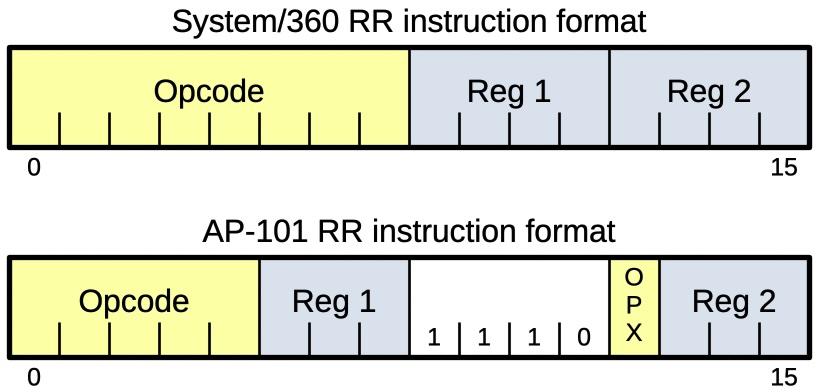
    A comparison of System/360 and MMP instruction formats for register-to-register instructions.

    A comparison of System/360 and MMP instruction formats for register-to-register instructions.

    The diagram above shows how the System/360 and MMP encoded instructions in completely different ways. Both systems use an "RR" instruction format, for example, to add two registers. But the 16-bit instructions are encoded with a completely different structure. In particular, MMP uses three bits instead of four to specify a register, along with a shortened opcode field.

    Because of the similar instruction sets, it was very easy for a System/360 assembly-language programmer to start programming the AP series. However, due to the incompatibilities, MMP programs could not run directly on a System/360 but needed to execute through a functional simulator program. In contrast, the earlier System/4 Pi EP was compatible with System/360, so programs could run directly on either machine. 

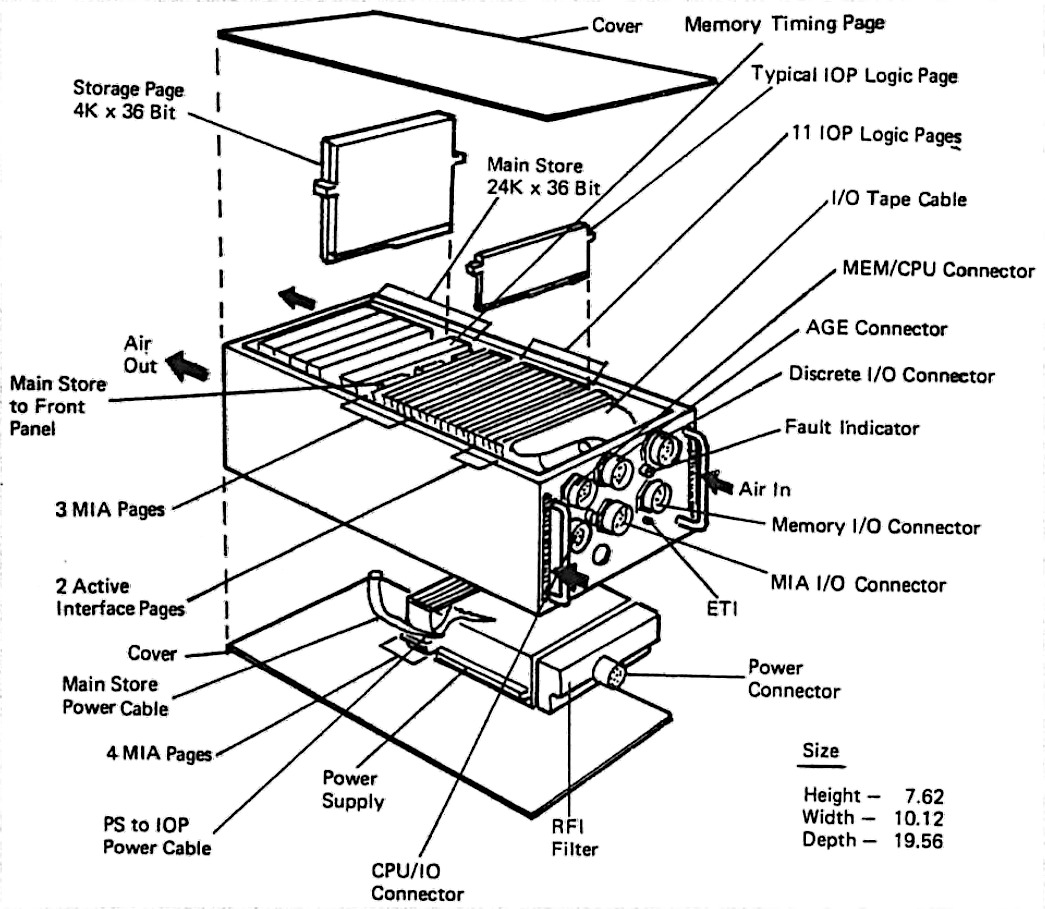
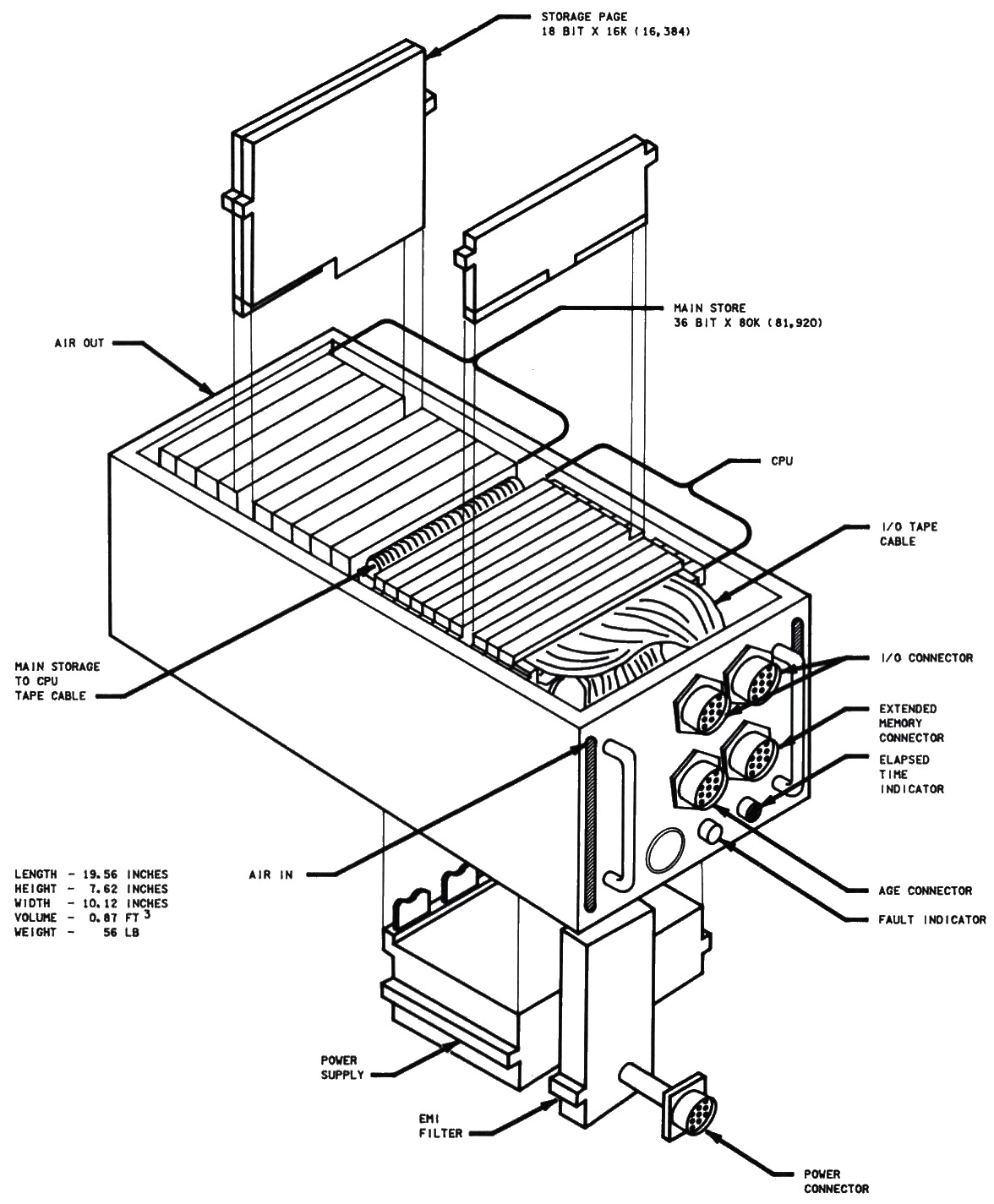
  14. The drawing below shows an exploded view of the Space Shuttle AP-101B CPU (i.e., the earlier version). Half the box is occupied by large storage pages. The logic is implemented with the standard squat System/4 Pi pages, with the power supply underneath. The round connectors on the front are connected to pages through flexible polyimide printed circuits, an impressive technology for the 1970s. The function of each page is described in Space Shuttle Advanced System/4 Pi Model AP-101 Central Processor Unit, page 131 (6-11).

    Space Shuttle CPU—Exploded View. (Click for a larger version.) From Space Shuttle Systems Handbook.

    Space Shuttle CPU—Exploded View. (Click for a larger version.) From Space Shuttle Systems Handbook.


  15. The redundancy of the Space Shuttle computers was important during flight STS-9A (1983). The Space Shuttle encountered two computer failures about five hours before the flight was scheduled to land. GPC-1 (General Purpose Computer 1) failed and could not be brought back online. Six minutes later, GPC-2 also failed, but was successfully brought back online (STS-9 Mission Report, Spacelab 1 factsheet). The failure was attributed to a loose piece of solder. Commander John Young described the situation: "My knees started shaking. When the next computer failed, I turned to jelly. Our eyes opened a lot wider than they were before!" Despite the computer problems, an IMU (inertial measurement unit) failure, and two APUs (auxiliary power units) on fire, the Shuttle landed successfully.

    In response to this double computer failure, starting with flight STS-11 (1984), the Shuttle carried a sixth computer as a spare. The spare was kept in a locker and could be physically swapped with a malfunctioning computer in orbit. The spare was put into use on flight STS-30 (1989) after computer #4 encountered a "data parity external storage error", indicating a hardware problem. 

  16. Curiously, the Shuttle's AP-101B and the IOP used different storage pages: the computer used 16K×18 storage pages, while the IOP used 8K×18 storage pages. Originally, the system was designed for 64K words in total, using sixteen 8K pages (source, details). The computer ended up using the higher-density 16K pages, but for some reason, the IOP stayed with the lower-density 8K pages, resulting in 102K words total from sixteen pages, rather than the 128K words you might expect. (See Space Shuttle System Handbook diagrams.) 

  17. Most of the AP-101C information is from an IBM brochure: "IBM Advanced System/4 Pi Modular Computer Series Model AP-101C". The AP-101C instruction set and architecture are described in a 1979 document with the title Space Shuttle - Model AP-101 C/M Principles of Operation. This title is puzzling because the Shuttle used the AP-101B, and the B-52 used the AP-101C. The document opaquely says that it describes the "AP-101C and AP-101, monolithic version". Then, a 1987 document, AP-101S with Shuttle Instruction Set, says that the AP-101S (the upgraded Shuttle computer) is software compatible with the AP-101C/M. My hypothesis is that IBM prototyped the AP-101C with semiconductor (monolithic) memory for a Shuttle upgrade, but abandoned this approach. 

  18. System/4 Pi computers flip-flopped on the floating-point number representations. Modern computers use base-2 (binary) exponents for floating-point, but System/360 used base-16 (hexadecimal) exponents. (The difference is whether you raise 2 to the exponent or 16 to the exponent.) The EP systems copied the System/360 representation, but then AP-1 switched to binary exponents. Then AP-101 switched back to base-16 exponents (although one probably-wrong source says that the AP-101B used binary exponents). Support for the 1750A instruction set required binary exponents, so dual-architecture machines supported both types of exponent. 

  19. The later System/4 Pi computers were known as MCS (variously Modular Computer Series, Modular Computer System, or Military Computer Series). They used larger boards, called MCS pages, measuring 9"×6.4". An MCS page consisted of two printed-circuit boards (called a MIB, multilayer interconnection board) bonded to a metal thermal plate between the boards. The thermal plate made contact with the computer's heat exchanger through fasteners called wedgelocks that provided a thermal path for heat to escape. This system allowed the computer to be air-cooled while isolating the cooling air from the components. 

  20. I couldn't find a photo of the AP-101F, but line drawings show that it looked just like the AP-101C, with the same connector layout. This makes sense if the AP-101F were built as a plug-compatible upgrade. 

  21. The shadow core memory in the AP-101F is mentioned in Standards Application to B-1B Avionics Program. It had 128K words of high-density modular core memory (HMCM) shadowing 128K words of active semiconductor memory (SCM). This combined the speed and low power consumption of semiconductor memory with the radiation resistance of magnetic core memory.

    The Shuttle's AP-101S computer used an error correcting code (ECC) to recover from flipped bits in memory. Each 16-bit halfword had an additional six ECC (Error Correcting Code) bits, which allowed a bitflip in a word to be corrected, while two bitflips could be detected but not repaired. Error correction was performed by AMD's Am2960 chips. A memory "scrubber" scanned memory every 1.6789 seconds to fix any flipped bits. Bit flips from cosmic rays were not uncommon: over 100 bit flips could be experienced on a flight, but they were corrected before causing problems (details). In one case, a single cosmic ray caused 14 bit errors; the structure of the memory system ensured that these errors affected one bit in 14 different words, so there were no double-bit errors and the errors were all correctable. The register memory in the CPU, however, was not protected against errors; two computer malfunctions are thought to be due to radiation.

    Shuttle memory had "storage protection" bits to ensure that code wasn't overwritten (as well as ensuring that data wasn't executed). A different technique was used to avoid corruption of the storage protection bits: Each word had three storage protection bits and a voting algorithm determined the value. 

  22. The pipelined architecture of the AP-101S executed an instruction in six steps: instruction address translation, fetching the instruction, decoding the instruction and computing the memory address of the operand, data address translation, fetching the operand from memory, and executing the instruction. Without pipelining, an instruction would take six cycles to go through all these stages. With pipelining, as soon as an instruction completes a stage, the next instruction can start that stage, so six instructions can be active at the same time.

    Pipelining made the processor considerably more complicated. Moreover, various factors reduce the performance benefit, so the speedup is less than the theoretical factor of six. For instance, a branch to a new address requires the pipeline to be restarted with the new instruction, wasting three clock cycles. If two instructions in the pipeline modify the same register, a "hazard" can occur, requiring a delay in the pipeline so each instruction gets the correct register value. Some instructions take more than one cycle for the execution phase, delaying the pipeline. Self-modifying code can also cause hazards, if the program modifies instructions that have already been prefetched. In this case, the pipeline needs to be restarted so the correct instruction is executed. The AP-101S pipelining is described in detail in Space Shuttle Model AP-101S Principles of Operation with Shuttle Instruction Set

  23. The formation of the AP-101S is also described in AP-101S with Shuttle Instruction Set, section 4. "The elements utilized from the AP-101F are the CPU, MMU (Memory Management Unit), and Interrupt sections. The microcode has been modified so that existing shuttle software can be used on the AP-101S. The Timing page, SDI (Software Development Interface) page and the SIB bus have been eliminated. The unused circuitry in the MMU has been removed to permit integration of the timing and SDI functions into the MMU. The IOP has been repackaged using medium scale integration to reduce the number of pages from fourteen to seven." A more detailed diagram of the AP-101S evolution is in The new AP101S general-purpose computer (GPC) for the space shuttle. Curiously, that source claims the memory in the AP-101S came from the AP-101F, not the AP-102. This source also explains the AP-101S/G, an interim version that was used on the ground during development. The AP-101S/G was essentially the AP-101S with the Shuttle's IOP (I/O Processor) as a separate box.

    Did the Shuttle's AP-101S support the Air Force's standard 1705A instruction set as well as the MMP instruction set? Sources are contradictory. The B-1B's AP-101F supported both instruction sets and the AP-101S inherited this architecture: "The AP-101S central processor unit is optimized for both MMP and MIL=-STD-1750A" (source). According to The new AP101S general-purpose computer (GPC) for the Space Shuttle, the internal controls and microcode of the AP-101S support both architectures and the AP-101S could readily be configured for either architecture by a control signal on the interface. The obscure AP-101SG/1750 ground computer is said to have run 1750A. Other sources say that the AP-101S did not support 1750. My interpretation is that although the hardware for the AP-101S supported both instruction sets, the flight version of the AP-101S did not have the microcode for 1750A, due to the limited microcode space. 

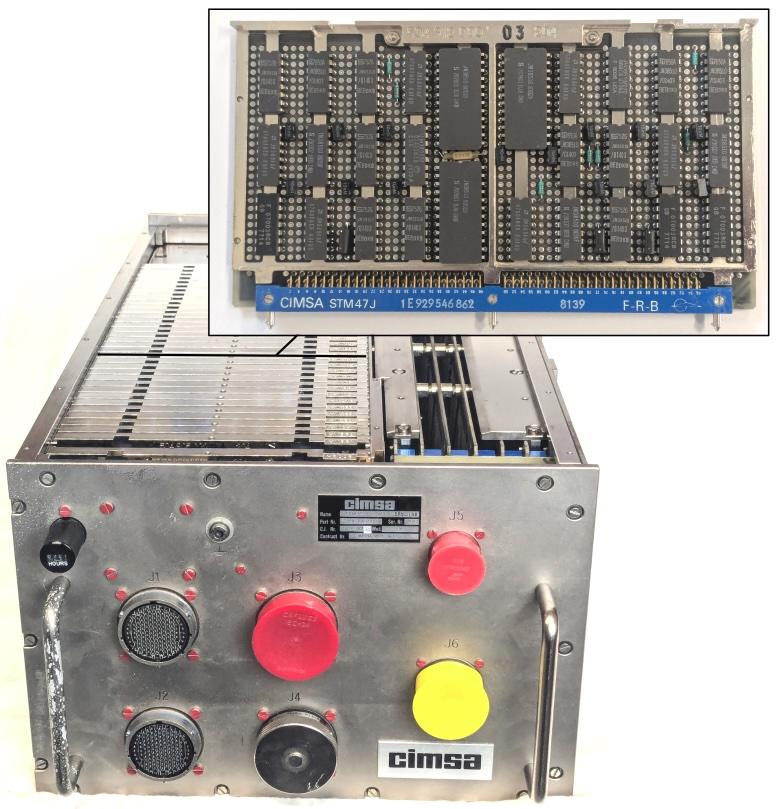
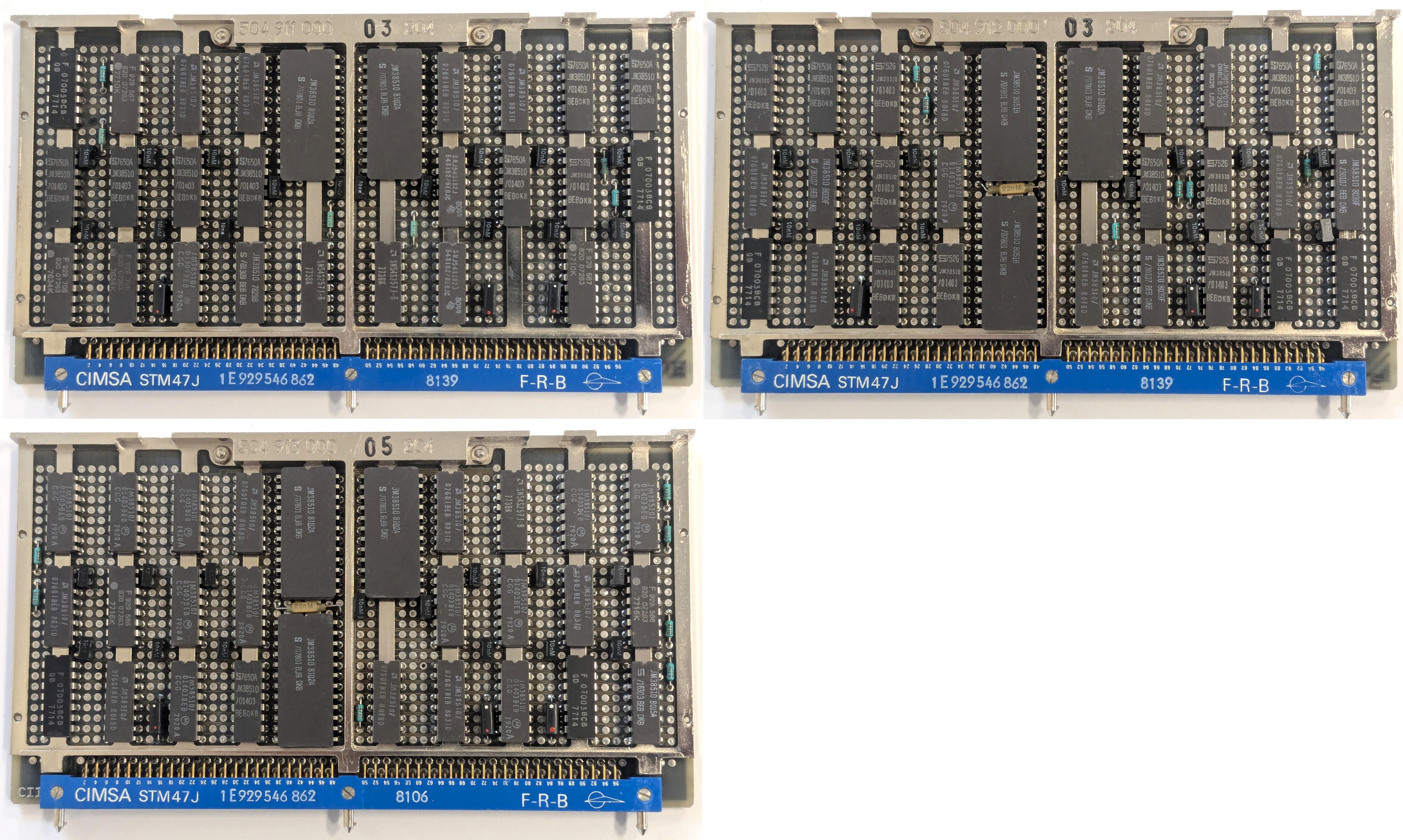
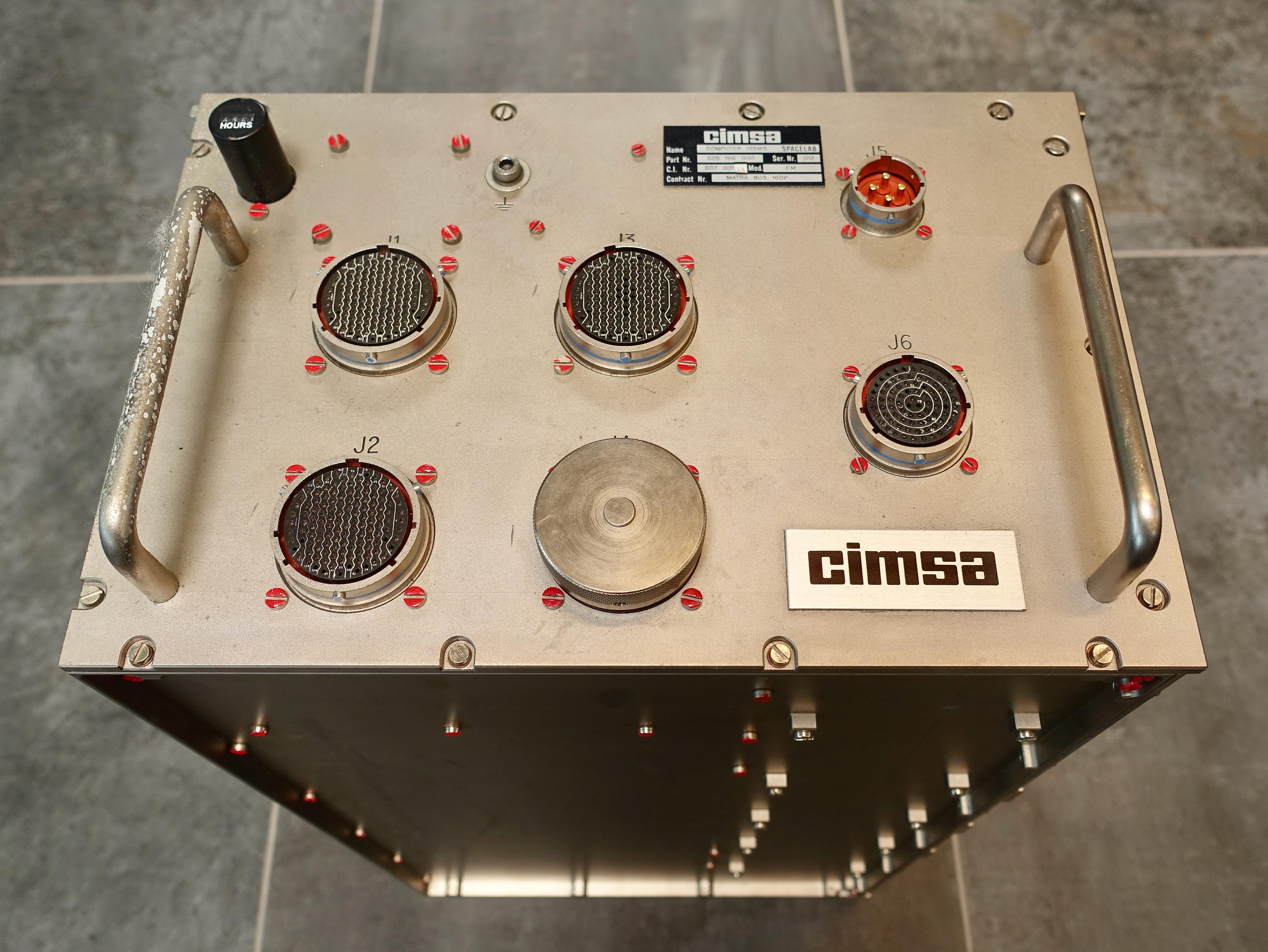
  24. Spacelab originally used CIMSA 125 MS computers. The naming of this computer is very confusing. Starting in 1971, a French company called CII produced a popular line of 16-bit minicomputers called Mitra 15. In 1975, CII produced a successor called the Mitra 125. In the mid-1970s, CII and Honeywell merged and the computer division was spun off to form SEMS, with majority shareholder Thomson. Thomson's subsidiary CIMSA produced the computer for Spacelab, the 125 MS computer, part of the CIMSA militarized 15 M computer line. This computer was functionally identical to the Mitra 125 S that the Spacelab project used on the ground (details). Meanwhile, MATRA (different from Mitra) was the contractor for Spacelab command and data management. To summarize, Spacelab used CIMSA 125 MS computers, as can be verified from the label below. This is a militarized version of the Mitra 125, produced under contract from MATRA. People sometimes call this computer the MATRA 125, but that's an error.

    CIMSA 125 MS computer. Click this photo (or any other) for a larger version. Photo by Steve Jurvetson, CC BY 2.0.

    CIMSA 125 MS computer. Click this photo (or any other) for a larger version. Photo by Steve Jurvetson, CC BY 2.0.


  25. In 1990, lint caused computer failures that almost ruined observations by the Astro ultraviolet imaging telescope on a Columbia flight (see Shuttle Lands in Good Shape, But Puzzle of Lint Remains and STS-35 Space Shuttle Mission Report). Both of Spacelab's Data Display System terminals overheated and failed, accompanied by a burning odor and high carbon monoxide readings (although the carbon monoxide readings were later determined to be invalid). The failed terminals were part of the French-built computer system in Spacelab; I don't know how much this problem influenced the decision to replace Spacelab's computers with IBM's AP-101SL.

    IBM's computers weren't immune to lint-induced cooling problems, though. One of Challenger's computers overheated and failed during ground testing in 1984 after its air passages got clogged by lint (details).  

  26. The AP-101S had a Memory Management Unit (MMU), implemented on two pages. In most computers, a Memory Management Unit implements virtual memory by translating virtual addresses to physical addresses, but the MMU in the AP-101S is not as advanced: its MMU enlarged the memory address space through bank switching.

    The AP-101 line of computers originally used 16-bit addresses that accessed 16-bit halfwords (not bytes), so they could directly access 64K halfwords (equivalent to 128 KB). This wasn't enough address space for constantly-growing software, so the AP-101B used a bank-switching technique that allowed access to 512K halfwords, albeit in 32K chunks. (The AP-101B could not hold this much memory internally, but external memory boxes could be added.) Specifically, the Processor Status Word held a 4-bit bank select field for code access and another 4-bit bank select field for data access. These fields could be substituted for the top bit, enlarging the address space from 16 bits to 19 bits. The AP-101S extended this approach with a complicated scheme of "Expanded Addressing". In this approach, each index register had a separate 4-bit bank select field. This allowed multiple banks of 32K to be used at the same time.

    The main purpose of the Memory Management Unit was to convert a 16-bit memory address to a 19-bit physical memory address by substituting the appropriate bank select bits. The MMU also detected and handled memory faults. Finally, the MMU included seemingly random functions such as the processor's 40 MHz system clock.

    (Don't confuse the MMU (Memory Management Unit) in the computer with the MMU (Mass Memory Unit), one of two tape drives on the Shuttle; the MMU (Manned Maneuvering Unit), a propulsion backpack for spacewalks; or the MMU (Monolithic Memory Unit), the CC-2E's semiconductor memory.) 

  27. From front to back, the boards in the AP-101SL are: A4, A5, A6 (CPU3), A7 (CPU2), A8 (CPU1), A9 (interrupt), A10, A11, A12 (RAM), A13 (RAM), A14 (12V power supply), and A15 (5V power supply). A10 contains the 40 MHz oscillator, which was on the MMU2 board in the AP-101S. Perhaps A10 and A11 are the equivalent of the MMU boards, but without the peculiar memory block scheme of the AP-101S. A4 may be a digital I/O board. A5 has optoisolators and analog components, so it is presumably an I/O board. The power supplies and memory boards look identical between the Shuttle's AP-101S and Spacelab's AP-101SL. The CPU and interrupt pages are very similar, perhaps just bug fixes during development. The exception is that one side of the CPU3 page is substantially different. (The boards in the AP-101S are listed in AP-101S with Shuttle instruction set page 18, so I won't repeat the list here.) 

  28. You may have noticed that System/4 Pi computers mostly look the same, rectangular boxes with handles and connectors on the front. It's not a coincidence. Many System/4 Pi computers have cases that fit the ATR (Air Transport Rack) standard, commonly used for avionics. A standard ATR box is approximately 10.12" wide and 7.62" tall (source). Depth is 12.62" for a short box and 19.62" for a long box. A standard 1/2 ATR box is 4.88" wide (slightly less than half the width of a full box due to the thickness of the rack that holds the box). The CP-1, CP-2, CP-3, and AP-101 have an ATR long case, while the ML-1, SP-1, and AP-102 are 1/2 ATR. Other systems, such as the TC-2 and AP-1, don't match a standard size. 

  29. The VHSIC chips were expected to operate in environments with "nuclear and space radiation threats" so they were hardened against radiation and electromagnetic pulse damage (source).

    IBM's V1750 processor was also used in the F-15 aircraft's central computer (the VCC, VHSIC Central Computer), which replaced the earlier AP-1R computer around 1992. A VHSIC Signal Conditioner chip was used to improve the Advanced Signal Processor in the mid-1980s, doubling its performance. The VHSIC program also funded IBM's "Generic VHSIC Spaceborne Computer" (GVSC), used in the Cassini space probe to Saturn and other space missions. (Confusingly, the Department of Defense funded both Honeywell and IBM to build Generic VHSIC Spaceborne Computers, so there were two different computers with the same name.) By this point, IBM had apparently dropped the System/4 Pi branding, viewing VHSIC as a more exciting label. 

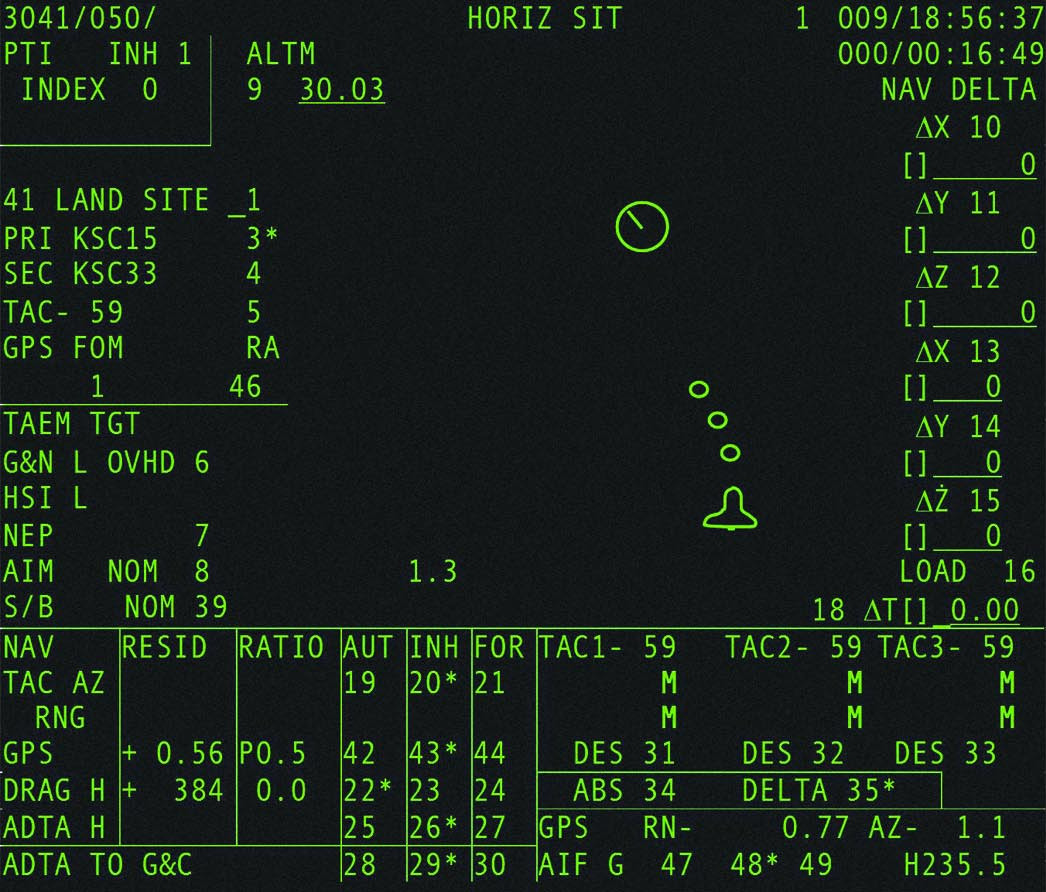
  30. The Space Shuttle display screens are heavy on text, but include vector graphics, advanced for the time. The display below shows the Shuttle coming in for landing. The small circles predict the Shuttle's location in 20, 40, and 60 seconds. The large circle indicates the runway.

    The Horizontal Situation Display. From New Displays for the Space Shuttle Cockpit.

    The Horizontal Situation Display. From New Displays for the Space Shuttle Cockpit.

    The Space Shuttle's displays are described by a jumble of acronyms. A CRT screen was a Display Unit (DU), part of the Multifunction CRT Display System (MCDS). The screen was controlled by a Display Electronic Unit (DEU), which contained the SP-0 processor. The SP-0 created Format Control Words (FCWs) in memory that controlled the characters and vectors on the display. In 2000, the MCDS was upgraded to eleven color LCD screens (MEDS). For details, see Space Shuttle Avionics Upgrade: Issues and Opportunities, Entry, TAEM, and Approach/Landing Guidance Workbook, Space Shuttle Flight Software, Space Shuttle Avionics Systems, and The Space Shuttle Orbiter's Advanced Display Designs and an Analysis of its Growth Capabilities

  31. Some sources say that the Harpoon missile used the SP-0A computer, while IBM's brochure says that the missile used the SP-0B computer. Maybe there was an upgrade? 

  32. One IBM article includes several other signal processors in a discussion of the IBM System/4 Pi family. These specialized systems performed tens of millions of operations per second, orders of magnitude faster than contemporary general-purpose computers. I'm not sure if they are categorized as "real" System/4 Pi systems, so I'll describe them briefly in this footnote.

    The Advanced Signal Processor (AN/UYS-1 "Proteus") was a large, cabinet-sized system that processed sonar signals in numerous Navy aircraft, ships, and submarines. It has up to four arithmetic elements with a pipelined multiplier and adder, as well as a sine-cosine generator for FFTs (fast Fourier transforms), allowing it to perform up to 60 million operations per second. More details on the ASP are here.

    The ASP array processor led to the development of the IBM 3838 Array Processor. The IBM 3838 was connected to a mainframe and provided vector operations such as add, multiply, FFT, trigonometry, and polynomials. It had the codename "Gusher" since it was originally intended for seismic analysis for the petroleum industry, but it could also be used for applications from weather modeling to plasma computation.

    The third signal processor mentioned in the article is called ARP, but I couldn't find more information, not even what ARP stands for.

    (On the topic of mysterious System/4 Pi computers, IBM was scheduled to deliver a paper on the FS-4 computer in 1972, but withdrew the paper without explanation, see IBM Plugs, Unplugs a '4th Generation'.)

    A later signal processor from IBM was the Common Signal Processor from 1986, a VLSI-based signal processor that was part of the PAVE PILLAR combat avionics system for advanced tactical fighters. 

  33. According to a 1971 brochure, "System/4 Pi Command and Control (Model CC)", the CC-1 instruction set "has been specifically designed to optimize instruction bit efficiency for large real-time problems. Features include short format (16-bit) register-to-storage instructions, three-address instructions, multiple (four) general register sets, automatic index register incrementing, and a CALL program interrupt."

    Many of these features are similar to how the AP-101 diverged from System/360: the AP-101 had 16-bit register-to-storage instructions, multiple (two) general register sets, automatic indirect address incrementing, and a stack call instruction. 

  34. For the ML-1 computer, IBM doesn't explicitly explain the ML name. It's referred to as "IBM's militarized LSI computer", so I presume that ML stands for "militarized LSI". 

  35. IBM's name for these chips in the ML-1 is "Dutchess", as they were made in IBM's East Fishkill plant in Dutchess County, New York. More information on Dutchess chips is available on an IBM 5100 page and a post on alt.folklore.computers. Each chip is said to contain 134 TTL-compatible gates: 60 three-input NAND gates, 40 four-input NAND gates, and 34 two-input NOR drivers. The chips had a fixed arrangement of gates in silicon that could be wired as needed for a particular purpose; IBM called this a "masterslice" but it's more typically called a gate array. (Chips didn't always use all the available gates, averaging 110 gates used.) The advantage of a masterslice is that it is faster to design and cheaper to manufacture than a fully custom chip.

    A few years later, the IBM System/38 used a bipolar masterslice that contained 704 gates, mounted on a 116-pin ceramic carrier; it is described in Customized Metal Layers Vary Standard Gate-Array Chip. A later IBM masterslice chip with 1300 gates per chip is described in A High-Density Bipolar Logic Masterslice for Small Systems

  36. Owego is often confused with Oswego. IBM's Federal Systems Division was in Owego, NY. This town is 100 miles south of Oswego, NY, but everyone from the New York Times to NASA to the EPA to IBM itself mixes up Owego and Oswego. The latter is home to the State University of New York at Oswego. 

  37. Many of the photos in this article are from a brochure, "IBM System/4 Pi and Advanced System/4 Pi Computers", August 1973, which has detailed information on many of the computers in the 4 Pi family. Because this document is so informative, I've scanned and uploaded it here

The origin and unexpected evolution of the word "mainframe"
1 February 2025 at 18:20

What is the origin of the word "mainframe", referring to a large, complex computer? Most sources agree that the term is related to the frames that held early computers, but the details are vague.1 It turns out that the history is more interesting and complicated than you'd expect.
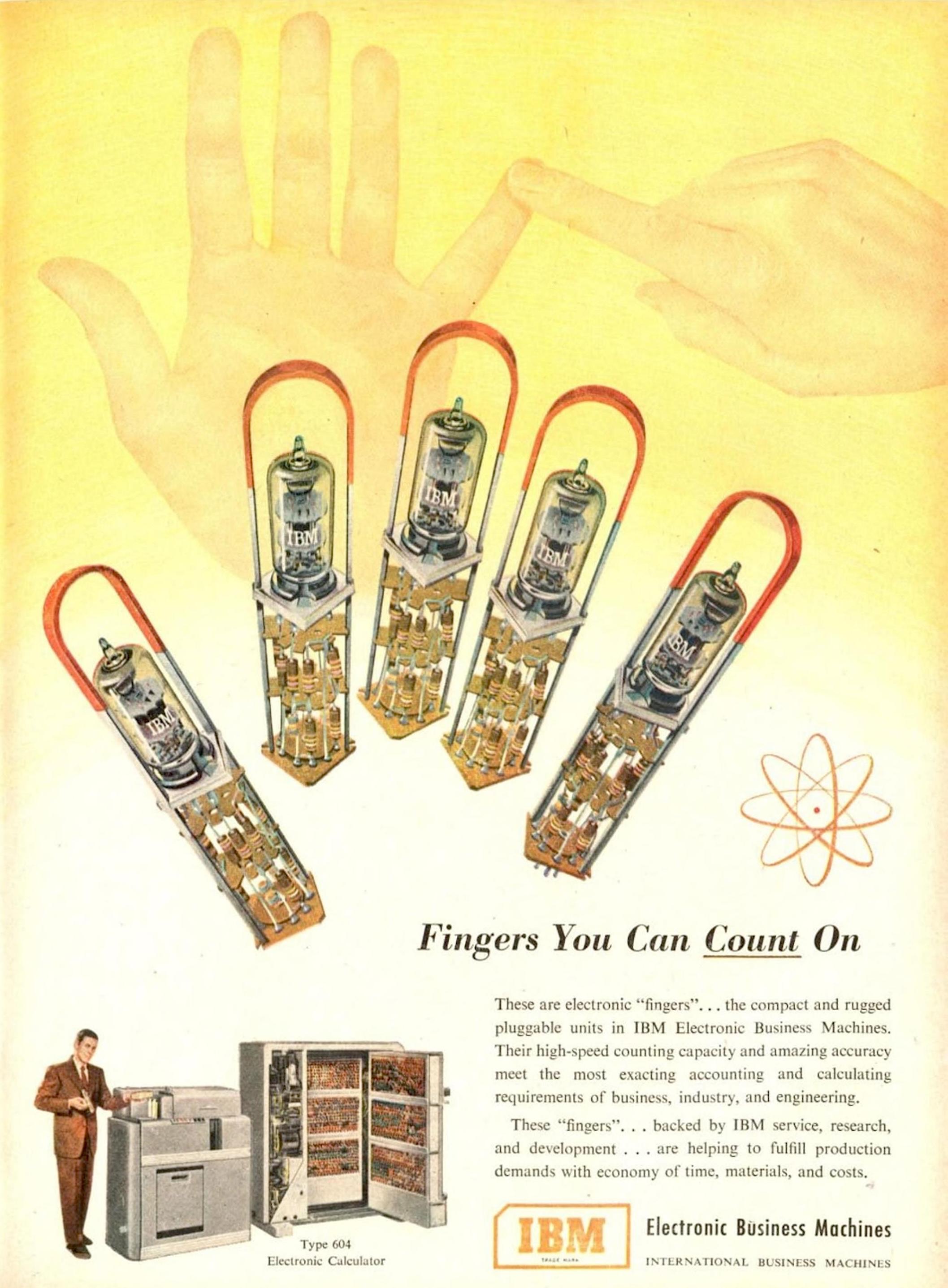
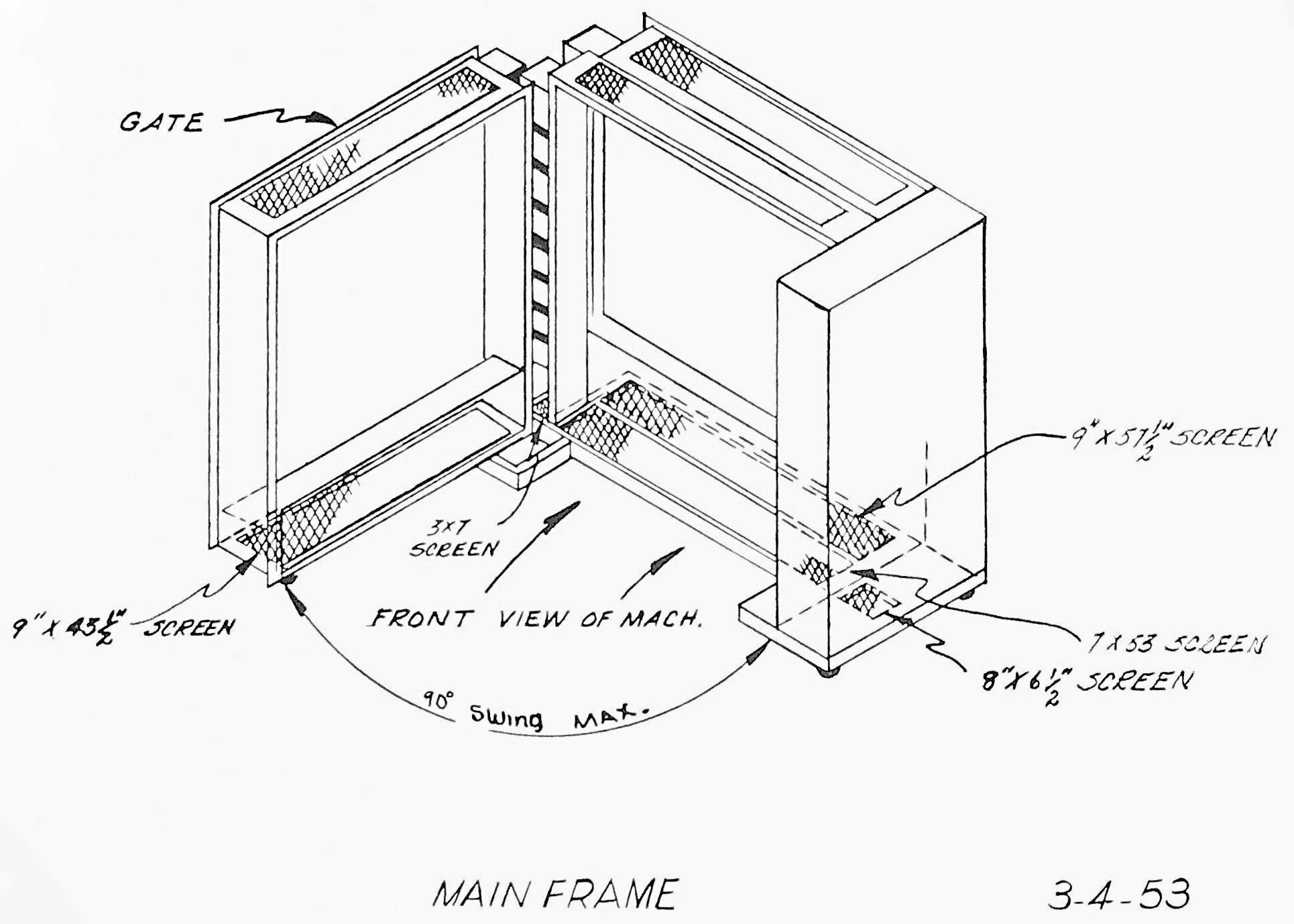
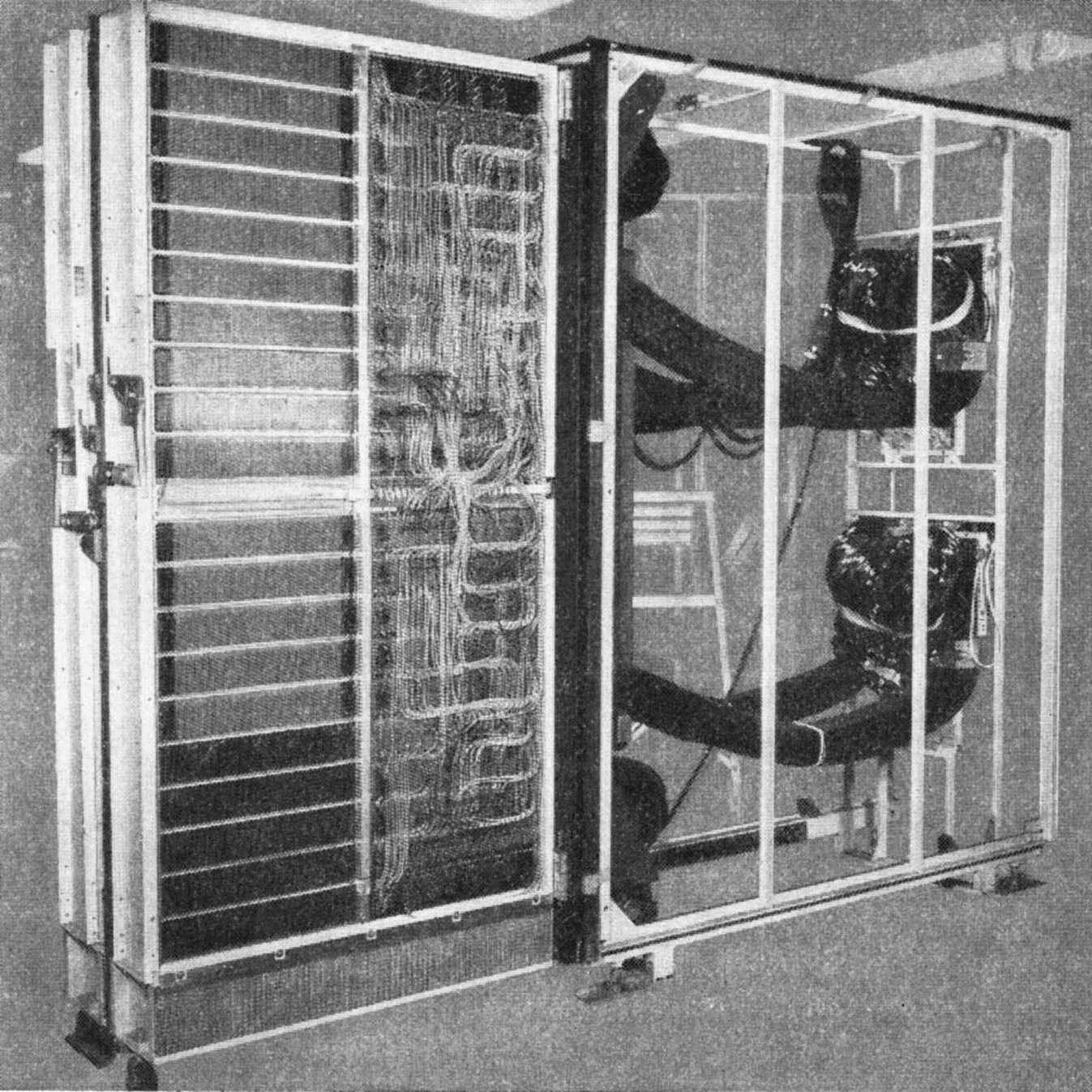
Based on my research, the earliest computer to use the term "main frame" was the IBM 701 computer (1952), which consisted of boxes called "frames." The 701 system consisted of two power frames, a power distribution frame, an electrostatic storage frame, a drum frame, tape frames, and most importantly a main frame. The IBM 701's main frame is shown in the documentation below.2

This diagram shows how the IBM 701 mainframe swings open for access to the circuitry. From "Type 701 EDPM Installation Manual", IBM. From Computer History Museum archives.

This diagram shows how the IBM 701 mainframe swings open for access to the circuitry. From "Type 701 EDPM [Electronic Data Processing Machine] Installation Manual", IBM. From Computer History Museum archives.

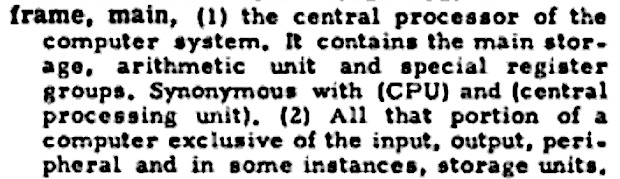
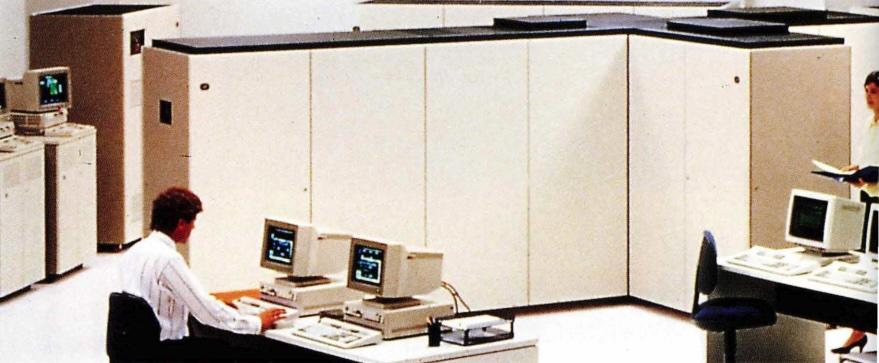
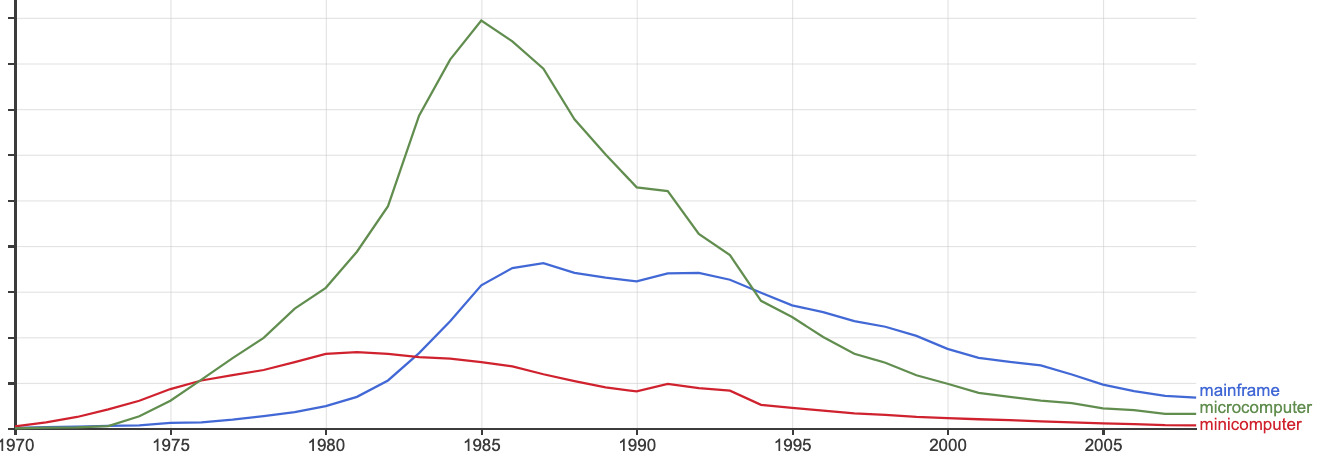
The meaning of "mainframe" has evolved, shifting from being a part of a computer to being a type of computer. For decades, "mainframe" referred to the physical box of the computer; unlike modern usage, this "mainframe" could be a minicomputer or even microcomputer. Simultaneously, "mainframe" was a synonym for "central processing unit." In the 1970s, the modern meaning started to develop—a large, powerful computer for transaction processing or business applications—but it took decades for this meaning to replace the earlier ones. In this article, I'll examine the history of these shifting meanings in detail.

Early computers and the origin of "main frame"
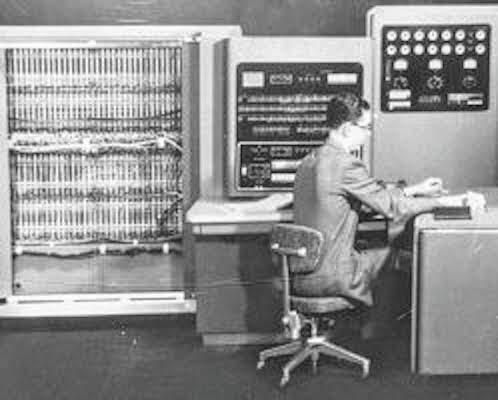
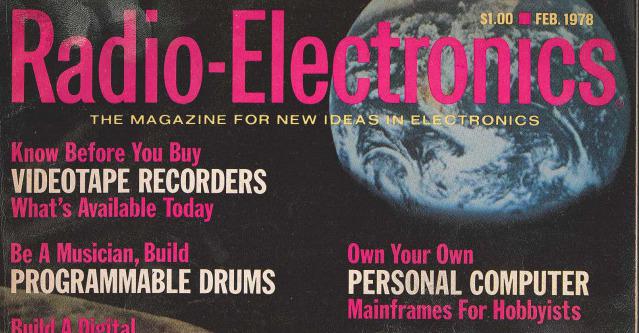
Early computers used a variety of mounting and packaging techniques including panels, cabinets, racks, and bays.3 This packaging made it very difficult to install or move a computer, often requiring cranes or the removal of walls.4 To avoid these problems, the designers of the IBM 701 computer came up with an innovative packaging technique. This computer was constructed as individual units that would pass through a standard doorway, would fit on a standard elevator, and could be transported with normal trucking or aircraft facilities.7 These units were built from a metal frame with covers attached, so each unit was called a frame. The frames were named according to their function, such as the power frames and the tape frame. Naturally, the main part of the computer was called the main frame.
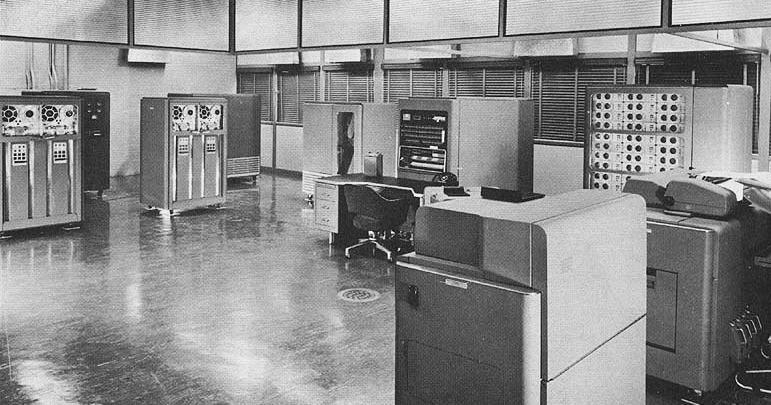
An IBM 701 system at General Motors. On the left: tape drives in front of power frames. Back: drum unit/frame, control panel and electronic analytical control unit (main frame), electrostatic storage unit/frame (with circular storage CRTs). Right: printer, card punch. Photo from BRL Report, thanks to Ed Thelen.

An IBM 701 system at General Motors. On the left: tape drives in front of power frames. Back: drum unit/frame, control panel and electronic analytical control unit (main frame), electrostatic storage unit/frame (with circular storage CRTs). Right: printer, card punch. Photo from BRL Report, thanks to Ed Thelen.

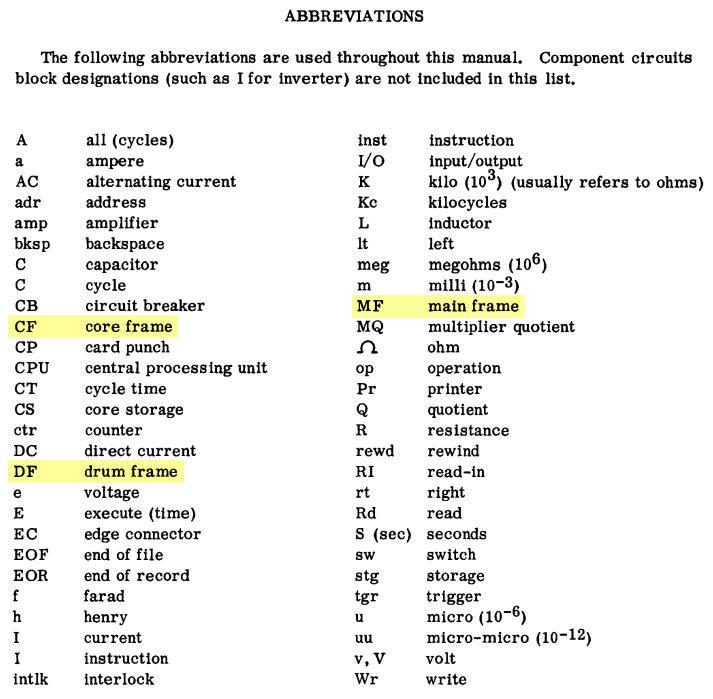
The IBM 701's internal documentation used "main frame" frequently to indicate the main box of the computer, alongside "power frame", "core frame", and so forth. For instance, each component in the schematics was labeled with its location in the computer, "MF" for the main frame.6 Externally, however, IBM documentation described the parts of the 701 computer as units rather than frames.5

The term "main frame" was used by a few other computers in the 1950s.8 For instance, the JOHNNIAC Progress Report (August 8, 1952) mentions that "the main frame for the JOHNNIAC is ready to receive registers" and they could test the arithmetic unit "in the JOHNNIAC main frame in October."10 An article on the RAND Computer in 1953 stated that "The main frame is completed and partially wired" The main body of a computer called ERMA is labeled "main frame" in the 1955 Proceedings of the Eastern Computer Conference.9

Operator at console of IBM 701. The main frame is on the left with the cover removed. The console is in the center. The power frame (with gauges) is on the right. Photo from NOAA.

Operator at console of IBM 701. The main frame is on the left with the cover removed. The console is in the center. The power frame (with gauges) is on the right. Photo from NOAA.

The progression of the word "main frame" can be seen in reports from the Ballistics Research Lab (BRL) that list almost all the computers in the United States. In the 1955 BRL report, most computers were built from cabinets or racks; the phrase "main frame" was only used with the IBM 650, 701, and 704. By 1961, the BRL report shows "main frame" appearing in descriptions of the IBM 702, 705, 709, and 650 RAMAC, as well as the Univac FILE 0, FILE I, RCA 501, READIX, and Teleregister Telefile. This shows that the use of "main frame" was increasing, but still mostly an IBM term.

The physical box of a minicomputer or microcomputer

In modern usage, mainframes are distinct from minicomputers or microcomputers. But until the 1980s, the word "mainframe" could also mean the main physical part of a minicomputer or microcomputer. For instance, a "minicomputer mainframe" was not a powerful minicomputer, but simply the main part of a minicomputer.13 For example, the PDP-11 is an iconic minicomputer, but DEC discussed its "mainframe."14. Similarly, the desktop-sized HP 2115A and Varian Data 620i computers also had mainframes.15 As late as 1981, the book Mini and Microcomputers mentioned "a minicomputer mainframe."

"Mainframes for Hobbyists" on the front cover of Radio-Electronics, Feb 1978.

"Mainframes for Hobbyists" on the front cover of Radio-Electronics, Feb 1978.

Even microcomputers had a mainframe: the cover of Radio Electronics (1978, above) stated, "Own your own Personal Computer: Mainframes for Hobbyists", using the definition below. An article "Introduction to Personal Computers" in Radio Electronics (Mar 1979) uses a similar meaning: "The first choice you will have to make is the mainframe or actual enclosure that the computer will sit in." The popular hobbyist magazine BYTE also used "mainframe" to describe a microprocessor's box in the 1970s and early 1980s16. BYTE sometimes used the word "mainframe" both to describe a large IBM computer and to describe a home computer box in the same issue, illustrating that the two distinct meanings coexisted.

Definition from Radio-Electronics: main-frame n: COMPUTER; esp: a cabinet housing the computer itself as distinguished from peripheral devices connected with it: a cabinet containing a motherboard and power supply intended to house the CPU, memory, I/O ports, etc., that comprise the computer itself.

Definition from Radio-Electronics: main-frame n: COMPUTER; esp: a cabinet housing the computer itself as distinguished from peripheral devices connected with it: a cabinet containing a motherboard and power supply intended to house the CPU, memory, I/O ports, etc., that comprise the computer itself.

Main frame synonymous with CPU

Words often change meaning through metonymy, where a word takes on the meaning of something closely associated with the original meaning. Through this process, "main frame" shifted from the physical frame (as a box) to the functional contents of the frame, specifically the central processing unit.17

The earliest instance that I could find of the "main frame" being equated with the central processing unit was in 1955. Survey of Data Processors stated: "The central processing unit is known by other names; the arithmetic and ligical [sic] unit, the main frame, the computer, etc. but we shall refer to it, usually, as the central processing unit." A similar definition appeared in Radio Electronics (June 1957, p37): "These arithmetic operations are performed in what is called the arithmetic unit of the machine, also sometimes referred to as the 'main frame.'"

The US Department of Agriculture's Glossary of ADP Terminology (1960) uses the definition: "MAIN FRAME - The central processor of the computer system. It contains the main memory, arithmetic unit and special register groups." I'll mention that "special register groups" is nonsense that was repeated for years.18 This definition was reused and extended in the government's Automatic Data Processing Glossary, published in 1962 "for use as an authoritative reference by all officials and employees of the executive branch of the Government" (below). This definition was reused in many other places, notably the Oxford English Dictionary.19

Definition from Bureau of the Budget: frame, main, (1) the central processor of the computer system. It contains the main storage, arithmetic unit and special register groups. Synonymous with (CPU) and (central processing unit). (2) All that portion of a computer exclusive of the input, output, peripheral and in some instances, storage units.

Definition from Bureau of the Budget: frame, main, (1) the central processor of the computer system. It contains the main storage, arithmetic unit and special register groups. Synonymous with (CPU) and (central processing unit). (2) All that portion of a computer exclusive of the input, output, peripheral and in some instances, storage units.

By the early 1980s, defining a mainframe as the CPU had become obsolete. IBM stated that "mainframe" was a deprecated term for "processing unit" in the Vocabulary for Data Processing, Telecommunications, and Office Systems (1981); the American National Dictionary for Information Processing Systems (1982) was similar. Computers and Business Information Processing (1983) bluntly stated: "According to the official definition, 'mainframe' and 'CPU' are synonyms. Nobody uses the word mainframe that way."

Mainframe vs. peripherals

Rather than defining the mainframe as the CPU, some dictionaries defined the mainframe in opposition to the "peripherals", the computer's I/O devices. The two definitions are essentially the same, but have a different focus.20 One example is the IFIP-ICC Vocabulary of Information Processing (1966) which defined "central processor" and "main frame" as "that part of an automatic data processing system which is not considered as peripheral equipment." Computer Dictionary (1982) had the definition "main frame—The fundamental portion of a computer, i.e. the portion that contains the CPU and control elements of a computer system, as contrasted with peripheral or remote devices usually of an input-output or memory nature."

One reason for this definition was that computer usage was billed for mainframe time, while other tasks such as printing results could save money by taking place directly on the peripherals without using the mainframe itself.21 A second reason was that the mainframe vs. peripheral split mirrored the composition of the computer industry, especially in the late 1960s and 1970s. Computer systems were built by a handful of companies, led by IBM. Compatible I/O devices and memory were built by many other companies that could sell them at a lower cost than IBM.22 Publications about the computer industry needed convenient terms to describe these two industry sectors, and they often used "mainframe manufacturers" and "peripheral manufacturers."

Main Frame or Mainframe?

An interesting linguistic shift is from "main frame" as two independent words to a compound word: either hyphenated "main-frame" or the single word "mainframe." This indicates the change from "main frame" being a type of frame to "mainframe" being a new concept. The earliest instance of hyphenated "main-frame" that I found was from 1959 in IBM Information Retrieval Systems Conference. "Mainframe" as a single, non-hyphenated word appears the same year in Datamation, mentioning the mainframe of the NEAC2201 computer. In 1962, the IBM 7090 Installation Instructions refer to a "Mainframe Diag[nostic] and Reliability Program." (Curiously, the document also uses "main frame" as two words in several places.) The 1962 book Information Retrieval Management discusses how much computer time document queries can take: "A run of 100 or more machine questions may require two to five minutes of mainframe time." This shows that by 1962, "main frame" had semantically shifted to a new word, "mainframe."

The rise of the minicomputer and how the "mainframe" become a class of computers

So far, I've shown how "mainframe" started as a physical frame in the computer, and then was generalized to describe the CPU. But how did "mainframe" change from being part of a computer to being a class of computers? This was a gradual process, largely happening in the mid-1970s as the rise of the minicomputer and microcomputer created a need for a word to describe large computers.

Although microcomputers, minicomputers, and mainframes are now viewed as distinct categories, this was not the case at first. For instance, a 1966 computer buyer's guide lumps together computers ranging from desk-sized to 70,000 square feet.23 Around 1968, however, the term "minicomputer" was created to describe small computers. The story is that the head of DEC in England created the term, inspired by the miniskirt and the Mini Minor car.24 While minicomputers had a specific name, larger computers did not.25

Gradually in the 1970s "mainframe" came to be a separate category, distinct from "minicomputer."2627 An early example is Datamation (1970), describing systems of various sizes: "mainframe, minicomputer, data logger, converters, readers and sorters, terminals." The influential business report EDP first split mainframes from minicomputers in 1972.28 The line between minicomputers and mainframes was controversial, with articles such as Distinction Helpful for Minis, Mainframes and Micro, Mini, or Mainframe? Confusion persists (1981) attempting to clarify the issue.29

With the development of the microprocessor, computers became categorized as mainframes, minicomputers or microcomputers. For instance, a 1975 Computerworld article discussed how the minicomputer competes against the microcomputer and mainframes. Adam Osborne's An Introduction to Microcomputers (1977) described computers as divided into mainframes, minicomputers, and microcomputers by price, power, and size. He pointed out the large overlap between categories and avoided specific definitions, stating that "A minicomputer is a minicomputer, and a mainframe is a mainframe, because that is what the manufacturer calls it."32

In the late 1980s, computer industry dictionaries started defining a mainframe as a large computer, often explicitly contrasted with a minicomputer or microcomputer. By 1990, they mentioned the networked aspects of mainframes.33

IBM embraces the mainframe label

Even though IBM is almost synonymous with "mainframe" now, IBM avoided marketing use of the word for many years, preferring terms such as "general-purpose computer."35 IBM's book Planning a Computer System (1962) repeatedly referred to "general-purpose computers" and "large-scale computers", but never used the word "mainframe."34 The announcement of the revolutionary System/360 (1964) didn't use the word "mainframe"; it was called a general-purpose computer system. The announcement of the System/370 (1970) discussed "medium- and large-scale systems." The System/32 introduction (1977) said, "System/32 is a general purpose computer..." The 1982 announcement of the 3084, IBM's most powerful computer at the time, called it a "large scale processor" not a mainframe.

IBM started using "mainframe" as a marketing term in the mid-1980s. For example, the 3270 PC Guide (1986) refers to "IBM mainframe computers." An IBM 9370 Information System brochure (c. 1986) says the system was "designed to provide mainframe power." IBM's brochure for the 3090 processor (1987) called them "advanced general-purpose computers" but also mentioned "mainframe computers." A System 390 brochure (c. 1990) discussed "entry into the mainframe class." The 1990 announcement of the ES/9000 called them "the most powerful mainframe systems the company has ever offered."

The IBM System/390: "The excellent balance between price and performance makes entry into the mainframe class an attractive proposition." IBM System/390 Brochure

The IBM System/390: "The excellent balance between price and performance makes entry into the mainframe class an attractive proposition." IBM System/390 Brochure

By 2000, IBM had enthusiastically adopted the mainframe label: the z900 announcement used the word "mainframe" six times, calling it the "reinvented mainframe." In 2003, IBM announced "The Mainframe Charter", describing IBM's "mainframe values" and "mainframe strategy." Now, IBM has retroactively applied the name "mainframe" to their large computers going back to 1959 (link), (link).

Mainframes and the general public

While "mainframe" was a relatively obscure computer term for many years, it became widespread in the 1980s. The Google Ngram graph below shows the popularity of "microcomputer", "minicomputer", and "mainframe" in books.36 The terms became popular during the late 1970s and 1980s. The popularity of "minicomputer" and "microcomputer" roughly mirrored the development of these classes of computers. Unexpectedly, even though mainframes were the earliest computers, the term "mainframe" peaked later than the other types of computers.

N-gram graph from Google Books Ngram Viewer.

N-gram graph from Google Books Ngram Viewer.

Dictionary definitions

I studied many old dictionaries to see when the word "mainframe" showed up and how they defined it. To summarize, "mainframe" started to appear in dictionaries in the late 1970s, first defining the mainframe in opposition to peripherals or as the CPU. In the 1980s, the definition gradually changed to the modern definition, with a mainframe distinguished as being large, fast, and often centralized system. These definitions were roughly a decade behind industry usage, which switched to the modern meaning in the 1970s.

The word didn't appear in older dictionaries, such as the Random House College Dictionary (1968) and Merriam-Webster (1974). The earliest definition I could find was in the supplement to Webster's International Dictionary (1976): "a computer and esp. the computer itself and its cabinet as distinguished from peripheral devices connected with it." Similar definitions appeared in Webster's New Collegiate Dictionary (1976, 1980).

A CPU-based definition appeared in Random House College Dictionary (1980): "the device within a computer which contains the central control and arithmetic units, responsible for the essential control and computational functions. Also called central processing unit." The Random House Dictionary (1978, 1988 printing) was similar. The American Heritage Dictionary (1982, 1985) combined the CPU and peripheral approaches: "mainframe. The central processing unit of a computer exclusive of peripheral and remote devices."

The modern definition as a large computer appeared alongside the old definition in Webster's Ninth New Collegiate Dictionary (1983): "mainframe (1964): a computer with its cabinet and internal circuits; also: a large fast computer that can handle multiple tasks concurrently." Only the modern definition appears in The New Merriram-Webster Dictionary (1989): "large fast computer", while Webster's Unabridged Dictionary of the English Language (1989): "mainframe. a large high-speed computer with greater storage capacity than a minicomputer, often serving as the central unit in a system of smaller computers. [MAIN + FRAME]." Random House Webster's College Dictionary (1991) and Random House College Dictionary (2001) had similar definitions.

The Oxford English Dictionary is the principal historical dictionary, so it is interesting to see its view. The 1989 OED gave historical definitions as well as defining mainframe as "any large or general-purpose computer, exp. one supporting numerous peripherals or subordinate computers." It has seven historical examples from 1964 to 1984; the earliest is the 1964 Honeywell Glossary. It quotes a 1970 Dictionary of Computers as saying that the word "Originally implied the main framework of a central processing unit on which the arithmetic unit and associated logic circuits were mounted, but now used colloquially to refer to the central processor itself." The OED also cited a Hewlett-Packard ad from 1974 that used the word "mainframe", but I consider this a mistake as the usage is completely different.15

Encyclopedias

A look at encyclopedias shows that the word "mainframe" started appearing in discussions of computers in the early 1980s, later than in dictionaries. At the beginning of the 1980s, many encyclopedias focused on large computers, without using the word "mainframe", for instance, The Concise Encyclopedia of the Sciences (1980) and World Book (1980). The word "mainframe" started to appear in supplements such as Britannica Book of the Year (1980) and World Book Year Book (1981), at the same time as they started discussing microcomputers. Soon encyclopedias were using the word "mainframe", for example, Funk & Wagnalls Encyclopedia (1983), Encyclopedia Americana (1983), and World Book (1984). By 1986, even the Doubleday Children's Almanac showed a "mainframe computer."

Newspapers

I examined old newspapers to track the usage of the word "mainframe." The graph below shows the usage of "mainframe" in newspapers. The curve shows a rise in popularity through the 1980s and a steep drop in the late 1990s. The newspaper graph roughly matches the book graph above, although newspapers show a much steeper drop in the late 1990s. Perhaps mainframes aren't in the news anymore, but people still write books about them.

Newspaper usage of "mainframe." Graph from newspapers.com from 1975 to 2010 shows usage started growing in 1978, picked up in 1984, and peaked in 1989 and 1997, with a large drop in 2001 and after (y2k?).

Newspaper usage of "mainframe." Graph from newspapers.com from 1975 to 2010 shows usage started growing in 1978, picked up in 1984, and peaked in 1989 and 1997, with a large drop in 2001 and after (y2k?).

The first newspaper appearances were in classified ads seeking employees, for instance, a 1960 ad in the San Francisco Examiner for people "to monitor and control main-frame operations of electronic computers...and to operate peripheral equipment..." and a (sexist) 1966 ad in the Philadelphia Inquirer for "men with Digital Computer Bkgrnd [sic] (Peripheral or Mainframe)."37

By 1970, "mainframe" started to appear in news articles, for example, "The computer can't work without the mainframe unit." By 1971, the usage increased with phrases such as "mainframe central processor" and "'main-frame' computer manufacturers". 1972 had usages such as "the mainframe or central processing unit is the heart of any computer, and does all the calculations". A 1975 article explained "'Mainframe' is the industry's word for the computer itself, as opposed to associated items such as printers, which are referred to as 'peripherals.'" By 1980, minicomputers and microcomputers were appearing: "All hardware categories-mainframes, minicomputers, microcomputers, and terminals" and "The mainframe and the minis are interconnected."

By 1985, the mainframe was a type of computer, not just the CPU: "These days it's tough to even define 'mainframe'. One definition is that it has for its electronic brain a central processor unit (CPU) that can handle at least 32 bits of information at once. ... A better distinction is that mainframes have numerous processors so they can work on several jobs at once." Articles also discussed "the micro's challenge to the mainframe" and asked, "buy a mainframe, rather than a mini?"

By 1990, descriptions of mainframes became florid: "huge machines laboring away in glass-walled rooms", "the big burner which carries the whole computing load for an organization", "behemoth data crunchers", "the room-size machines that dominated computing until the 1980s", "the giant workhorses that form the nucleus of many data-processing centers", "But it is not raw central-processing-power that makes a mainframe a mainframe. Mainframe computers command their much higher prices because they have much more sophisticated input/output systems."

Conclusion

After extensive searches through archival documents, I found usages of the term "main frame" dating back to 1952, much earlier than previously reported. In particular, the introduction of frames to package the IBM 701 computer led to the use of the word "main frame" for that computer and later ones. The term went through various shades of meaning and remained fairly obscure for many years. In the mid-1970s, the term started describing a large computer, essentially its modern meaning. In the 1980s, the term escaped the computer industry and appeared in dictionaries, encyclopedias, and newspapers. After peaking in the 1990s, the term declined in usage (tracking the decline in mainframe computers), but the term and the mainframe computer both survive.

Two factors drove the popularity of the word "mainframe" in the 1980s with its current meaning of a large computer. First, the terms "microcomputer" and "minicomputer" led to linguistic pressure for a parallel term for large computers. For instance, the business press needed a word to describe IBM and other large computer manufacturers. While "server" is the modern term, "mainframe" easily filled the role back then and was nicely alliterative with "microcomputer" and "minicomputer."38

Second, up until the 1980s, the prototype meaning for "computer" was a large mainframe, typically IBM.39 But as millions of home computers were sold in the early 1980s, the prototypical "computer" shifted to smaller machines. This left a need for a term for large computers, and "mainframe" filled that need. In other words, if you were talking about a large computer in the 1970s, you could say "computer" and people would assume you meant a mainframe. But if you said "computer" in the 1980s, you needed to clarify if it was a large computer.

The word "mainframe" is almost 75 years old and both the computer and the word have gone through extensive changes in this time. The "death of the mainframe" has been proclaimed for well over 30 years but mainframes are still hanging on. Who knows what meaning "mainframe" will have in another 75 years?

Follow me on Bluesky (@righto.com) or RSS. (I'm no longer on Twitter.) Thanks to the Computer History Museum and archivist Sara Lott for access to many documents.

Notes and References

  1. The Computer History Museum states: "Why are they called “Mainframes”? Nobody knows for sure. There was no mainframe “inventor” who coined the term. Probably “main frame” originally referred to the frames (designed for telephone switches) holding processor circuits and main memory, separate from racks or cabinets holding other components. Over time, main frame became mainframe and came to mean 'big computer.'" (Based on my research, I don't think telephone switches have any connection to computer mainframes.)

    Several sources explain that the mainframe is named after the frame used to construct the computer. The Jargon File has a long discussion, stating that the term "originally referring to the cabinet containing the central processor unit or ‘main frame’." Ken Uston's Illustrated Guide to the IBM PC (1984) has the definition "MAIN FRAME A large, high-capacity computer, so named because the CPU of this kind of computer used to be mounted on a frame." IBM states that mainframe "Originally referred to the central processing unit of a large computer, which occupied the largest or central frame (rack)." The Microsoft Computer Dictionary (2002) states that the name mainframe "is derived from 'main frame', the cabinet originally used to house the processing unit of such computers." Some discussions of the origin of the word "mainframe" are here, here, here, here, and here.

    The phrase "main frame" in non-computer contexts has a very old but irrelevant history, describing many things that have a frame. For example, it appears in thousands of patents from the 1800s, including drills, saws, a meat cutter, a cider mill, printing presses, and corn planters. This shows that it was natural to use the phrase "main frame" when describing something constructed from frames. Telephony uses a Main distribution frame or "main frame" for wiring, going back to 1902. Some people claim that the computer use of "mainframe" is related to the telephony use, but I don't think they are related. In particular, a telephone main distribution frame looks nothing like a computer mainframe. Moreover, the computer use and the telephony use developed separately; if the computer use started in, say, Bell Labs, a connection would be more plausible.

    IBM patents with "main frame" include a scale (1922), a card sorter (1927), a card duplicator (1929), and a card-based accounting machine (1930). IBM's incidental uses of "main frame" are probably unrelated to modern usage, but they are a reminder that punch card data processing started decades before the modern computer. 

  2. It is unclear why the IBM 701 installation manual is dated August 27, 1952 but the drawing is dated 1953. I assume the drawing was updated after the manual was originally produced. 

  3. This footnote will survey the construction techniques of some early computers; the key point is that building a computer on frames was not an obvious technique. ENIAC (1945), the famous early vacuum tube computer, was constructed from 40 panels forming three walls filling a room (ref, ref). EDVAC (1949) was built from large cabinets or panels (ref) while ORDVAC and CLADIC (1949) were built on racks (ref). One of the first commercial computers, UNIVAC 1 (1951), had a "Central Computer" organized as bays, divided into three sections, with tube "chassis" plugged in (ref ). The Raytheon computer (1951) and Moore School Automatic Computer (1952) (ref) were built from racks. The MONROBOT VI (1955) was described as constructed from the "conventional rack-panel-cabinet form" (ref). 

  4. The size and construction of early computers often made it difficult to install or move them. The early computer ENIAC required 9 months to move from Philadelphia to the Aberdeen Proving Ground. For this move, the wall of the Moore School in Philadelphia had to be partially demolished so ENIAC's main panels could be removed. In 1959, moving the SWAC computer required disassembly of the computer and removing one wall of the building (ref). When moving the early computer JOHNNIAC to a different site, the builders discovered the computer was too big for the elevator. They had to raise the computer up the elevator shaft without the elevator (ref). This illustrates the benefits of building a computer from moveable frames. 

  5. The IBM 701's main frame was called the Electronic Analytical Control Unit in external documentation. 

  6. The 701 installation manual (1952) has a frame arrangement diagram showing the dimensions of the various frames, along with a drawing of the main frame, and power usage of the various frames. Service documentation (1953) refers to "main frame adjustments" (page 74). The 700 Series Data Processing Systems Component Circuits document (1955-1959) lists various types of frames in its abbreviation list (below)

    Abbreviations used in IBM drawings include MF for main frame. Also note CF for core frame, and DF for drum frame, From 700 Series Data Processing Systems Component Circuits (1955-1959).

    Abbreviations used in IBM drawings include MF for main frame. Also note CF for core frame, and DF for drum frame, From 700 Series Data Processing Systems Component Circuits (1955-1959).

    When repairing an IBM 701, it was important to know which frame held which components, so "main frame" appeared throughout the engineering documents. For instance, in the schematics, each module was labeled with its location; "MF" stands for "main frame."

    Detail of a 701 schematic diagram. "MF" stands for "main frame." This diagram shows part of a pluggable tube module (type 2891) in mainframe panel 3 (MF3) section J, column 29.
The blocks shown are an AND gate, OR gate, and Cathode Follower (buffer).
From System Drawings 1.04.1.

    Detail of a 701 schematic diagram. "MF" stands for "main frame." This diagram shows part of a pluggable tube module (type 2891) in mainframe panel 3 (MF3) section J, column 29. The blocks shown are an AND gate, OR gate, and Cathode Follower (buffer). From System Drawings 1.04.1.

    The "main frame" terminology was used in discussions with customers. For example, notes from a meeting with IBM (April 8, 1952) mention "E. S. [Electrostatic] Memory 15 feet from main frame" and list "main frame" as one of the seven items obtained for the $15,000/month rental cost.  

  7. For more information on how the IBM 701 was designed to fit on elevators and through doorways, see Building IBM: Shaping an Industry and Technology page 170, and The Interface: IBM and the Transformation of Corporate Design page 69. This is also mentioned in "Engineering Description of the IBM Type 701 Computer", Proceedings of the IRE Oct 1953, page 1285. 

  8. Many early systems used "central computer" to describe the main part of the computer, perhaps more commonly than "main frame." An early example is the "central computer" of the Elecom 125 (1954). The Digital Computer Newsletter (Apr 1955) used "central computer" several times to describe the processor of SEAC. The 1961 BRL report shows "central computer" being used by Univac II, Univac 1107, Univac File 0, DYSEAC and RCA Series 300. The MIT TX-2 Technical Manual (1961) uses "central computer" very frequently. The NAREC glossary (1962) defined "central computer. That part of a computer housed in the main frame." 

  9. This footnote lists some other early computers that used the term "main frame." The October 1956 Digital Computer Newsletter mentions the "main frame" of the IBM NORC. Digital Computer Newsletter (Jan 1959) discusses using a RAMAC disk drive to reduce "main frame processing time." This document also mentions the IBM 709 "main frame." The IBM 704 documentation (1958) says "Each DC voltage is distributed to the main frame..." (IBM 736 reference manual) and "Check the air filters in each main frame unit and replace when dirty." (704 Central Processing Unit).

    The July 1962 Digital Computer Newsletter discusses the LEO III computer: "It has been built on the modular principle with the main frame, individual blocks of storage, and input and output channels all physically separate." The article also mentions that the new computer is more compact with "a reduction of two cabinets for housing the main frame."

    The IBM 7040 (1964) and IBM 7090 (1962) were constructed from multiple frames, including the processing unit called the "main frame."11 Machines in IBM's System/360 line (1964) were built from frames; some models had a main frame, power frame, wall frame, and so forth, while other models simply numbered the frames sequentially.12 

  10. The 1952 JOHNNIAC progress report is quoted in The History of the JOHNNIAC. This memorandum was dated August 8, 1952, so it is the earliest citation that I found. The June 1953 memorandum also used the term, stating, "The main frame is complete." 

  11. A detailed description of IBM's frame-based computer packaging is in Standard Module System Component Circuits pages 6-9. This describes the SMS-based packaging used in the IBM 709x computers, the IBM 1401, and related systems as of 1960. 

  12. IBM System/360 computers could have many frames, so they were usually given sequential numbers. The Model 85, for instance, had 12 frames for the processor and four megabytes of memory in 18 frames (at over 1000 pounds each). Some of the frames had descriptive names, though. The Model 40 had a main frame (CPU main frame, CPU frame), a main storage logic frame, a power supply frame, and a wall frame. The Model 50 had a CPU frame, power frame, and main storage frame. The Model 75 had a main frame (consisting of multiple physical frames), storage frames, channel frames, central processing frames, and a maintenance console frame. The compact Model 30 consisted of a single frame, so the documentation refers to the "frame", not the "main frame." For more information on frames in the System/360, see 360 Physical Planning. The Architecture of the IBM System/360 paper refers to the "main-frame hardware." 

  13. A few more examples that discuss the minicomputer's mainframe, its physical box: A 1970 article discusses the mainframe of a minicomputer (as opposed to the peripherals) and contrasts minicomputers with large scale computers. A 1971 article on minicomputers discusses "minicomputer mainframes." Computerworld (Jan 28, 1970, p59) discusses minicomputer purchases: "The actual mainframe is not the major cost of the system to the user." Modern Data (1973) mentions minicomputer mainframes several times. 

  14. DEC documents refer to the PDP-11 minicomputer as a mainframe. The PDP-11 Conventions manual (1970) defined: "Processor: A unit of a computing system that includes the circuits controlling the interpretation and execution of instructions. The processor does not include the Unibus, core memory, interface, or peripheral devices. The term 'main frame' is sometimes used but this term refers to all components (processor, memory, power supply) in the basic mounting box." In 1976, DEC published the PDP-11 Mainframe Troubleshooting Guide. The PDP-11 mainframe is also mentioned in Computerworld (1977). 

  15. Test equipment manufacturers started using the term "main frame" (and later "mainframe") around 1962, to describe an oscilloscope or other test equipment that would accept plug-in modules. I suspect this is related to the use of "mainframe" to describe a computer's box, but it could be independent. Hewlett-Packard even used the term to describe a solderless breadboard, the 5035 Logic Lab. The Oxford English Dictionary (1989) used HP's 1974 ad for the Logic Lab as its earliest citation of mainframe as a single word. It appears that the OED confused this use of "mainframe" with the computer use.

    Is this a mainframe? The HP 5035A Logic Lab was a power supply and support circuitry for a solderless breadboard. HP's ads referred to this as a "laboratory station mainframe."

    Is this a mainframe? The HP 5035A Logic Lab was a power supply and support circuitry for a solderless breadboard. HP's ads referred to this as a "laboratory station mainframe."


  16. In the 1980s, the use of "mainframe" to describe the box holding a microcomputer started to conflict with "mainframe" as a large computer. For example, Radio Electronics (October 1982), started using the short-lived term "micro-mainframe" instead of "mainframe" for a microcomputer's enclosure. By 1985, Byte magazine had largely switched to the modern usage of "mainframe." But even as late as 1987, a review of the Apple IIGC described one of the system's components as the '"mainframe" (i.e. the actual system box)'. 

  17. Definitions of "central processing unit" disagreed as to whether storage was part of the CPU, part of the main frame, or something separate. This was largely a consequence of the physical construction of early computers. Smaller computers had memory in the same frame as the processor, while larger computers often had separate storage frames for memory. Other computers had some memory with the processor and some external. Thus, the "main frame" might or might not contain memory, and this ambiguity carried over to definitions of CPU. (In modern usage, the CPU consists of the arithmetic/logic unit (ALU) and control circuitry, but excludes memory.) 

  18. Many definitions of mainframe or CPU mention "special register groups", an obscure feature specific to the Honeywell 800 computer (1959). (Processors have registers, special registers are common, and some processors have register groups, but only the Honeywell 800 had "special register groups.") However, computer dictionaries kept using this phrase for decades, even though it doesn't make sense for other computers. I wrote a blog post about special register groups here

  19. This footnote provides more examples of "mainframe" being defined as the CPU. The Data Processing Equipment Encyclopedia (1961) had a similar definition: "Main Frame: The main part of the computer, i.e. the arithmetic or logic unit; the central processing unit." The 1967 IBM 360 operator's guide defined: "The main frame - the central processing unit and main storage." The Department of the Navy's ADP Glossary (1970): "Central processing unit: A unit of a computer that includes the circuits controlling the interpretation and execution of instructions. Synonymous with main frame." This was a popular definition, originally from the ISO, used by IBM (1979) among others. Funk & Wagnalls Dictionary of Data Processing Terms (1970) defined: "main frame: The basic or essential portion of an assembly of hardware, in particular, the central processing unit of a computer." The American National Standard Vocabulary for Information Processing (1970) defined: "central processing unit: A unit of a computer that includes the circuits controlling the interpretation and execution of instructions. Synonymous with main frame." 

  20. Both the mainframe vs. peripheral definition and the mainframe as CPU definition made it unclear exactly what components of the computer were included in the mainframe. It's clear that the arithmetic-logic unit and the processor control circuitry were included, while I/O devices were excluded, but some components such as memory were in a gray area. It's also unclear if the power supply and I/O interfaces (channels) are part of the mainframe. These distinctions were ignored in almost all of the uses of "mainframe" that I saw.

    An unusual definition in a Goddard Space Center document (1965, below) partitioned equipment into the "main frame" (the electronic equipment), "peripheral equipment" (electromechanical components such as the printer and tape), and "middle ground equipment" (the I/O interfaces). The "middle ground" terminology here appears to be unique. Also note that computers are partitioned into "super speed", "large-scale", "medium-scale", and "small-scale."

    Definitions from Automatic Data Processing Equipment, Goddard Space Center, 1965. "Main frame" was defined as "The central processing unit of a system including the hi-speed core storage memory bank. (This is the electronic element.)

    Definitions from Automatic Data Processing Equipment, Goddard Space Center, 1965. "Main frame" was defined as "The central processing unit of a system including the hi-speed core storage memory bank. (This is the electronic element.)


  21. This footnote gives some examples of using peripherals to save the cost of mainframe time. IBM 650 documentation (1956) describes how "Data written on tape by the 650 can be processed by the main frame of the 700 series systems." Univac II Marketing Material (1957) discusses various ways of reducing "main frame time" by, for instance, printing from tape off-line. The USAF Guide for auditing automatic data processing systems (1961) discusses how these "off line" operations make the most efficient use of "the more expensive main frame time." 

  22. Peripheral manufacturers were companies that built tape drives, printers, and other devices that could be connected to a mainframe built by IBM or another company. The basis for the peripheral industry was antitrust action against IBM that led to the 1956 Consent Decree. Among other things, the consent decree forced IBM to provide reasonable patent licensing, which allowed other firms to build "plug-compatible" peripherals. The introduction of the System/360 in 1964 produced a large market for peripherals and IBM's large profit margins left plenty of room for other companies. 

  23. Computers and Automation, March 1965, categorized computers into five classes, from "Teeny systems" (such as the IBM 360/20) renting for $2000/month, through Small, Medium, and Large systems, up to "Family or Economy Size Systems" (such as the IBM 360/92) renting for $75,000 per month. 

  24. The term "minicomputer" was supposedly invented by John Leng, head of DEC's England operations. In the 1960s, he sent back a sales report: "Here is the latest minicomputer activity in the land of miniskirts as I drive around in my Mini Minor", which led to the term becoming popular at DEC. This story is described in The Ultimate Entrepreneur: The Story of Ken Olsen and Digital Equipment Corporation (1988). I'd trust the story more if I could find a reference that wasn't 20 years after the fact. 

  25. For instance, Computers and Automation (1971) discussed the role of the minicomputer as compared to "larger computers." A 1975 minicomputer report compared minicomputers to their "general-purpose cousins." 

  26. This footnote provides more on the split between minicomputers and mainframes. In 1971, Modern Data Products, Systems, Services contained .".. will offer mainframe, minicomputer, and peripheral manufacturers a design, manufacturing, and production facility...." Standard & Poor's Industry Surveys (1972) mentions "mainframes, minicomputers, and IBM-compatible peripherals." Computerworld (1975) refers to "mainframe and minicomputer systems manufacturers."

    The 1974 textbook "Information Systems: Technology, Economics, Applications" couldn't decide if mainframes were a part of the computer or a type of computer separate from minicomputers, saying: "Computer mainframes include the CPU and main memory, and in some usages of the term, the controllers, channels, and secondary storage and I/O devices such as tape drives, disks, terminals, card readers, printers, and so forth. However, the equipment for storage and I/O are usually called peripheral devices. Computer mainframes are usually thought of as medium to large scale, rather than mini-computers."

    Studying U.S. Industrial Outlook reports provides another perspective over time. U.S. Industrial Outlook 1969 divides computers into small, medium-size, and large-scale. Mainframe manufacturers are in opposition to peripheral manufacturers. The same mainframe vs. peripherals opposition appears in U.S. Industrial Outlook 1970 and U.S. Industrial Outlook 1971. The 1971 report also discusses minicomputer manufacturers entering the "maxicomputer market."30 1973 mentions "large computers, minicomputers, and peripherals." U.S. Industrial Outlook 1976 states, "The distinction between mainframe computers, minis, micros, and also accounting machines and calculators should merge into a spectrum." By 1977, the market was separated into "general purpose mainframe computers", "minicomputers and small business computers" and "microprocessors."

    Family Computing Magazine (1984) had a "Dictionary of Computer Terms Made Simple." It explained that "A Digital computer is either a "mainframe", a "mini", or a "micro." Forty years ago, large mainframes were the only size that a computer could be. They are still the largest size, and can handle more than 100,000,000 instructions per second. PER SECOND! [...] Mainframes are also called general-purpose computers." 

  27. In 1974, Congress held antitrust hearings into IBM. The thousand-page report provides a detailed snapshot of the meanings of "mainframe" at the time. For instance, a market analysis report from IDC illustrates the difficulty of defining mainframes and minicomputers in this era (p4952). The "Mainframe Manufacturers" section splits the market into "general-purpose computers" and "dedicated application computers" including "all the so-called minicomputers." Although this section discusses minicomputers, the emphasis is on the manufacturers of traditional mainframes. A second "Plug-Compatible Manufacturers" section discusses companies that manufactured only peripherals. But there's also a separate "Minicomputers" section that focuses on minicomputers (along with microcomputers "which are simply microprocessor-based minicomputers"). My interpretation of this report is the terminology is in the process of moving from "mainframe vs. peripheral" to "mainframe vs. minicomputer." The statement from Research Shareholders Management (p5416) on the other hand discusses IBM and the five other mainframe companies; they classify minicomputer manufacturers separately. (p5425) p5426 mentions "mainframes, small business computers, industrial minicomputers, terminals, communications equipment, and minicomputers." Economist Ralph Miller mentions the central processing unit "(the so-called 'mainframe')" (p5621) and then contrasts independent peripheral manufacturers with mainframe manufacturers (p5622). The Computer Industry Alliance refers to mainframes and peripherals in multiple places, and "shifting the location of a controller from peripheral to mainframe", as well as "the central processing unit (mainframe)" p5099. On page 5290, "IBM on trial: Monopoly tends to corrupt", from Harper's (May 1974), mentions peripherals compatible with "IBM mainframe units—or, as they are called, central processing computers." 

  28. The influential business newsletter EDP provides an interesting view on the struggle to separate the minicomputer market from larger computers. Through 1968, they included minicomputers in the "general-purpose computer" category. But in 1969, they split "general-purpose computers" into "Group A, General Purpose Digital Computers" and "Group B, Dedicated Application Digital Computers." These categories roughly corresponded to larger computers and minicomputers, on the (dubious) assumption that minicomputers were used for a "dedicated application." The important thing to note is that in 1969 they did not use the term "mainframe" for the first category, even though with the modern definition it's the obvious term to use. At the time, EDP used "mainframe manufacturer" or "mainframer"31 to refer to companies that manufactured computers (including minicomputers), as opposed to manufacturers of peripherals. In 1972, EDP first mentioned mainframes and minicomputers as distinct types. In 1973, "microcomputer" was added to the categories. As the 1970s progressed, the separation between minicomputers and mainframes became common. However, the transition was not completely smooth; 1973 included a reference to "mainframe shipments (including minicomputers)."

    To specific, the EDP Industry Report (Nov. 28, 1969) gave the following definitions of the two groups of computers:

    Group A—General Purpose Digital Computers: These comprise the bulk of the computers that have been listed in the Census previously. They are character or byte oriented except in the case of the large-scale scientific machines, which have 36, 48, or 60-bit words. The predominant portion (60% to 80%) of these computers is rented, usually for $2,000 a month or more. Higher level languages such as Fortran, Cobol, or PL/1 are the primary means by which users program these computers.

    Group B—Dedicated Application Digital Computers: This group of computers includes the "mini's" (purchase price below $25,000), the "midi's" ($25,000 to $50,000), and certain larger systems usually designed or used for one dedicated application such as process control, data acquisition, etc. The characteristics of this group are that the computers are usually word oriented (8, 12, 16, or 24-bits per word), the predominant number (70% to 100%) are purchased, and assembly language (at times Fortran) is the predominant means of programming. This type of computer is often sold to an original equipment manufacturer (OEM) for further system integration and resale to the final user.

    These definitions strike me as rather arbitrary. 

  29. In 1981 Computerworld had articles trying to clarify the distinctions between microcomputers, minicomputers, superminicomputers, and mainframes, as the systems started to overlay. One article, Distinction Helpful for Minis, Mainframes said that minicomputers were generally interactive, while mainframes made good batch machines and network hosts. Microcomputers had up to 512 KB of memory, minis were 16-bit machines with 512 KB to 4 MB of memory, costing up to $100,000. Superminis were 16- to 32-bit machines with 4 MB to 8 MB of memory, costing up to $200,000 but with less memory bandwidth than mainframes. Finally, mainframes were 32-bit machines with more than 8 MB of memory, costing over $200,000. Another article Micro, Mini, or Mainframe? Confusion persists described a microcomputer as using an 8-bit architecture and having fewer peripherals, while a minicomputer has a 16-bit architecture and 48 KB to 1 MB of memory. 

  30. The miniskirt in the mid-1960s was shortly followed by the midiskirt and maxiskirt. These terms led to the parallel construction of the terms minicomputer, midicomputer, and maxicomputer.

    The New York Times had a long article Maxi Computers Face Mini Conflict (April 5, 1970) explicitly making the parallel: "Mini vs. Maxi, the reigning issue in the glamorous world of fashion, is strangely enough also a major point of contention in the definitely unsexy realm of computers."

    Although midicomputer and maxicomputer terminology didn't catch on the way minicomputer did, they still had significant use (example, midicomputer examples, maxicomputer examples).

    The miniskirt/minicomputer parallel was done with varying degrees of sexism. One example is Electronic Design News (1969): "A minicomputer. Like the miniskirt, the small general-purpose computer presents the same basic commodity in a more appealing way." 

  31. Linguistically, one indication that a new word has become integrated in the language is when it can be extended to form additional new words. One example is the formation of "mainframers", referring to companies that build mainframes. This word was moderately popular in the 1970s to 1990s. It was even used by the Department of Justice in their 1975 action against IBM where they described the companies in the systems market as the "mainframe companies" or "mainframers." The word is still used today, but usually refers to people with mainframe skills. Other linguistic extensions of "mainframe" include mainframing, unmainframe, mainframed, nonmainframe, and postmainframe

  32. More examples of the split between microcomputers and mainframes: Softwide Magazine (1978) describes "BASIC versions for micro, mini and mainframe computers." MSC, a disk system manufacturer, had drives "used with many microcomputer, minicomputer, and mainframe processor types" (1980). 

  33. Some examples of computer dictionaries referring to mainframes as a size category: Illustrated Dictionary of Microcomputer Terminology (1978) defines "mainframe" as "(1) The heart of a computer system, which includes the CPU and ALU. (2) A large computer, as opposed to a mini or micro." A Dictionary of Minicomputing and Microcomputing (1982) includes the definition of "mainframe" as "A high-speed computer that is larger, faster, and more expensive than the high-end minicomputers. The boundary between a small mainframe and a large mini is fuzzy indeed." The National Bureau of Standards Future Information Technology (1984) defined: "Mainframe is a term used to designate a medium and large scale CPU." The New American Computer Dictionary (1985) defined "mainframe" as "(1) Specifically, the rack(s) holding the central processing unit and the memory of a large computer. (2) More generally, any large computer. 'We have two mainframes and several minis.'" The 1990 ANSI Dictionary for Information Systems (ANSI X3.172-1990) defined: mainframe. A large computer, usually one to which other computers are connected in order to share its resources and computing power. Microsoft Press Computer Dictionary (1991) defined "mainframe computer" as "A high-level computer designed for the most intensive computational tasks. Mainframe computers are often shared by multiple users connected to the computer via terminals." ISO 2382 (1993) defines a mainframe as "a computer, usually in a computer center, with extensive capabilities and resources to which other computers may be connected so that they can share facilities."

    The Microsoft Computer Dictionary (2002) had an amusingly critical definition of mainframe: "A type of large computer system (in the past often water-cooled), the primary data processing resource for many large businesses and organizations. Some mainframe operating systems and solutions are over 40 years old and have the capacity to store year values only as two digits." 

  34. IBM's 1962 book Planning a Computer System (1962) describes how the Stretch computer's circuitry was assembled into frames, with the CPU consisting of 18 frames. The picture below shows how a "frame" was, in fact, constructed from a metal frame.

    In the Stretch computer, the circuitry (left) could be rolled out of the frame (right)

    In the Stretch computer, the circuitry (left) could be rolled out of the frame (right)


  35. The term "general-purpose computer" is probably worthy of investigation since it was used in a variety of ways. It is one of those phrases that seems obvious until you think about it more closely. On the one hand, a computer such as the Apollo Guidance Computer can be considered general purpose because it runs a variety of programs, even though the computer was designed for one specific mission. On the other hand, minicomputers were often contrasted with "general-purpose computers" because customers would buy a minicomputer for a specific application, unlike a mainframe which would be used for a variety of applications. 

  36. The n-gram graph is from the Google Books Ngram Viewer. The curves on the graph should be taken with a grain of salt. First, the usage of words in published books is likely to lag behind "real world" usage. Second, the number of usages in the data set is small, especially at the beginning. Nonetheless, the n-gram graph generally agrees with what I've seen looking at documents directly. 

  37. More examples of "mainframe" in want ads: A 1966 ad from Western Union in The Arizona Republic looking for experience "in a systems engineering capacity dealing with both mainframe and peripherals." A 1968 ad in The Minneapolis Star for an engineer with knowledge of "mainframe and peripheral hardware." A 1968 ad from SDS in The Los Angeles Times for an engineer to design "circuits for computer mainframes and peripheral equipment." A 1968 ad in Fort Lauderdale News for "Computer mainframe and peripheral logic design." A 1972 ad in The Los Angeles Times saying "Mainframe or peripheral [experience] highly desired." In most of these ads, the mainframe was in contrast to the peripherals. 

  38. A related factor is the development of remote connections from a microcomputer to a mainframe in the 1980s. This led to the need for a word to describe the remote computer, rather than saying "I connected my home computer to the other computer." See the many books and articles on connecting "micro to mainframe." 

  39. To see how the prototypical meaning of "computer" changed in the 1980s, I examined the "Computer" article in encyclopedias from that time. The 1980 Concise Encyclopedia of the Sciences discusses a large system with punched-card input. In 1980, the World Book article focused on mainframe systems, starting with a photo of an IBM System/360 Model 40 mainframe. But in the 1981 supplement and the 1984 encyclopedia, the World Book article opened with a handheld computer game, a desktop computer, and a "large-scale computer." The article described microcomputers, minicomputers, and mainframes. Funk & Wagnalls Encyclopedia (1983) was in the middle of the transition; the article focused on large computers and had photos of IBM machines, but mentioned that future growth is expected in microcomputers. By 1994, the World Book article's main focus was the personal computer, although the mainframe still had a few paragraphs and a photo. This is evidence that the prototypical meaning of "computer" underwent a dramatic shift in the early 1980s from a mainframe to a balance between small and large computers, and then to the personal computer. 

Inside an IBM/Motorola mainframe controller chip from 1981

16 July 2024 at 06:15

In this article, I look inside a chip in the IBM 3274 Control Unit.1 But before I discuss the chip, I need to give some background on mainframes. (I didn't completely analyze the chip, so don't expect a nice narrative or solid conclusions.)

Die photo of the Motorola/IBM SC81150 chip. Click this image (or any other) for a larger version.

Die photo of the Motorola/IBM SC81150 chip. Click this image (or any other) for a larger version.

IBM's vintage mainframes were extremely underpowered compared to modern computers; a System/370 mainframe ran well under 1 million instructions per second, while a modern laptop executes billions of instructions per second. But these mainframes could support rooms full of users, while my 2017 laptop can barely handle one person.2 Mainframes achieved their high capacity by offloading much of the data entry overhead so the mainframe could focus on the "important" work. The mainframe received data directly into memory in bulk over high-speed I/O channels, without needing to handle character-by-character editing. For instance, a typical data entry terminal (a "3270") let the user update fields on the screen without involving the computer. When the user had filled out the screen, pressing the "Enter" key sent the entire data record to the mainframe at once. Thus, the mainframe didn't need to process every keystroke; it only dealt with complete records. (This is also why many modern keyboards have an "Enter" key.)

A room with IBM 3179 Color Display Stations, 1984. Note that these are terminals, not PCs. From 3270 Information Display System Introduction.

A room with IBM 3179 Color Display Stations, 1984. Note that these are terminals, not PCs. From 3270 Information Display System Introduction.

But that was just the beginning of the hierarchy of offloaded processing in a mainframe system. Terminals weren't attached directly to the mainframe. You could wire 16 terminals to a terminal multiplexer (such as the 3299). This would in turn be connected to a 3274 Control Unit that merged the terminal data and handled the network protocols. The Control Unit was connected to the mainframe's channel processor which handled I/O by moving data between memory and peripherals without slowing down the CPU. All these layers allowed the mainframe to focus on the important data processing while the layers underneath dealt with the details.3

An overview of the IBM 3270 Information Display System attachment. The yellow highlights indicate the 3274 Control Unit. From 3270 Information Display System: Introduction.

An overview of the IBM 3270 Information Display System attachment. The yellow highlights indicate the 3274 Control Unit. From 3270 Information Display System: Introduction.

The 3274 Control Unit (highlighted above) is the source of the chip I examined. The purpose of the Control Unit "is to take care of all communication between the host system and your organization's display stations and printers". The diagram above shows how terminals were connected to a mainframe, with the 3274 Control Unit (indicated by arrows) in the middle. The 3274 was an all-purpose box, handling terminals, printers, modems, and encryption (if needed). It could communicate with the mainframe at up to 650,000 characters per second. The control unit below (above) is a boring beige box. The control panel is minimal since people normally didn't interact with the unit. On the back are coaxial connectors for the lines to the terminals, as well as connectors to interface with the computer and other peripherals.

An IBM 3274-41D Control Unit. From bitsavers.

An IBM 3274-41D Control Unit. From bitsavers.

The Keystone II board

In 1983, IBM announced new Control Unit models with twice the speed: these were the Model 41 and Model 61. These units were built around a board called Keystone II, shown below. The board is constructed with IBM's peculiar PCB style. The board is arranged as a grid of squares with the PCB traces too small to see unless you zoom in. Most of the decoupling capacitors are in IBM's thin, rectangular packages, although I see a few capacitors in more standard blue packages. IBM is almost a parallel universe with its unusual packaging for ICs and capacitors as well as the strange circuit board appearance.

The Keystone II board. The box is labeled Keystone II FCS [i.e. First Customer Shipment] July 23, 1982. Photo from bitsavers, originally from Bob Roberts.

The Keystone II board. The box is labeled Keystone II FCS [i.e. First Customer Shipment] July 23, 1982. Photo from bitsavers, originally from Bob Roberts.

Most of the chips on the board are IBM chips packaged in square aluminum cans, known as MST (Monolithic System Technology). The first line on each package is the IBM part number, which is usually undocumented. The empty socket can hold a ROS chip; ROS is Read-Only Store, known as ROM to people outside IBM. The Texas Instruments ICs in the upper right are easier to identify; the 74LS641 chips are octal bus transceivers, presumably connecting this board to the rest of the system. Similarly, the 561 5843 is a 74S240 octal bus driver while the 561 6647 chips are 74LS245 octal bus transceivers.

The memory chips on the left side of this board are interesting: each one consists of two "piggybacked" 16-kilobit DRAM chips. IBM's part number 8279251 corresponds to the Intel 4116 chip, originally made by Mostek. With 18 piggybacked chips, the board holds 64 kilobytes of parity-protected memory.

The photo below shows the Keystone II board mounted in the 3274 Control Unit. The board is in slot E towards the left and the purple Motorola IC is visible.

The Keystone II card in slot E of a 3274-41D Control Unit. Photo from bitsavers.

The Keystone II card in slot E of a 3274-41D Control Unit. Photo from bitsavers.

The Motorola/IBM chip

The board has a Motorola chip in a purple ceramic package; this is the chip that I examined. Popping off the golden lid reveals the silicon die underneath. The package has the part number "SC81150R", indicating a Motorola Special/Custom chip. This part number is also visible on the die, as shown below.

The corner of the die is marked with the SC81150 part number. Bond pads and bond wires are also visible.

The corner of the die is marked with the SC81150 part number. Bond pads and bond wires are also visible.

While the outside of the IC is labeled "Motorola", there are no signs of Motorola internally. Instead, the die is marked "IBM" with the eight-striped logo. My guess is that IBM designed the chip and Motorola manufactured it.

The IBM logo on the die.

The IBM logo on the die.

The diagram below shows the chip with some of the functional blocks identified. Around the outside are the bond pads and the bond wires that are connected to the chip's grid of pins. At the right is the 16×16 block of memory, along with its associated control, byte swap, and output circuitry. The yellowish-white lines are the metal layer on top of the chip that provides the chip's wiring. The thick metal lines distribute power and ground throughout the chip. Unlike modern chips, this chip only has a single metal layer, so power and ground distribution tends to get in the way of useful circuitry.

The die with some functional blocks identified.

The die with some functional blocks identified.

The chip is centered around a 16-bit bus (yellow line) that connects many part of the chip. To write to the bus, a circuit pulls bus lines low. The bus lines are kept high by default by 16 pull-up transistors. This approach was fairly common in the NMOS era. However, performance is limited by the relatively weak pull-up current, making bus lines slow to go high due to R-C delays. For higher performance, some chips would precharge the bus high during one clock cycle and then pull lines low during the next cycle.

The two groups of I/O pins at the bottom are connected to the input buffer on the left and the output buffer on the right. The input buffer includes XOR circuits to compute the parity of each byte. Curiously, only 6 bits of the inputs are connected to the main bus, although other circuits use all 8 bits. The buffer also has a circuit to test for a zero value, but only using 5 of the bits.

I've put red boxes around the numerous PLAs, which can be identified by their grids of transistors. This chip has an unusually large number of PLAs. Eric Schlaepfer hypothesizes that the chip was designed on a prototype circuit board using commercial PAL chips for flexibility, and then they transferred the prototype to silicon, preserving the PLA structure. I didn't see any obvious structure to the PLAs; they all seemed to have wires going all over.

The miscellaneous logic scattered around the chip includes many latches and bus drivers; the latch circuit is similar to the memory cells. I didn't fully reverse-engineer this circuitry but I didn't see anything that looked particularly interesting, such as an ALU or counter. The circuitry near the PLAs could be latches as part of state machines, but I didn't investigate further.

I was hoping to find a recognizable processor inside the package, maybe a Motorola 6809 or 68000 processor. Instead, I found a complicated chip that doesn't appear to be a processor. It has a 16×16 memory block along with about 20 PLAs (Programmable Logic Arrays), a curiously large number. PLAs are commonly used in processors for decoding instructions, since they can match bit patterns. I couldn't find a datapatch in the chip; I expected to see the ALU and registers organized in a large but regular 8-bit or 16-bit block of circuitry. The chip doesn't have any ROM4 so there's no microcode on the chip. For these reasons, I think the chip is not a processor or microcontroller, but a specialized data-handling chip, maybe using the PLAs to interpret bits of a protocol.

The chip is built with NMOS technology, the same as the 6502 and 8086 for instance, rather than CMOS technology that is used in modern chips. I measured the transistor features and the chip appears to be built with a 3.5 µm process (not nm!), which Motorola also used for the 68000 processor (1979).

The memory buffer

The chip has a 16×16 memory buffer, which could be a register file or a FIFO buffer. One interesting feature is that the buffer is triple-ported, so it can handle two reads and one write at the same time. The buffer is implemented as a grid of cells, each storing one bit. Each row corresponds to a 16-bit word, while each column corresponds to one bit in a word. Horizontal control lines (made of polysilicon) select which word gets written or read, while vertical bit lines of metal transmit each bit of the word as it is written or read.

The microscope photo below shows two memory cells. These cells are repeated to create the entire memory buffer. The white vertical lines are metal wiring. The short segments are connections within a cell. The thicker vertical lines are power and ground. The thinner lines are the read and write bit lines. The silicon die itself is underneath the metal. The pinkish regions are active silicon, doped to make it conductive. The speckled golden lines are regions are polysilicon wires between the silicon and the metal. It has two roles: most importantly, when polysilicon crosses active silicon, it forms the gate of a transistor. But polysilicon is also used as wiring, important since this chip only has one layer of metal. The large, dark circles are contacts, connections between the metal layer and the silicon. Smaller square regions are contacts between silicon and polysilicon.

Two memory cells, side by side, as they appear under the microscope.

Two memory cells, side by side, as they appear under the microscope.

It was too difficult to interpret the circuits when they were obscured by the metal layer so I dissolved the metal layer and oxide with hydrochloric acid and Armour Etch respectively. The photo below shows the die with the metal removed; the greenish areas are remnants in areas where the metal was thick, mostly power and ground supplies. The dark regions in this image are regions of doped silicon. These are the active areas of the chip, showing the blocks of circuitry. There are also some thin lines of polysilicon wiring. The memory buffer is the large block on the right, just below the center.

The chip with the metal layer removed. Click to zoom in on the image.

The chip with the metal layer removed. Click to zoom in on the image.

Like most implementations of static RAM, each storage cell of the buffer is implemented with cross-coupled inverters, with the output of one inverter feeding into the input of the other. To write a new value to the cell, the new value simply overpowers the inverter output, forcing the cell to the new state. To support this, one of the inverters is designed to be weak, generating a smaller signal than a regular inverter. Most circuits that I've examined create the inverter by using a weak transistor, one with a longer gate. This chip, however, uses a circuit that I haven't seen before: an additional transistor, configured to limit the current from the inverter.

The schematic below shows one cell. Each cell uses ten transistors, so it is a "10T" cell. To support multiple reads and writes, each row of cells has three horizontal control signals: one to write to the word, and two to read. Each bit position has one vertical bit line to provide the write data and two vertical bit lines for the data that is read. Pass transistors connect the bit lines to the selected cells to perform a read or a write, allowing the data to flow in or out of the cell. The symbol that looks like an op-amp is a two-transistor NMOS buffer to amplify the signal when reading the cell.

Schematic of one memory cell.

Schematic of one memory cell.

With the metal layer removed, it is easier to see the underlying silicon circuitry and reverse-engineer it. The diagram below shows the silicon and polysilicon for one storage cell, corresponding to the schematic above. (Imagine vertical metal lines for power, ground, and the three bitlines.)

One memory cell with the metal layer removed. I etched the die a few seconds too long so some of the polysilicon is very thin or missing.

One memory cell with the metal layer removed. I etched the die a few seconds too long so some of the polysilicon is very thin or missing.

The output from the memory unit contains a byte swapper. A 16-bit word is generated with the left half from the read 1 output and the second half from the read 2 output, but the bytes can be swapped. This was probably used to read an aligned 16-bit word if it was unaligned in memory.

Parity circuits

In the lower right part of the chip are two parity circuits, each computing the parity of an 8-bit input. The parity of an input is computed by XORing the bits together through a tree of 2-input XOR gates. First, four gates process pairs of input bits. Next, two XOR gates combine the outputs of the first gates. Finally, an XOR gate combines the two previous outputs to generate the final parity.

The arrangement of the 14 XOR gates to compute parity of the two 8-bit values A and B.

The arrangement of the 14 XOR gates to compute parity of the two 8-bit values A and B.

The schematic below shows how an XOR gate is built from a NOR gate and an AND-NOR gate. If both inputs are 0, the first NOR gate forces the output to 0. If both inputs are 1, the AND gate forces the output to 0. Thus, the circuit computes XOR. Each labeled block above implements the XOR circuit below.

Schematic of an XOR gate.

Schematic of an XOR gate.

Conclusion

My conclusion is that the processor for the Keystone II board is probably one of the other chips, one of the IBM metal-can MST packages, and this chip helps with data movement in some way. It would be possible to trace out the complete circuitry of the chip and determine exactly how it functions, but that is too time-consuming a project for this relatively obscure chip.

Follow me on Twitter @kenshirriff or RSS for more chip posts. I'm also on Mastodon occasionally as @kenshirriff@oldbytes.space. Thanks to Al Kossow for providing the chip and Dag Spicer for providing photos. Thanks to Eric Schlaepfer for discussion.

Notes and references

  1. The 3274 Control Unit was replaced by the 3174 Establishment Controller, introduced in 1986. An "Establishment Controller" managed a cluster of peripherals or PCs connected to a host mainframe, essentially a box that provided a "kitchen-sink" of functionality including terminal support, local disk storage, Ethernet or token-ring networking, ASCII terminal support, encryption/decryption, and modem support. These units ranged from PC-sized boxes to mini-fridge-sized boxes, depending on how much functionality was required. 

  2. I'm serious that my laptop can barely handle one person; my 2017 MacBook Air starts dropping characters if it has even a moderate load, and I have to start one-finger typing. You would think that a 1.8 GHz dual-core i5 processor could handle more than 2 characters per second. I don't know if there's something wrong with it, or if modern software just has too much overhead. Don't worry, I upgraded and do most of my work on a faster, more recent laptop. 

  3. The IBM hardware model had the CPU focusing on the big picture, while the hierarchy of boxes underneath processed data, performed storage, handled printing, and so forth. In a sense, this paralleled the structure of offices in that era, where executives had assistants and secretaries to do the tedious work for them: typing, filing, and so forth. Nowadays, the computer hierarchy and the office hierarchy are both considerably flatter. Maybe there's a connection? 

  4. A ROM and a PLA are similar in many ways. The general distinction is that a ROM activates one word (row) at a time, while a PLA can activate multiple rows at a time and combine the values, giving more flexibility. A ROM generally has a binary decoder to select the row. This decoder can be recognized by its binary structure: transistors alternating by 1's, by 2's, by 4's, and so forth. 

❌
❌