The new Meta AI desktop app is version 1.0 beta at launch and weighs just 16MB once installed.
Based on initial inspection, it runs natively on Apple silicon Macs with macOS 15 or later, using an AppKit and SwiftUI shell with WebKit for richer chat content. In other words, this is not an Electron app or a repackaged iPad release.
Meta’s other major Mac app is WhatsApp, and it comes in at over 650 MB (and over a gigabyte on Windows). Its iOS apps are no better: Instagram is 605 MB, Facebook is 491 MB, and even Threads is over 200 MB. I do not understand why since virtually everything displayed in these apps is served remotely.
[…] Smartglasses bring the functionality of smartphones, cameras included, into every moment. Several people I spoke to said that even when the LED is functioning as intended it can be subtle and difficult to spot from far away, especially if you aren’t aware of how smartglasses work. Others shared that they sought out the glasses to capture more “natural” footage of those around them, explicitly because people act differently when they know they’re being recorded. As Meta themselves put in their advertising materials: “Record life as you live it – every detail, every angle.”
[…]
Meta refuted to the Guardian that the main purpose of the glasses is to make unnoticeable recordings. […]
Actually, it is the whole point of these things. What Meta probably intends to say is that the main purpose of these glasses is not to make creepy and gross unnoticeable recordings. However, they are absolutely intended to be a less-obvious way of shooting photos and videos “as you live it”, if you believe Meta’s own marketing. Sure, maybe someone recorded you today with their smartphone and you did not notice, but it is very obviously an effect of hidden camera glasses like these — and, perhaps, headphones — that such recordings become dramatically more covert.
Harrison Dupré quotes Ryan Clarkson in this article, an attorney who filed a sprawling class action lawsuit (PDF) against Meta alleging serious privacy violations. But virtually all its claims refer to the blockbuster article published by Svenska Dagbladet in March revealing that contractors in Nairobi were reviewing recordings without the explicit knowledge or consent of users — undeniably, in my view, a violation of their privacy and expectations. But so many of the examples in this article and others are entirely about the simple fact that images or videos were captured.
The defining questions of our age are who will have access to superintelligence and what will we direct it towards. Will it be centralized and restricted to a few institutions, or will it be a tool that empowers everyone?
We propose a philosophy based on individual empowerment as the source of prosperity, invention as the primary purpose of superintelligence, and balance of power as the foundation of safety.
The themes of this essay are reminiscent of those in the “Personal Superintelligence” one Zuckerberg published a year ago. It has the same aspirational messaging about empowering individuals with decentralized superintelligence, the same acknowledgement of the new risks of this technology, and the same total reluctance to define “superintelligence” in any meaningful sense. The term appears 55 times in his latest essay, not one of which explains what it actually is. I suppose it must be synonymous with generative A.I. but the beauty of a proprietary term like this one is in its flexibility.
What I would like to focus on are the specific references Zuckerberg makes to studies, initiatives, or plain anecdotes. Despite the word count, there are few concrete references; much of this is about visionary concepts, not grounded reality. Despite their paucity, Zuckerberg also provides no links or citations, making it particularly difficult to track down the source of claims like this one (emphasis mine):
People fear that automation will outpace individuals’ capability growth, leading to job displacement followed by a difficult period as people learn new jobs. But there is no rule that AI must increase automation faster than it increases individuals’ capabilities or demand for new skills. Recent statistics suggest it may be more likely that individuals’ capability growth could match or outpace automation, in which case people will gain the ability to do many new things before their current jobs change. This would lead to a healthy balance and potentially even job growth.
What this actually refers to I have no idea. There is enough hedging — “recent”, “suggest”, “may be”, “likely” — that it kind of means nothing at all. What I think Zuckerberg is saying in this paragraph is that people can learn new things faster than A.I. can take jobs, but I could not find “recent statistics” backing this up.
There are some relevant observations, though. A June research note (PDF) from the Stanford Digital Economy Lab found, using data from ADP payroll services, that automation-friendly entry-level positions saw employment declines since the November 2022 launch of ChatGPT. Meanwhile, a report published by PWC in June (PDF) suggested increasing wages and employment in jobs that could be automated, even at the entry level. One possible difference is in methodology; while Stanford’s information came from payroll data, PWC’s was from job ads. PWC’s findings were also highly sector-dependent, and indicate entry-level jobs now require more skills to compete with automation. I think PWC’s report is the closest match to what Zuckerberg is arguing, but it is difficult to know for sure. Also, how exactly are young people fresh out of school supposed to develop skills like “team building” and “stakeholder management” before they can be hired?
Here is another anecdote from Zuckerberg’s essay, this time about how Meta is committed to building its physical A.I. infrastructure to support “high-paying local jobs, investment in schools and public services, ensuring energy prices don’t rise, and taking care of the environment”:
For example, in Richland Parish, Louisiana, where Meta is building a large data center, teachers received a $50,000 bonus this year because of the increased tax revenue from our investment. The superintendent told us that teachers are now moving there from across the country and he believes it will become one of the nation’s best school districts.
This is true, but elides the reasons why teachers are somehow getting bonus cheques from a data centre construction project they have nothing to do with. Reporting about this for the New York Times, Jacey Fortin writes that this undeniably exciting windfall is due to a “decades-old ordinance that directs 1 percent of local sales tax revenue to educators”. However:
But many of the workers are likely to leave in the next few years, ending the tax boom. And the Meta payment, which amounted this year to about $22 million, represents only a fraction of the taxes that a company would normally pay to build in the area.
Meta’s tax bill should be over nine times the amount it actually pays, and it will drop precipitously when construction is complete. But Meta made backroom negotiations to get all kinds of concessions and incentives to build its enormous data centre in the region. If the tax breaks had not been implemented and Meta constructed the data centre anyway, it would raise enough money to cover the salaries of all Louisiana public school teachers for more than a year. Eli Tan and Maureen Farrell, also of the Times, noted one resident’s sixfold rent increase thanks to housing demand from construction crews, but quotes the state’s governor saying the tax revenue pre-Meta was “zero”.
Zuckerberg:
We help keep electricity prices low by building our own energy-generating infrastructure wherever we invest. This ensures that not only are we not consuming energy that could have gone to the local communities, but in some cases we even supply a surplus of low-cost energy back to the communities. We think this is an important investment principle for sustainability.
Meta has previouslyemphasized its sustainability bonafides, but Zuckerberg omits such discussion here, perhaps because it would require considerable caveats that could be a distraction from the essay’s marketing angle. In Louisiana, for example, Meta is paying $2.65 billion to build several power plants with Entergy, but the region still needs more power. So Entergy is looking to acquire a plant in Texas, which could increase customers’ rates. In El Paso, at a different data centre project, Meta is only contracted to cover power plant construction costs for one to five years, after which costs will be transferred to customers. Like in Louisiana, it is also gas-fired.
Closer to home, a gas-fired plant in Alberta will not come online until years after Meta’s to-be-built data centre is up and running, all while electricity rates are predicted to climb.
Zuckerberg:
Developing personal agents requires a new way of thinking about alignment. Most labs today view alignment as a defensive measure for enforcing a centralized set of values. For example, one leading model was aligned to refuse helping draft a letter to prospective parents at a school because it thought standardized testing was unethical.
If this is a real anecdote, I cannot find the source.
And, if you can believe it, those are all the specific and checkable claims Zuckerberg makes in this essay. The rest of it is strikingly like one of those Microsoft concept videos from a decade ago albeit without the After Effects artist expense. One last thing, though, from Zuckerberg:
Privacy is an important foundation for individual empowerment and freedom. […]
Meta continues to make virtually all of its income from advertising targeted by some of the most privacy hostile technologies ever created. While “superintelligence” appears over fifty times in this essay, the words “ads”, “advertising”, and “advertisement” go unmentioned. They appear not even once.
A state district judge in Santa Fe on Thursday ordered social media giant Meta Platforms Inc. to pay $567 million into an abatement fund to address public harm to New Mexico children and teens.
Judge Bryan Biedscheid’s ruling resolves the second of a two-part civil proceeding in a landmark case filed in 2023 by New Mexico Attorney General Raúl Torrez, who argued Meta’s social media platforms have led to a youth mental health crisis in the state and have exposed kids to exploitation by sexual predators.
This is in addition to a $375 million penalty issued by a jury in March.
The judge’s orders are worth reading, I think, because they show the careful reasoning that guided the state’s new requirements of Meta. People like Eric Goldman and Techdirt’s Mike Masnick who worried that Section 230 of the Communications Decency Act would be fundamentally undermined by the verdict of this case might be pleased. For example, the judge declined to mandate changes to “features designed to maximize screen time, such as autoplay videos [and] infinite scroll” because it would risk “running afoul of the First Amendment and Section 230 because of the direct effect those features have on content presentation”. If features like those — or algorithmic recommendations, about which the state’s proposed changes “are vague and aspirational” — are to be altered, it is something this judge punted to the two other branches of U.S. government.
Similarly, the judge declined the state’s proposal to restrict or eliminate end-to-end encryption in Instagram messages. In part, that is because Meta already removed the feature in March. But it is also because the evidence did not point to end-to-end encryption being of particular concern (paragraph 149):
Fundamentally, regarding sextortion, grooming and other exploitative activities, it is the algorithmically recommended connections of adults and adolescents that creates the most significant harm.
To that end, the judge says children’s accounts must not be recommended to adult users (paragraph 143), something Meta apparently does not already do.
Meta must make many other changes to the way it handles accounts belonging to children, including this curious restriction (paragraph 170):
Meta shall implement a mandatory usage time limit for accounts belonging to users under 18 years of age. Meta shall restrict the usage of all such users to not more than 90 hours of use per month cumulatively across Facebook and Instagram.
However, because of the Children’s Online Privacy Protection Act of 1998, the judge cannot order that Meta “request children to submit personal data or be passively tracked online, even for age-verification purposes”. Therefore, all of these age-based limitations will be based on estimations or information derived from other interactions.
Many of the most damning statements in this decision are quotes from internal Meta research, and the company could have made lots of positive changes itself. Instead, it exploited its own findings. A May 2020 presentation, for example, “explicitly connected notifications to time spent: a graphic included in the presentation shows the phrase ‘Fewer Notifications,’ which is then followed by an arrow pointing to ‘Fewer Sessions,’ which is followed by an arrow pointing to ‘Less Time Spent.'” while a presentation from June 2023 found “[p]erceived life interference from app use is highest for younger users”. Now that it has been forced to react by this court, it suggested a bunch of stuff it could do, which often agreed with its recommendations: limiting push notifications during school hours and at night, removing like counts, comparing itself to a polluting factory, and so on. Meta and its peers cannot and will not self-govern, even when they have the research. I have low expectations these changes will be rolled out to child users worldwide.
Interestingly, since the launch of her namesake frames, Jenner doesn’t seem to be wearing them much in public. At the World Cup finals, she wore what appeared to be different tapered oval sunnies, and at a Knicks game, she used an old-school point-and-shoot camera to take photos of her boyfriend, rather than Meta glasses.
She did wear them in a recent Instagram post promoting her swimwear line.
Surely a good sign when a celebrity endorses a product they do not really care for. Imagine lending your entire image and your voice to something and then not promoting the hell out of it. Then again, imagine getting paid all that money and then realizing you are not contractually obligated to do so.
Meta Platforms faces trial in Tennessee on Monday over the state’s claims that Instagram’s design is to blame for a youth mental-health crisis, one of several trials in the coming weeks testing allegations that the company’s social media platforms were intentionally built to be addictive.
I imagine Meta will spend considerable time trying to nail down a definition of “addiction”. The lawsuit makes no attempt to define the term, though it does quote several internal Meta communications acknowledging this as an outcome of the company’s products.1 In a legal sense, this might be an important question.
The term, however, seems loaded: is Instagram really comparable to cigarettes? As a matter of practicality and ethics, I have personally found it more useful to think of this in terms of whether Instagram and its competitors are intended to be hypnotic and compelling beyond users’ comfort levels. I believe they are. A social media app today looks more like gambling, where you wager your time, than it does a continuation of real-world social experiences.
It is therefore too bad this lawsuit and others like it are exclusively related to the effects they have on children. I understand why, but I think we all need greater control over what we see. There are people I know whose TikTok feeds are absolutely full of A.I.-generated nonsense, often a mix of not-harmful trash and malicious information. This will not be solved by simply telling people of all ages to just say no to using these apps.
A friend pointed me to this option in Meta Accounts Center called “Activity from other businesses”, which shows “activity sent from other businesses or organizations to show you relevant content.” Their main help page doesn’t even work in my region.
If you dig around in your Meta account privacy settings, you can turn this feature off. While you are there, though, you might take a scroll through the audience-based advertising list. These are companies that have, most often for me, “uploaded or used a list” of email addresses or phone numbers. In my case, this is hundreds of businesses — some of which I recognize or can see why they would have my contact information, and many of which I have never heard of. Advertisers are supposed to have permission to use this information, of course, but there is basically no way for me to confirm whether I gave permission or report that I did not. Restricting further use is also comically unfriendly: it is a button two levels deep and, for all but the first four advertisers, you must click a “See more” button each time to display the full list.
Update:Rodrigo Ghedin counts four separate privacy-hostile things Meta has done or is rumoured to be working on since the beginning of June.
Meta, in a press release called “Meta’s A.I. Glasses: Your Questions Answered”:
Can’t people just cover up or disable the LED?
The camera is disabled when people try to do this. Beginning with our second generation of glasses, the camera is automatically disabled if we detect that the capture LED has been blocked. No photos or videos can be taken until we detect that the light is unblocked.
Since the introduction of this safeguard, we’ve seen some people go beyond using tape to sophisticated efforts to modify or destroy the capture LED. We are continuously improving our ability to detect tampering, and now we’re updating the glasses to disable the camera if they detect the LED was physically tampered with or destroyed. No other kind of camera has done this and we’re proud to lead the industry forward.
Meta is not being entirely honest here. For many, many years, Apple’s laptops have contained a camera indicator light with among the highest security protections possible. Over ten years ago, iSight cameras were not adequately secured. I cannot find a more recent example showing a similar vulnerability, at least suggesting a better level of protection in today’s cameras. Other computers also have built-in cameras with in-use indicators, with various approaches to security, some of which have vulnerabilities. In general, though, it is not new for an indicator light to resist tampering as long as the camera remains functional.
What is different is the threat. Cameras built into computers need protection mostly from remote attacks, while Meta’s glasses need protection from an owner deliberately altering them. Meta is selling creep glasses and hoping it can outsmart everyone buying them — and that the rest of us similarly trust Meta to protect our privacy.
But it gets better! Meta’s planning a new version of the glasses that records continuously! [FT, archive]
a new hardware line of smart glasses that would continuously record audio while taking photos every few seconds.
And they won’t have a recording light. […]
This product is still rumoured, and perhaps the shipping version will have some kind of external recording indicator. But given the way Meta would intend a device like this to be used, I doubt it will, otherwise it would be indicating basically all the time.
Meta is in the business of asking for forgiveness instead of seeking permission. It will release these regardless of public approval, and with the belief it can control how that continuous recording is used. But determined people will surely find workarounds and vulnerabilities, and Meta surely believes it can trust itself to fix them. But I do not. Meta has not earned the right to ship anything like this without incurring deep suspicion about the product and anyone using it.
Meta left potentially sensitive information collected from employee laptops accessible to anyone inside the company, according to an internal security notice seen by WIRED and three current employees familiar with the issue.
The data, which was collected as part of a divisive initiative to train artificial intelligence models, is believed to include keystrokes, mouseclicks, and content displayed on the computer screens of Meta’s US employees.
Meta said on Monday it will pause an internal program that tracks employee mouse movements and digital activity for AI training as the social media giant investigates data security concerns.
Meta staying in character by doing something creepy, badly.
Meta has a booming business, and is already a beneficiary of AI via increased ads revenue. Meanwhile, my Facebook feed is filled with fake, AI-generated videos, with hundreds of comments from bots and people who seemingly don’t realize it’s AI. It all seems like just more content for Meta to show ads next to.
And yet, despite business booming, Meta’s leadership has gone on a crusade to inflict the most damage possible on its engineering org. Apparently, they’re now learning that most of it was pointless.
Just a devastating assessment of Meta’s cultural shift from an organization that values software engineers to one that is very excited to see them minimized. This is already impacting users — see above, the month of account hijackings, and so on — and its software engineers. But Meta is not accountable to them as much as it is to advertisers and, so long as it continues matching ads to users, the money will keep flowing.
A video released on Telegram by pro-Iran hackers claimed to document a remarkably simple exploit that appears to have involved using a VPN connection with an IP address that is in or near the target’s usual hometown, requesting a password reset for the account, and then choosing to chat with Meta’s AI support assistant. From there, the video shows the attacker told the bot to link the account in question to a new email address, after which the bot dutifully sent that address a one-time code that allowed a password reset.
Meta, a trillion-dollar corporation, should probably hire a few more people who have read the SMBC comic.
[Sarah] Wynn-Williams, whose bestselling memoir, Careless People, details her years working at Facebook, was due to appear in conversation with the investigative journalist Carole Cadwalladr and academic Tim Wu.
Instead, Wynn-Williams sat on stage for the duration of the hour-long discussion between Cadwalladr and Wu, without speaking or responding. She was unable even to nod or shake her head.
To be sure, Wynn-Williams’ silent appearance onstage is the kind of thing that would encourage press coverage and, presumably, this publicity could encourage book sales. Yet Meta has, for a full year now, insisted that “Careless People” is just a bunch of old anecdotes; pay no mind, there is nothing to see here. But its lawyers are vigorously enforcing the arbitration order (PDF) preventing her from making public remarks about Meta that could be construed as critical or negative.
I am no media relations expert, but I bet “Careless People” would feel much less potent if Meta realized it is a trillion-dollar corporation with a crappy reputation regardless of one ex-employee’s book, and with shareholders who do not care about what she wrote so long as the ads keep selling.
Attorney General Ken Paxton filed suit against Meta Platforms Inc. and WhatsApp LLC (collectively “WhatsApp”) after the company misled consumers regarding the strength and scope of its privacy protections for its messaging app, WhatsApp.
Paxton is alleging (PDF) Meta is fully lying about the end-to-end encryption promise of WhatsApp in this wild lawsuit.
The sole factual evidence cited for the claims is an article published last month by Bloomberg. It reported that the US Commerce Department’s Bureau of Industry and Security [BIS] had abruptly closed an investigation into allegations that Meta could access encrypted WhatsApp messages shortly after one of the department’s agents sent an email outlining the probe’s preliminary findings.
[…]
Thursday’s lawsuit doesn’t indicate that the AG’s office has obtained the email itself or gathered any information from the investigators involved. Instead, it cites only the Bloomberg report for support. The complaint also noted that Meta employees receive plaintext WhatsApp messages that are reported to the company by fellow WhatsApp users. Those messages, however, are taken from the reporting party’s device only after they have been decrypted using the decryption keys available only to the reporting party.
More backdoor allegations were made in another lawsuit (PDF), this one filed in March, citing a January Bloomberg article that, in turn, says this was being investigated by the U.S. Department of Commerce and noting a 2024 SEC whistleblower report. There is no explanation in the lawsuit of how such a vulnerability could exist.
Earlier this year, before either Bloomberg article was published, a group of plaintiffs hired one of the most prestigious law firms in the United States to sue Meta with similar allegations, though they provided no technical evidence either. In later filings, the plaintiffs eventually cited the same April Bloomberg piece as Paxton. In response, Meta’s attorney submitted a forceful declaration (PDF) explaining that “the [Bloomberg] article itself included a statement from a BIS spokesperson explaining that the claims against WhatsApp were ‘unsubstantiated’ and BIS was not investigating WhatsApp or Meta”, and cited a number of external public articles questioning the technical merits of the case. The plaintiffs lawyer wrote in response (PDF) that “saying an investigation was not complete is very different than saying the facts are wrong” and, in turn, points to an article on Medium by Adrian Găitan. Găitan writes:
By the end of this article, you’ll understand not just that WhatsApp’s privacy model is broken — but exactly how it’s broken, layer by layer, from the cryptographic primitives all the way up to the FBI agent pulling your metadata every 15 minutes in near-real time.
This article feels compelling in its length, technical detail, and citation of declassified documents, but I found a closer reading conspicuously differs from what its introduction — and, indeed, these lawsuits — allege. Găitan points to eight distinct vulnerabilities. Two of them are extraction methods when data is at rest, like when it is stored in an iCloud or Google Drive backup, or bugs in the app that are exploited by a spyware vendor. This is not nothing, but it is also not a problem with end-to-end encryption; it is, in fact, a reminder of its limitations. Two others are irrelevant: Meta does not claim either A.I. prompts nor business chats are end-to-end encrypted.
That leaves four possible vulnerabilities Găitan alleges in WhatsApp’s specific security. One is the company’s willingness to install a “pen register” which provides to law enforcement a near-real-time record of user chat metadata, but not the contents of chats themselves. The second is the metadata WhatsApp stores and how it can be used to triangulate connections. Another complaint Găitan has is that WhatsApp is not open source, so it is not possible to fully verify Meta’s claims of secure end-to-end encryption. Lastly, Găitan points to research claiming it is possible for WhatsApp to surreptitiously modify the participants in a group chat.
For those keeping track, that leaves basically one vulnerability — the latter group chat problem — that would satisfy the kinds of claims being made in these lawsuits: that Meta has “unrestricted access to users’ communications”; that Meta and WhatsApp “have access to all WhatsApp users’ encrypted communications in their entirety”. One could make the case — and I certainly have — that backups of supposedly secure and private messaging platforms should be similarly inaccessible for meaningful “end-to-end encryption”. One could even make a reasonable argument that all of the issues raised in Găitan’s piece as all of them degrade WhatsApp’s privacy promise.
But these lawsuits are not making those claims. They are citing a single email from a government investigator as passed through a media report, and claims from whistleblowers and others that have not been validated. I am not stumping for WhatsApp here. If Meta has been lying about its privacy to the extent these lawsuits allege, it should face serious punishment. I suppose we will learn as they play out whether these claims have merit. It is, however, shocking to me how many lawsuits have been filed in such a short time period making essentially the same allegations yet without any actual proof.
You probably know the gist. Predictions and dire warnings of a future lived in an immersive virtual world had been around for decades before Neal Stephenson solidified the concept in his 1992 novel “Snow Crash”, but Stephenson called it the “metaverse”, and that was important. It was a cautionary tale. Not everyone understood that. The video game Second Life, launched in 2003, provided an early glimpse of the concept in a P.C. environment. Another piece of the puzzle, consumer-grade virtual reality, began to take shape when Oculus was founded in 2012, and shipped a developer-centric version of its virtual reality headset in 2013. The company was acquired by Facebook a year later. Oculus released a few more headsets while Facebook figured out what to do to “truly transform the way we live, work and connect with each other”.
Despite this goal, “metaverse” was not yet part of Facebook’s lingo, though it was in Oculus’vocabulary. A 2015 internal memo from Mark Zuckerberg does not once contain the word despite describing the strategy it was developing. Even “Oculus” was barely mentioned in the company’s quarterly earnings calls around this time. But in the Q1 2018 call (PDF), Zuckerberg laid out a “10-year journey” for why Facebook bought Oculus, saying “every 10 to 15 years or so, there’s a major new computing paradigm”, and it is “very likely that the next one is going to be around virtual and augmented reality”. “One of my great regrets in how we’ve run the company so far is I feel like we didn’t get to shape the way that mobile platforms developed,” Zuckerberg said, explaining that it was important to spend vast sums of money now “in order to build some of the muscles to be competitive” later. Facebook was training for a major battle that would never materialize.
In the weeks after Meta announced it was retreating from its metaverse efforts earlier this year, I revisited this and other earnings calls, plus presentations and other documentation, as I tried to better understand what the metaverse was pitched as compared to what it ultimately became. I wanted to know how something so silly was treated by executive and media figures alike as a sincere directional shift for one of the world’s biggest companies in particular. In hindsight, it feels like a particularly narrow period of hype coinciding with — and, I think, benefitting from — the most urgent years of the COVID-19 pandemic. As enthusiasm deflated, it was almost unnoticeable despite forecasters labelling it an essential next step of the internet — a necessary next frontier.
The obsession with the metaverse seems to have solidified in Silicon Valley after Matthew Ball published an essay in January 2020 in which he forecasted that, at the very least…
…it is likely to produce trillions in value as a new computing platform or content medium. But in its full vision, the Metaverse becomes the gateway to most digital experiences, a key component of all physical ones, and the next great labor platform.
Ball admits “we don’t really know how to describe the Metaverse”, but sets seven criteria that, in general, portray it as an expansion and continuation of our blended physical and digital worlds, without the constraints of a physical space and with its own economy. Most notably, he says it will offer “unprecedented interoperability” between platforms and providers. He also lists eight things it is not, among them: it is not just a virtual world, or virtual reality, or a digital economy, or a new app store, or a new platform. It is more about a set of protocols and ideas that, yes, incorporate all these elements, but the metaverse is not itself these qualities.
Ball published this essay with darkly fortuitous timing. A week earlier, Chinese health authorities had isolated a new strain of coronavirus aggressively spreading in Wuhan; a day before, they published its genetic sequence. Within a couple of months, the world had turned upside down and many of us were suddenly spending our days in a space that felt more virtual than physical. We may have only been working from home — or, at least, those of us who had the option and were not laid off — and socializing over Zoom, all while remembering the last concert we went to or the last time we ate a meal in a restaurant.
In July 2020, Forbes contributor and futurist Cathy Hackl imagined a world — one that was “for certain, it’s coming and it’s a big deal” — that connects augmented reality, neural interfaces, and a whole bunch of assumptions. In this environment, you could merely remember that you need to buy something, and then a virtual vending machine would materialize so you could order that thing. Hackl defines the metaverse as “a future iteration of the internet, made up of persistent, shared, 3D virtual spaces linked into a perceived virtual universe”.
In “The Future is a Dead Mall”, a video essay using Decentraland as a jumping-off point for a discussion of the metaverse, Dan Olson navigates several writers’ conflicting definitions before making the reasonable conclusion it is basically irrelevant:
If you comb through dozens and dozens of definitions of the metaverse you can assemble a web of broad attributes where some are generally agreed upon, while others border on being mutually exclusive. It’s a vague, largely incoherent cloud of ideas that’s malleable enough that basically anything can be called part of the metaverse, a proto-metaverse, or a semi-metaverse.
[…]
When you understand that the metaverse isn’t a distinct invention or construct, but merely a rhetorical proxy for The Future of Technology, then all of this becomes a lot easier to deal with.
I think Olson is largely correct; this is how the term is actually used. But, though not his intent, I think defining “metaverse” in vague terms is favourable to its boosters because it does not hold them to something specific. I think the explanation offered by Mark Zuckerberg in Facebook’s Q2 2021 earnings call (PDF) is actually pretty fair. This was two quarters before the company changed its name, and between prepared remarks and the question period, there were twenty total mentions of “metaverse” on this call.
So what is the metaverse? It’s a virtual environment where you can be present with people in digital spaces. You can kind of think about this as an embodied internet that you’re inside of rather than just looking at. We believe that this is going to be the successor to the mobile internet.
You’re going to be able to access the metaverse from all different devices in different levels of fidelity — from apps on phones and PCs to immersive virtual and augmented reality devices. Within the metaverse, you’re going to be able to hang out, play games with friends, work, create, and more. You’re basically going to be able to do everything that you can on the internet today as well as some things that don’t make sense on the internet today, like dancing.
So, in some ways, exactly like Olson’s definition: “different devices in different levels of fidelity” that let you socialize and do work, just like everything you currently do on the internet — plus dancing. It seems almost halfway toward being normalized in his head, though it feels as alien to read this today as it surely did then. Yet Zuckerberg is getting at something here. Virtual and augmented reality are ways of immersing us in unique environments that radically change how we interact with technology. And on the next quarter’s earnings call (PDF), Zuckerberg expanded:
[…] If you’re in the metaverse every day, then you’ll need digital clothes, digital tools, and different experiences. Our goal is to help the metaverse reach a billion people and hundreds of billions of dollars of digital commerce this decade. Strategically, helping to shape the next platform should also reduce our dependence on delivering our services through
competitors.
Your avatar cannot simply be a picture of you. You will “need digital clothes” for this space. Need.
In addition to building hype among investors during these earnings calls, Facebook was pumping up its metaverse efforts in more general audience settings. In May 2021, CNetpublished a transcript of a thirty-minute Zoom call between Zuckerberg and Scott Stein where the former could wax lyrical about the bonafides of where Meta was at the time — “with the fidelity of experiences that are possible today, to me that just says, wow, in five years this is going to be clearly better on almost all of these fronts for a lot of the things that we do”. Casey Newton, of the Verge, was given by Facebook a copy of an internal meeting in which Zuckerberg told employees the company’s “overarching goal across all of these initiatives is to help bring the metaverse to life”. The two then recorded a soft and cuddly episode of the Vergecast that allows Zuckerberg to play visionary and rattle off the company’s metaverse talking points. “I think over the next five years or so, in this next chapter of our company,” Zuckerberg told Newton, “I think we will effectively transition from people seeing us as primarily being a social media company to being a metaverse company.” By October, Sarah E. Needleman was relaying to readers of the Wall Street Journal the words of Unity Software’s Marc Whitten the imperative for businesses to develop a “metaverse strategy”. “The metaverse is going to be the biggest revolution in computing platforms the world has seen,” said Whitten, “bigger than the mobile revolution, bigger than the web revolution”.
It is not difficult to see the deliberate strategy here. In 2019 and 2020, Facebook was not talking about the metaverse and, though a few commentators connected the just-announced Horizon social world to the concept, it was not treated yet as the inevitable future. As 2021 rolled on, Facebook’s promotional drumbeat grew stronger. Suddenly people were talking about the metaverse, and connecting it all back to Facebook. There was, it would appear, real buzz — enough, at least, for the Journal to find corroborating voices and take it seriously.
Three days after its Q3 2021 earnings call, Facebook held its Connect conference, which is centred around its augmented and virtual reality efforts. This was a big moment. This would be the keynote where the company laid out its metaverse-centric vision, and changed its name to Meta to reflect this new focus, and because it had to. “From now on,” Zuckerberg said, “we’re going to be metaverse-first, not Facebook-first”.
Rewatching this presentation in 2026 is a bizarre experience, not least of which because of how it is shot. Most scenes appear to be green screened with composited animations. Demos are virtually nonexistent, with most representations of the metaverse carrying a disclaimer that they are “not actual product images” and they are “strictly for illustrative purposes only”. Even so, Zuckerberg and other executives at Meta are all-in on hyping up an experience that, at best, only barely resembles what it ended up shipping. In many cases, it is not even close.
There is a Jon Batiste concert visualized as something that could be attended in-person by someone in Los Angeles and in the metaverse by someone in Kyoto, presumably through the glasses each person is wearing. We do not see the performance from their perspective, but the implication is that the virtual viewer would see it from the same or similar perspective to the in-person attendee. Both get invited to a virtual after-party where they can buy NFT-based digital merch and meet Batiste or, at the very least, his avatar. The reality of metaverse concerts is quite different than this concept. In 2024, Meta showed a Sabrina Carpenter performance in Horizon Worlds. The seats were great, but even in this immersive environment, it appears more like a concert film than a unbroken show viewed from a single perspective. Also, I cannot find any record of an after-party or virtual merch.
Zuckerberg touts Horizon Worlds as the place users will go to socialize, and Horizon Workrooms as the virtual environment for their job. The latter has since been completely shut down, while the former was put on ice. In gaming, Zuckerberg was particularly excited about Rockstar’s port of “Grand Theft Auto: San Andreas” which, three years later, Rockstar cancelled before it had been released. He said “remote work is here to stay for a lot of people” in this keynote, less than two years before ordering in-office work three days per week; two years after that, Instagram demanded five days per week in-office. I guess “a lot of people” does not include the people who are building the products that let a lot of other people work remotely. That is a little weird.
The wishcast-a-thon of Connect 2021 was treated by some with an entirely unearned gravitas. Dean Takahashi, of VentureBeat, called it a “historic moment” and compared it to the Manhattan Project. He thought Meta could bring about universal basic income, with Zuckerberg “paying us to use his devices so that we can make a living in his ecosystem”. In a mostly skeptical article in the New York Times, Kevin Roose raised the possibility that Meta’s focus change “could help with the company’s demographic crisis”, and advocated taking it seriously because the company “has found what may be an escape hatch” from “Facebook’s messy, troubled present”.
To mark the occasion, Zuckerberg granted interviews to four publications, all embargoed until after the Connect 2021 video was published. Dylan Byers, for Puck, was left with the understanding that Zuckerberg “doesn’t really care” about press coverage or questions about the legitimacy of this pivot — in a good way. “[I]t’s just that he’s not so bothered by the unrelenting criticism, and near-term and collateral damage,” wrote Byers, “that he’s going to check his ambitions or think twice about whether or not he’s the right person to help usher in the next phase of the internet”. Alex Heath, of the Verge, implicitly acknowledges the role Facebook’s public relations team played in creating the impression of interest in the metaverse, writing “it wasn’t thrust into the mainstream conversation until Zuckerberg started talking about it publicly earlier this year”. Heath did not break any news of note; neither did Matthew Olson, of the Information. The latter did at least contradict Zuckerberg’s protest of the “relatively high fees”, “a nod to the 30% commission” of Apple’s App Store and Google’s Play Store, by stating that while “Zuckerberg didn’t indicate what commission Facebook would charge”, “Oculus’ Quest
Store currently takes 30%”.
The following day, Matthew Ball spoke with Zuckerberg in a live audio session that has since been pulled from Zuckerberg’s Facebook page, though clips remain available on YouTube. A transcript of the conversation reads like a context-free time capsule of that era, with praise for meme stocks, NFTs, and Web3 in concept more than in practice — and, of course, Ball’s writing on the metaverse. (Six months after this interview, the NFT market would well and truly collapse, with peak transactions occurring the month before Ball and Zuckerberg spoke.) Ball raises the subject of the company’s $10 billion annual spending on Reality Labs. Zuckerberg believes “the metaverse can reach a billion people, say, in the next decade, and that there can be supported hundreds of billions of dollars of commerce. And that if that’s the case, then even with relatively modest fees on the transactions that happen in our services, we think that could be a big business”. But Zuckerberg says he does not want to lose too much money, which is being treated as a “somewhat moderating force over the next period that will keep us from being able to make all of the fees maybe as low as we would want to”. The strategy is, to be clear, entirely dependent on a massive groundswell of public interest in a fundamentally new understanding of computing.
(Zuckerberg also takes time in this conversation to note his respect for intellectual property, at least for luxury brands: if “someone can just make a knock-off Gucci sweater, then I don’t think Gucci’s going to feel that good about being in that space, right, or participating in that system”. Just a few years later, Zuckerberg would allegedly approve the use of pirated ebooks for training the company’s artificial intelligence systems. The work of authors, it would seem, is not as concerning as the reaction of luxury brands.)
A few days later, Zuckerberg again eschewed traditional media outlets and sat down for an interview with Sara Dietschy; then, he chose a softer approach in spirit, if not in volume or cadence with professional talking guy Gary Vaynerchuk. Earlier that year, Vaynerchuk had launched his own NFT collection and, not long before speaking with Zuckerberg, had sold five of his paper doodles for $1.2 million at a completely real Christie’s auction, so you could say they are both on the same wavelength:
Vaynerchuk: The extremity of the NFT space is going to be even greater for what that means. It’s almost like our
world is all about to become the fashion industry because we communicate so much through what we wear. The digital version of that is going to have an incredible impact on society.
Zuckerberg: Oh, totally.
Totally. Just like the fashion industry.
In 2022, Meta added support for NFTs in Facebook and Instagram, a project which it discontinued less than a year later. Digital collectibles got a shoutout in the Connect 2021 presentation, had a brief moment in the sun, and were quickly forgotten about. These things are supposed to be building blocks of the metaverse and Meta barely tried.
Meta’s annual commitment that Ball referenced, of $10 billion, represents all Reality Labs spending, including game development, some A.I. investments, and its EssilorLuxottica collaboration. Even so, despite a complete change in corporate priorities explicitly in the direction of the metaverse, Meta’s long-term interest did not match its investment. Here is a chart I made of mentions of “metaverse” in the transcripts of quarterly earnings calls from Q1 2021 — the quarter before its public relations push — through Q1 2026:
Mentions of “metaverse” in Facebook/Meta quarterly earnings calls. Source: company transcripts.
The highest point on that chart is the Q2 2021 earnings call I used earlier for the definition of “metaverse”; the second-highest is Q4 2021, the first earnings call after Connect 2021. The total count includes mentions in Meta’s prepared remarks, plus the question-and-answer period that follows. Investor conference calls are not a perfect proxy for a company’s priorities, but they are indicative. At the very least, for a company that entirely changed course with a new goal — “from now on, we’re going to be metaverse-first” — and a directly relevant name, one might imagine the company and analysts will be similarly eager to discuss how that is going. But no. In Q4 2022, mentions are half that of the year prior. By Q1 2024, neither Meta nor the analysts on the call seem to care all that much — while there were just four mentions of “metaverse”, there were ninety of “A.I.”.
This speaks volumes. It is the kind of thing that makes you wonder if this company was ever serious about this metaverse pivot at all. It seems like it had every intention, sure, but could it ever have executed on its vision? Of the four interviewers chosen for pieces related to Connect 2021, only Ben Thompson even thought to question its feasibility. (Thompson was also the only one to say he was permitted to view a copy of the presentation in advance. I do not know if this means the other three interviewers did not see it and, therefore, could not interrogate it more thoroughly, or if they did see it and simply did not bother to ask.) At the time, Facebook had no track record in building an operating system, barely had any credibility in hardware, and it only kind of created a platform on its “blue site”. (It arguably avoided creating platforms for developers with Instagram and WhatsApp.) This same company was claiming it was launching the successor to the smartphone and the next iteration of the internet. Every one of these chosen interviewers should have been all over this, but they were too distracted by the rebrand and Facebook’s sordid history to notice it was only a concept video more than it was any kind of real concept.
2. The Others
While Meta made itself the face and name of the metaverse, it was far from alone in promising the immersive computing platform of the near-future. Time basically acknowledged this by declaring one of the best inventions of 2021 was the Qualcomm Snapdragon XR2 — a foundational headset chip, rather than Meta’s attempt to build the platform.
In April 2020, Washington Post reporter Gene Park proclaimed the “next version of the Internet is often described as the Metaverse”, going on to confidently explain how it would be built. Of all the companies involved, Park wrote, “it’s Epic Games, with Fortnite, that has the most viable path forward in terms of creating the metaverse”, citing Ball’s seminal metaverse essay.
In April 2021, months before Facebook began asserting its commitment, Epic Games announced it had raised a billion dollars to “support [its] long-term vision for the metaverse” with $200 million of that coming from Sony. A year later, Epic raised another $2 billion, a billion of which again came from Sony, and the other billion from Lego. In 2023, a Lego game was added to Fortnite, which is not really the metaverse as much as it is a nifty Minecraft-like game-within-a-game.
Yet in Epic Games’ telling, it is basically delivering the metaverse already. CEO Tim Sweeney spoke at the 2023 Game Developers Conference about the company’s vision. Since there are around 600 million monthly active users of games, like Fortnite and Minecraft, set in virtual worlds, Sweeney reckoned “we can set aside the crazy hype cycle around NFTs and VR goggles. Yes, these technologies may play a role in the future, but they are not required. This revolution is happening right now.” Sweeney spoke of interconnectedness and open standards that would allow users to move between different spaces in a unified way. “What a user would really like is to be able to buy a cool-looking outfit in one place and take it everywhere they go” Sweeney claimed. (Why do they always mention digital clothes? My theory is because they do not view fashion as having much value beyond a basic assessment that how someone dresses is an expression of identity.) Sweeney describes Fortnite, Unreal Engine, and the Epic Games Store as “on-ramps to the metaverse”, and that the users of which already understand their in-game socialization can be extended to “going to a concert and dancing” in a virtual environment. Leaving aside the contradiction with definitions of the metaverse that mandate a more immersive environment, it is a big leap to think a brief animation of Eminem scratches the same itch as an actual performance.
Microsoft, as ever ahead of a trend without fully conceptualizing it, said it was doing metaverse stuff before Facebook started referencing it in public. Satya Nadella, defining the metaverse as “made up of digital twins, simulated environments, and mixed reality”, claimed a mix of Azure features, HoloLens, and Mesh would allow enterprises to get aboard. Last year, Microsoft said it was getting out of V.R. hardware and turning its mixed reality collaboration product into a glorified Snapchat filter in Teams.
Then there is Roblox. When Andreessen Horowitz announced its investment in the company, Marc Andreessen and David George wrote that “[w]hile pundits have been distracted by the readiness debates and questions over V.R. vs. A.R., the foundations of a global metaverse have been quietly built in the background… in Roblox”. This was in February 2020 — before Epic Games, before Microsoft, and well before Meta said anything in public about the metaverse. In January 2021, as part of Wired’s predictions for the coming year, Roblox CEO David Baszucki confidently predicted “the metaverse will experience widespread use, and start to become a human co-experience utility”. In March, the company went public at a $30 billion valuation. After Facebook changed its name to Meta, Baszucki saw that as validation of its strategy. That November, he made the rounds on business television networks like Bloomberg and CNBC to advocate for the company as a trailblazer.
In January 2022, Bernhard Warner of Fortune was getting excited about the possibilities of the metaverse, writing it “might be the most important trend in tech since the iPhone”, perhaps “a tectonic shift in tech that they [big tech and big investors] can’t afford to miss”. The way Roblox was “monetizing the metaverse” was a key piece of evidence, with virtual concerts and — most importantly — brands. “A parade of consumer brands […] have set up a presence on Roblox in the past year”, wrote Warner, citing Nike’s approach as being particularly exciting. A month earlier, it had acquired a company called RTFKT, which its press release extolled was a “leading brand that leverages cutting edge innovation to deliver next generation collectibles”. Guggenheim Securities, a subsidiary of Guggenheim Partners which has over $350 billion in assets under management, said it was the “‘best idea’ of 2022”, according to Warner. People are going to need virtual outfits, right? Yet, just three years later, Nike shut down RTFKT.
Gucci, another of the brands with a virtual presence in Roblox, sold virtual handbags for in-game currency for a limited time in 2021 and 2022; users realized they could effectively counterfeit and resell them. At least one of Zuckerberg’s predictions kind of came true. And, while Warner highlighted Disney as another company with in-game presence, it has not maintained a meaningful investment because, according to Variety, it feels Roblox is unsafe for children, a sentiment that was not helped when Baszucki appeared on the “Hard Fork” podcast. Roblox has settled lawsuits with the attorneys general of Nevada, Alabama, and West Virginia over accusations its platform features enabled child exploitation by other users. Roblox has denied any wrongdoing though it says it is enabling better parental controls and tighter restrictions on children’s accounts.
Through 2021 and 2022, the metaverse hype cycle was apparent across the tech industry. Max A. Cheney, reporting for Barron’s in August 2021, noted “[m]entions of the metaverse in earnings transcripts and other corporate documents are up five times this year compared with 2020, according to data from Sentieo”. This relative figure must have a hilariously low baseline, sure, but it is an indicator of how many businesses became briefly enchanted by this concept. There were serious financial analyses of real estate in the metaverse. Keep in mind that what is meant by “real estate” is much, much, much closer to domain names than it is land and deed. In July 2022, Technavio, a market research company, forecasted this market would be worth $5.37 billion by 2026. This report was picked up by Debra Kamin, of the New York Times, who published an article in the paper’s real estate section in February 2023 explaining this “new frontier for real estate builders and investors”. The primary anecdote in Kamin’s story is a just-completed mansion in Florida with a “twin” in a metaverse platform called the Sandbox. “As these technologies get more immersive”, the homebuilder said, “it’s going to make a lot more sense” to have a 3D virtual model of a house. Kamin was not breaking news on this specific story, as it was first reported by Emma Reynolds, of Forbes, over a year earlier. One would think that Kamin could therefore have asked some more probing questions or surveyed the actual market for NFTs which, by 2023, had fallen off a cliff. But no. Instead, the builder got the imprimatur of the Times describing the combined physical and digital sale in flattering terms. Ultimately, neither the listing nor many of the sale notices mentioned the sole marketing quirk of this house, suggesting that by 2023 the novelty of a digital model of a mansion was kind of over. I was curious if the NFT was a factor in the buyer’s decision, but did not receive a response to requests for comment I sent to a phone number associated with the current owner of the property.
Both the Times and Forbes articles are individual disasters in their own right. Sure, we might not expect a pinacle of journalistic integrity from Forbes and, to a lesser extent, the unabridged property ads that form the real estate section in prestigious newspapers including the Times. But to communicate this nonsense with the framing of “real estate” is treating wild speculation with unearned seriousness. This project was also co-signed by Sotheby’s. The whole thing is an embarrassing validation of a market that, predictably, would prove to have no substance. This was obvious by the time the metaverse mansion was being peddled. Eric Ravenscraft, in Wired in December 2021, reported that the attempts at artificial scarcity “more closely resembles early-access video games and common pump-and-dump schemes” than a real estate market. Indeed, a Coingecko analysis found metaverse “land” was worth 34% less in 2024 compared to the year prior, and 72% less than at its peak in 2022. This was an average across several platforms, and the biggest decline was in the Sandbox, the digital home of that mansion’s 3D model twin. According to a CoinDesk report published last year, the Sandbox laid off half its employees and its token has dropped in value from its peak by 90%. As of March 2026, user rights to space in Sandbox and Decentraland — another metaverse platform — that had originally sold for hundreds-of-thousands to millions of dollars were not a market totalling $5.37 billion as forecasted by Technavio. They had become basically worthless.
3. Fever Dream
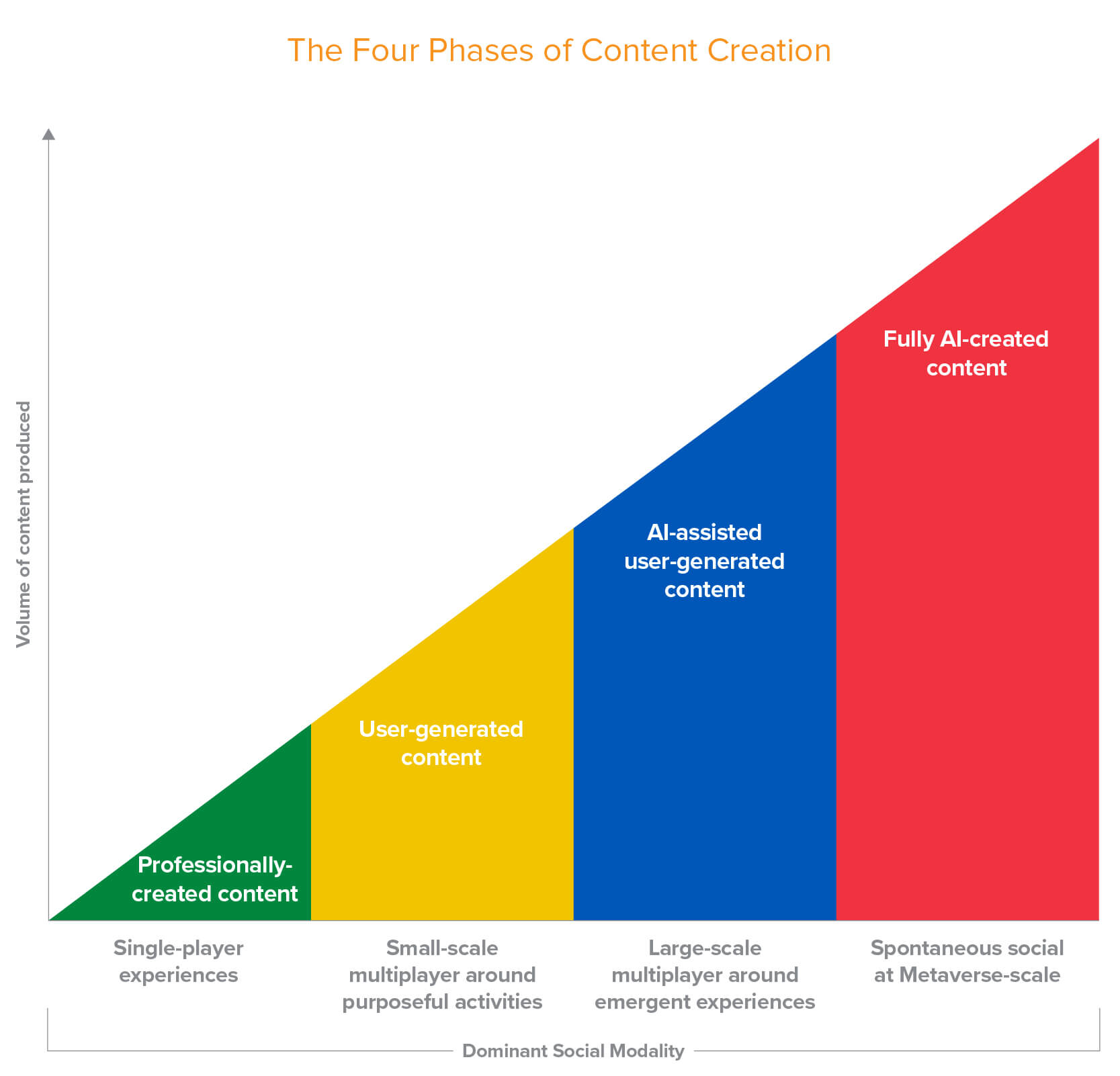
Officially, Meta is still all-in on the concept around which it pivoted the entire company in 2021. It still has a whole marketing page proclaiming its belief “in the future of connection in the metaverse”. You can go shop its lineup of Quest headsets which Meta says represent the best and most immersive metaverse experience, though its flagship model is now two-and-a-half years old. It has awkwardly promoted its Ray-Bans as “A.I. glasses” despite them becoming the company’s most successful line of mixed reality products, and it is desperately trying to connect its newest muse of A.I. with its last one. The single mention of “metaverse” on its Q1 2026 earnings call (PDF) is when Zuckerberg claimed to be “excited for more of our metaverse efforts to be powered by the A.I. models we’re training as well”. If you want to be unfairly generous in your interpretation of Zuckerberg’s brief remark, you could point to a December 2020 Andreessen Horowitz piece, in which general partner Jonathan Lai refers to this shape as a “pyramid”, and says that “fully A.I.-created content” is directly correlated with “spontaneous social at metaverse scale”. Obviously. I am not feeling generous.
Others in the space have not fared much better. Roblox has not mentioned the word “metaverse” in its quarterly or annual reports since Q1 2022 (PDF). Epic Games scarcely mentions it in recent news releases, either: since January last year, just one announcement contains the word “metaverse”, while seven are dedicated to the lawsuits Epic has been fighting against Apple and Google. Far from the inevitable next chapter of the internet, the metaverse, supposedly the future of how we live, work, and play online, is a non-event.
Near the end of the Connect 2021 presentation, Nick Clegg, then Meta’s global affairs chief, said “the metaverse isn’t something we’re building, so much as it’s something we’re building for”. Olson, in his video, wryly notes that, in the eyes of its promoters, “the metaverse cannot fail; you can only fail to make the metaverse”. The metaverse is so inevitable that “you might even already be in it”, according to Barron’s. But the metaverse is not predestined; it never has been. It is a construction of tech companies that saw in the pandemic their future — not ours.
A slightly charitable interpretation of what I think the pandemic demonstrated to Facebook executives, for example, was how invaluable technology companies were in maintaining connections even when most people could not do so in-person. They recognized how much time people were spending in front of screens already, even in years prior, and assumed that could be a more social experience.
But a more cynical view is no less fair. With the pandemic undoubtably came a realization of how much money Facebook stood to make, if only it had a platform. In 2019, there were two publicly traded companies worth over a trillion U.S. dollars; by the end of 2021, there were five, with Apple and Microsoft now worth over two trillion dollars each. This pandemic was not going to last forever — but it did not need to. Our world was permanently changed, or so it would have seemed, and we would surely want to virtually attend concerts and buy PNG files of band t-shirts with real money. And these companies would take their cut.
One thing I have mentioned but did not emphasize is just how often Zuckerberg and Sweeney mention Apple and Google platform fees as a primary justification for building the metaverse. Sweeney spent several years fighting lawsuits against both companies, mostly winning the one against Google and mostly losing the one against Apple. His efforts have, nevertheless, shined a spotlight on these grotesque practices. But it would be a mistake to assume this is an objection on ideological grounds. These guys just want to take those commissions for themselves. Sweeney spent his GDC 2023 presentation comparing the need for open standards in the metaverse to the openness of the web, but unlike the web, the Epic Games store takes a 12% commission. Meta beat that, though; it even beat Apple and Google. By the time the individual fees are added together, transactions made through Horizon Worlds could be levied a commission of up to 47.5%. The money thing is not even a secret; it was often the very first thing people like Zuckerberg and Sweeney discussed in interviews about their metaverse plans. This was a financial decision before it was a product or service people might actually want to use.
It would not be fair to characterize Meta’s endeavour as an impulsive flash in the pan. Zuckerberg laid out his vision in a 2015 internal memo in which he explained how the company “would like a stronger strategic position in the next
wave of computing”. Then, in January 2017, the Chan Zuckerberg Initiative acquired a company called Meta, I think mostly for the name; a year later, Zuckerberg floated the idea of a rebrand. The 2015 memo that effectively set this whole thing into motion gives the impression of a surprisingly cogent document if you set aside the wildly optimistic timelines — “VR/AR will be the next major computing platform after mobile in about 10 years” — and the idea that virtual and augmented reality are so compelling it will supersede the desire for phones and televisions. If anything, the unearned confidence in this memo should have been alarming at the time. As Zuckerberg himself writes, the “core social networking work is no longer new, Internet.org is extending something rather than inventing it, and A.I. is not yet tangible”. This is not a company known for doing new, and it is now stuck with a name reflecting a bungled attempt to change that. Staff are not happy after years of mass layoffs, court losses, role reassignments, and internal surveillance to feed the company’s A.I. projects. Do not get me wrong — Meta’s business of collecting vast amounts of information about its users and selling relevant ad slots is as strong as it has ever been. But Meta the ad company is not Meta the platform innovator.
And this feels like the why of it all. If tech companies can channel a meaningful sliver of our entire lived experience into a world of their creation, one where they collect a portion of revenue, it would make them inescapable. Ball, Sweeney, and Zuckerberg may have all written or spoken about the importance of interoperability and open standards, but these platforms want to exercise a degree of control more similar to native software than to the open web. The steps for migrating from Horizon Workrooms to a competitor’s product, for instance, are not what one would expect if openness were a priority.
For a brief couple of years, it seemed like there could be enough enthusiasm from reporters in the space, venture capitalists, and executives to make the metaverse happen. Then ChatGPT launched in November 2022, and the pandemic ended in the U.S. in May 2023, and any interest anyone may have had for spending more time with people in a virtual setting largely evaporated. It turns out we are okay with having meetings and playing games online, but we actually like seeing live music in-person and travelling to real places. The problems each of these things may have — high costs, environmental impact, and so on — are notable and real, but are not ones with metaverse-based solutions.
The pandemic did not make the metaverse. There was sufficient interest in developing it well before then, and it is possible all of these companies would have announced all these products and services on the same timeline. But in a world without a pandemic, I cannot imagine anyone would have treated these metaverse announcements with anything like the seriousness they did. The pandemic officially ended in the U.S. just six months after the first release of ChatGPT, so it is impossible to disentangle the influence of either. But it is notable to me that the nosedive in mentions of “metaverse” on Meta’s investor calls occurred in Q3 2023 — the quarter immediately following the declared end of the pandemic.
As for the futurists like Hackl, who confidently proclaimed the metaverse was “for certain”, they have found an out thanks to its flexible definition. Jeff Barrett, of the Shorty Awards’ “It’s No Fluke” podcast, published a glowing profile of “the Godmother of the Metaverse” earlier this year under the headline “Why Cathy Hackl Keeps Getting the Future Right”. “When enthusiasm cooled and narratives collapsed, many distanced themselves from the space”, writes Barrett, noting with seeming approval that “Hackl did the opposite. She reframed it”. Many people — perhaps everyone, come to think of it — could predict the future if they got to retcon their predictions to fit reality.
There are many open questions about the metaverse; most glaringly among them, whether it could actually become a thing for normal people. That depends a little bit on what definition we use. If it simply means the slow erosion of the boundary between our physical and digital environments, that is probably something that will continue to happen. For most people, though, that does not look like Meta’s Connect 2021 concept animations. Whatever that ends up being will probably be the result of people finding something useful and intriguing about doing something different. It will not be the product of big companies redirecting the money hose of platform fees onto themselves.
With thanks to Marquette University for granting me access to the Zuckerberg Files. A frustrating number of Zuckerberg’s post-Meta interviews are video-based, so the transcripts produced by this effort were invaluable. Where possible, I have checked these copies against the originals.
A Sherwood News analysis shows that the breaks afforded to Meta on just the sales tax of GPUs would come out to more than $3.3 billion — enough to build 33 new high schools, pay the salaries of all the state’s public school teachers for more than a year, or pay for more than seven years of the Louisiana State Police budget. (The secretary from the Parish committee that approved the financing plans declined to comment, and the chair of the committee didn’t respond to requests for comment.)
This is the very same project where Jonathan Weil, of the Wall Street Journal, found “aggressive accounting” that “strains credibility”. Neither of these advantages would be possible for a less-resourced competitor. Meta is a company so rich it benefits immensely without carrying nearly as much risk as the scale of this project would imply.
Mike Masnick, of Techdirt, unsurprisingly opposes the verdicts earlier this week finding Meta and Google guilty of liability for how their products impact children’s safety. I think it is a perspective worth reading. Unlike the Wall Street Journal, Masnick respects your intelligence and brings actual substance. Still, I have some disagreements.
Masnick, on the “design choices” argument:
This distinction — between “design” and “content” — sounds reasonable for about three seconds. Then you realize it falls apart completely.
Here’s a thought experiment: imagine Instagram, but every single post is a video of paint drying. Same infinite scroll. Same autoplay. Same algorithmic recommendations. Same notification systems. Is anyone addicted? Is anyone harmed? Is anyone suing?
Of course not. Because infinite scroll is not inherently harmful. Autoplay is not inherently harmful. Algorithmic recommendations are not inherently harmful. These features only matter because of the content they deliver. The “addictive design” does nothing without the underlying user-generated content that makes people want to keep scrolling.
This sounds like a reasonable retort until you think about it for three more seconds and realize that the lack of neutrality in the outcomes of these decisions is the entire point. Users post all kinds of stuff on social media platforms, and those posts can be delivered in all kinds of different ways, as Masnick also writes. They can be shown in reverse-chronological order in a lengthy scroll, or they can be shown one at a time like with Stories. The source of the posts someone sees might be limited to just accounts a user has opted into, or it can be broadened to any account from anyone in the world. Twitter used to have a public “firehose” feed.
But many of the biggest and most popular platforms have coalesced around a feed of material users did not ask for. This is not like television, where each show has been produced and vetted by human beings, and there are expectations for what is on at different times of the day. This is automated and users have virtually no control within the platforms themselves. If you do not like what Instagram is serving you on your main feed, your choice is to stop using Instagram entirely — even if you like and use other features.
Platforms know people will post objectionable and graphic material if they are given a text box or an upload button. We know it is “impossible” to moderate a platform well at scale. But we are supposed to believe they have basically no responsibility for what users post and what their systems surface in users’ feeds? Pick one.
Masnick, on the risks of legal accountability for smaller platforms:
And this is already happening. TikTok and Snap were also named as defendants in the California case. They both settled before trial — not because they necessarily thought they’d lose on the merits, but because the cost of fighting through a multi-week jury trial can be staggering. If companies the size of TikTok and Snap can’t stomach the expense, imagine what this means for mid-size platforms, small forums, or individual website operators.
I am going to need a citation that TikTok and Snap caved because they could not afford continuing to fight. It seems just as plausible they could see which way the winds were blowing, given what I have read so far in the evidence that has been released.
Masnick:
One of the key pieces of evidence the New Mexico attorney general used against Meta was the company’s 2023 decision to add end-to-end encryption to Facebook Messenger. The argument went like this: predators used Messenger to groom minors and exchange child sexual abuse material. By encrypting those messages, Meta made it harder for law enforcement to access evidence of those crimes. Therefore, the encryption was a design choice that enabled harm.
The state is now seeking court-mandated changes including “protecting minors from encrypted communications that shield bad actors.”
Yes, the end result of the New Mexico ruling might be that Meta is ordered to make everyone’s communications less secure. That should be terrifying to everyone. Even those cheering on the verdict.
This is undeniably a worrisome precedent. I will note Raúl Torrez, New Mexico’s Attorney General and the man who brought this case against Meta, says he wants to do so for minors only. The implementation of this is an obvious question, though one that mandated age-gating would admittedly make straightforward.
Meta cited low usage when it announced earlier this month that it would be turning off end-to-end encryption in Instagram. If it is a question of safety or liability, it is one Meta would probably find difficult to articulate given end-to-end encryption remains available and enabled by default in Messenger and WhatsApp. An executive raised concerns about the feature when it was being planned, drawing a distinction between it and WhatsApp because the latter “does not make it easy to make social connections, meaning making Messenger e2ee will be far, far worse”.
I think Masnick makes some good arguments in this piece and raises some good questions. It is very possible or even likely this all gets unwound when it is appealed. I, too, expect the ripple effects of these cases to create some chaos. But I do not think the correct response to a lack of corporate accountability — or, frankly, standards — is, in Masnick’s words, “actually funding mental health care for young people”. That is not to say mental health should not be funded, only that it is a red herring response. In the U.S., total spending on children’s mental health care rose by 50% between 2011 and 2017; it continued to rise through the pandemic, of course. Perhaps that is not enough. But, also, it is extraordinary to think that we should allow companies to do knowingly harmful things and expect everyone else to correct for the predictable outcomes.
A New Mexico jury found Tuesday that social media conglomerate Meta is harmful to children’s mental health and in violation of state consumer protection law.
The landmark decision comes after a nearly seven-week trial. Jurors sided with state prosecutors who argued that Meta — which owns Instagram, Facebook and WhatsApp — prioritized profits over safety. The jury determined Meta violated parts of the state’s Unfair Practices Act on accusations the company hid what it knew [about] the dangers of child sexual exploitation on its platforms and impacts on child mental health.
Meta communications jackass Andy Stone noted on X his company’s delight to be liable for “a fraction of what the State sought”. The company says it will appeal the verdict.
Meta and Google were found liable in a landmark legal case that social media platforms are designed to be addictive to children, opening up the tech giants to penalties in thousands of similar claims filed around the US.
A jury in the Los Angeles trial on Wednesday returned a verdict after nine days of deliberation, finding Meta’s platforms such as Instagram and Google’s YouTube were harmful to children and teenagers and that the companies failed to warn users of the dangers.
To come to its liability decision, the jury was asked whether the companies’ negligence was a substantial factor in causing harm to KGM [the plaintiff] and if the tech firms knew the design of their products was dangerous. The 12-person panel of jurors returned a 10-2 split answering in favor of the plaintiff on every single question.
Collectively, the suits seek to prove that harm flowed not from user content but from the design and operation of the platforms themselves.
That’s a critical legal distinction, experts say. Social media companies have so far been protected by a powerful 1996 law called Section 230, which has shielded the apps from responsibility for what happens to children who use it.
For its part, the Wall Street Journal editorial board is standing up for beleaguered social media companies in an editorial today criticizing everything about these verdicts, including this specific means of liability, which it calls a “dodge” around Section 230.
But it is not. The principles described by Section 230 are a good foundation for the internet. This law, while U.S.-centric, has enabled the web around the world to flourish. Making companies legally liable for the things users post will not fix the mess we are in, but it would cause great damage if enacted.
Product design, though, is a different question. It would be a mistake, I think, to read Section 230 as a blanket allowance for any way platforms wish to use or display users’ posts. (Update: In part, that is because it is a free speech question.) From my entirely layman perspective, it has never struck me as entirely reasonable that the recommendations systems of these platforms should have no duty or expectation of care.
The Journal’s editorial board largely exists to produce rage bait and defend the interests of the powerful, so I am loath to give it too much attention, but I thought this paragraph was pretty rich:
Trial lawyers and juries may figure that Big Tech companies can afford to pay, but extorting companies is certain to have downstream consequences. Meta and Google are spending hundreds of billions of dollars on artificial intelligence this year, which could have positive social impacts such as accelerating treatments for cancer.
Do not sue tech companies because they could be finding cancer treatments — why should I take this editorial board seriously if its members are writing jokes like these? They think you are stupid.
As for the two cases, I am curious about how these conclusions actually play out. I imagine other people who feel their lives have been eroded by the specific way these platforms are designed will be able to test their claims in court, too, and that it will be complicated by the inevitably lengthy appeals and relitigation process.
I am admittedly a little irritated by both decisions being reached by jury instead of a judge; I would have preferred to see reasoning instead of overwhelming agreement among random people. However, it sends a strong signal to big social media platforms that people saw and heard evidence about how these products are designed, and they agreed it was damaging. This is true of all users, not just children. Meta tunes its feeds (PDF) for maximizing engagement across the board, and it surely is not the only one. There are a staggering number of partially redacted exhibits released today to go through, if one is so inclined.
If these big social platforms are listening, the signals are out there: people may be spending a lot of time with these products, but that is not a good proxy for their enjoyment or satisfaction. Research indicates a moderate amount of use is correlated with neutral or even positive outcomes among children, yet there are too many incentives in these apps to push past self-control mechanisms. These products should be designed differently.
Meta is laying off several hundred employees on Wednesday, CNBC confirmed.
The cuts are happening across several different organizations within the company, including Facebook, global operations, recruiting, sales and its virtual reality division Reality Labs, according to a source familiar with the company’s plans who asked not to be named because they are confidential.
Some impacted employees are being offered new roles within the company, the person said. In some cases, those new positions will require relocation.
“Several hundred” employees is a long way off from the numbers reported earlier this month. Perhaps Reuters got it all wrong but, more worryingly for employees, perhaps those figures were correct and this is only the beginning.
CEO Sam Altman announced the changes to staff on Tuesday, writing that the company would wind down products that use its video models. In addition to the consumer app, OpenAI is also discontinuing a version of Sora for developers and won’t support video functionality inside ChatGPT, either.
OpenAI is not shutting this down because it has ethical qualms with what it has created, despite goodreasons to do just that. It is because it is expensive without any clear reason for it to exist other than because OpenAI wants to be everywhere.
If you are desperate for a completely synthetic social media feed, Meta’s Vibes is apparently still around. Users are readily abusing it, of course, because that is what happens if you give people a text input box.
Update: In a tweet, OpenAI has confirmed it is shutting down Sora. But, while it originally announced “We’re saying goodbye to Sora”, it changed that about an hour later to read “We’re saying goodbye to the Sora app“, emphasis mine. The Journal has not changed its report to retract claims about shutting down the platform altogether, though, while OpenAI continues to promote Sora API pricing.
Meta is also helping to fund the Digital Childhood Alliance, a coalition of conservative groups leading efforts to pass app-store age verification, according to three people familiar with the funding.
The App Store Accountability Act is based on model legislation written by the Digital Childhood Alliance. The lobbying group also publishes marketing pieces, including one (PDF) that calls Apple’s age verification frameworks “ineffective”. Specifically, it points to the lack of parental consent required “for kids to enter into complex contracts”, with “no way to verify that parental consent has been obtained”.
Meta, for its part, requires users to self-report their birthday and click a button that says “I agree” to create an Instagram account. In fairness, the title of that page says “read and agree to our terms” and, on the terms page, Meta does say you need to be 13 years old. This is pretty standard stuff but, if Meta actually cared about this, it could voluntarily implement the stricter controls at sign-up without a legislative incentive.
Though this article was published last year, I am linking to it now because something called the TBOTE Project recently resurfaced these findings and added some of its own in an open source investigation. Unlike similar investigations from sources like Bellingcat, it does not appear that the person or people behind TBOTE have editors or fact-checkers to verify their interpretation of this information. That does not mean it is useless; it is simply worth exercising some caution. Regardless, their findings show a massive amount of lobbyist spending on Meta’s part to try and get these laws passed.
Birnbaum continues:
The App Association, a group backed by Apple, has been running ads in Texas, Alabama, Louisiana and Ohio arguing that the app store age verification bills are backed by porn websites and companies. The adult entertainment industry’s main lobby said it is not pushing for the bills; pornography is mostly banned from app stores.
A few weeks ago, Meta published an update from Samantha Ryan, of Reality Labs, announced a “renewed focus” and a “doubling down” on virtual reality. It planned to achieve this by “almost exclusively” betting its future on the smartphone Horizon Worlds app.
In an announcement today, Meta shifted its definition of “almost exclusively” to simply “exclusively”:
Earlier this year, we shared an update on our renewed focus for VR and Horizon. We are separating the two platforms so each can grow with greater focus, and the Horizon Worlds platform will become a mobile-only experience. This separation will extend across our ecosystem, including our mobile app. To support this vision, we are making the following changes to streamline your Quest experience throughout 2026.
This opening paragraph is opaque and, though the announcement goes on to explain exactly what is happening, it is not nearly as clear as the email sent to Horizon Worlds users. I really think Meta is looking to exit from its pure V.R. efforts, especially with the sales success of the perv glasses.
As I write this, the Horizon app for iOS is the sixty-ninth most popular free game in the Canadian App Store, just behind Wordscapes and ahead of Perfect Makeover Cleaning ASMR. Nice?
The workers in Kenya say that it feels uncomfortable to go to work. They tell us about deeply private video clips, which appear to come straight out of Western homes, from people who use the glasses in their everyday lives.
Several describe video material showing bathroom visits, sex and other intimate moments.
Another worker talks about people coming out of bathrooms.
It is appalling that massively rich corporations like Meta continue to offload critical tasks like these onto people who receive little support or pay. I recently finished “Ghost Work” by Mary L. Gray and Siddharth Suri and, while not my favourite book nor surfacing anything conceptually new, is worth your time. Meta can and should be doing far better, but can avoid association with labour atrocities better than, say, Nike in the 1990s in part because I doubt most people think too much about human intervention in artificial intelligence. Meta does not celebrate the hard work of its contract labour in Kenya; it does not even acknowledge them.
Speaking of not acknowledging the human labour involved, this story is the obvious nightmare you would expect. Some of these incidents of sensitive video recordings appear to be accidental, while others are seemingly deliberate. Without excusing the people who seem to be recording creepy videos on purpose, I assume few people would have believed it would be seen by someone at a company they probably have not heard about.
At first glance, it appears that we have significant control over our data. It states that voice recordings may only be saved and used for improvement or training of other Meta products if the user actively agrees.
But for the AI assistant to function, voice, text, image and sometimes video must be processed and may be shared onwards. This data processing is done automatically and cannot be turned off.
This is the kind of thing I would expect would be bundled into the additional diagnostic information Meta asks if you would like to opt into sharing. But Meta says this “does not include the photos and videos captured by your glasses”. That is, as this investigation found, part of the mandatory data collection.
This is offensive on behalf of users who might be less likely to consent if they had this full information. But it is also offensive to their romantic partners, friends, acquaintances, and passers-by, none of whom agreed to have their image or conversations adjudicated by these contractors.
Samantha Ryan, “VP of Content” at Meta’s Reality Labs:
We’ve recently made some pretty big changes, including right-sizing our Reality Labs investment to ensure that our efforts remain sustainable over time. We’ve been in this space for over a decade, and we aren’t going anywhere. We’re in it for the long haul.
By “right-sizing”, Ryan means laying off ten percent of the Reality Labs workforce, and pouring money into the Ray-Ban partnership instead of metaverse initiatives. By “in it for the long haul”, Ryan means shifting the definition of the “metaverse” to meet Mark Zuckerberg’s latest obsession. They did not whiff by renaming the entire company around a crappy update to Second Life; you just are not getting it.
Ryan:
Our goal remains constant: to empower developers and creators as they build long-term, sustainable businesses. We used to have a pretty well-defined audience for VR, but as we’ve grown, we’ve attracted new audiences — who want different things — and the onus is on us to make sure that each of these distinct groups can find the apps and games that appeal to them.
That’s why we’re changing our roadmaps to increase your chances for success. We’re explicitly separating our Quest VR platform from our Worlds platform in order to create more space for both products to grow. We’re doubling down on the VR developer ecosystem while shifting the focus of Worlds to be almost exclusively mobile. By breaking things down into two distinct platforms, we’ll be better able to clearly focus on each.
Meta can say it is “doubling down on the V.R. developer ecosystem” all it wants, but it announced in January it would be shutting down its work-focused V.R. app with only a month’s notice, and it has cancelled third-party headsets. Now, it is saying Horizon Worlds is basically a phone app. Last February, Andrew Bosworth wrote in a memo about the importance of this very strategy:
[…] And Horizon Worlds on mobile absolutely has to break out for our long term plans to have a chance. […]
As I write this, Meta Horizon is the fifty-seventh most popular free game in the Canadian App Store, just two spots behind Hole.io, “the most addictive black hole game”. Maybe people do not, in general, want to wear a computer on their entire head — not for the thousands of dollars Apple is charging, and not for the hundreds Meta is.
Meta Platforms Inc.’s Mark Zuckerberg is expected to meaningfully cut resources for building the so-called metaverse, an effort that he once framed as the future of the company and the reason for changing its name from Facebook Inc.
Executives are considering potential budget cuts as high as 30% for the metaverse group next year, which includes the virtual worlds product Meta Horizon Worlds and its Quest virtual reality unit, according to people familiar with the talks, who asked not to be named while discussing private company plans. Cuts that high would most likely include layoffs as early as January, according to the people, though a final decision has not yet been made.
Wagner’s reporting was independently confirmed by Mike Isaac, of the New York Times, and Meghan Bobrowsky and Georgia Wells, of the Wall Street Journal, albeit in slightly different ways. While Wagner wrote it “would most likely include layoffs as early as January”, Isaac apparently confirmed the budget cuts are likely large-scale personnel cuts, which makes sense:
The cuts could come as soon as next month and amount to 10 to 30 percent of employees in the Metaverse unit, which works on virtual reality headsets and a V.R.-based social network, the people said. The numbers of potential layoffs are still in flux, they said. Other parts of the Reality Labs division develop smart glasses, wristbands and other wearable devices. The total number of employees in Reality Labs could not be learned.
Alan Dye is just about to join Reality Labs. I wonder if this news comes as a fun surprise for him.
At Meta Connect a few months ago, the company spent basically the entire time on augmented reality glasses, but it swore up and down it was all related to its metaverse initiatives:
We’re hard at work advancing the state of the art in augmented and virtual reality, too, and where those technologies meet AI — that’s where you’ll find the metaverse.
The metaverse is whatever Meta needs it to be in order to justify its 2021 rebrand.
Our vision for the future is a world where anyone anywhere can imagine a character, a scene, or an entire world and create it from scratch. There’s still a lot of work to do, but we’re making progress. In fact, we’re not far off from being able to create compelling 3D content as easily as you can ask Meta AI a question today. And that stands to transform not just the imagery and videos we see on platforms like Instagram and Facebook, but also the possibilities of VR and AR, too.
You know, whenever I am unwinding and chatting with friends after a long day at work, I always get this sudden urge to create compelling 3D content.
Hank Green was not getting a lot of traction on a promotional post on Threads about a sale on his store. He got just over thirty likes, which does not sound awful, until you learn that was over the span of seven hours and across Green’s following of 806,000 accounts on Threads.
So he tried replying to rage bait with basically the same post, and that was far more successful. But, also, it has some pretty crappy implications:
That’s the signal that Threads is taking from this: Threads is like oh, there’s a discussion going on.
It’s 2025! Meta knows that “lots of discussion” is not a surrogate for “good things happening”!
I assume the home feed ranking systems are similar for Threads and Instagram — though they might not be — and I cannot tell you how many times my feed is packed with posts from many days to a week prior. So many businesses I frequent use it as a promotional tool for time-bound things I learn about only afterward. The same thing is true of Stories, since they are sorted based on how frequently you interact with an account.
Everyone is allowed one conspiracy theory, right? Mine is that a primary reason Meta is hostile to reverse-chronological feeds is because it requires businesses to buy advertising. I have no proof to support this, but it seems entirely plausible.
It seems like a marvel of financial engineering: Meta Platforms is building a $27 billion data center in Louisiana, financed with debt, and neither the data center nor the debt will be on its own balance sheet.
That outcome looks too good to be true, and it probably is.
The phrase “marvel of financial engineering” does not seem like a compliment. In addition to the evidence from Weil’s article, Meta is taking advantage of a tax exemption created by Louisiana’s state legislature. But, in its argument, it is merely a user of this data centre.
Also, colour me skeptical this data centre will truly be “the size of Manhattan” before the bubble bursts, despite the disruption to life in the area.
Update:Paris Martineau points to Weil’s bio noting he was “the first reporter to challenge Enron’s accounting practices”.
Rather than because of wifi, the reason this happened is because these so-called AIs are just regurgitating information that has been parsed from scanning the internet. It will have been trained on recipes written by professional chefs, home cooks and cookery sites, then combined this information to create something that sounds a lot like a recipe for a Korean sauce. But it, not being an intelligence, doesn’t know what Korean sauce is, nor what recipes are, because it doesn’t know anything. So it can only make noises that sound like the way real humans have described things. Hence it having no way of knowing that ingredients haven’t already been mixed — just the ability to mimic recipe-like noises. The recipes it will have been trained on will say “after you’ve combined the ingredients…” so it does too.
I would love to know how this demo was supposed to go. In an ideal world, is it supposed to walk you through the preparation ingredient-by-ingredient? If Jack Mancuso had picked up the soy sauce, would it have guided the recipe-suggested amount? That would be impressive, if it had worked. The New York Times’ tech reporters got to try the glasses for about thirty minutes and, while they shared no details, said it was “as spotty as Mr. Zuckerberg’s demonstration”.
I think Walker is too hard on the faux off-the-cuff remarks, though they are mock-worthy in the context of the failed demo. But I think the diagnosis of this is entirely correct: what we think of as “A.I.” is kind of overkill for this situation. I can see some utility. For example, I could not find a written recipe that exactly matched the ingredients on Mancuso’s bench, but perhaps Meta’s A.I. software can identify the ingredients, and assume the lemons are substituting for rice vinegar. Sure. After that, what would actually be useful is a straightforward recitation of a specific recipe: measure out a quarter-cup of soy sauce and pour it into a bowl; next, stir in one tablespoon of honey — that kind of thing. This is pretty basic text-to-speech stuff, though it would be cool if it can respond to questions like how much ginger?, and did I already add the honey?, too.
Also, I would want to know which recipe it was following. A.I. has a terrible problem with not crediting its sources of information in general, and it is no different here.
Also — and this probably goes without saying — even if these glasses worked as well as Meta suggests they should, there is no way I would buy a pair. You are to tell me that I should strap a legacy of twenty years of privacy violations and user hostility to my face? Oh, please.
While the prerecorded videos of the products in use were slick and highly produced, some of the live demos simply failed.
“Glasses are the ideal form factor for personal superintelligence because they let you stay present in the moment while getting access to all of these AI capabilities to make you smarter, help you communicate better, improve your memory, improve your senses,” CEO Mark Zuckerberg reiterated at the start of the event, but the ensuing bloopers certainly didn’t make it feel that way.
I like that Meta took a chance with live demos but, in addition to the bloopers, Connect felt like another showcase of an inspiration-bereft business. The opening was a more grounded — figuratively and literally — version of the Google Glass skydive from 2012. Then, beginning at about 52 minutes, Zuckerberg introduced the wrist-based control system, saying “every new computing platform has a new way to interact with it”, summarizing a piece of the Macworld 2007 iPhone introduction. It is not that I am offended by Meta cribbing others’ marketing. What I find amusing, more than anything, is Zuckerberg’s clear desire to be thought of as an inventor and futurist, despite having seemingly few original ideas.
The social networking app is now home to more than 400 million monthly active users, Meta shared with Fast Company on Tuesday. That’s 50 million more than just a few months ago, and a long way from the 175 million it had around its first birthday last summer.
What is even more amazing about this statistic is how non-essential Threads seems to be. I might be in a bubble, but I cannot recall the last time someone sent me a link to a Threads post or mentioned they saw something worthwhile there. I see plenty of screenshots of posts from Bluesky, X, and even Mastodon circulating in various other social networks, but I cannot remember a single one from Threads.
Formerly a place to view friend requests and People You May Know, the Friends tab will now show your friends’ stories, reels, posts, birthdays and friend requests.
You know, I think this concept of showing people things they say they want to see might just work.
Meta says this is just one of “several ‘O.G.’ Facebook experiences [coming] throughout the year” — a truly embarrassing sentence. But Mark Zuckerberg said in an autumn earnings call that Facebook would “add a whole new category of content which is A.I. generated or A.I. summarized content, or existing content pulled together by A.I. in some way”. This plan is going just great. I think the way these things can be reconciled is exactly how Facebook is doing it: your friends go in a “Friends” tab, but you will see all the other stuff it wants to push on you by default. Just look how Meta has done effectively the same thing in Instagram and Threads.
Ms O’Carroll’s lawsuit argued that Facebook’s targeted advertising system was covered by the UK’s definition of direct marketing, giving individuals the right to object.
Meta said that adverts on its platform could only be targeted to groups of a minimum size of 100 people, rather than individuals, so did not count as direct marketing. But the Information Commissioner’s Office (ICO) disagreed.
“Organisations must respect people’s choices about how their data is used,” a spokesperson for the ICO said. “This means giving users a clear way to opt out of their data being used in this way.”
Meta, in response, says “no business can be mandated to give away its services for free”, a completely dishonest way to interpret the ICO’s decision. There is an obvious difference between advertising and personalized advertising. To pretend otherwise is nonsense. Sure, personalized advertising makes Meta more money than non-personalized advertising, but that is an entirely different problem. Meta can figure it out. Or it can be a big soggy whiner about it.
Zuckerberg then launched into a lengthy rant about his frustrations with “closed” ecosystems like Apple’s App Store. None of that is particularly new, as the Meta founder has been feuding with Apple for years. But then Zuckerberg, who is usually quite controlled in his public appearances, revealed just how frustrated he is, telling Huang that his reaction to being told “no” is “fuck that.”
It all has a whiff of the image consultant, with notes of Musk.
Everybody knows a corporate executive wearing boring business clothes and answering questions with defined talking points is playing a role. This costume Zuckerberg is wearing is just as much of a front. The billionaire CEO of a publicly traded social media company cannot be a rebel in any meaningful sense.
Ashley Belanger, reporting for Ars Technica in July 2022 in what I will call “foreshadowing”:
Despite all the negative feedback [over then-recent Instagram changes], Meta revealed on an earnings call that it plans to more than double the number of AI-recommended Reels that users see. The company estimates that in 2023, about a third of Instagram and Facebook feeds will be recommended content.
In this document [leaked to Zitron], they discuss the term “meaningful interactions,” the underlying metric which (allegedly) guides Facebook today. In January 2018, Adam Mosseri, then Head of News Feed, would post that an update to the News Feed would now “prioritize posts that spark conversations and meaningful interactions between people,” which may explain the chaos (and rot) in the News Feed thereafter.
To be clear, metrics around time spent hung around at the company, especially with regard to video, and Facebook has repeatedly and intentionally made changes to manipulate its users to satisfy them. In his book “Broken Code,” Jeff Horwitz notes that Facebook “changed its News Feed design to encourage people to click on the reshare button or follow a page when they viewed a post,” with “engineers altering the Facebook algorithm to increase how often users saw content reshared from people they didn’t know.”
When you look at Instagram or Facebook, I want you to try and think of them less as social networks, and more as a form of anthropological experiment. Every single thing you see on either platform is built or selected to make you spend more time on the app and see more things that Meta wants you to see, be they ads, sponsored content, or suggested groups that you can interact with, thus increasing the amount of your “time spent” on the app, and increasing the amount of “meaningful interactions” you have with content.
Zitron is a little too eager, for my tastes, to treat Meta’s suggestions of objectionable and controversial posts as deliberate. It seems much more likely the company simply sucks at moderating this stuff at scale and is throwing in the towel.
In late 2021, TikTok was on the rise, Facebook interactions were declining after a pandemic boom and young people were leaving the social network in droves. Chief Executive Officer Mark Zuckerberg assembled a handful of veterans who’d built their careers on the Big Blue app to figure out how to stop the bleeding, including head of product Chris Cox, Instagram boss Adam Mosseri, WhatsApp lead Will Cathcart and head of Facebook, Tom Alison.
During discussions that spanned several meetings, a private WhatsApp group, and an eventual presentation at Zuckerberg’s house in Palo Alto, California, the group came to a decision: The best way to revive Facebook’s status as an online destination for young people was to start serving up more content from outside a person’s network of friends and family.
At first, previously viral (but real) images were being run through image-to-image AI generators to create a variety of different but plausibly believable AI images. These images repeatedly went viral, and seemingly tricked real people into believing they were real. I was able to identify a handful of the “source” or “seed” images that formed the basis for this type of content. Over time, however, most AI images on Facebook have gotten a lot easier to identify as AI and a lot more bizarre. This is presumably happening because people will interact with the images anyway, or the people running these pages have realized they don’t need actual human interaction to go viral on Facebook.
Instagram confirmed it’s testing unskippable ads after screenshots of the feature began circulating across social media. These new ad breaks will display a countdown timer that stops users from being able to browse through more content on the app until they view the ad, according to informational text displayed in the Instagram app.
These pieces each seem like they are circling a theme of a company finding the upper bound of its user base, and then squeezing it for activity, revenue, and promising numbers to report to investors. Unlike Zitron, I am not convinced we are watching Facebook die. I think Koebler is closer to the truth: we are watching its zombification.

 Login
Login